
ChatGPT Ads: Everything You Need to Know as a Marketer or User (2026 Update)
On February 9, 2026, OpenAI turned on ads inside ChatGPT for the first time. If you use the free or Go plan, you will now see sponsored content appearing below ChatGPT's responses. If you are a marketer, this is the most significant new ad inventory since Google launched search ads. On June 11, 2026, OpenAI expanded the Ads Manager beta with a new product feed feature, letting retail advertisers upload a full catalog and generate ads automatically instead of building each one by hand. On September 16, 2026, OpenAI went further still, launching a named Sponsored Agents format and confirming that ChatGPT Ads had already crossed a $1 billion annualized revenue run rate in under 200 days. What follows covers exactly how ChatGPT ads work, what the ad formats look like (including the new feed-based and Sponsored Agents formats), how targeting uses your chat history, which brands are already inside the platform, what the ads cost, how to apply as an advertiser, and how to control the ads you see as a user. Everything is based on OpenAI's official announcements, the first screenshots from live ads, and reporting from Ad Week, Search Engine Land, and marketing analysts.
Detailed Tool Reviews
What Are ChatGPT Ads and Why They Matter
ChatGPT crossed 300 million weekly active users in early 2026. That number alone makes it one of the most visited destinations on the internet. What makes it different from any other ad platform is the nature of how people use it. Users do not browse ChatGPT passively. They type specific questions, describe problems they need solved, and ask for product recommendations. That makes every session a signal of intent.
Google built a trillion-dollar business on search intent. Meta built one on behavioral targeting. ChatGPT ads combine both: you get the intent signal from what someone just asked, plus behavioral context from their chat history and saved memories. That is a targeting combination that has not existed before in advertising.
OpenAI began the pilot quietly on February 9, 2026. Ads currently show only to logged-in adult users in the United States on the Free and Go ($8/month) tiers. Users on Plus, Pro, Business, Enterprise, and Education plans see no ads at all. That means the addressable audience for this pilot is the tens of millions of people using the free version of ChatGPT.
OpenAI stated clearly in its announcement: "Ads do not influence the answers you get from ChatGPT. Your chats stay private." Advertisers receive only aggregate performance data. They cannot see individual conversations or personal information.
The Two ChatGPT Ad Formats (With Screenshots)
As of February 2026, there are two confirmed ad formats running inside ChatGPT. Both appear below the AI's response, clearly labeled as sponsored, and are visually separated from the organic answer.
Format 1: Shopping Product Carousel
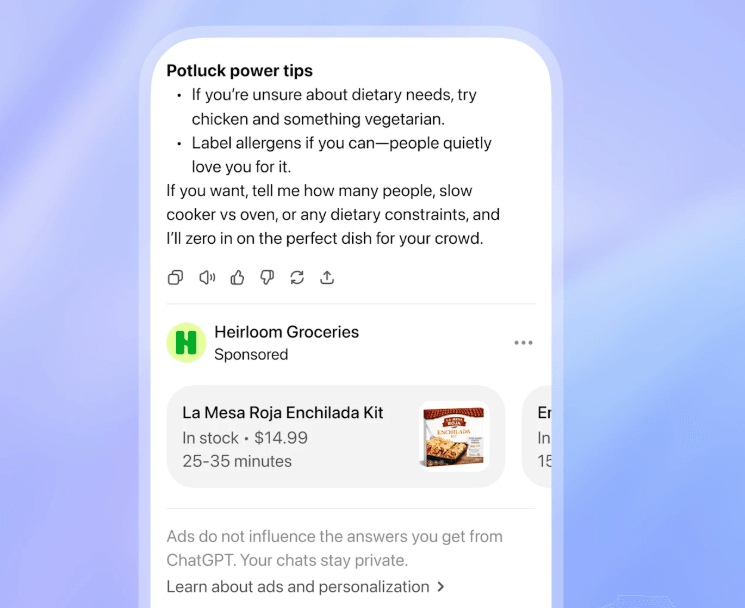
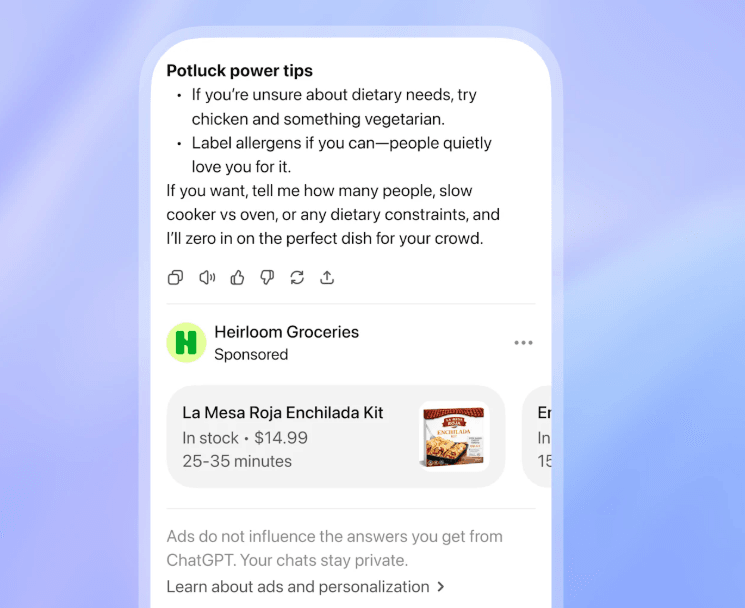
This is the format most likely to run for e-commerce brands. When a user asks a question related to food, products, or shopping, a sponsored product card appears beneath the answer. The card shows the brand logo, a "Sponsored" label, the product name, price, stock status, and estimated delivery or prep time.
In the first live screenshot circulating from February 9, a brand called Heirloom Groceries appeared with a product called "La Mesa Roja Enchilada Kit" priced at $14.99 with a "25-35 minutes" preparation note. The card is scrollable, meaning multiple products can appear side by side.
OpenAI has confirmed partnerships with Etsy and Shopify for this format. Users can either check out directly inside ChatGPT via the shopping integration or click through to the brand's own website. This makes it a full purchase funnel, not just an awareness placement.
Format 2: Conversational Banner with "Ask ChatGPT About This Ad"
The second format is more experimental and potentially far more powerful for lead generation and B2B. It is a display-style card that includes a call to action and an "Ask ChatGPT about this ad" button.
When a user clicks that button, they enter a conversation powered by instructions the advertiser has pre-loaded, similar to how a Custom GPT works. The system prompt found inside the ChatGPT code describes it this way: "The user is referring to an ad shown to them. Your response must be about the ad shown since the user explicitly asked about them. You must reply to the user query using information about the ads which is data."
In practice, this means an advertiser can upload product information, FAQs, and service details, and ChatGPT will answer user questions on behalf of the brand. If someone asks "tell me more about this" or "what sizes do you have", ChatGPT pulls the answer from the advertiser's uploaded data. The conversation stays private from the advertiser, but the user gets a relevant, brand-informed answer.
This format is the reason marketers focused on lead generation and B2B are paying attention. A user who asks ChatGPT to help them find accounting software for their business, sees a sponsored result, and then has a real back-and-forth with that product's GPT is much further along the buying journey than someone who clicked a Google ad.
More AI tool picks like this
Tested AI tools and workflows for marketers and advertisers, twice a week.
June 2026 Update: Product Feed Ads Arrive in ChatGPT Ads Manager
Breaking, June 11, 2026: OpenAI expanded the ChatGPT Ads Manager beta with a new product feed feature. Retail advertisers can now upload an entire product catalog and have ChatGPT generate ads for each item automatically, instead of building a separate campaign for every product. The update was first reported by Search Engine Land, based on details shared by Menachem Ani, founder of agency JXT Group.
What changed
Until now, every ad inside the Ads Manager beta had to be built one at a time, fine for a handful of hero products, but unworkable for a retailer with hundreds or thousands of SKUs. The product feed feature removes that bottleneck. Upload your catalog once, and ChatGPT turns each item into its own ad unit, matching specific products to the conversations where they fit.
OpenAI told advertisers that feed-based ads have been among the strongest-performing formats in its Ads Beta so far. That performance is likely why catalog feeds were one of the first additions to Ads Manager beyond manual, single-product campaigns.
How this connects to the shopping carousel
This is the same Format 1 carousel covered above, the one that showed Heirloom Groceries' "La Mesa Roja Enchilada Kit" in the first live screenshots back in February. Product feed ads are the infrastructure that lets that carousel scale. Instead of someone manually configuring each product card, your existing Shopify or Etsy feed now does the work, refreshing prices, stock status, and images automatically as your inventory changes.
If you have used Google Merchant Center or Meta's Catalog Manager, the concept will feel familiar. One structured feed, covering product names, prices, images, and availability, can power an unlimited number of individual ads.
What this means if you sell products
The $200,000 minimum spend and agency-only access from the original February pilot has not been officially lifted for the wider market. But adding feed-based tooling to Ads Manager is a strong signal that OpenAI is building toward a self-serve model closer to Google Ads or Meta's Ads Manager, where any business can connect a feed and launch.
If you sell physical products online, now is the time to get your data in order before access widens:
- •Make sure your Shopify or Etsy feed is complete. Every SKU needs a title, price, availability status, and a clear product image.
- •Check that product titles and descriptions read naturally. ChatGPT surfaces these directly inside a conversation, so copy stuffed with keywords for Google Shopping can look out of place in a chat response.
- •Review your inventory sync settings. The original February screenshots showed live stock status, so stale availability data could mean ads pointing at products that are already sold out.
- •If you already run Google Shopping or Meta Catalog ads, you likely have most of the feed infrastructure ChatGPT needs. The remaining step is registering interest and waiting for access to expand beyond the current retail beta.
September 2026 Update: Sponsored Agents Launch as ChatGPT Ads Crosses $1 Billion
Breaking, September 16, 2026: OpenAI rolled out Sponsored Agents, a new ad format that lets someone click an ad and land in a real, clearly labeled conversation with that business's own AI agent, kept separate from both ChatGPT's own answers and the user's original conversation thread. Wayfair and home-services marketplace Angi are the first named partners, with Angi letting a user go from discussing a leaky faucet to booking a local contractor without ever leaving ChatGPT.
How Sponsored Agents differs from the original "Ask ChatGPT about this ad" format
This is the same underlying idea covered in Format 2 above, now named, formalized, and given real advertiser partners rather than a generic description. The distinction OpenAI is drawing this time is isolation: a Sponsored Agent conversation is explicitly walled off from your main chat and from ChatGPT's own independent answers, not just a Q&A tucked under an ad card. Functionally, you're handed off to the brand's own agent for that specific conversation, then handed back to ChatGPT.
The rollout is still limited alpha testing with select advertisers, and OpenAI hasn't published performance benchmarks yet, so treat this as an experimental format, not a proven channel.
The revenue number that actually matters
OpenAI reported on August 31, 2026 that ChatGPT Ads had already reached a $1 billion annualized revenue run rate, in under 200 days since the February 9 pilot launch, with tens of thousands of advertisers now active across more than 40 countries. That's a genuinely fast ramp for a brand-new ad platform, and it's the clearest signal yet that this isn't staying a small enterprise pilot.
New tools shipping alongside Sponsored Agents
- •Ads Manager, now natural-language. Advertisers can create, update, and analyze campaigns by describing what they want in plain English inside ChatGPT, instead of clicking through a traditional dashboard.
- •AI creative assistance. ChatGPT can now generate ad copy and imagery suggestions, and adapt headlines and translate ad text for different markets automatically.
- •HubSpot integration. The first CRM partnership for ChatGPT Ads, letting advertisers track leads generated from ChatGPT straight into their existing pipeline.
- •Shopify integration expands internationally on September 23, 2026, extending the US-only shopping-ad partnership covered above to more markets.
What this means if you're preparing to advertise
The core advice from the June update still holds: get your product feed clean, register at openai.com/advertisers, and prepare a real knowledge base for conversational ads. Two things are genuinely new to plan around. If lead generation matters to your business, the HubSpot integration means ChatGPT-sourced leads can flow directly into a CRM you likely already use, worth setting up before wider access opens. And if you sell internationally, the Shopify expansion on September 23 is a real date to watch, not a vague "later this year" promise.
How ChatGPT Ad Targeting Works
ChatGPT ad targeting operates on three layers that work together. Each layer can be adjusted by the user through the Ads Controls panel.
Layer 1: Current conversation context. The most basic targeting signal. If you ask ChatGPT about planning a trip to Japan, travel-related ads may appear. This targeting happens even with personalization turned off.
Layer 2: Past chat history. If you have previously discussed running a small business, home renovation, or cooking, those themes can influence which ads appear across future sessions. This is the layer that makes ChatGPT more powerful than keyword-based search targeting. Someone who has spent weeks discussing their startup plans is a different user than someone who mentioned business once.
Layer 3: ChatGPT Memory. If you have Memory enabled (where ChatGPT remembers facts about you across conversations), that saved information also influences ad selection. Your saved preferences, location context, and noted interests all feed into which ads appear.
OpenAI has confirmed that ads are excluded from: users under 18, Temporary Chats (where no history is saved), logged-out sessions, image generation conversations, and any sessions flagged as sensitive topics including health, mental health, and politics.
The user data used for targeting includes: current and past conversation topics, ad engagement history, general location, and language. What advertisers never receive: your name, email, precise location, IP address, health data, or political views. Advertisers see aggregate metrics only, views and clicks, not individual profiles.
User Controls: How to Manage the Ads You See
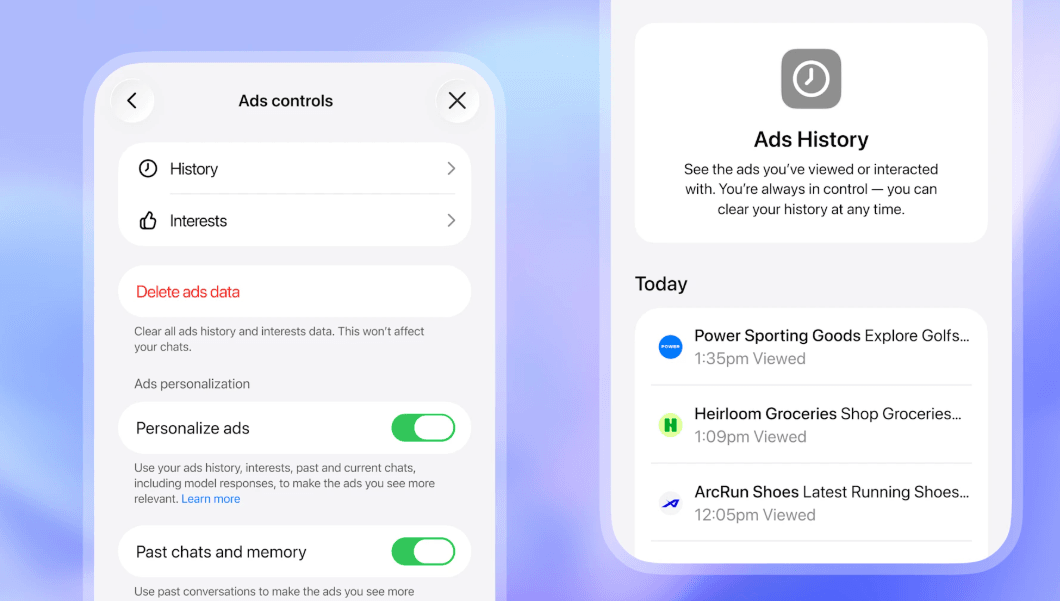
OpenAI has built a reasonably complete set of user controls into the initial launch. To access them, go to Settings inside ChatGPT and look for "Ad controls". You will find four main options:
Ads History. A timestamped log of every ad you have viewed or interacted with. The first live screenshots showed ads from Power Sporting Goods, Heirloom Groceries, and ArcRun Shoes appearing at different times within the same day. You can clear this history at any time.
Interests. As you interact with ads (by clicking, dismissing, or asking questions), ChatGPT builds a profile of your interests. You can view and edit this list.
Personalize ads toggle. When on (the default), your past and current chats plus Memory influence which ads appear. When you turn this off, ads are targeted only on the current conversation topic, with no historical context.
Past chats and memory toggle. A separate control specifically for whether your saved Memory and chat history influence ad selection, independent of current-session targeting.
Delete ads data. A one-tap option to clear your full ad history and interests profile. This does not affect your regular ChatGPT conversations or settings.
Users also have per-ad controls on every sponsored card: Hide this ad, See more about this ad, Ask ChatGPT about the ad, and Report the ad. These controls are visible from the three-dot menu on each ad unit.
If you want no ads at all, upgrading to ChatGPT Plus ($20/month) removes all advertising from your experience.
Which Brands Are Currently Advertising on ChatGPT
The pilot is not open to all advertisers. OpenAI selected a small group of agencies and brands to work with during the initial testing phase. The minimum spend to participate is $200,000, which immediately limits this to large enterprises and agencies.
According to Ad Week reporting, three of the largest media agencies in the world have joined the pilot: Omnicom Media Group, WPP, and Dentsu. Omnicom confirmed in a statement that more than 30 of its clients have secured placements in the OpenAI ads pilot.
The clients of these agencies include some of the largest advertisers on earth: Apple, PepsiCo, McDonald's, Volkswagen, Unilever, Ford, Google, Dow, HSBC, Toyota, Canon, and American Express. Not all of these brands are necessarily running ads today, but they are within the agencies that have pilot access.
For small and medium businesses, there is still no public self-serve platform. But the Ads Manager beta is now active for a wider group of retail advertisers, and as of June 2026 it supports product feed uploads, the same catalog-based approach Google and Meta use. As of September 2026, Wayfair and Angi are the first named brands testing the new Sponsored Agents format specifically, separate from the original $200,000-minimum enterprise pilot routed through Omnicom, WPP, and Dentsu. OpenAI has not announced a timeline for when the platform opens to all advertisers. The current phase is explicitly a beta designed to generate feedback on formats, measurement, and the overall advertiser experience before a wider rollout later in 2026.
If you want to be notified when the ChatGPT Ads Manager opens for general advertisers, you can register your interest at openai.com/advertisers.
ChatGPT Ads Pricing: What Does It Cost to Advertise?
The reported pricing for the ChatGPT ads pilot is $60 CPM (cost per thousand impressions). For context, Meta's average CPM across its platforms runs around $14-20. Google Search ads do not use a CPM model but comparable placements run $8-15 CPM equivalent. At $60 CPM, ChatGPT is pricing itself at roughly three times the cost of Meta advertising.
The $200,000 minimum spend means a brand entering the pilot at minimum price would receive approximately 3.3 million impressions. For an enterprise brand with a large budget, that is not an unreasonable test. For most businesses, it is completely out of reach in 2026.
Marketing analysts who have reviewed the pricing argue the $60 CPM may actually represent good value given the targeting quality. A $60 CPM ad shown to someone who has been discussing buying a specific product type in their recent chat history is fundamentally different from a $20 CPM social feed impression shown to someone with a broadly matching demographic profile.
The pricing is expected to decrease as OpenAI scales the platform and introduces auction-based buying similar to Google Ads. The current high floor pricing is a deliberate strategy to work with a small number of premium advertisers who can provide quality feedback while generating meaningful revenue for OpenAI.
OpenAI reported $300 million in monthly revenue in early 2026, primarily from subscriptions. The ad business is intended to add a revenue layer that funds continued free access for the hundreds of millions of users who cannot or will not pay for a subscription.
What Marketers Should Do Right Now
If you cannot get into the pilot yet, there are concrete steps you can take today that will position you for success when the platform opens to all advertisers.
1. Register your advertiser interest. Go to openai.com/advertisers and submit your details. OpenAI is building a waitlist for when the broader platform launches.
2. Optimize for organic ChatGPT mentions now. The ads appear below organic ChatGPT responses. If your brand already appears organically when someone asks ChatGPT about your product category, a sponsored placement below that answer gives you two visible positions on the same page. This is the same dynamic that made owning both paid and organic Google results so valuable in the early search era. Start now by ensuring your website is crawlable, your product information is accurate on Shopify or your e-commerce platform (given the Shopify partnership), and your brand appears in ChatGPT's answers when you test relevant queries.
3. Prepare your product data feed now, this is no longer optional. As of June 2026, the Ads Manager beta accepts product feed uploads and generates ads automatically from your catalog. OpenAI says feed-based ads are already among the strongest-performing formats in the beta. A clean, up-to-date Shopify or Etsy feed, with accurate titles, prices, stock status, and images, puts you ahead of competitors who will scramble to fix their data once wider access opens.
4. Think about your conversational ad script. The "Ask ChatGPT about this ad" format requires advertisers to prepare a knowledge base the AI will use to answer user questions. Start drafting what that knowledge base would contain: your top 20 FAQs, product specifications, pricing, use cases, and objection handling. Brands that prepare this content now will deploy faster when access opens.
5. Watch the measurement story. OpenAI has not yet published a detailed measurement framework. As a marketer, push for clarity on attribution before spending. The CPM model measures impressions, but the conversational ad format may develop engagement metrics (conversation starts, questions asked, links clicked) that are more meaningful indicators of actual interest.
6. Connect HubSpot now if lead gen is your goal. As of September 2026, HubSpot is the first CRM ChatGPT Ads integrates with directly, so leads generated through a Sponsored Agent conversation can land straight in a pipeline you're already running, instead of you having to build a manual export process later.
Frequently Asked Questions
ChatGPT ads appear below the AI's response as clearly labeled sponsored content. They use your current conversation topic and, if personalization is enabled, your past chat history and ChatGPT Memory to select relevant ads. There are two formats: a shopping product carousel (with Etsy and Shopify integration for checkout) and a conversational banner where users can ask ChatGPT questions about the advertised product. Ads never influence ChatGPT's actual answers, which remain based entirely on accuracy and helpfulness.
ChatGPT Ads: From Pilot to a $1 Billion Run Rate in Seven Months
ChatGPT ads launched February 9, 2026 with two formats, a $200,000 pilot minimum, and targeting that combines live intent with chat history in a way no existing ad platform offers. By June 11, 2026, the Ads Manager beta had expanded to support product feed uploads. By September 16, 2026, OpenAI had named and formalized the conversational ad format as Sponsored Agents, added HubSpot and international Shopify integration, and confirmed ChatGPT Ads had already crossed a $1 billion annualized revenue run rate in under 200 days. That pace of change matters: it suggests the gap between "enterprise pilot" and "open platform" is closing faster than most marketers expect, and the revenue number shows OpenAI has real reason to keep pushing it open. The practical steps remain the same: register at openai.com/advertisers, optimize your brand to appear organically in ChatGPT responses, get your Shopify or Etsy product feed accurate and current, connect HubSpot if lead generation is the goal, and prepare the knowledge base you will use for conversational ads. The brands that use this window to prepare will have a meaningful advantage when broader access arrives. Read the official OpenAI announcement for the latest updates direct from the source.
Register Your Interest at openai.com/advertisers
About the Author

Amara
Amara is an AI tools expert who has tested over 1,800 AI tools since 2022. She specializes in helping businesses and individuals discover the right AI solutions for text generation, image creation, video production, and automation. Her reviews are based on hands-on testing and real-world use cases, ensuring honest and practical recommendations.
View full author bio→Related Guides
ChatGPT Pro Reddit: Is $200/Month Worth It? Real Users Weigh In [2026]
Discover if ChatGPT Pro is worth $200/month according to Reddit users in 2026. Based on r/ChatGPT, r/ChatGPTPro, r/OpenAI discussions. Pro vs Plus vs free alternatives comparison.
Perplexity vs ChatGPT Reddit: Which AI Tool Wins in 2026?
Reddit users compare Perplexity vs ChatGPT across research, writing, speed, accuracy. Honest head-to-head analysis, pricing comparison, and workflow recommendations.
Best AI Tools: Top Picks from Reddit Communities [2026]
Discover the best AI tools recommended by Reddit communities in 2026. Based on 4M+ r/ChatGPT members, r/ArtificialIntelligence insights, and real user reviews. Expert guide.
What Is ai.com? Everything You Need to Know (I Tested It After Super Bowl Ad)
I signed up for ai.com after the $8M Super Bowl ad. Reality: it is an OpenClaw wrapper with better security. AGI promises vs actual features, pricing, comparisons.