
Tool DiscoveryTool Discovery

How to Learn AI in 2026: What Reddit Actually Recommends

The r/learnmachinelearning subreddit has 171,000 members and one recurring theme: people asking where to start with AI and getting very different answers depending on which path they actually want. A software engineer switching into ML engineering has a different starting point than a marketing manager who wants to automate workflows. This guide pulls from hundreds of Reddit discussions across r/learnmachinelearning, r/datascience, r/MachineLearning, and r/artificial to show the actual community consensus on resources, timelines, and learning paths in 2026. The short version: Andrew Ng's Machine Learning Specialization on Coursera is the closest thing to a universal Reddit recommendation for ML learners. For non-technical professionals who want AI skills for business use, the community tends toward structured beginner courses. The Udemy AI for Everyone course covers AI fundamentals, generative AI, and prompt engineering without requiring a coding background, and the Complete AI Bootcamp is the most comprehensive paid path for career changers.

Updated: 2026-02-1811 min read
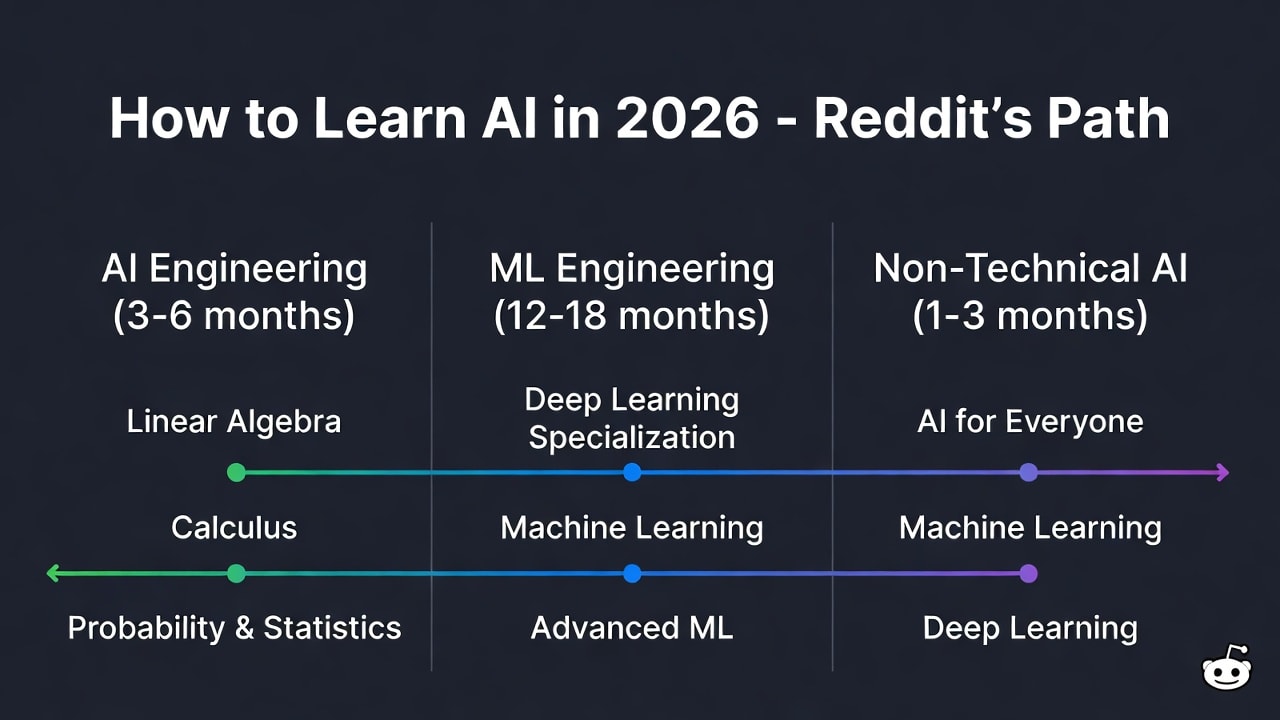
How to learn AI in 2026 - Reddit learning path recommendations

Detailed Tool Reviews

1

AI for Everyone: Master AI, ML & Generative AI (Udemy)

4.7

The most accessible entry point for people who want AI skills without a programming background. Covers AI fundamentals, machine learning concepts, generative AI, and prompt engineering taught by certified AWS, Azure, Snowflake, and Databricks professionals. Designed for students, business professionals, and anyone who wants working knowledge of AI without writing code. One-time payment gives you lifetime access, which matters as the content updates with new AI developments.

Key Features:

  • No technical background required - built for complete beginners
  • AI fundamentals, machine learning, and generative AI in one course
  • Prompt engineering for ChatGPT and other AI tools
  • Real-world AI applications across industries
  • Certificate of completion for professional documentation
  • Lifetime access after one-time payment
  • Udemy 30-day money-back guarantee

Pricing:

One-time payment, lifetime access (check current Udemy price)

Pros:

  • + Genuinely beginner-friendly - no coding or math required
  • + Covers generative AI and prompt engineering alongside ML fundamentals
  • + One-time payment beats Coursera monthly subscription for casual learners
  • + Instructors with real cloud platform certifications (AWS, Azure)
  • + 30-day refund policy removes purchase risk

Cons:

  • - Reddit's technical communities prefer Andrew Ng's ML Specialization for depth
  • - Does not prepare you for ML engineering or data science roles
  • - Lighter on hands-on coding compared to fast.ai or Kaggle courses
  • - Non-technical focus means you won't be writing ML models after this

Best For:

Business professionals, students, and non-technical people who want to understand AI, use generative AI tools effectively, and document their AI knowledge without a programming background

Try AI for Everyone: Master AI, ML & Generative AI (Udemy)
2

Complete AI Bootcamp: Zero to AI Hero 2026 (Udemy)

4.6

The comprehensive course for people who want to go from zero technical knowledge to deployable AI skills. Covers machine learning, deep learning, generative AI, LLMs, and how to build and deploy actual AI projects. Designed for career changers and developers who want full AI competency. At a higher price point than single-topic courses, it replaces multiple courses with a single structured path from beginner foundations to advanced implementation.

Key Features:

  • Full career-change curriculum from beginner to advanced AI
  • Machine learning, deep learning, and generative AI all covered
  • LLM fine-tuning and AI agent building
  • Portfolio projects you can show employers
  • Deployment skills - not just training models but shipping them
  • Lifetime access after one-time payment
  • Certificate of completion for career documentation

Pricing:

Check current Udemy price (one-time payment, lifetime access)

Pros:

  • + Replaces multiple individual courses with one structured path
  • + Covers current 2026 skills: LLMs, agents, and deployment
  • + Portfolio projects give you something to show beyond a certificate
  • + One-time payment compared to Coursera's monthly subscription model
  • + Highest commission course in the Udemy AI cluster - strong value signal

Cons:

  • - Higher price point than topic-specific courses
  • - Reddit notes Udemy AI content can lag 6-12 months behind cutting-edge LLM developments
  • - Requires more time commitment than a single-skill course
  • - Fast.ai and Hugging Face are free alternatives for specific ML/LLM topics

Best For:

Career changers, developers expanding into AI, and serious learners who want a single comprehensive path from AI fundamentals to deployable projects

Try Complete AI Bootcamp: Zero to AI Hero 2026 (Udemy)

What Reddit actually recommends for learning AI

The r/learnmachinelearning community has produced a fairly stable consensus over years of discussions: start with Andrew Ng's Machine Learning Specialization on Coursera. It appears in almost every "where do I start" thread in the subreddit, and the recommendation holds up across skill levels. The course is free to audit, which removes the cost barrier, and it covers the mathematical and conceptual foundations that the technical subreddits respect.

Beyond Andrew Ng, the community splits based on what you actually want to do. r/learnmachinelearning (beginner-friendly, 171K members) recommends starting with Python basics via YouTube tutorials like Corey Schafer's channel, then moving to NumPy and Pandas before hitting ML frameworks. r/MachineLearning (research-focused) recommends a full math stack first: linear algebra, calculus, probability theory, and statistics before touching any code.

fast.ai gets consistent praise across both communities as the most practical alternative. The courses are free, project-first, and updated more frequently than most university-adjacent offerings. A frequently cited r/learnmachinelearning comment: "fast.ai assumes you're not a researcher and teaches you to ship things, which is what most people actually need."

For non-technical learners who do not plan to write ML code, the community's advice shifts entirely. r/artificial and r/productivity discussions point toward AI fundamentals courses that cover how to use AI tools, prompt engineering, and generative AI workflows. This is a different goal from ML engineering and needs a different course.

The three AI learning paths: which one is yours?

Reddit discussions in 2026 have increasingly divided AI learning into three distinct tracks that require different resources and timelines. Picking the wrong track wastes months.

AI Engineering (fastest growing path)

Building applications with existing AI models: LLM APIs, retrieval-augmented generation, AI agents, prompt engineering. This track is wide open in 2026 because it requires software development skills rather than ML research knowledge. Timeline: 3-6 months from software engineering background. Key resources: Hugging Face courses, LangChain documentation, OpenAI API docs. r/artificial and r/webdev cover this most.

ML Engineering / Data Science

Training, fine-tuning, and deploying machine learning models. Requires Python proficiency, statistics, and hands-on experience with frameworks like PyTorch. Timeline: 12-18 months from beginner. This is what r/learnmachinelearning primarily discusses. Andrew Ng's Specialization and fast.ai are the most cited starting points.

AI Business / Non-Technical

Understanding AI well enough to make decisions, manage AI projects, or use AI tools effectively in a professional context. No coding required. Timeline: 1-3 months. This track gets the least Reddit discussion because the ML-focused communities dominate, but it is the most common actual use case for working professionals. Coursera and Udemy AI fundamentals courses serve this path.

The community warning from r/datascience: "Most people asking 'how do I learn AI' actually want AI Engineering, not ML Engineering. They're different fields with different requirements, and picking the wrong track wastes a year."

Free resources Reddit actually recommends

Reddit is straightforward about free AI learning: the quality is high and certificates have marginal impact on hiring decisions. One r/learnmachinelearning thread put it directly: "You don't need to pay for anything. Everything valuable is free if you know where to look."

Andrew Ng's Machine Learning Specialization (Coursera - free to audit)

The community's consensus starting point for ML. Three courses covering ML fundamentals, advanced algorithms, and unsupervised learning. Free to audit means you get the content without the certificate. Reddit verdict: "Still the best structured introduction to ML, years later."

fast.ai Practical Deep Learning

Jeremy Howard's free course takes a top-down, project-first approach that produces working models faster than theory-first alternatives. r/learnmachinelearning calls it "the most practical option for people who want to ship things." No cost, constantly updated.

Kaggle Learn

Free micro-courses covering Python, ML, deep learning, and more. Competitions give you real projects to show in a portfolio. Reddit treats Kaggle as the closest thing to a practical credential: "A top 10% finish in a Kaggle competition carries more hiring weight than any certificate."

Hugging Face Courses

Free courses on transformers, NLP, diffusion models, and LLM fine-tuning. The go-to for 2026 LLM skills. r/MachineLearning treats Hugging Face documentation and tutorials as required reading for anyone working with modern models.

3Blue1Brown (YouTube)

Visual explanations of linear algebra and calculus that multiple subreddits cite as the best math foundation for ML. Free, no registration. Reddit recommendation: "Watch the Essence of Linear Algebra series before touching any ML course."

When a paid AI course makes sense

Reddit's bias toward free resources is well-founded for content quality. The debate is about structure, accountability, and what you actually get from a paid course that you cannot get free.

The main case for paid courses comes down to three factors. First: structure. Free resources require you to build your own curriculum, decide your own sequence, and keep yourself on track. Paid courses give you a predetermined path that eliminates decision fatigue about what to learn next. One r/learnmachinelearning user framed it: "The course content is the same. What you're paying for is someone else having figured out the sequence."

Second: completion rates. Free Coursera audits have significantly lower completion rates than paid versions, and the ML community acknowledges this. If you know you need external accountability to finish a course, that accountability has real value.

Third: documentation. A completed paid course gives you a certificate you can attach to a LinkedIn profile or resume. This matters most for non-technical roles where AI knowledge is an add-on skill, not a primary hiring criteria. r/datascience is clear that certificates do not substitute for portfolio projects in technical hiring, but for business and management roles, documented training does carry weight.

Udemy's specific advantage over Coursera for this purpose: one-time payment, lifetime access. Coursera's monthly subscription model means you pay for every month you take to complete a course. For courses you want to revisit as AI tools evolve, ownership beats rental.

Realistic timelines from Reddit discussions

The most consistent piece of advice across r/learnmachinelearning, r/datascience, and r/artificial: every timeline estimate you find online is optimistic.

The community's actual documented experiences break down by track. For AI Engineering (building applications with AI APIs and LLMs), a software engineer with existing Python skills reported moving from zero LLM knowledge to a deployed AI application in about three months at 10 hours per week. The lower barrier is real: you are orchestrating existing models, not training them.

For ML Engineering, the documented range is 12-18 months of consistent study before landing a first role. A Zero to Mastery bootcamp student in r/WGU_CompSci used the Complete Machine Learning and Data Science course for a capstone project in an 11-month program and landed a software engineer offer with ML components. That is an accelerated case with structured curriculum and a degree program behind it.

For complete beginners with no coding background, the community consensus is 18-24 months to ML Engineer readiness. Python alone takes 2-3 months to reach ML-useful fluency.

The pattern from r/learnmachinelearning discussions: people who build projects throughout their learning consistently land roles faster than people who complete more courses first. "Project-first learners outperform course-collectors at every timeline" was one r/learnmachinelearning comment with significant upvotes.

Frequently Asked Questions

Reddit says no, but the path matters. AI Engineering roles working with LLM APIs and AI agents are wide open in 2026 with less competition than traditional data science. Traditional ML Engineering and data science roles are more saturated but still hiring for strong portfolios. r/artificial users note that AI is evolving fast enough that early movers gain durable advantages in niche applications.

Which AI learning path fits your situation

For technical learners who want ML engineering or data science roles, Andrew Ng's Machine Learning Specialization (free to audit on Coursera) combined with fast.ai and Kaggle projects is the path Reddit consistently points to. No paid course necessary if you have the self-discipline to build your own structure. For non-technical professionals who want to understand AI for business use, a structured beginner course covering AI fundamentals, generative AI, and prompt engineering covers the ground faster than piecing together free resources. For career changers who want a comprehensive path from beginner to deployable AI projects with portfolio evidence, a complete AI bootcamp at a one-time price covers more ground than individual courses. Whatever path you choose, the community consensus on one point is unanimous: start building projects before you feel ready.

About the Author

Amara - AI Tools Expert

Amara

Amara is an AI tools expert who has tested over 1,800 AI tools since 2022. She specializes in helping businesses and individuals discover the right AI solutions for text generation, image creation, video production, and automation. Her reviews are based on hands-on testing and real-world use cases, ensuring honest and practical recommendations.

View full author bio

Related Guides