
Tool DiscoveryTool Discovery

Best Agentic AI Courses in 2026: What Reddit Actually Recommends

Agentic AI is the fastest-growing skill category in AI engineering in 2026. The concept is straightforward: instead of prompting a single AI response, you build systems where AI models make decisions, call tools, and complete multi-step tasks autonomously. Reddit communities like r/AI_Agents and r/LangChain have been working through which frameworks actually hold up, which tutorials are worth your time, and what skills translate into real freelance and employment opportunities. The honest answer from these communities: basic Python is enough to start, the framework landscape is still unsettled, and the businesses paying for agentic AI skills want practical outputs not academic credentials. For developers who want a structured path covering Google Cloud agentic AI with Vertex AI, Gemini, and Google ADK, the GCP Vertex AI and Agentic AI course on Udemy covers the full 2026 Google AI stack including MCP and A2A protocols at a one-time price.

Updated: 2026-02-1810 min read
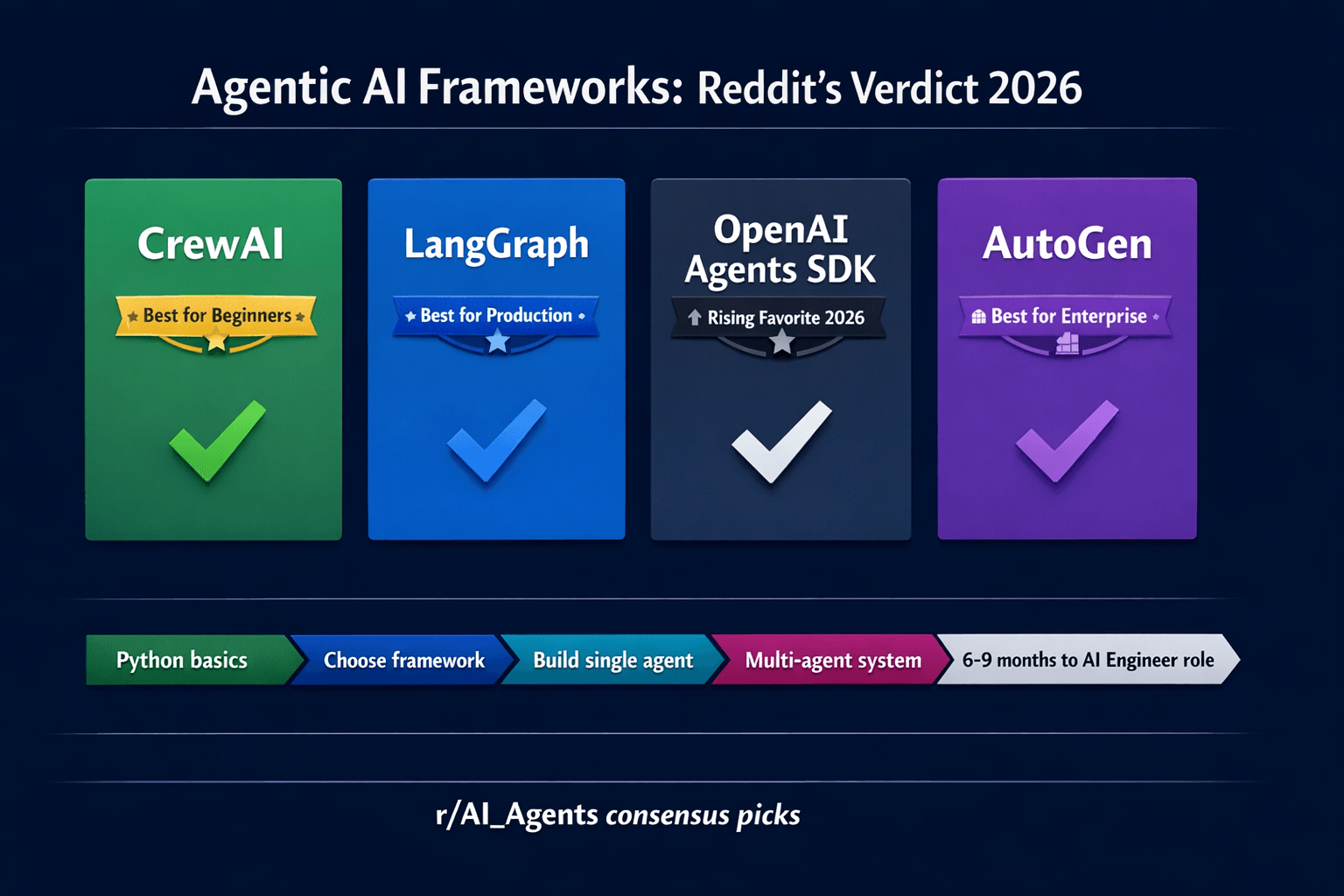
Agentic AI frameworks comparison 2026: CrewAI best for beginners, LangGraph for production, OpenAI Agents SDK rising favorite, AutoGen for enterprise - r/AI_Agents consensus

Detailed Tool Reviews

1

GCP Vertex AI | Google AI & ML | Agentic AI (ADK) | MCP | A2A (Udemy)

4.5

The most up-to-date 2026 course covering Google Cloud agentic AI, including Vertex AI, Gemini models, Google ADK (Agent Development Kit), MCP (Model Context Protocol), and A2A (Agent-to-Agent) protocols. Unlike courses that cover framework basics, this one addresses the actual 2026 agentic AI stack for the Google Cloud ecosystem: how to build and deploy production AI agents using Google infrastructure. For developers targeting enterprise roles or companies running Google Cloud, this covers skills that official Google training has not yet incorporated.

Key Features:

  • Vertex AI and Gemini model integration for agentic applications
  • Google ADK (Agent Development Kit) - official Google agentic framework
  • MCP (Model Context Protocol) for tool and context management
  • A2A (Agent-to-Agent) protocol for multi-agent coordination
  • Google Cloud ML pipeline and deployment
  • Lifetime access after one-time payment
  • Certificate of completion

Pricing:

Check current Udemy price (one-time payment, lifetime access)

Pros:

  • + Most current 2026 Google Cloud AI content available on any platform
  • + Covers ADK, MCP, A2A - skills not yet in official Google training materials
  • + One-time payment with lifetime access vs subscription alternatives
  • + Addresses enterprise-level agentic AI deployment on Google Cloud
  • + Practical focus on building and deploying agents, not just theory

Cons:

  • - Requires basic Google Cloud familiarity to get full value
  • - Google ADK is newer than LangChain or CrewAI - smaller community for troubleshooting
  • - Not the starting point if you have no Python or cloud background
  • - Google Cloud ecosystem specifically - less applicable to AWS or Azure environments

Best For:

Developers with Python and some cloud experience who want to build agentic AI applications on Google Cloud infrastructure, or professionals preparing for Google Cloud AI Engineering roles

Try GCP Vertex AI | Google AI & ML | Agentic AI (ADK) | MCP | A2A (Udemy)

What Reddit actually thinks about agentic AI in 2026

The r/AI_Agents community is one of the faster-growing technical subreddits in 2026, and the discussions there are practical rather than theoretical. The dominant conversation is about which frameworks actually work in production, which learning resources are worth the time, and what real clients are willing to pay for.

The community view on the opportunity: 78% of organizations are already using AI agents in production according to sources cited in r/AI_Agents, and the market is growing toward $47 billion by 2030. That demand is creating genuine freelance and employment opportunities for people who can build working agentic systems.

The honest Reddit framing on learning: basic Python is enough to start. You do not need an ML background, a data science degree, or experience training models. Agentic AI engineering is about orchestrating existing LLMs using tool calls and decision loops, not about building the underlying models. One r/AI_Agents user summarized the skills needed: "Python basics like loops, JSON parsing, and API calls, then understanding how LLMs work at a high level, then learning how one specific framework handles tool calling and agent loops."

What the community agrees the learning path looks like: start simple with a single-agent system using one framework, build something that solves a real problem, then expand to multi-agent coordination. The frameworks you choose matter less than building something that actually works.

The agentic AI framework debate on Reddit

The framework question is the most actively debated topic in r/AI_Agents and r/LangChain, and Reddit has not reached a consensus - which is itself useful information for anyone deciding where to start.

LangChain and LangGraph

LangChain is the most discussed framework by volume but generates polarized opinions. The criticism is direct: one r/LangChain comment described the documentation as something to "run away from as fast as you can." The underlying abstraction layer has frustrated developers who find it harder to debug than direct API calls. LangGraph - LangChain's more structured sibling for stateful agent workflows - gets better technical reviews. It handles complex multi-step agent logic with explicit state management, which makes it easier to reason about in production.

CrewAI

The consensus beginner recommendation. r/AI_Agents users consistently point to CrewAI as the starting point for multi-agent systems because its task/crew/agent structure maps intuitively to how business workflows actually operate. Multiple agents with defined roles completing coordinated tasks. The documentation is better than LangChain's, and the number of community tutorials has grown significantly in 2025-2026.

OpenAI Agents SDK

The emerging production favorite in 2026 r/AI_Agents threads. Multiple users report switching to it after trying several other frameworks: "After trying 10+ agent frameworks I dropped all for the OpenAI agent sdk." Cleaner architecture, better documentation, and direct integration with OpenAI's model improvements. The limitation: vendor lock-in to OpenAI models.

AutoGen

Microsoft's multi-agent framework, positioned for enterprise use cases with more complex coordination requirements. Gets positive mentions in r/MachineLearning for research applications and enterprise deployments. Steeper learning curve than CrewAI.

The practical Reddit verdict: start with CrewAI to understand multi-agent concepts, move to LangGraph or OpenAI Agents SDK for production systems.

Free resources Reddit actually uses

The agentic AI learning ecosystem has more quality free content than most technical domains. The frameworks themselves publish extensive documentation and tutorials, and the YouTube coverage has grown as the field has expanded.

CrewAI official documentation and tutorials

The CrewAI team maintains tutorials that multiple r/AI_Agents users describe as the best starting point. The official GitHub repository includes example agents that you can run and modify, which the community treats as the primary learning material.

LangGraph documentation

Despite criticisms of LangChain's documentation in general, LangGraph's specific docs are better regarded. The step-by-step tutorials for building stateful agent workflows are cited in r/AI_Agents as the reference for production agent architecture.

AssemblyAI YouTube channel

Consistently mentioned in r/AI_Agents as the most useful YouTube resource for agentic AI. Practical tutorials covering real use cases rather than abstract framework introductions. The videos show complete working agents rather than hello-world examples.

DeepLearning.AI "AI Agents in LangGraph"

Mentioned positively in r/AI_Agents as a structured free course for understanding the agentic AI fundamentals. The LangGraph focus makes it specifically useful for building stateful workflows rather than simple chatbot interactions.

The community note: free resources are sufficient for learning agentic AI fundamentals. The case for paid courses is the same as in other technical domains - structured sequencing, certificate documentation, and content that covers platform-specific skills (like Google Cloud ADK) that free tutorials have not yet covered.

What you can actually build and get paid for

The r/AI_Agents community is specific about what agentic AI clients actually pay for, and the answer surprises some newcomers. The most valuable agentic AI projects are not impressive research demos. They are boring, automatable business processes that were previously done manually.

The use cases that community members report getting paid for: invoice extraction and categorization, email processing and response drafting, news and competitor monitoring agents, meeting transcript parsing and action item extraction, grant application screening, and recruitment pipeline automation. One frequently cited framing: "The clients paying for AI agents want to stop paying humans for repetitive cognitive tasks. Find those tasks."

For freelancers specifically, r/AI_Agents discussions point to platforms like Upwork and direct outreach to small businesses as the most practical starting paths. The competitive advantage in 2026 is speed to working prototype: clients who have been burned by complex AI projects respond better to seeing a working agent in the first meeting than to hearing about technical capabilities.

The career track is separate from freelancing. AI Engineering roles in 2026 typically require Python proficiency, experience with at least one major agentic framework (LangGraph, CrewAI, or OpenAI Agents SDK), understanding of LLM tool-calling and state management, and some exposure to observability tools like LangSmith. Cloud platform experience (Google Cloud, AWS, Azure) is increasingly required for enterprise roles. Six to nine months of consistent learning and project building is the Reddit-documented timeline to production-ready skills.

Skills you actually need to start

The prerequisite question is one of the most searched in r/AI_Agents, and the community answer has stabilized around a clear minimum bar.

Python at an intermediate level is the core requirement. Not machine learning Python, but practical Python: writing loops and functions, working with JSON data, making API calls, and understanding async operations. If you can call an OpenAI API endpoint and parse the response, you have enough Python to start building agents.

LLM fundamentals come next: understanding what a context window is, how system prompts work, how tool calling allows models to take actions in the world, and what makes a good agent prompt different from a good chatbot prompt. This knowledge is free and available across documentation and YouTube in 2026.

From there, picking one framework and building a working agent matters more than studying frameworks comparatively. The community consensus: "Pick CrewAI if you want to start quickly. Pick LangGraph if you want to understand what's happening under the hood. Build something real before switching frameworks."

The skills you do not need: machine learning theory, PyTorch or TensorFlow, statistics beyond the basics, or any model training experience. Agentic AI engineering in 2026 is closer to software engineering than to data science.

Frequently Asked Questions

Reddit does not name a single winner. Free options: CrewAI official documentation and tutorials, LangGraph documentation, DeepLearning.AI AI Agents in LangGraph course, and AssemblyAI YouTube tutorials. For structured paid learning covering Google Cloud agentic AI specifically (Vertex AI, Google ADK, MCP, A2A), the Udemy GCP Vertex AI course covers skills not yet available in free resources. The community consensus: build a working agent with any resource before comparing alternatives.

How to get started with agentic AI in 2026

For complete beginners, start with CrewAI's official tutorials or the DeepLearning.AI AI Agents in LangGraph course, both free. Build one working agent that solves a real problem before moving to multi-agent systems. For developers who want a structured path covering the Google Cloud agentic AI ecosystem including Vertex AI, Google ADK, MCP, and A2A protocols, the Udemy GCP Vertex AI and Agentic AI course covers skills that free tutorials and official Google training have not yet incorporated. For freelancers, focus on the boring business automation use cases that clients actually pay for. Six to nine months of consistent building is the community-documented path to production-ready agentic AI skills.

About the Author

Amara - AI Tools Expert

Amara

Amara is an AI tools expert who has tested over 1,800 AI tools since 2022. She specializes in helping businesses and individuals discover the right AI solutions for text generation, image creation, video production, and automation. Her reviews are based on hands-on testing and real-world use cases, ensuring honest and practical recommendations.

View full author bio

Related Guides