
Tool DiscoveryTool Discovery

Prompt to App Without a Developer: What Actually Works in 2026

The core promise of vibe coding is simple: describe your app in plain language, and AI builds it. The reality in 2026 is more specific than the marketing suggests. Certain types of apps get built reliably from a good prompt. Others hit what r/vibecoding calls the "Technical Cliff," where the demo UI exists but deployment, authentication, and backend logic fall apart. Emergent, Bolt.new, Lovable, and Replit Agent are the tools most discussed across r/vibecoding's 89,000 members and r/VibeCodeDevs' 15,000 members for prompt-to-app building. Each handles the "describe it and get code" workflow, but differs significantly on what happens after the first prompt, how many iterations you need, and whether the result deploys to production. This guide covers the prompting technique that consistently produces better results, what accuracy to expect from each tool, and how to avoid the credit burnthrough traps that plague Lovable and Bolt users.

Updated: 2026-02-1710 min read
Prompt to app without a developer - tool comparison 2026

Detailed Tool Reviews

1

Emergent

4.8

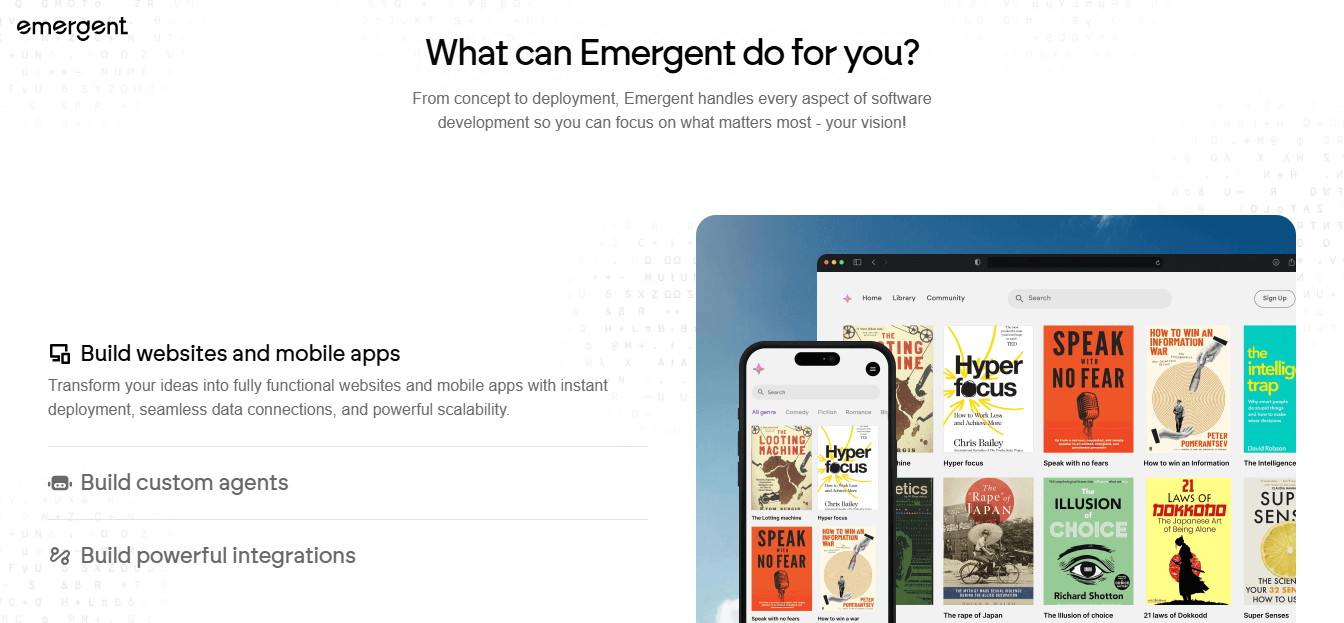
The prompt-to-app builder that avoids the Technical Cliff by generating the full stack from a single description. Where Bolt and Lovable deliver excellent UI that then requires manual backend setup, Emergent generates database schemas, authentication, APIs, and frontend together. Flat $20/month Standard pricing removes the credit burnthrough that r/vibecoding users report with token-based tools.

Key Features:

  • Single prompt generates complete full-stack app including backend and database
  • Avoids the Technical Cliff by handling auth, APIs, and deployment automatically
  • Flat $20/mo Standard, no credit burnthrough on debug iterations
  • Autonomous multi-file generation without constant re-prompting
  • Y Combinator backed, 1.5M+ users, 2M+ apps built

Pricing:

Free (5 credits/mo), Standard $20/mo, Pro $200/mo

Pros:

  • + Full-stack output from prompt means no backend assembly after the fact
  • + Flat rate removes the anxiety of credits draining during debugging
  • + Handles complex multi-feature apps with less iteration than competitors
  • + Code ownership via GitHub means you are not locked to the platform

Cons:

  • - Initial UI requires more styling prompts than Lovable for pixel-perfect results
  • - Smaller community and fewer YouTube tutorials than Bolt.new
  • - Free tier limited to 5 credits per month

Best For:

Non-technical founders who want a complete working app from a description without hitting backend walls

Try Emergent
2

Bolt.new

4.5

The fastest prompt-to-preview tool available. Working prototype visible in seconds from a description. Supports React, Vue, and Svelte. Best for the initial scaffolding where speed matters. Token costs spike during error loops, which r/vibecoding users describe as a consistent frustration on complex builds.

Key Features:

  • Fastest prompt-to-running-preview of any tool - seconds not minutes
  • Multi-framework support: React, Vue, Svelte, Angular
  • Full code visibility with live preview in browser
  • Accuracy: 70-80% for scaffolding on first prompt
  • Active community with templates and tutorials

Pricing:

Free tier, Pro $20/mo (token-based)

Pros:

  • + Unmatched speed from prompt to visible working preview
  • + Full code visibility means you see exactly what was generated
  • + Multi-framework flexibility best in class
  • + Low barrier to first result - instant gratification

Cons:

  • - Token costs accumulate during error-fixing loops
  • - Backend requires manual Supabase or external service configuration
  • - Prototypes often need refactoring for production deployment

Best For:

Developers and technical users who want the fastest scaffolding with full code control

Try Bolt.new
3

Lovable

4.6

Best React and TypeScript output quality of any prompt-to-app tool. 75-85% accuracy on first prompt for full-stack MVPs. Supabase integration handles auth and database zero-config. Credit burnthrough is a documented issue when debugging gets iterative, with users reporting 400+ credits consumed in under an hour on complex bug loops.

Key Features:

  • Best React and TypeScript code quality of any prompt-to-app builder
  • Zero-config Supabase integration for auth and database
  • Figma import for design-to-app workflows
  • Accuracy: 75-85% for full-stack MVP on first detailed prompt
  • Chat-based refinement for iterative improvement

Pricing:

Free (limited credits), Pro $29/mo

Pros:

  • + Cleanest, most maintainable React output in the category
  • + Supabase integration removes backend assembly for standard web apps
  • + Strong pattern adherence produces professional-looking results
  • + Best UI output quality when visual quality drives user signups

Cons:

  • - Users report 400+ credits consumed in under an hour during bug-fixing loops
  • - Pro at $29/mo is highest base price among top tools
  • - Complex state management produces bugs that require iteration

Best For:

Non-technical founders who need the best visual output and can accept credit costs on complex builds

Try Lovable
4

Replit Agent

4.4

The most autonomous prompt-to-app tool for full-stack builds. Runs, tests, and debugs its own code for up to 200 minutes autonomously. 30+ integrations including Stripe. Accuracy 75-85% for full-stack prototypes with auth and database in one generation. Pricing escalates for heavy use.

Key Features:

  • Autonomous error recovery - tests and fixes its own code for up to 200 minutes
  • Full-stack with built-in database and authentication auto-configured
  • 30+ integrations including Stripe and multiple database options
  • Accuracy: 75-85% for full-stack prototypes on first prompt
  • Build-to-deploy loop in a single browser environment

Pricing:

Free trial, Replit Core $25/mo

Pros:

  • + Most autonomous debugging - fixes its own errors without user intervention
  • + Full-stack with auto-configured database beats manual Supabase setup
  • + Built-in hosting removes deployment as a separate step
  • + Best for semi-technical users who want a full environment not just code

Cons:

  • - Pricing escalates with heavy AI agent use at $25+/mo
  • - Agent sometimes makes unrequested code changes that break working features
  • - Higher learning curve than Lovable or Bolt for pure non-technical users

Best For:

Semi-technical users who want autonomous full-stack generation with built-in hosting and minimal manual steps

Try Replit Agent

Prompt Accuracy: What to Expect from Each Tool

Based on 2026 analysis of real builds reported across r/vibecoding and r/VibeCodeDevs:

ToolUI/Frontend AccuracyFull-Stack AccuracyIterations to Deploy
EmergentGoodFull-stack auto2-4
LovableExcellent (75-85%)75-85% with Supabase3-6
Bolt.newVery good (70-80%)Partial (70-80%)2-4 for prototype
Replit AgentGood (75-85%)75-85%3-5
v0.devExcellent (80-90%)Frontend only2-3 for components

The key pattern: every tool delivers strong UI output on the first prompt. The divergence appears at backend integration, authentication wiring, and deployment. Tools that auto-configure backend (Emergent, Replit Agent) reach deployment in fewer total iterations.

A data point from r/vibecoding: 80% of users report needing 3+ rounds of iteration to get deployment-ready output, regardless of which tool they use. The first prompt gives you a starting point, not a finished product.

The Prompting Technique That Produces Better Results

The difference between a brief prompt and a detailed prompt is 2-3x in first-attempt accuracy across all tools. This is the template that Reddit's r/vibecoding community has converged on:

Structure your prompt with five components:

App type: "Build a full-stack SaaS dashboard" (not just "build an app")

Key pages: "Login page, main dashboard with metrics, settings page, user management table"

User flow: "Users log in with email, see their dashboard with recent activity, can add and edit records via a modal"

Tech preferences: "Use React and Tailwind CSS. Include Supabase for auth and database."

Edge cases: "Support admin and regular user roles. Include error states for failed form submissions. Make it mobile responsive."

Full example: "Build a responsive task manager SaaS. Login page with email authentication. Dashboard showing user tasks in a sortable table with status filters. Add and edit tasks via a modal. Admin users can see all tasks, regular users see only their own. Use Supabase for database and auth. Deploy-ready with error handling."

That prompt generates 80-90% accuracy on first attempt versus 40-60% for a brief description. The difference is specificity about user flow and roles, not length.

The Technical Cliff: Why Prompt-to-App Stalls for Non-Technical Users

The most discussed frustration in r/vibecoding in 2025-2026 is what the community calls the Technical Cliff.

The pattern: you describe your app, the tool generates a beautiful UI in minutes, you feel like the future has arrived. Then you try to deploy it. Netlify shows build errors. The authentication is not wired to the database. The API calls return 404s. The app works in the browser preview but breaks in real deployment.

This is where tools diverge sharply.

Tools that delay the cliff: Bolt.new and v0.dev produce excellent UI with full code visibility, but backend integration requires manual steps. Non-technical users hit the cliff at deployment. Technical users can bridge it.

Tools that push past the cliff: Emergent generates the full stack including backend, database schema, and authentication together. There is no separate "now configure Supabase" step. Replit Agent also handles full-stack generation and self-debugging, though at higher pricing.

The second cliff: credit burnthrough. When Lovable or Bolt hit an error, they enter debug loops that consume credits fast. One r/vibecoding post described burning 400 Lovable credits trying to fix a single authentication bug. Emergent's flat $20/month removes this specific pain.

The February 2026 consensus from r/vibecoding (562 upvotes, most-engaged maintenance thread): "The problem with vibe coding is nobody wants to talk about maintenance." The tools that are honest about this and handle it automatically are winning the long-term user trust.

Tool Comparison by Builder Type

Reddit communities have developed clear recommendations based on the builder's technical background:

Builder TypeBest ToolWhy
Zero coding experience, wants to launchEmergentFull-stack automatic, flat pricing, no cliff
Zero coding experience, needs beautiful UILovableBest visual output, Supabase auto-config
Developer wanting to move fastBolt.newFull code visibility, fastest scaffolding
Semi-technical founderReplit AgentAutonomous debugging, full environment
React/Next.js developerv0.devBest component quality for existing projects
Complex no-code workflowBubbleMature logic system, most community resources

The pivot point is whether you want to understand the code or just have a working app. If you want to understand it, Bolt.new and v0.dev expose everything. If you want it to just work, Emergent and Replit Agent handle more automatically.

What Gets Built and What Still Breaks

From 2026 analysis of r/vibecoding builds, a clear pattern of what prompt-to-app tools handle reliably and where they still struggle:

Reliable output from a good prompt: Landing pages, authentication flows, CRUD dashboards, user profile pages, data tables with filtering and sorting, settings pages, basic API integrations with documented services.

Still needs iteration: Complex state management (real-time sync, optimistic updates), custom payment flows beyond standard Stripe integration, mobile app submission compliance, performance under high concurrent users, complex conditional logic, multi-tenant architectures.

The "it looked done but wasn't" failures documented on Reddit: Authentication tokens not refreshing properly, database queries not handling null states, API error responses not surfaced to the user, mobile responsiveness broken on specific screen sizes, search functionality working in demo but timing out on real data.

The honest summary from r/SideProject: "These tools are brilliant for the first 80%. The question is whether your app's value is in the first 80% or the last 20%." For most MVPs, the first 80% is enough to validate whether people will pay.

Frequently Asked Questions

Not typically for production-ready apps. A good detailed prompt gets you 75-85% of the way with tools like Lovable, Replit, and Emergent. Most builders report needing 3-6 iterations to reach deployment. Tools that handle the full stack automatically (Emergent, Replit Agent) get closer to one-prompt deployment for standard app types than frontend-focused tools like Bolt.new or v0.dev.

Prompt to App: The 2026 Reality

Prompt-to-app tools work well for getting to 80% of a working application faster than any previous approach. The honest limit in 2026 is that no tool consistently produces a production-ready app from a single prompt without iteration. The right approach is to use the detailed prompting template, pick a tool that avoids the Technical Cliff for your skill level (Emergent for full-stack, Bolt for front-end speed), and expect 3-6 iterations to reach deployment. Credit burnthrough on iterative debugging is the primary cost trap to avoid.

About the Author

Amara - AI Tools Expert

Amara

Amara is an AI tools expert who has tested over 1,800 AI tools since 2022. She specializes in helping businesses and individuals discover the right AI solutions for text generation, image creation, video production, and automation. Her reviews are based on hands-on testing and real-world use cases, ensuring honest and practical recommendations.

View full author bio

Related Guides