
AI for Data Analysis & Visualization
Complete Guide for Data Science/Analytics Students 2026
Analyze datasets, create visualizations, and extract insights using AI
Quick Answer
Julius AI is the most effective AI tool for Data Science students who need to quickly analyze datasets and create professional visualizations without extensive coding. Upload CSV files, ask questions in natural language, and receive statistical insights with publication-ready charts in minutes, making it ideal for semester projects, Kaggle competitions, and placement preparation.
Why Data Science/Analytics Students Need AI for Data Analysis & Visualization
Data Science/Analytics students face unique challenges when it comes to data analysis & visualization. From managing complex academic assignments to meeting tight deadlines, AI tools can significantly streamline your workflow and improve the quality of your work.
Common Challenges
Understanding complex datasets
Creating meaningful visualizations
Statistical analysis without coding
Interpreting data for reports
Presenting data findings
How AI Tools Help
Natural language data queries
Automatic chart and graph generation
Statistical analysis without coding
Excel and CSV file support
Export-ready visualizations
Featured Tool Recommendation
Julius AI
Our top recommendation for data analysis & visualization among Data Science/Analytics students.
Why Students Love It:
- ✓ Specifically designed for academic use
- ✓ Student discounts available
- ✓ Easy to learn and use
- ✓ Excellent customer support
Recommended AI Tools
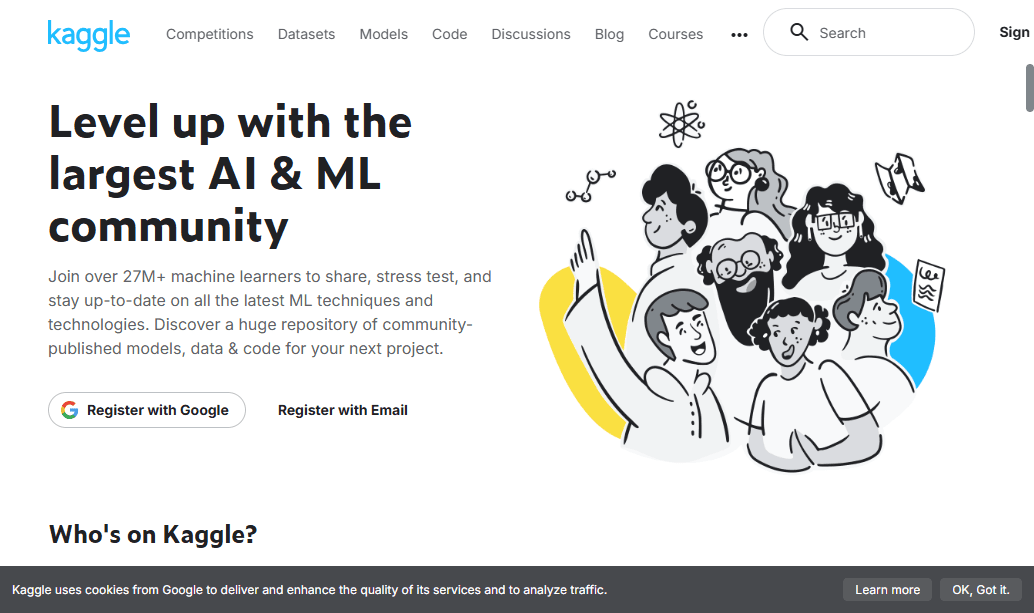
Kaggle
World's largest data science community with datasets, competitions, and notebooks - essential for DS students
For Data Science/Analytics Students:
Perfect for data analysis & visualization
Key Features:

Anaconda
Python distribution for data science with 8000+ packages - standard environment for DS students
For Data Science/Analytics Students:
Perfect for data analysis & visualization
Key Features:

Scikit-learn
Most popular Python machine learning library - fundamental tool for DS students learning ML algorithms
For Data Science/Analytics Students:
Perfect for data analysis & visualization
Key Features:

ChatGPT
ChatGPT is OpenAI's conversational AI assistant powered by GPT-5.2, providing human-like responses for writing, coding, research, problem-solving, and creative tasks. With 180+ million users, it understands context, generates code, analyzes data, and assists with content creation across unlimited conversations, making advanced AI accessible for professionals, students, and businesses worldwide.
For Data Science/Analytics Students:
Perfect for data analysis & visualization
Key Features:

SPSS AI Add-on
AI-enhanced statistical analysis for SPSS - psychology students analyze research data with machine learning
For Data Science/Analytics Students:
Perfect for data analysis & visualization
Key Features:

Claude
Claude is Anthropic's AI assistant emphasizing safety, accuracy, and nuanced reasoning for complex tasks including writing, analysis, coding, and research. Supporting 200K token context windows, Claude excels at processing long documents, maintaining conversational memory, and providing detailed explanations while prioritizing ethical AI use and minimizing harmful outputs for enterprise and professional applications.
For Data Science/Analytics Students:
Perfect for data analysis & visualization
Key Features:
Related Use Cases for Data Science/Analytics
Data Science and Analytics students face intense pressure during placement season, especially when recruiters expect polished visualizations and statistical insights during technical rounds. Whether you are preparing for campus placements at companies like Amazon, Flipkart, or analytics firms, or working on Kaggle competitions to build your portfolio, the ability to quickly analyze datasets and create compelling visualizations is critical. Julius AI addresses the core pain points that Data Science students encounter: understanding complex datasets without spending hours on exploratory data analysis, generating publication-ready visualizations without wrestling with matplotlib syntax, performing statistical tests without deep coding knowledge, interpreting results for project reports and viva presentations, and presenting findings confidently to non-technical stakeholders. For students juggling semester projects, internship applications, and placement preparation, Julius AI acts as an intelligent data analyst that works in natural language. You can upload CSV files, ask questions about distributions and correlations, generate interactive charts, and receive statistical interpretations instantly. This is particularly valuable during the final year when project deadlines coincide with placement drives, and you need to demonstrate both technical competence and business communication skills that Indian tech recruiters prioritize.
Top 5 Challenges & AI Solutions
Understanding Dataset Structure and Quality Issues
When you download datasets from Kaggle or receive project data from professors, the first challenge is understanding what you actually have. Missing values, outliers, data types, and feature distributions require extensive exploratory analysis. During placement preparation, you cannot afford to spend 2-3 hours just understanding a new dataset. Professors expect you to identify data quality issues quickly during viva sessions, and interviewers test your ability to spot anomalies in unfamiliar data within minutes.
✨ AI Solution:
Julius AI's Data Explorer automatically generates comprehensive data profiling reports showing missing values, distributions, correlations, and anomalies. Upload your CSV and ask questions like 'what are the data quality issues' to get instant insights.
Creating Professional Visualizations Without Coding Struggles
Creating clean, publication-ready visualizations in Python requires mastering matplotlib, seaborn, and plotly syntax. Students waste hours debugging plot formatting, color schemes, and layout issues instead of focusing on insights. During project presentations and placement interviews, poorly formatted charts create negative impressions. Recruiters at analytics firms expect candidates to demonstrate visualization best practices, but learning these libraries thoroughly takes months of practice that most students do not have during semester crunch time.
✨ AI Solution:
Julius AI generates professional charts through natural language prompts. Request 'create a correlation heatmap with proper labels' or 'show distribution plots for all numeric variables' and receive publication-ready visualizations instantly without writing code.
Performing Statistical Tests Without Deep Statistical Knowledge
Data Science projects require hypothesis testing, ANOVA, chi-square tests, and regression analysis. While you learn these concepts in theory classes, applying them correctly to real datasets is challenging. Choosing the right test, checking assumptions, interpreting p-values, and writing statistical conclusions for reports requires expertise. During semester exams and project vivas, professors ask pointed questions about statistical validity. Many students struggle to explain why they chose a particular test or what their results actually mean in practical terms.
✨ AI Solution:
Julius AI performs statistical tests through conversational queries like 'test if there is significant difference between groups' and provides interpretations. It automatically checks assumptions, selects appropriate tests, and explains results in plain language suitable for reports.
Interpreting Analysis Results for Project Reports and Documentation
After running analysis in Python or R, students struggle to translate technical outputs into clear explanations for project reports. Writing findings sections that connect statistical results to business implications is difficult. Placement interviewers often ask 'what does this correlation actually mean for the business' and expect articulate answers beyond numbers. Academic reports require proper statistical writing with correct terminology, confidence intervals, and effect sizes. Most students can code the analysis but fail to communicate insights effectively, which impacts grades and interview performance.
✨ AI Solution:
Julius AI provides narrative explanations of analysis results. Ask 'explain these regression results in simple terms' or 'what business insights can we draw from this analysis' to receive well-structured interpretations ready for reports and presentations.
Preparing Data-Driven Presentations for Non-Technical Audiences
During final year project presentations, industrial visits, and placement group discussions, you must explain technical findings to non-technical audiences including management faculty and HR panels. Converting complex statistical analysis into compelling stories with clear visualizations is a skill that determines placement success. Recruiters evaluate your ability to communicate data insights to business stakeholders. Students often create slides filled with technical jargon and complex charts that confuse rather than convince. This communication gap costs opportunities at consulting firms and product companies that value data storytelling.
✨ AI Solution:
Julius AI helps create presentation-ready outputs by generating simplified visualizations and executive summaries. Request 'create a dashboard showing key insights for management presentation' to receive business-focused charts and narrative summaries suitable for non-technical stakeholders.
Best Practices for Using AI Tools
Use Julius AI's Notebooks feature to save your analysis workflows. This allows you to reuse the same analytical approach across multiple Kaggle competitions and semester projects without starting from scratch each time.
Start every dataset analysis by asking Julius AI for a data quality report and summary statistics. This gives you a complete picture in 2 minutes instead of 30 minutes of manual exploration, crucial during tight project deadlines.
Schedule your heavy analysis work during the first two weeks after receiving project datasets. This leaves buffer time before mid-semester exams and placement drives when you need to focus on interview preparation rather than debugging code.
Always verify Julius AI's statistical test results by checking the assumptions and sample sizes. Cross-reference critical findings with manual calculations for academic submissions where professors may question your methodology during vivas.
Maintain a separate document where you record the exact prompts that generated useful outputs in Julius AI. This creates a personal prompt library you can reuse across projects and share with classmates preparing for similar analyses.
Before campus placements, practice explaining Julius AI-generated visualizations in your own words. Interviewers at companies like Mu Sigma and Fractal Analytics expect you to defend your analytical choices and interpret results without relying on AI-generated text.
Frequently Asked Questions
Can Julius AI handle large datasets from Kaggle competitions with millions of rows?
Julius AI efficiently processes datasets up to several GB in size, which covers most Kaggle competition datasets and academic projects. For extremely large datasets exceeding platform limits, you can perform initial sampling or aggregation in Python and then upload the processed subset to Julius AI for detailed analysis and visualization.
Will using Julius AI for semester projects be considered academic dishonesty?
Julius AI is a legitimate analysis tool similar to using Excel or Tableau, not a solution generator that does your thinking. Use it for data exploration, visualization creation, and understanding statistical concepts, but ensure you understand the methodology and can explain your analytical decisions during vivas. Always cite AI assistance in your project acknowledgments as per your college's guidelines.
How does Julius AI compare to writing Python code for placement interview preparation?
Julius AI complements but does not replace Python coding skills that interviewers test directly. Use Julius AI to quickly prototype analysis approaches and understand dataset patterns, then implement the same logic in Python for your GitHub portfolio. This dual approach demonstrates both analytical thinking and coding proficiency that top tech companies value.
Can Julius AI help with time series analysis for stock market or sales forecasting projects?
Yes, Julius AI handles time series data and can generate trend plots, seasonal decomposition, and forecasting visualizations. You can ask questions like 'show monthly trends with moving averages' or 'identify seasonality patterns' to get insights quickly, which is valuable for projects in finance electives or business analytics courses.
Does Julius AI work with datasets in regional languages or non-English text data?
Julius AI primarily works with English text and standard data formats, but it can analyze numerical and categorical data regardless of column names. For text analysis in Hindi or other Indian languages, you would need to preprocess the data using Python libraries like IndicNLP before uploading to Julius AI for visualization and statistical analysis.
What is the cost for students and are there any educational discounts available?
Julius AI offers a free tier with 15 messages per month suitable for occasional analysis, while the Pro plan costs $20 per month with unlimited messages and advanced features. There is currently no specific student discount, but using the coupon code DHRUVIR provides 10% off, bringing the monthly cost to $18, which is reasonable when split among project group members.
Can I export Julius AI visualizations for inclusion in IEEE format research papers?
Yes, Julius AI allows you to download charts as high-resolution PNG or SVG files suitable for academic publications and project reports. You can customize chart themes for professional appearance and export them directly into LaTeX documents or Word reports formatted according to IEEE, ACM, or university thesis guidelines.
How can Julius AI help during placement interviews when I cannot access the tool?
Use Julius AI during preparation to build intuition about common analytical patterns, statistical test selection, and visualization best practices. Practice explaining AI-generated insights in your own words, and maintain a notebook of analytical approaches you learned through Julius AI that you can recall during whiteboard interviews and case study discussions.
How to Use AI for Data Analysis & Visualization: Data Science/Analytics Step-by-Step Guide
Total time: 2-3 hours
Upload Dataset and Request Initial Data Profiling
15 minSign into Julius AI and upload your CSV, Excel, or Google Sheets file containing the project dataset. Immediately ask 'provide a comprehensive data quality report with summary statistics, missing values, and data types for all columns.' Review the automated profiling output to understand dataset structure, identify potential issues, and plan your analysis approach. This replaces manual exploratory data analysis that typically takes 45-60 minutes in Jupyter notebooks.
Tool: Julius AIGenerate Distribution and Relationship Visualizations
30 minRequest specific visualizations using natural language prompts like 'create distribution plots for all numeric variables' or 'show correlation heatmap with coefficient values.' Ask for comparative visualizations such as 'plot boxplots comparing target variable across categorical groups.' Download the generated charts as PNG files for your project report. Customize chart themes by requesting 'use professional color scheme suitable for academic presentation.' This step produces publication-ready visualizations without writing matplotlib or seaborn code.
Tool: Julius AIPerform Statistical Tests and Hypothesis Validation
40 minAsk Julius AI to conduct appropriate statistical tests by prompting 'test if there is significant difference in average values between groups' or 'perform regression analysis to identify key predictors.' Request assumption checking with queries like 'verify normality and homogeneity assumptions for ANOVA.' The tool automatically selects appropriate tests, checks prerequisites, and provides p-values with interpretations. Save the statistical outputs and explanations for your methodology section and results discussion in project documentation.
Tool: Julius AIGenerate Business Insights and Report Narratives
35 minRequest interpretation of your analysis results by asking 'explain these findings in business terms suitable for management presentation' or 'what actionable recommendations emerge from this analysis.' Use prompts like 'summarize key insights in bullet points for executive summary.' Julius AI converts technical statistical outputs into clear narratives that you can directly use in your project report's findings and discussion sections. This addresses the common student challenge of translating numbers into meaningful conclusions.
Tool: Julius AICreate Presentation Materials and Validate Understanding
30 minAsk Julius AI to 'create a dashboard showing top 5 insights with supporting visualizations for 15-minute presentation.' Request simplified versions of complex charts suitable for non-technical audiences. Before finalizing, verify your understanding by asking follow-up questions like 'why did you choose this statistical test' or 'what are the limitations of this analysis.' Export all visualizations and summary text, then practice explaining the methodology and results in your own words for viva preparation and placement interviews.
Tool: Julius AIBest AI Tools for Data Analysis & Visualization: Data Science/Analytics Students
| Tool | Best For | Pricing | Rating | Verdict |
|---|---|---|---|---|
| Julius AITop PickFree tier | Comprehensive data analysis with natural language interface, ideal for semester projects and Kaggle competition exploration requiring quick insights and professional visualizations | $20/month Pro plan, free tier with 15 messages/month | 4.8/5 | Best overall choice for Data Science students who need statistical analysis, visualization, and report-ready interpretations without extensive coding during placement preparation. |
| DataCamp WorkspaceFree tier | Cloud-based Python and R coding environment with integrated datasets, excellent for building portfolio projects and learning data manipulation alongside analysis | $25/month for full access, limited free tier | 4.5/5 | Choose this when you need to demonstrate actual coding skills for GitHub portfolio and want structured learning paths, but requires more time investment than Julius AI. |
| Google Colab with ChatGPTFree tier | Free Python environment where you can write code with AI assistance, suitable for students who want complete control over analysis methodology | Free with Google account, ChatGPT Plus $20/month optional | 4.3/5 | Use this free alternative when budget is constrained and you have time to write code, but expect longer analysis time compared to Julius AI's direct approach. |
Data Science/Analytics Context: What You Need to Know
When You Need This Most
Data Science students need robust analysis and visualization skills most intensely during 6th and 7th semesters when major projects, internship applications, and placement preparation overlap. This is also when Machine Learning and Business Analytics courses require extensive dataset work with tight submission deadlines.
Career Relevance
Proficiency in data analysis and visualization directly impacts placement success at analytics firms like Mu Sigma, Fractal Analytics, and Tiger Analytics, as well as data scientist roles at product companies like Flipkart, Swiggy, and Razorpay. Recruiters specifically test your ability to derive insights from unfamiliar datasets and communicate findings clearly during technical rounds.
Common Mistakes to Avoid
- ✗Spending excessive time perfecting visualizations instead of focusing on analytical insights, which reduces time available for interpretation and documentation
- ✗Blindly accepting AI-generated statistical results without verifying assumptions or understanding the methodology, leading to incorrect conclusions during viva questioning
- ✗Using Julius AI outputs verbatim in reports without rephrasing in your own words, which becomes obvious during oral examinations when you cannot explain the analysis approach
India-Specific Context
During campus placement season from August to December, Data Science students face simultaneous pressure from project deadlines and company interviews. Top analytics recruiters like ZS Associates and LatentView expect candidates to demonstrate both technical analysis skills and business communication ability within 45-minute case study rounds.
Related Pages
More Tools for Data Science/Analytics
Resume & CV Building for Data Science/Analytics
AI tools for resume & cv building specifically designed for Data Science/Analytics students
Coding & Programming Help for Data Science/Analytics
AI tools for coding & programming help specifically designed for Data Science/Analytics students
Interview Preparation for Data Science/Analytics
AI tools for interview preparation specifically designed for Data Science/Analytics students
Data Analysis & Visualization for Other Courses
Data Analysis & Visualization for Engineering (B.Tech/B.E.)
Discover data analysis & visualization tools tailored for Engineering (B.Tech/B.E.) students
Data Analysis & Visualization for Computer Science (BCA/MCA)
Discover data analysis & visualization tools tailored for Computer Science (BCA/MCA) students
Data Analysis & Visualization for CA/CS/CMA
Discover data analysis & visualization tools tailored for CA/CS/CMA students
Ready to Transform Your Data Analysis & Visualization Workflow?
Join thousands of Data Science/Analytics students using AI tools to work smarter and achieve better results with data analysis & visualization.