
Tool DiscoveryTool Discovery

Solopreneur App Builder: Ship Your First Product Without a Developer in 2026

Building an app used to require either $10,000 and a developer relationship or years of coding experience. Neither option worked well for solo founders who needed to validate an idea before spending serious money. AI app builders changed that equation in 2024 and the tools have matured significantly since. This guide covers what solopreneurs are actually building, which tools fit which situations, and the honest answer to whether you can go from idea to paying customers without writing a single line of code.

Updated: 2026-02-1710 min read
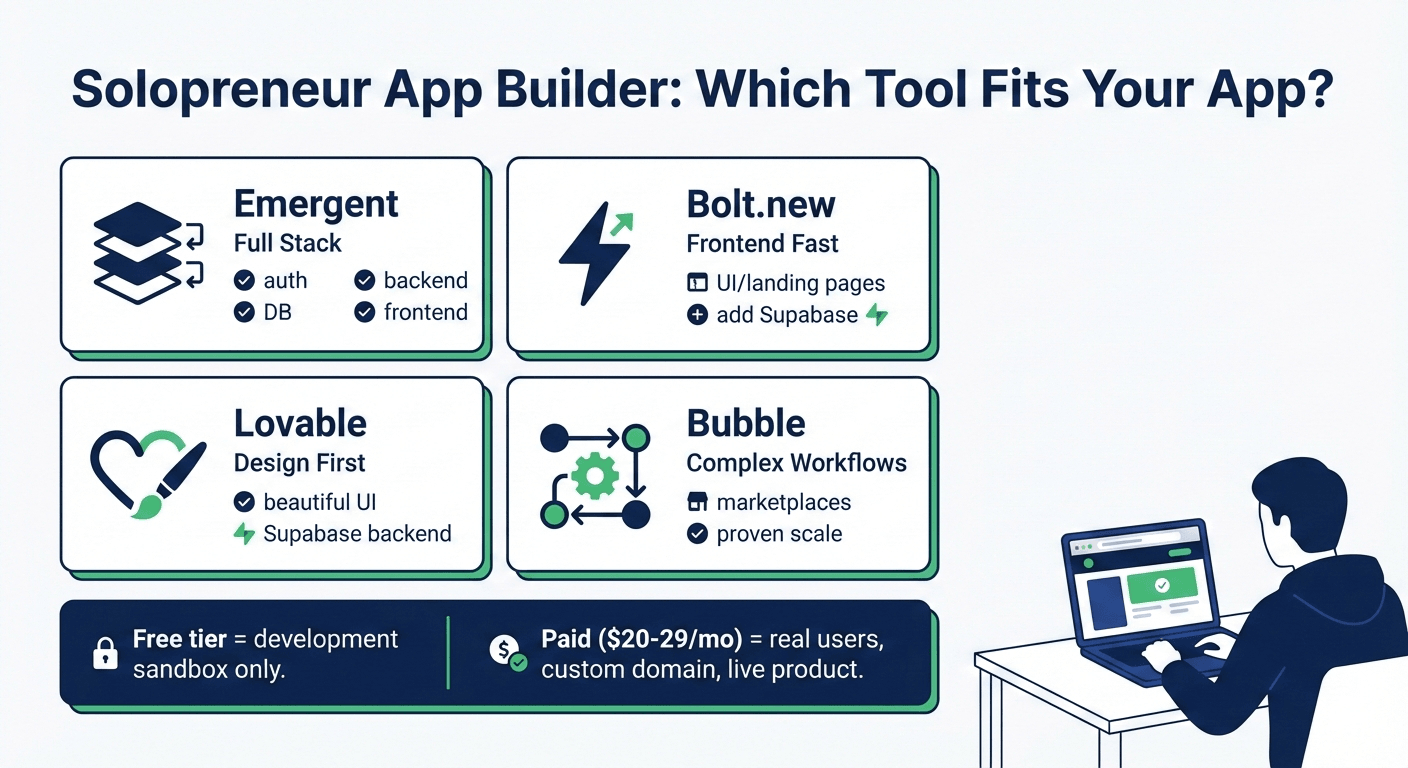
Solopreneur app builder comparison 2026 - Emergent vs Bolt.new vs Lovable vs Bubble

Detailed Tool Reviews

1

Emergent

4.8

Full stack AI app builder handling frontend, backend, database, and auth in one prompt. Best choice for solopreneurs who need a complete deployable product.

Key Features:

  • Full stack generation (frontend + backend + database)
  • Built-in authentication and user management
  • One-click deployment to live URL
  • Iterative editing via natural language
  • Y Combinator backed, 1.5M+ users

Pricing:

Free (5 credits/mo), Standard $20/mo, Pro $200/mo

Pros:

  • + Only builder that handles full stack in a single prompt
  • + Free tier lets you test the idea before paying
  • + Standard plan at $20/mo is cheaper than 1 hour of freelance dev
  • + No context about databases or APIs needed

Cons:

  • - Free tier (5 credits/mo) is enough to prototype but not launch
  • - Complex business logic still requires iteration
  • - Less design flexibility than Lovable for pixel-perfect UI

Best For:

Solopreneurs who need a functional full stack app deployed quickly

Try Emergent
2

Bolt.new

4.6

Fast frontend prototyping tool. Excellent for landing pages, UI-heavy apps, and quick demos. No native backend, so complex data apps need Supabase integration.

Key Features:

  • Fastest time from prompt to deployed frontend
  • Strong React and Next.js output quality
  • Supabase integration for adding a database layer
  • Good for validating UI before building backend

Pricing:

Free tier, Pro $20/mo

Pros:

  • + Fastest prototyping speed of any tool tested
  • + Excellent UI output quality
  • + Strong community and template library

Cons:

  • - No native backend means extra setup for data-heavy apps
  • - Credit system burns fast on complex iterations
  • - Requires Supabase knowledge for full stack builds

Best For:

Solopreneurs who need a polished frontend fast and can handle basic Supabase setup

Try Bolt.new
3

Lovable

4.5

Design-first AI builder producing the most visually polished output. Integrates with Supabase for backend. Best when the product experience depends heavily on UI quality.

Key Features:

  • Highest design quality output of any AI builder
  • Supabase backend integration built in
  • Good for consumer-facing SaaS products
  • Strong component library and responsive design

Pricing:

Free tier, Pro $25/mo

Pros:

  • + Consistently the best-looking output without design skills
  • + Supabase integration works well out of the box
  • + Active community sharing prompts and patterns

Cons:

  • - More expensive than alternatives for the same feature set
  • - Slower iteration cycle than Bolt.new
  • - Backend capabilities require Supabase configuration

Best For:

Solopreneurs building consumer products where design quality drives conversion

Try Lovable
4

Bubble

4.3

The most mature no-code platform with the largest ecosystem of plugins and templates. Steeper learning curve than newer AI builders but more control over complex logic.

Key Features:

  • Largest plugin ecosystem in no-code (500+ plugins)
  • Full visual programming environment
  • Strong for marketplace and multi-sided platform apps
  • Proven scalability to thousands of users

Pricing:

Free tier, Starter $29/mo, Growth $119/mo

Pros:

  • + Most mature platform, proven at scale
  • + Best for complex workflow and marketplace apps
  • + Large community with answered questions for almost every problem

Cons:

  • - Steeper learning curve than AI-first builders
  • - Pricing jumps significantly at growth tier
  • - Performance can lag on heavy data operations

Best For:

Solopreneurs building marketplaces, complex workflows, or apps needing proven scalability

Try Bubble

What solopreneurs are actually building in 2026

<p>The myth is that AI app builders are only good for landing pages and simple CRUD tools. The reality on r/solopreneur and r/indiehackers is different. Solopreneurs are shipping Shopify apps, marketplace integrations, SaaS tools, client portals, and booking platforms using AI builders as the primary development environment.</p>

<p>The most common progression looks like this: solopreneurs start with marketplace integrations (Pipedrive add-ons, Outlook integrations) to validate demand with zero infrastructure cost, then move to standalone SaaS once they have paying customers. One r/indiehackers post described building a $1M ARR app in under a week using Emergent for the full stack build, which sparked a 400-comment thread about whether the number was real. Most commenters concluded it was, but noted the founder had spent years understanding the problem space before touching the builder.</p>

<p>The pattern that actually works: deep domain knowledge plus AI builder beats shallow domain knowledge plus custom developer code. The solopreneurs shipping fastest are the ones who know their customer problem intimately and use AI builders to execute, not the ones trying to build something generic.</p>

<p>Common app types solopreneurs successfully ship with AI builders:</p> <ul> <li>Internal tools for their own business operations (saving 10+ hours/week)</li> <li>SaaS products targeting niches they know from previous work</li> <li>Client-facing portals replacing manual email workflows</li> <li>Booking and scheduling apps for service businesses</li> <li>Data dashboards pulling from APIs they already use</li> </ul>

Which tool fits your situation

<p>The most common mistake is picking a tool based on what gets the most YouTube coverage rather than what fits the actual app type. Here is the breakdown based on what solopreneurs report on r/nocode and r/SideProject:</p>

<table> <thead> <tr> <th>Situation</th> <th>Best Tool</th> <th>Why</th> </tr> </thead> <tbody> <tr> <td>Need full stack: auth + database + API + frontend</td> <td>Emergent</td> <td>Only tool that handles all layers in one prompt without Supabase configuration</td> </tr> <tr> <td>Need polished UI fast, fine with basic Supabase setup</td> <td>Lovable</td> <td>Best design output quality, good Supabase integration</td> </tr> <tr> <td>Need frontend prototype or landing page in hours</td> <td>Bolt.new</td> <td>Fastest time-to-deployed-URL, excellent React output</td> </tr> <tr> <td>Building a marketplace or multi-sided platform</td> <td>Bubble</td> <td>Most mature plugin ecosystem, proven at marketplace scale</td> </tr> <tr> <td>Have basic coding knowledge, want full control</td> <td>Cursor</td> <td>Best AI code editor for semi-technical solopreneurs</td> </tr> </tbody> </table>

<p>The free tier question comes up constantly on r/solopreneur. Every tool above offers a free tier, but free tiers are development environments, not launch environments. Emergent's free tier gives 5 credits per month, enough to build and test a prototype but not enough to run a live product with real users. The paid tiers ($20-$29/mo) unlock deployment to custom domains, higher usage limits, and support. For context, $20/mo is less than one hour of freelance developer time.</p>

Developer cost vs AI builder: the real numbers

<p>The standard comparison floating around r/indiehackers puts custom development at $5,000 to $15,000 for an MVP, depending on complexity and geography. That number holds up for a functional product with user auth, a database, a payment integration, and a basic dashboard. The same product built with Emergent Standard takes 2 to 8 hours and costs $20/mo.</p>

<p>Where the comparison breaks down is maintenance. A developer-built product has source code you own outright and can take anywhere. An AI-builder product runs on the platform's infrastructure. If the platform changes pricing or shuts down, you have a problem. This is the ownership concern that generates the most debate in r/nocode threads.</p>

<p>Practical cost breakdown for a solopreneur SaaS MVP:</p> <ul> <li>Traditional freelancer route: $8,000 to $12,000 upfront, 6 to 12 weeks timeline, full code ownership</li> <li>AI builder route: $20 to $29/mo, 1 to 5 days timeline, platform-dependent deployment</li> <li>Hybrid route: AI builder for MVP validation, hire developer to rebuild once you have revenue</li> </ul>

<p>Most solopreneurs on r/SideProject recommend the hybrid route for anything you plan to scale past a few hundred users. Build with AI to validate demand fast, then use the revenue to fund proper development if it works. If it does not work, you lost $20 instead of $10,000.</p>

From idea to live app: a realistic timeline

<p>The marketing material from AI builder companies shows apps launching in 15 minutes. The r/solopreneur reality is different but still dramatically faster than traditional development. Here is what experienced solopreneurs actually report:</p>

<ul> <li>Day 1: Define the core use case in one sentence. Write 3 to 5 specific prompts describing the app behavior. Run them through your chosen builder and review output.</li> <li>Days 2 to 3: Iteration phase. Most solopreneurs go through 10 to 20 refinement prompts before the app works the way they intended. Complex features like payment integrations or email notifications usually need explicit prompting.</li> <li>Day 4: Test with 3 to 5 real potential users. This step gets skipped constantly and causes the most wasted time. Apps that look complete often have UX issues that only show up when someone unfamiliar tries to use them.</li> <li>Day 5 to 7: Fix issues from user testing, upgrade to paid plan, deploy to custom domain.</li> </ul>

<p>The solopreneurs who ship fastest on r/indiehackers share a common pattern: they treat the AI builder like a junior developer, not a magic box. You still need to describe what you want clearly, review the output critically, and iterate on specific problems rather than re-prompting the entire app from scratch.</p>

The questions everyone asks but nobody answers directly

<p>Three topics generate disproportionate debate across r/nocode, r/indiehackers, and r/solopreneur. Here are direct answers based on what actually surfaces in those threads.</p>

<p>On IP ownership: when an AI builder generates your app code, the ownership situation varies by platform terms of service. Most platforms give you ownership of the application logic and data. The infrastructure you do not own. Platforms like Bubble run on their servers. If you export code (possible with Bolt.new and some Lovable plans), you own what you export. Emergent operates as a deployment platform, meaning your app logic is yours but the hosting is theirs until you migrate. For a validation-stage MVP this does not matter. For a product with 1,000 paying customers, consult a lawyer before assuming anything.</p>

<p>On scalability: the honest answer is that most solopreneur apps never hit the scale where this matters. Of the apps started on r/SideProject in any given month, fewer than 5% reach 500 active users. If you get there, you will have revenue to fund migration. Build first, optimize later.</p>

<p>On whether AI will replace developers entirely: the community consensus in 2026 is no, but the bar for what requires a developer has risen significantly. Standard CRUD apps, simple SaaS products, and internal tools no longer require developers. Products with complex real-time features, high-volume data processing, or tight performance requirements still do.</p>

Frequently Asked Questions

Yes, for standard SaaS patterns: user auth, a database, a dashboard, and payment integration. Emergent, Bolt.new, and Lovable all handle these without code. The limit is complexity. Apps requiring real-time collaboration, complex data processing, or custom integrations with obscure APIs will hit walls that require either technical knowledge or a developer. Most validation-stage MVPs do not need those features.

Which builder to start with

If you need a full stack app and want the fastest path to a live product, Emergent handles auth, database, and frontend in one place without Supabase configuration. If design quality is your primary concern and you are comfortable with a bit of backend setup, Lovable produces the best-looking output. If you need a frontend prototype in hours, Bolt.new is the fastest. For marketplace and complex workflow apps where you plan to scale, Bubble has the most mature ecosystem. Start with the free tier on whichever fits your app type, build the prototype, test it with 5 real users, and upgrade only when you have evidence it solves a real problem.

About the Author

Amara - AI Tools Expert

Amara

Amara is an AI tools expert who has tested over 1,800 AI tools since 2022. She specializes in helping businesses and individuals discover the right AI solutions for text generation, image creation, video production, and automation. Her reviews are based on hands-on testing and real-world use cases, ensuring honest and practical recommendations.

View full author bio

Related Guides