
AI for Data Analysis & Visualization
Complete Guide for BSc/MSc Sciences Students 2026
Analyze datasets, create visualizations, and extract insights using AI
Quick Answer
Julius AI is an AI data analyst that lets BSc/MSc Sciences students analyze experimental data using plain language instead of code. Upload your CSV or Excel file, ask questions about patterns or statistics, and get professional visualizations and interpretations instantly for lab reports, research projects, and placement interviews.
Why BSc/MSc Sciences Students Need AI for Data Analysis & Visualization
BSc/MSc Sciences students face unique challenges when it comes to data analysis & visualization. From managing complex academic assignments to meeting tight deadlines, AI tools can significantly streamline your workflow and improve the quality of your work.
Common Challenges
Understanding complex datasets
Creating meaningful visualizations
Statistical analysis without coding
Interpreting data for reports
Presenting data findings
How AI Tools Help
Natural language data queries
Automatic chart and graph generation
Statistical analysis without coding
Excel and CSV file support
Export-ready visualizations
Featured Tool Recommendation
Julius AI
Our top recommendation for data analysis & visualization among BSc/MSc Sciences students.
Why Students Love It:
- ✓ Specifically designed for academic use
- ✓ Student discounts available
- ✓ Easy to learn and use
- ✓ Excellent customer support
Recommended AI Tools

scienceOS
AI research platform for drug discovery and life sciences - science students access computational biology tools
For BSc/MSc Sciences Students:
Perfect for data analysis & visualization
Key Features:

Deep Research
AI-powered business research assistant - BBA students conduct market research with intelligent data gathering
For BSc/MSc Sciences Students:
Perfect for data analysis & visualization
Key Features:
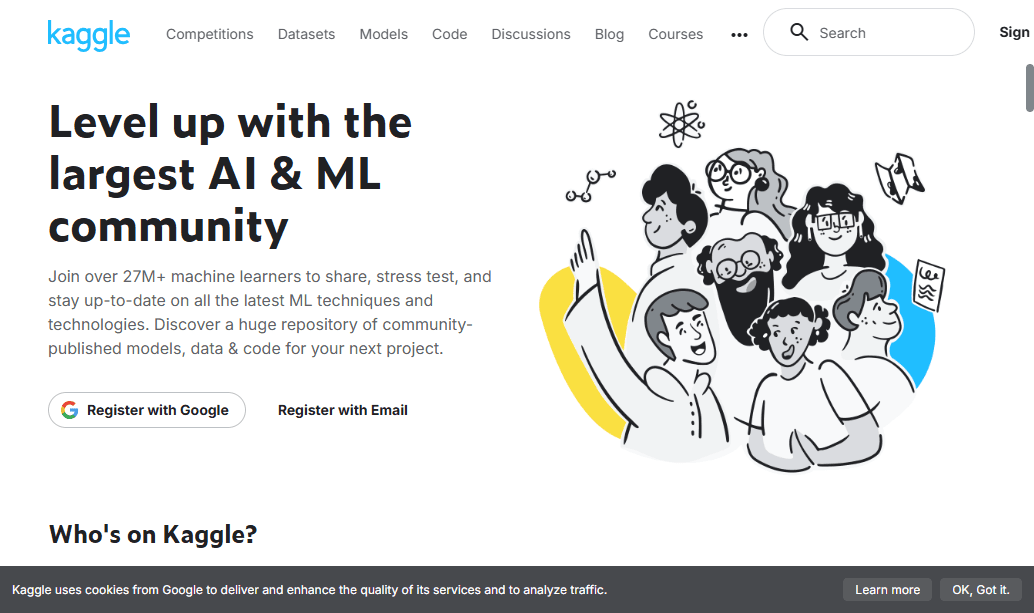
Kaggle
World's largest data science community with datasets, competitions, and notebooks - essential for DS students
For BSc/MSc Sciences Students:
Perfect for data analysis & visualization
Key Features:

ChatGPT
ChatGPT is OpenAI's conversational AI assistant powered by GPT-5.2, providing human-like responses for writing, coding, research, problem-solving, and creative tasks. With 180+ million users, it understands context, generates code, analyzes data, and assists with content creation across unlimited conversations, making advanced AI accessible for professionals, students, and businesses worldwide.
For BSc/MSc Sciences Students:
Perfect for data analysis & visualization
Key Features:

SPSS AI Add-on
AI-enhanced statistical analysis for SPSS - psychology students analyze research data with machine learning
For BSc/MSc Sciences Students:
Perfect for data analysis & visualization
Key Features:

R with AI Extensions
R programming language with AI packages - psychology students perform statistical analysis with ML tools
For BSc/MSc Sciences Students:
Perfect for data analysis & visualization
Key Features:
As a BSc or MSc Sciences student in India, you're likely grappling with the demands of rigorous coursework, competitive exams, and a challenging job market. Navigating through complex datasets and extracting meaningful insights can be daunting. This is where AI tools become indispensable. By harnessing the power of AI for Data Analysis & Visualization, you can not only simplify your learning process but also gain a competitive edge in placements and internships. One such powerful tool is Julius AI, designed to empower students like you to excel in data-centric projects and research.
Top 5 Challenges & AI Solutions
Complex Data Interpretation
Students often struggle to interpret complex datasets accurately, leading to errors in analyses.
✨ AI Solution:
AI tools like Julius AI simplify data interpretation by providing intuitive visualizations and insights, ensuring clarity and accuracy.
Time Management Issues
Balancing coursework, projects, and exam preparation leaves little time for thorough data analysis.
✨ AI Solution:
With Julius AI, automate data processing and visualization, freeing up your time for critical thinking and studying.
Lack of Technical Skills
Many students lack programming skills necessary for advanced data analysis, which can be a roadblock.
✨ AI Solution:
Julius AI requires minimal technical expertise, allowing you to focus on analysis rather than coding.
Visualizing Data Effectively
Creating impactful visualizations that convey the right message can be challenging for students.
✨ AI Solution:
Julius AI provides user-friendly templates and customizable options for creating compelling visual representations of data.
Understanding Statistical Concepts
Grasping complex statistical concepts is essential for accurate data analysis but can be overwhelming.
✨ AI Solution:
AI tools like Julius AI offer built-in statistical analysis features, helping you understand and apply concepts effortlessly.
Best Practices for Using AI Tools
Familiarize yourself with Julius AI features through tutorials.
Use AI-generated insights to supplement your analysis.
Ethically cite any AI-generated content in your projects.
Regularly update your skills and knowledge in data analysis.
Engage in peer discussions to enhance understanding of data concepts.
Frequently Asked Questions
What is Julius AI and its benefits?
Julius AI is an intuitive tool designed to assist students in data analysis and visualization. It simplifies data interpretation, provides user-friendly templates, and requires minimal technical expertise, making it ideal for BSc/MSc Sciences students.
Is Julius AI affordable for students?
Yes, Julius AI offers competitive pricing with student discounts. Additionally, many universities provide access to such tools, making it accessible for most BSc/MSc Sciences students.
Can AI tools replace traditional learning?
While AI tools like Julius AI significantly enhance the learning process, they should complement, not replace, traditional learning methods. Understanding core concepts remains essential for academic success.
How can I ensure academic integrity using AI tools?
To maintain academic integrity, always cite AI-generated content in your projects and use these tools as aids rather than substitutes for your own analysis.
Are there free alternatives to Julius AI?
Several free tools are available, but they may lack the comprehensive features of Julius AI. Consider starting with free trials to assess their effectiveness before committing.
Can I use Julius AI for group projects?
Absolutely! Julius AI is excellent for collaborative projects, allowing multiple users to work on data analysis and visualization together, enhancing teamwork and productivity.
What kind of datasets can I analyze with Julius AI?
Julius AI supports a wide variety of datasets, making it suitable for diverse fields within BSc/MSc Sciences, including biology, chemistry, and environmental science.
How do I get started with Julius AI?
Start by signing up for a free trial on the Julius AI website. Explore tutorials and resources to familiarize yourself with its features, ensuring you maximize its potential for your studies.
How to Use AI for Data Analysis and Visualization: BSc/MSc Sciences Step-by-Step Guide
Total time: 15-30 minutes
Export and Prepare Your Experimental Data
3 minExtract your lab data from instruments or spreadsheets into CSV or Excel format. Ensure column headers are clear like 'Temperature', 'Absorbance', 'pH'. Remove empty rows and check for consistent units. This preparation takes 2-3 minutes and ensures Julius AI understands your data structure correctly.
Tool: Julius AI Files interfaceUpload Your Dataset to Julius AI
2 minClick the paperclip icon in Julius AI chat or drag your file into the window. Julius instantly displays a data preview and generates suggested analysis questions based on your dataset. Review these suggestions to understand what analyses are possible. This step takes 1 minute and gives you immediate insight into your data.
Tool: Julius AI Chat interfaceAsk for Exploratory Analysis and Summary Statistics
3 minStart with basic questions like 'What are the summary statistics for this dataset?' or 'Show me the distribution of values.' Julius calculates mean, median, standard deviation, and identifies outliers. This gives you the foundation for understanding your experimental results before deeper analysis. Perfect for lab report introductions.
Tool: Julius AI Advanced AnalysisCreate Visualizations for Your Findings
5 minRequest specific chart types by asking 'Show me a scatter plot of X versus Y' or 'Create a histogram of this variable.' Julius generates publication-ready graphs instantly. You can ask for multiple visualization types to explore different relationships. Export each chart as PNG for your lab report or presentation.
Tool: Julius AI Charts and GraphsPerform Statistical Tests and Export Results
5 minAsk Julius to run statistical tests relevant to your hypothesis like 'Run a t-test comparing these two groups' or 'Calculate the correlation coefficient.' Get p-values, confidence intervals, and interpretations. Export your cleaned and analyzed data as CSV. Use these results directly in your lab report conclusions and viva preparation.
Tool: Julius AI Machine Learning and Advanced AnalysisBest AI Tools for Data Analysis and Visualization: BSc/MSc Sciences Students
| Tool | Best For | Pricing | Rating | Verdict |
|---|---|---|---|---|
| Julius AITop PickFree tier | Lab experiments, research projects, quick statistical analysis without coding. Ideal for CSIR/UGC NET prep and placement portfolio building. | Free plan with 15 messages/month. Pro plan at 20 USD/month (approximately 1,650 INR). Annual plans available. | 4.8/5 | Best choice for BSc/MSc Sciences students needing fast, professional data analysis and visualizations for academic and placement purposes. |
| Google Sheets with AIFree tier | Collaborative data entry and basic analysis. Good for group lab projects where multiple students contribute data. | Free with Google account. Premium storage at 100 INR/month for 100GB. | 4/5 | Use when collaboration matters more than advanced analysis. Limited statistical capabilities compared to Julius AI. |
| Python with Pandas and MatplotlibFree tier | Students who want to learn coding. Provides complete control over analysis but requires programming knowledge. | Free and open-source. | 4.5/5 | Choose this if you have time to learn Python during your course. Julius AI is faster for immediate lab report deadlines. |
BSc/MSc Sciences Context: What You Need to Know
When You Need This Most
BSc/MSc Sciences students need data analysis tools most during lab report writing (throughout the year), research project phases (3rd-4th semester), and exam preparation periods (CSIR/UGC NET in final year). Placement season (final 6 months) demands portfolio-ready visualizations.
Career Relevance
Data analysis and visualization skills are critical for careers in pharmaceutical research, environmental science, quality control, clinical research, and analytics roles at companies like TCS, Infosys, and Wipro. Research institutes like CSIR, ICMR, and IISER specifically hire scientists who can present data effectively. Placement interviews at these organizations test your ability to interpret experimental data and communicate findings visually.
Common Mistakes to Avoid
- ✗Uploading messy data with inconsistent formatting or missing headers. Clean your data before uploading to get accurate results.
- ✗Asking vague questions like 'Analyze this data' instead of specific ones like 'Show me the trend over time.' Specific prompts get better results.
- ✗Relying entirely on AI without verifying results against your experimental design. Always cross-check statistical outputs with your hypothesis and methodology.
India-Specific Context
Indian placement interviews for research and analytics roles emphasize practical data handling skills. CSIR/UGC NET exams include data interpretation questions where speed and accuracy matter. Using Julius AI during your BSc/MSc program builds the exact skills that Indian research institutes, pharma companies, and analytics firms look for in candidates. Many students from IIT, Delhi University, and other top institutions use AI tools to stand out in placements.
Related Pages
More Tools for BSc/MSc Sciences
Research Paper Writing for BSc/MSc Sciences
AI tools for research paper writing specifically designed for BSc/MSc Sciences students
Smart Note-Taking for BSc/MSc Sciences
AI tools for smart note-taking specifically designed for BSc/MSc Sciences students
AI Presentation Maker for BSc/MSc Sciences
AI tools for ai presentation maker specifically designed for BSc/MSc Sciences students
Data Analysis & Visualization for Other Courses
Data Analysis & Visualization for Engineering (B.Tech/B.E.)
Discover data analysis & visualization tools tailored for Engineering (B.Tech/B.E.) students
Data Analysis & Visualization for Computer Science (BCA/MCA)
Discover data analysis & visualization tools tailored for Computer Science (BCA/MCA) students
Data Analysis & Visualization for Data Science/Analytics
Discover data analysis & visualization tools tailored for Data Science/Analytics students
Ready to Transform Your Data Analysis & Visualization Workflow?
Join thousands of BSc/MSc Sciences students using AI tools to work smarter and achieve better results with data analysis & visualization.