
Tool DiscoveryTool Discovery

Can AI Do My Taxes in 2026? What Reddit Actually Uses

Updated: 2026-06-1511 min read

Reddit's short answer to "can AI do my taxes" is no, not on its own, but AI now handles real pieces of the tax and bookkeeping workload. Tools like TaxGPT and BlueJ pull cited answers from the tax code for research, FlyFin automates quarterly estimates for freelancers, and AI bookkeeping platforms such as Digits and Puzzle.io categorize transactions automatically. None of them file a return and take legal responsibility for it. That part still sits with you or your preparer.

This guide goes through what r/tax, r/Accounting, r/taxpros, r/bookkeeping, and r/personalfinance actually say works, what the AI tax tools cost, where AI gets tax law wrong, and who is on the hook if it does.

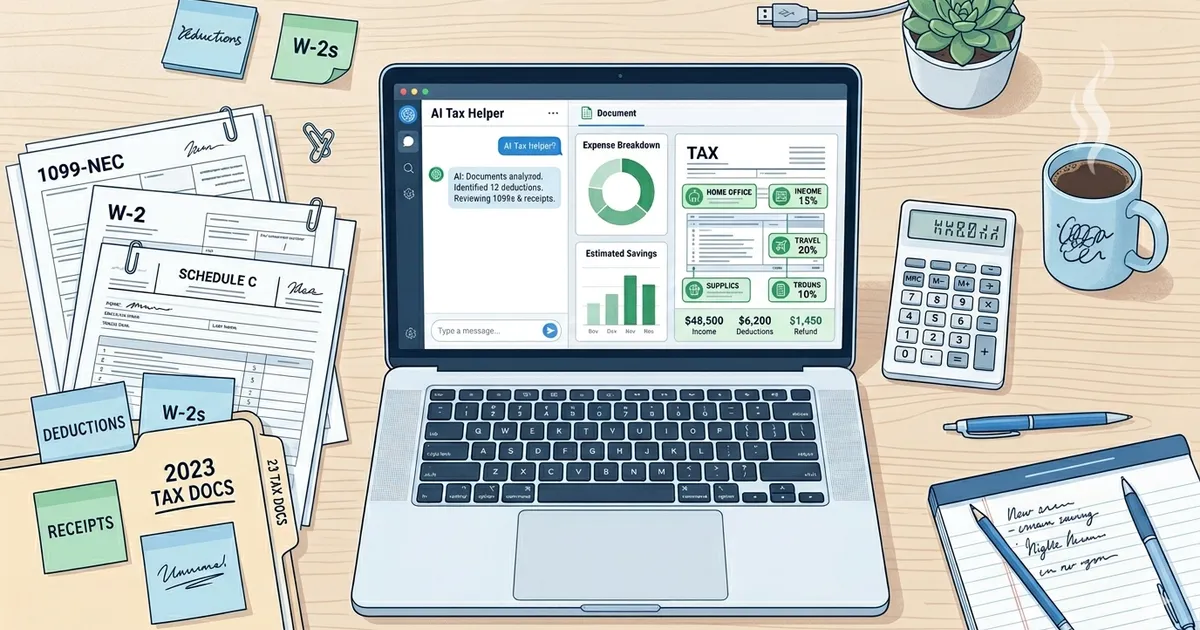
Laptop showing AI tax assistant chat with expense breakdown next to W-2, 1099, and receipt documents

Detailed Tool Reviews

1

TaxGPT

4.4

TaxGPT is an AI research assistant built specifically for tax professionals and trained on the tax code, IRS guidance, and case law. r/taxpros threads describe it as "quite effective" for first-pass research, with answers that cite the source code section so a preparer can verify before relying on it. It is built for accountants, not for someone filing a single 1040.

Key Features:

  • Answers cite specific Internal Revenue Code sections and IRS publications
  • Built for CPA and EA workflows, not consumer tax filing
  • Used for first-pass research on multi-state and entity-level questions
  • Drafting support for client memos and emails

Pricing:

Paid plans, roughly $2,000 to $2,500 per year for professional tiers

Pros:

  • + Source citations let preparers verify the answer instead of trusting it blindly
  • + Reddit users in r/taxpros call it effective for routine research questions
  • + Cuts time spent searching IRS publications for common scenarios

Cons:

  • - Annual pricing in the $2,000 to $2,500 range puts it out of reach for individual filers
  • - Still requires a licensed preparer to confirm anything before it goes on a return
  • - Less reliable on edge cases like multi-state or international filings, per r/tax discussions

Best For:

CPAs, EAs, and tax firms that want a faster first pass on research questions, with a human always checking the citation before using the answer.

Try TaxGPT
2

FlyFin

4.2

FlyFin is built for freelancers and self-employed filers. It connects to your bank and card accounts, scans transactions for write-offs in real time, and pairs the AI output with a human CPA for the final review and filing. It is the closest thing on this list to "AI does my taxes," because it is designed around the 1099 workflow specifically.

Key Features:

  • Automatic transaction scanning to flag potential write-offs as they happen
  • Quarterly estimated tax calculations for 1099 income
  • Human CPA review included before the return is filed
  • Built around Schedule C and self-employment tax, not corporate returns

Pricing:

Freemium, paid plans typically in the $15 to $20 per month range when billed annually

Pros:

  • + Combines AI deduction-finding with a human sign-off, which addresses the "who checks this" concern
  • + Designed for the freelancer use case Reddit asks about most in r/Entrepreneur and r/smallbusiness
  • + Ongoing deduction tracking through the year, not just at filing time

Cons:

  • - Not useful if your return involves rental property, multiple entities, or multi-state income
  • - Subscription cost adds up compared to filing once a year with a traditional preparer
  • - Accuracy still depends on transactions being categorized correctly, which needs occasional review

Best For:

Freelancers and self-employed filers with relatively simple 1099 income who want write-offs tracked automatically through the year, with a CPA still reviewing the final return.

Try FlyFin
3

Wondershare PDFelement

4.3

PDFelement is a PDF editor with built-in ChatGPT and Gemini integration, which a few r/smallbusiness and r/tax threads mention as a way to deal with the paperwork side of tax season before any AI tax tool gets involved. It can summarize a stack of scanned receipts, extract figures from 1099s and bank statements into editable text, and translate documents across 75 languages for filers with foreign income.

Key Features:

  • AI chat (ChatGPT and Gemini) summarizes and extracts data from scanned PDFs
  • OCR converts scanned receipts and statements into searchable, editable text
  • 75-language translation for foreign income documents
  • Form filling and e-signature for organizing 1099s and engagement letters

Pricing:

$79.99 per year

Pros:

  • + Cheaper than most AI tax subscriptions on this list at $79.99 per year
  • + Useful regardless of which tax tool or CPA you end up using
  • + OCR extraction reduces the manual data entry r/bookkeeping threads complain about most

Cons:

  • - Does not calculate taxes, find deductions, or file anything itself
  • - Value depends on how many paper documents you are actually dealing with
  • - AI chat features are an add-on to a PDF editor, not the core product

Best For:

Anyone heading into tax season with a folder of scanned receipts, 1099s, and bank statements who wants them organized and searchable before handing them off.

Try Wondershare PDFelement

The AI tax tools Reddit actually discusses

Reddit does not talk about one all-purpose "AI that does taxes." It talks about several narrow tools, each handling a different slice of the job, and a community that is specific about which slice each one covers.

ToolWhat it actually doesReddit sentimentPricing
TaxGPTAI tax research with cited code sections"Quite effective" for first-pass research, r/taxpros~$2,000 to $2,500 per year
BlueJ (Ask BlueJ)Tax research assistant, answers link to sourcesPreferred when accuracy matters, r/Accounting~$1,000 per year with NATP subscription
Black OreDocument classification for simple 1040sBest for straightforward individual returnsFirm pricing, not public
Taxfyle / TXF IntelligencePushes client data into tax softwareClaims 75% less manual data entryFirm pricing, not public
CPA PilotWorkflow and compliance assistantUsed by 1,000+ accountants for payroll and 1099 prepSubscription, firm pricing
FlyFinAI write-off tracking plus human CPA filingBuilt for the 1099/freelancer use case~$15 to $20 per month
KeeperAI bookkeeping and tax app for freelancersCategorizes expenses automatically~$20 per month

The split in that table matters more than any single tool. TaxGPT and BlueJ are research tools for people who already know tax law and want a faster way to check it. Black Ore and Taxfyle sit inside accounting firm workflows, automating the document intake and data entry that used to take a staff member hours. FlyFin and Keeper are the only two built directly for an individual filer, and both pair the AI with a human reviewer rather than letting the AI file alone.

BlueJ in particular comes up in r/Accounting threads when the conversation turns to accuracy, because its answers link back to the underlying source document.

"Excellent for verified tax information on a daily basis. I trust it because I can check the sources." — r/Accounting, u/TaxPrepPro (2025)

How to use AI for taxes without it going wrong

The approach Reddit recommends is to treat AI as a research and organization layer, never as the final word on what goes on a return. Three uses come up repeatedly across r/tax and r/smallbusiness threads.

  • Use AI to draft questions for your accountant, not to replace the conversation. Ask it to explain a concept in plain language, then bring the specific question to your CPA.
  • Use AI to organize and summarize documents before tax season, so your preparer spends less time on data entry and more time on the parts that actually need judgment.
  • Use AI bookkeeping tools to categorize transactions throughout the year, so nothing gets missed at filing time and your books are ready when your accountant needs them.

A prompt structure that comes up often in r/tax threads for the first use case looks like this:

"Explain [specific tax situation, e.g. home office deduction for a single-member LLC] in plain language, including what documentation the IRS typically asks for. I will confirm the details with my accountant before filing."

For the document organization use case, the workflow is simpler: scan or photograph every receipt, 1099, and statement as it arrives, then run them through an OCR or AI-PDF tool so they are text-searchable instead of sitting in a folder of images. By the time tax season starts, the documents are already sorted and summarized.

The community refinement that shows up again and again is to never paste a full tax document, including Social Security numbers or account numbers, into a general-purpose chatbot. Several r/tax threads recommend redacting identifying numbers before uploading anything, even to tools that claim not to train on your data.

"Use it to understand the rule, not to apply the rule to your specific numbers. The moment you put real figures in, you need a real preparer checking the output." — r/tax, u/EnrolledAgent22 (1,100 upvotes, 2025)

The risks: hallucinated tax law, confidentiality, and who is liable

The risk conversation on r/tax and r/ArtificialIntelligence breaks into three categories, and they are not equally serious.

Risk typeRisk levelWhat it looks likeWhat happens if it goes wrong
Hallucinated code sections or case lawHighAI cites a deduction or rule that does not exist or no longer appliesReturn gets filed with an incorrect position, IRS notice follows
Confidentiality of uploaded documentsMediumTax documents with SSNs and account numbers sent to a general chatbotData exposure risk, depends on the tool's data policy
Liability for an AI-assisted errorHighAI suggests a deduction, you take it, IRS disallows itTaxpayer is liable regardless of what tool was used

The hallucination problem is the most documented. General-purpose chatbots like ChatGPT and Gemini have been shown in multiple r/tax threads to confidently cite tax code sections that do not say what the AI claims, or that were changed in a prior year's update. This is exactly why BlueJ and TaxGPT differentiate themselves by linking every answer to a real source document, something general chatbots do not reliably do.

The liability question has a blunt answer in r/tax and r/taxpros: the taxpayer is always liable for what is on their return, no matter what software or AI tool produced the number. AI vendors disclaim liability in their terms of service, and a preparer who relies on an AI-generated position without checking it is still the one signing the return.

"Do NOT rely on ChatGPT for tax advice. It will sound completely confident while citing a section of the code that was repealed three years ago." — r/tax, u/CPAthrowaway2025 (1,900 upvotes, early 2025)

The practical rule that comes out of these threads: use AI to understand a topic, use a real preparer or current-year IRS publication to confirm the specific number, and never upload a document with unredacted SSNs or account numbers to a tool whose data policy you have not checked.

AI accounting software for small business: what is actually in use

Separate from individual tax filing, small businesses are using AI bookkeeping platforms to automate the categorization and bank-feed work that used to be a recurring monthly task for a bookkeeper.

ToolArchitecturePricingWhat it automates
DigitsAI-native general ledgerCustom, contact for pricingReal-time transaction categorization and anomaly detection
Puzzle.ioAI accounting platform for startupsFree tier for early-stage companiesModern general ledger, automated bookkeeping
ZeniAI bookkeeping plus CFO servicesPlans starting around $399 per monthBookkeeping, cash flow, and finance team functions combined
DextReceipt and invoice capture$25 to $60 per monthExtracts data from receipts and invoices into accounting software

The common thread across r/smallbusiness and r/bookkeeping threads is that these tools speed up categorization, extraction, and flagging of unusual transactions, but they do not remove the need for a human to review the books periodically. The debate in r/bookkeeping is less about whether the tools work and more about what it does to the bookkeeper's job: several threads describe the role shifting from manual data entry toward review and advisory work, rather than disappearing.

One stat that comes up often when comparing AI bookkeeping to a traditional bookkeeper: Taxfyle's TXF Intelligence claims roughly 75% less manual data entry for firms that adopt it. The AI is doing the repetitive extraction and categorization work. The human is doing the review, the judgment calls, and the client conversations.

"It is not replacing my bookkeeper, it is making her faster. We went from a week of catch-up at month end to maybe an hour of review." — r/smallbusiness, u/FounderOnABudget (2025)

For estate planning specifically, a related but smaller thread of discussion, AI tools are used the same way: as a research starting point for understanding concepts like trusts, step-up in basis, or gifting limits, with an estate attorney or CPA confirming anything before documents are drafted. No AI tool on this list, or elsewhere on Reddit, is described as drafting estate planning documents on its own.

Does AI replace your accountant? Reddit's verdict

Across r/tax, r/Accounting, r/taxpros, and r/smallbusiness, the same line shows up over and over: AI is a copilot, not a replacement. The threads that argue otherwise tend to come from people who have not yet had a return questioned by the IRS.

The pattern that repeats: people start using AI for a quick answer, find it genuinely useful for explaining concepts and organizing documents, and then hit a point where the answer needs to be verified against a primary source or a professional. For simple situations, a W-2 employee with no side income, no itemized deductions, standard filing, AI tools and tax software have handled this for years and AI just makes the explanations clearer. If your finances are otherwise simple, a broader AI financial planning tool can also help you track budgeting and savings goals alongside the tax side. For anything with self-employment income, multiple states, rental property, or business entities, the threads consistently say to bring in a CPA or EA.

Signs that your situation is simple enough for AI-plus-software to be enough:

  • Single W-2, no significant side income or freelance work
  • Standard deduction, no itemizing
  • One state, no business entity involved

Signs you need a human reviewing the AI's output, or a human handling it directly:

  • Self-employment income, multiple 1099s, or a business entity
  • Multi-state or international income
  • Any deduction or credit you are not 100% sure you qualify for

The test that shows up across multiple high-upvote threads is simple: if you would be comfortable explaining the position to an IRS auditor in your own words, AI helped you understand something you already had a handle on. If you are relying on the AI's confidence because you do not know the answer yourself, that is exactly the situation where a professional needs to check it first.

"The test I use: would I bet $500 that this answer is correct? If not, I am not filing on it without someone qualified looking at it first." — r/tax, u/QuietCPA (2025)

So can AI do your taxes. It can do the parts that are mechanical: extracting data, categorizing transactions, explaining rules, drafting questions. It cannot take responsibility for the return, and on Reddit, nobody is pretending otherwise.

Frequently Asked Questions

No. AI tools can research tax questions, extract data from documents, categorize transactions, and estimate quarterly payments, but no AI tool files a return and takes legal responsibility for it. FlyFin gets closest by pairing AI write-off tracking with a human CPA who reviews and files the return. r/tax and r/taxpros consistently describe AI as a research and prep layer, not a replacement for filing.

The bottom line on AI and your taxes

AI cannot do your taxes by itself, but it has a real role in the parts that used to eat the most time: researching rules, organizing documents, and categorizing transactions. TaxGPT and BlueJ speed up research for professionals who verify the citations. FlyFin pairs AI deduction tracking with a human CPA for freelancers. AI bookkeeping platforms like Digits and Puzzle.io automate the monthly grind for small businesses. None of them remove the taxpayer's liability for what ends up on the return, and Reddit's tax community is consistent on that point across every thread that matters.

Start with the paperwork. Get receipts, 1099s, and last year's return organized and text-searchable with Wondershare PDFelement before tax season gets busy, then use AI research tools to understand your situation and a licensed preparer to confirm it.

About the Author

Amara - AI Tools Expert

Amara

Amara is an AI tools expert who has tested over 1,800 AI tools since 2022. She specializes in helping businesses and individuals discover the right AI solutions for text generation, image creation, video production, and automation. Her reviews are based on hands-on testing and real-world use cases, ensuring honest and practical recommendations.

View full author bio

Related Guides