

Key Numbers
Key Takeaways
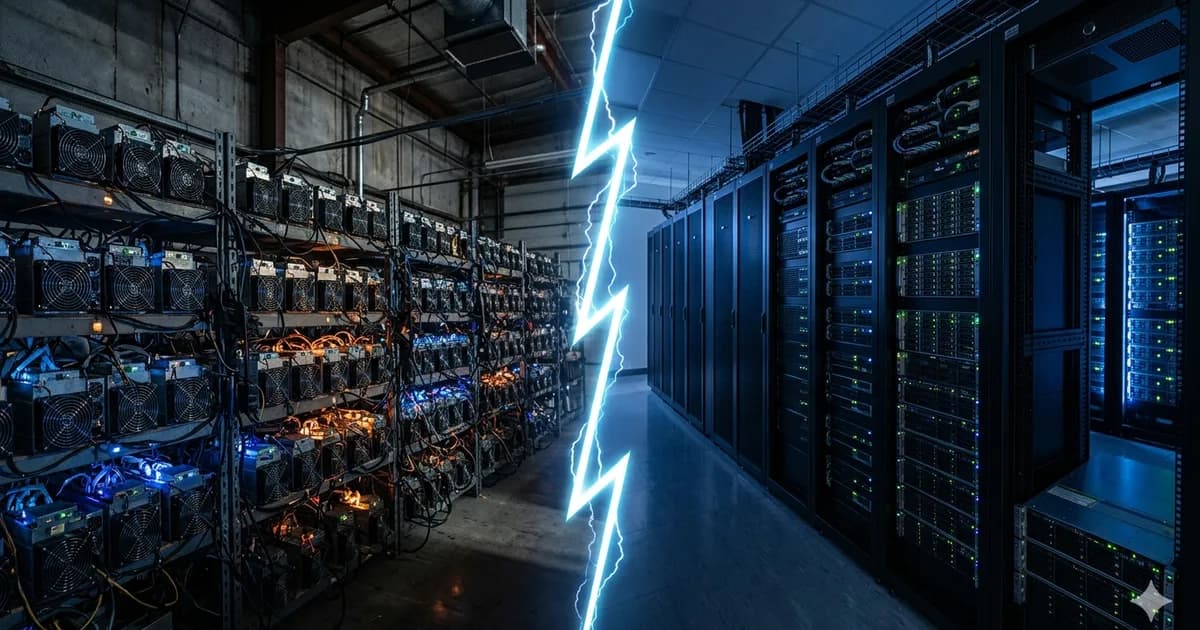
- 1As of 2026, Bitcoin mining still uses more electricity worldwide than AI data centers, about 150 TWh a year for Bitcoin against an estimated 100 to 300 TWh for AI, but AI's growth rate is far higher and the gap is closing.
- 2A single Bitcoin transaction burns roughly 700 kWh of electricity, the same as running a ChatGPT-style query about 244,000 times, because Bitcoin energy use barely depends on how many transactions actually happen.
- 3The IEA estimates combined AI and Bitcoin electricity demand could reach around 1,050 TWh in 2026, comparable to the annual electricity use of a large industrialized country, with AI driving almost all of the future growth.
Not yet, but it is close. Bitcoin mining still uses more electricity than AI data centers worldwide: an estimated 150 TWh a year for Bitcoin against 100 to 300 TWh for AI in 2026, depending on which estimate you use. AI's electricity use is growing far faster than Bitcoin's, and several analysts expect AI to overtake Bitcoin within the next year or two.
Here is the part most comparisons skip. A single Bitcoin transaction uses about 700 kWh of electricity, enough to run a ChatGPT-style query roughly 244,000 times, based on figures from the Cambridge Bitcoin Electricity Consumption Index and the per-query estimate Goldman Sachs Research gave Brookings in 2024. Bitcoin's energy use barely moves whether the network settles one transaction or one million. AI's energy use scales directly with how often people actually use it, which is exactly why its trajectory looks so different.
You'll come away with the TWh-by-TWh numbers for Bitcoin and AI side by side, the real energy cost of a Google search versus a ChatGPT query versus an AI-generated image, and why the IEA expects combined AI and Bitcoin demand to reach the scale of an entire country's electricity grid by 2026.
In This Article
- 1Does AI use more electricity than Bitcoin?
- 2How Bitcoin mining and AI data centers actually use power
- 3Who tracks these numbers, and what they say
- 4Per query vs. per transaction: the numbers most guides skip
- 5Why AI's energy curve looks nothing like Bitcoin's
- 6Common misconceptions about AI vs. Bitcoin energy use
- 7What happens next: will AI overtake Bitcoin?
Does AI use more electricity than Bitcoin?
Not yet, by most current estimates, but the margin is shrinking. Bitcoin mining draws a fairly steady 110 to 180 TWh a year, according to the live range published by the Cambridge Bitcoin Electricity Consumption Index, with a commonly cited mid-point around 150 TWh. Global AI data center workloads are harder to pin down because there is no single official "AI-only" tracker, but estimates from the Bitcoin Policy Institute and a 15% AI share of total data center demand calculated from the IEA's Energy and AI report put the figure somewhere between 100 and 300 TWh for 2026.
That is a wide range, and it exists because AI workloads are scattered across thousands of facilities run by dozens of companies, none of which publish a clean, audited TWh figure. Bitcoin's number is easier to track because mining hardware runs at near-constant load and hash rate is public.
| Category (2024-2026) | Electricity use | Roughly comparable to |
|---|---|---|
| Bitcoin network (global) | ~110-180 TWh/year | The Netherlands' total annual use |
| Global AI data center workloads | ~100-300 TWh/year, rising fast | Argentina's annual use (low end) |
| All global data centers (every workload) | ~415-540 TWh/year | More than 3x Bitcoin's footprint alone |
| IEA combined AI + Bitcoin forecast, 2026 | ~1,050 TWh | A large industrialized country's total grid |
So the honest answer in 2026 is that Bitcoin still uses more electricity than AI specifically, but AI sits inside a much larger and faster-growing category (all data centers) that already dwarfs Bitcoin several times over.
How Bitcoin mining and AI data centers actually use power
Bitcoin and AI consume electricity for almost opposite reasons. Bitcoin mining exists to secure a ledger. AI data centers exist to answer questions, generate images, and run recommendation engines for people who are actively using a product right now.
- Bitcoin mining runs thousands of specialized ASIC chips around the clock, competing to solve a cryptographic puzzle. The electricity is spent on raw computational guesswork, not on processing the transaction itself.
- Bitcoin's energy draw tracks hash rate and coin price, not transaction volume. More miners join when the price rises, regardless of how many people are actually sending Bitcoin that day.
- AI training runs thousands of GPUs for weeks at a stretch to build a model once. This is a large but one-time cost per model version.
- AI inference, the process of answering a user's prompt, happens billions of times a day and scales directly with product usage. Most cumulative AI electricity use over a model's lifetime comes from inference, not training.
- Both industries cluster near cheap power. Bitcoin miners chase stranded hydro and flared gas; AI data centers chase existing grid capacity near fiber routes and cheap industrial electricity rates.
The mechanism difference matters for forecasting. Bitcoin's electricity use can fall sharply if the price drops and miners switch off, something that has happened multiple times since 2021. AI's electricity use has no equivalent off-switch: usage keeps climbing as more people and more products adopt it, and training versus inference workloads scale very differently as deployment grows.
Who tracks these numbers, and what they say
Five organizations supply almost every figure quoted in AI-versus-Bitcoin energy debates, and they do not always agree with each other.
| Organization | What they track | Key 2024-2026 figure |
|---|---|---|
| Cambridge Bitcoin Electricity Consumption Index | Live Bitcoin network electricity use | ~110-180 TWh/year |
| International Energy Agency (IEA) | Global data center and AI electricity demand | 415 TWh global data centers in 2024, ~945 TWh projected by 2030 |
| Goldman Sachs Research | AI-driven data center power growth | Power demand from data centers up 50% by 2027, up to 165% by 2030 vs. 2023 |
| Bitcoin Policy Institute | US-focused AI vs. Bitcoin electricity comparison | AI at ~169 TWh in 2024, projected ~240 TWh by 2027 |
| Deloitte | Generative AI's share of data center growth | ~536 TWh in 2025, rising to ~1,065 TWh by 2030 |
Cambridge is explicit that its own methodology has limits. Its FAQ addresses one of the most misused statistics in this entire debate, the "energy per Bitcoin transaction" figure:
"Electricity consumption per transaction is not a meaningful indicator, as the Bitcoin network would likely use the same electricity even if transaction volume declined by 90%." (Cambridge Bitcoin Electricity Consumption Index, FAQ)
That caveat matters because most viral AI-vs-Bitcoin comparisons divide Bitcoin's total network electricity by transaction count to get a shock figure, then compare it to a single AI query as if the two numbers measure the same thing. They do not. Bitcoin's energy is a near-fixed network cost. AI's is a marginal, per-use cost.
Per query vs. per transaction: the numbers most guides skip
Comparing AI and Bitcoin at the per-unit level produces wildly different numbers depending on what unit you pick, and almost nobody lines them up side by side.
| Activity | Approximate energy used | Source |
|---|---|---|
| Google search | ~0.3 Wh | Brookings, 2024 |
| ChatGPT-style AI query | ~2.9 Wh, about 10x a Google search | Goldman Sachs, via Brookings, 2024 |
| AI image generation | ~10-15 Wh, roughly a full smartphone charge | Goldman Sachs, via Socomec, 2025 |
| One Bitcoin on-chain transaction | ~700 kWh | Cambridge CBECI-based estimates |
The gap on that last row is not a typo. A Bitcoin transaction uses hundreds of thousands of times more electricity than a single AI query, because Bitcoin's energy cost is tied to securing the entire network for a ten-minute block, not to the marginal work of moving one payment.
"In 2024, a single query on an advanced generative AI model like ChatGPT required an estimated 2.9 watt-hours of electricity, nearly 10 times the 0.3 watt-hours needed for a conventional Google search." (Brookings Institution, 2024)
The number most guides don't show
Divide it out and the comparison gets concrete. A single Bitcoin transaction, at roughly 700,000 Wh, uses about the same electricity as 244,000 ChatGPT-style queries (700,000 ÷ 2.9 ≈ 244,000). Picture a heavy AI user firing off 50 prompts a day, every single day. It would take that person about 13 years of daily use to burn through the electricity spent on one Bitcoin transaction.
That asymmetry is exactly why per-unit comparisons between the two systems mislead people more often than they inform them. The right comparison is network-wide TWh against network-wide TWh, which is what the table in the first section above shows.
Why AI's energy curve looks nothing like Bitcoin's
AI electricity demand is climbing because adoption keeps climbing, not because any single technical bottleneck forces it higher. Every additional product that bolts on a chatbot, an image generator, or a recommendation model adds inference load that did not exist the year before.
Deloitte frames the comparison this way:
"On average, a gen AI-based prompt request consumes 10 to 100 times more electricity than a typical internet search query." (Deloitte, 2025)
That per-query premium, multiplied across hundreds of millions of daily AI queries, explains most of the growth curve. How much energy does AI use already covers the per-query and per-training-run breakdown in more depth, but the short version is that inference, not training, accounts for most of AI's cumulative electricity bill once a model ships.
Bitcoin's curve behaves differently because its energy use is gated by price and difficulty, not by how many people want to use it. When the Bitcoin price falls, miners go offline and total network electricity drops within weeks. AI products have shown no comparable pullback: usage has only gone up since ChatGPT launched in late 2022, and every major lab keeps shipping more capable, more compute-hungry models in response to demand.
Common misconceptions about AI vs. Bitcoin energy use
A few claims circulate constantly in this debate, and most of them oversimplify the underlying data.
- "AI already uses more electricity than Bitcoin." Not according to most current estimates. AI data centers remain below Bitcoin's roughly 150 TWh a year in most 2025-2026 analyses, though the gap is narrowing.
- "Bitcoin's energy use is driven by how many transactions people send." It is not. Cambridge's own documentation states that transaction volume could fall 90% with little change to total network electricity, because mining difficulty and hash rate, not throughput, set the energy cost.
- "AI query energy is a fixed, known number." It is not. Energy per query varies by model size, prompt length, and hardware generation. The 2.9 Wh figure from Goldman Sachs is a 2024 estimate for an advanced model, not a universal constant.
- "Calling one of these 'wasteful' and the other 'useful' is a fact, not an opinion." Whether Bitcoin mining or AI inference delivers more value per kilowatt-hour is a values judgment about what each technology is for, not something the energy data itself settles.
Is AI worse for the environment than Bitcoin, then? Neither comparison holds up well as a single yes-or-no answer. Is AI bad for the environment covers the broader carbon and water picture, where the answer also depends heavily on which electricity grid powers the data center in question.
What happens next: will AI overtake Bitcoin?
Most named forecasts point toward AI closing the gap with Bitcoin within the next one to two years, then pulling well ahead by 2030.
The IEA's base case has total global data center electricity nearly doubling from 415 TWh in 2024 to about 945 TWh in 2030, with AI workloads as the primary driver of that growth. Goldman Sachs Research projects data center power demand rising 50% by 2027 and up to 165% by 2030 versus 2023 levels, almost entirely attributable to AI. Deloitte's separate model lands in a similar place: roughly 536 TWh in 2025 climbing to 1,065 TWh by 2030.
Bitcoin's trajectory looks flat by comparison. Its electricity use rises and falls with price and mining difficulty, and even bullish crypto cycles have not pushed the network meaningfully past the 150 to 200 TWh band it has occupied since 2021.
So will AI overtake Bitcoin? On current trend lines, most likely yes, and probably within the next year or two rather than the next decade. By the end of this decade, the more useful question won't be whether AI passes Bitcoin. It will be how AI's growing electricity demand compares to entire national grids, since that is the scale the IEA, Goldman Sachs, and Deloitte are all now using to describe it.
Frequently Asked Questions
Does AI use more electricity than Bitcoin?
Not yet, as of 2026, but the gap is closing fast. Bitcoin mining uses an estimated 150 TWh a year, while global AI data center workloads use somewhere between 100 and 300 TWh, depending on the source. AI's electricity use is growing far faster than Bitcoin's, and several analyst projections expect AI to pass Bitcoin's footprint within the next year or two.
How many TWh does Bitcoin mining use per year?
The Cambridge Bitcoin Electricity Consumption Index puts Bitcoin's annualized network electricity use at roughly 110 to 180 TWh, with a commonly cited mid-point around 150 TWh. That figure has stayed in the 100 to 200 TWh range since 2021, rising and falling with Bitcoin's price and mining difficulty rather than transaction volume.
How much electricity does AI use per year?
Global AI data center electricity use is estimated at 100 to 300 TWh for 2026, based on Bitcoin Policy Institute projections and a 15% AI share of the IEA's 415 TWh global data center total for 2024. There is no single official 'AI-only' tracker, so estimates vary depending on methodology.
How much energy does a ChatGPT query use compared to a Google search?
A ChatGPT-style query uses about 2.9 watt-hours of electricity, roughly 10 times the 0.3 watt-hours a conventional Google search uses, according to a Goldman Sachs Research estimate cited by the Brookings Institution in 2024. An AI-generated image uses considerably more, around 10 to 15 watt-hours, close to a full smartphone charge.
How much electricity does one Bitcoin transaction use?
Roughly 700 kWh, based on Cambridge CBECI network data divided across on-chain transaction counts. That is enough to run a ChatGPT-style query about 244,000 times. Cambridge itself cautions that this per-transaction figure is not a meaningful efficiency metric, since Bitcoin's total electricity use would barely change even if transaction volume fell 90%.
Will AI's electricity use overtake Bitcoin's?
Most current forecasts suggest yes, within the next one to two years. The IEA, Goldman Sachs Research, and Deloitte all project AI-driven data center electricity demand climbing sharply through 2030, while Bitcoin's electricity use has stayed comparatively flat in the 100 to 200 TWh range since 2021, tied to price and mining difficulty rather than steady growth.
Is AI worse for the environment than Bitcoin?
There is no single answer. Bitcoin's environmental footprint comes almost entirely from electricity used for mining, while AI's footprint includes electricity, water for cooling, and the carbon intensity of whichever specific grid powers a given data center. Comparing the two fairly requires looking at total network-wide impact rather than a single per-unit number.
Why can't Bitcoin and AI energy use be compared per transaction or per query?
Because the two systems spend electricity for different reasons. Bitcoin's energy cost secures the entire network for a fixed block time and barely changes with transaction count. AI's energy cost scales directly with usage: more queries means more electricity, roughly in proportion. Dividing Bitcoin's total network use by transaction count produces a number Cambridge itself says is not meaningful.
Related Articles
How Much Energy Does AI Use? The Real Numbers for 2026
11 min read
How Much Water Does AI Use? The Real Numbers for 2026
9 min read
Is AI Bad for the Environment? The Real Numbers
10 min read
AI Training vs Inference: What's the Difference and Why the Cost Gap Is Growing
10 min read