
How Much Water Does AI Use? The Real Numbers for 2026

Key Numbers
Key Takeaways
- 1AI data centers use water two ways: directly in cooling towers (evaporation) and indirectly through power plant cooling. Google used 6.4 billion gallons for data centers in 2023. Microsoft used 1.7 billion gallons, up 34% from 2022.
- 2Training GPT-4 consumed 13.4 million gallons in one month at Microsoft's Iowa data centers in August 2022, equivalent to the monthly water use of 130,000 Americans for a single training run.
- 3Cooling technology choice is the dominant variable. Google's air-cooled Texas site used 10,000 gallons in all of 2024. Its water-cooled Iowa site used 1 billion gallons. Same AI workloads, 100,000x difference in water consumption.
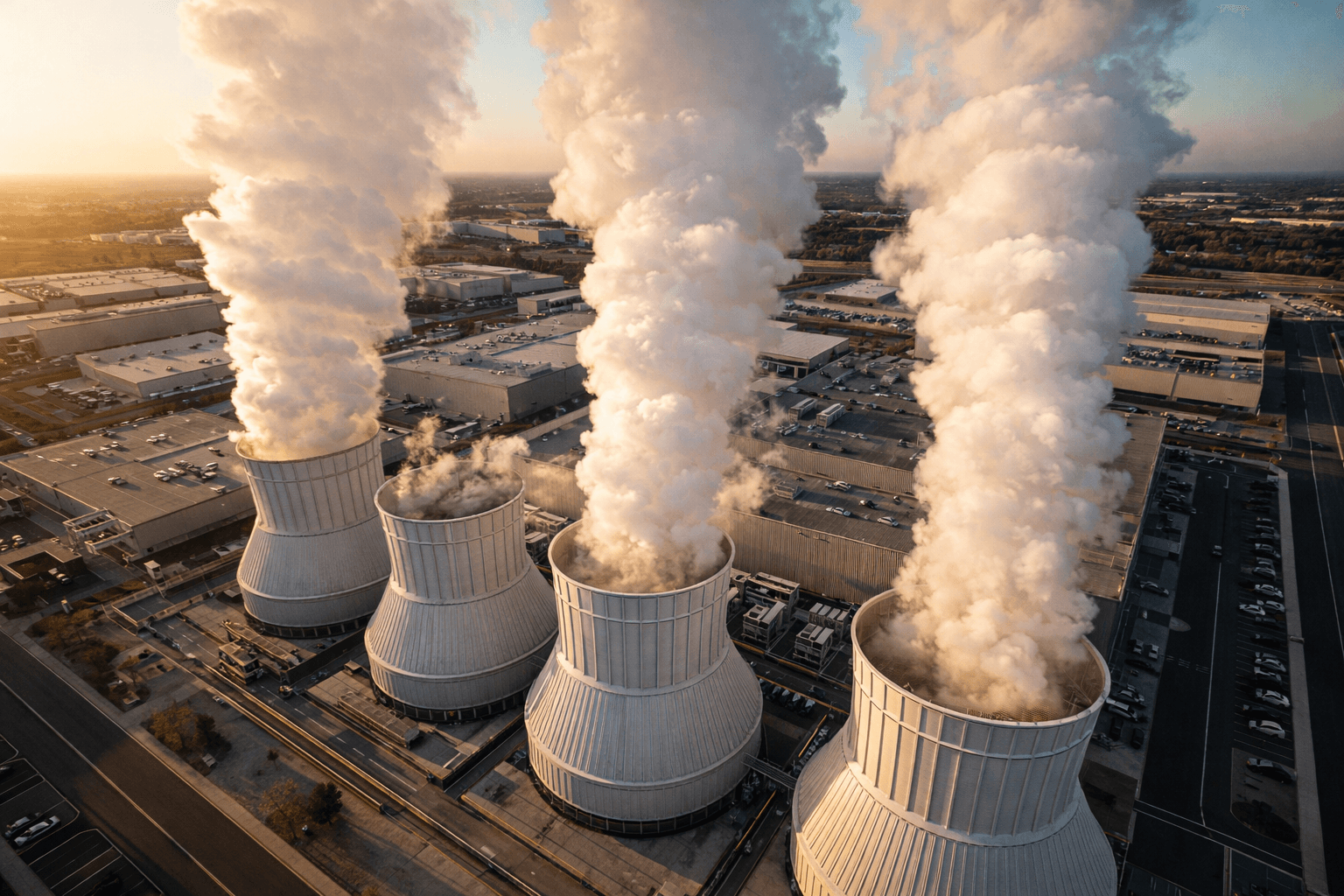
AI data centers use water in two distinct ways, and most people only know about one of them. The direct use is visible: cooling towers evaporate freshwater to remove the heat generated by GPU racks running model training and inference. The indirect use is larger and invisible: power plants burn fuel or use steam to generate the electricity those data centers consume, and power generation is the largest single user of freshwater in the United States.
The direct numbers are already large. Google consumed 6.4 billion gallons across its global data centers in 2023, about 95% of that attributable to data center cooling. Microsoft used 1.7 billion gallons in 2023, up 34% from 2022. Training GPT-4 at Microsoft's Iowa facilities consumed 11.5 million gallons in July 2022 and 13.4 million gallons in August 2022. That is roughly the monthly water use of 130,000 Americans for a single training run.
This article explains exactly where AI's water goes, what the leading companies actually use, why location determines impact far more than workload, and what the numbers look like if current growth rates continue through 2027.
In This Article
- 1Direct vs. Indirect: Where AI's Water Actually Goes
- 2How Much Water Google, Microsoft, Meta, and Amazon Actually Use
- 3What a Single AI Training Run Actually Costs in Water
- 4Why Cooling Technology Choice Determines Everything
- 5Where AI's Water Problem Is Already a Crisis
- 6What Actually Reduces AI Water Consumption
- 7The AI Water Outlook Through 2028
Direct vs. Indirect: Where AI's Water Actually Goes
AI data centers consume water through two separate mechanisms. Understanding which is which matters, because they have different solutions and different scales.
Direct water use is the water that evaporates inside the data center property itself, primarily in cooling towers. When GPU racks generate heat, chilled water absorbs that heat and is then pumped to cooling towers on the roof or grounds, where some of it evaporates into the air. This evaporated water is lost, not recycled. A large AI training campus running at 100 megawatts might evaporate 2 million liters per day in this process.
Indirect water use comes from the power plants generating the electricity those data centers consume. Coal, natural gas, and nuclear plants all use water for steam generation and cooling. According to Lawrence Berkeley National Laboratory's 2024 US Data Center Energy Usage Report, US data centers consumed 66 billion liters directly in 2023, but the indirect water footprint from electricity generation reached 800 billion liters, more than ten times larger.
| Water Type | Source | Scale (US, 2023) | Visibility |
|---|---|---|---|
| Direct | Cooling tower evaporation | 66 billion liters | On-site, measurable |
| Indirect | Power plant cooling for electricity | 800 billion liters | Off-site, rarely reported |
| Total footprint | Both combined | ~866 billion liters | Mostly unreported |
The distinction matters for policy. A data center that switches to air cooling (no evaporation on-site) reduces direct water use to near zero but does nothing about the indirect footprint from its power supply. A data center powered by renewable electricity with no cooling water requirement is the only configuration that reduces both.
How Much Water Google, Microsoft, Meta, and Amazon Actually Use
The four largest AI infrastructure operators disclose water consumption in their annual sustainability reports. The figures are specific and striking.
| Company | 2023 Total Water Use | YoY Change | Notes |
|---|---|---|---|
| 6.4 billion gallons | +20% from 2022 | Council Bluffs, Iowa alone: 1 billion gallons | |
| Microsoft | 1.7 billion gallons | +34% from 2022 | Des Moines, IA (5 facilities): 68.5 million gallons |
| Meta | 813 million gallons | Not disclosed | 95% attributable to data centers |
| Amazon (AWS) | Not disclosed | Not disclosed | Recycling preserved 530 million gallons/year |
Google's thirstiest single site, its Council Bluffs, Iowa data center, consumed 1 billion gallons in 2024 and peaked at 2.7 million gallons per day during summer 2024, equivalent to the daily water use of a city of 25,000 people. Microsoft's five Des Moines, Iowa facilities collectively used 68.5 million gallons, making the company the largest single water user in that utility district.
Amazon does not report aggregate water consumption. What is known: the company's water recycling programs preserved 530 million gallons per year across its fleet, and proposed new facilities in Aragon, Spain were estimated at approximately 755,720 cubic meters per year, roughly 200 million gallons annually from a single country's operations.
"Microsoft's data center water use increased 34% from 2022 to 2023, reaching 1.7 billion gallons, as AI infrastructure expansion accelerated." (Microsoft Environmental Sustainability Report, 2023)
The trend across all four companies is upward. Microsoft's 34% annual growth rate, if sustained, would place its consumption above 6 billion gallons by 2027. Even at a more conservative 15% annual growth rate, it would reach 2.7 billion gallons by 2026.
More AI infrastructure stories like this
We cover the real environmental and hardware side of AI, not just new model launches. Twice a week.
What a Single AI Training Run Actually Costs in Water
The most concrete data on per-training-run water consumption comes from Microsoft's Iowa facilities during the GPT-4 training period. The facility consumed 11.5 million gallons in July 2022 and 13.4 million gallons in August 2022, the two months when the training run was at peak intensity.
Put another way: training one frontier AI model consumed more freshwater in a single month than 130,000 Americans use in the same period. The average American uses approximately 100 gallons of water per day, so 13.4 million gallons per month is equivalent to the monthly water use of a mid-sized town.
GPT-3, an earlier and smaller model, required an estimated 700,000 liters (185,000 gallons) of freshwater for its training run, roughly 70 times less than GPT-4. The scaling trend is not linear. As models grow, their training compute requirements grow faster than their parameter count, and water use tracks compute hours.
For inference, figures are harder to isolate because inference workloads run continuously and intermix with other data center operations. The most-cited estimate, from a 2023 study, placed consumption at roughly 500 milliliters per 20 to 50 ChatGPT queries, a figure that has circulated widely but whose methodology is contested. What is not contested: as inference scales to billions of daily queries, the aggregate water use from serving deployed models will eventually exceed the one-time cost of training them.
For context on how much compute training runs actually require, see our breakdown of what AI data centers are and how they work.
Why Cooling Technology Choice Determines Everything
The single largest variable in a data center's water consumption is not its workload, it is the cooling system it uses. Two Google facilities illustrate this more clearly than any chart.
Google's Council Bluffs, Iowa data center: 1 billion gallons in 2024. Water-cooled, evaporative towers, located in a region where summer humidity makes air cooling less effective.
Google's Pflugerville, Texas data center: approximately 10,000 gallons in all of 2024. Air-cooled, no evaporative towers, located in a region where dry ambient air allows heat rejection without water evaporation.
Same company. Same AI workloads. A 100,000-fold difference in water consumption.
The Number Most Guides Don't Show
That 100,000x gap between Google's Iowa and Texas sites represents the maximum theoretical impact of cooling technology choice. At $10.7 million per MW construction cost, an operator choosing air cooling over evaporative cooling might spend 15 to 20% more on mechanical systems upfront, but save 990,000 gallons per million gallons that would have evaporated. For a 100 MW facility running continuously, that is roughly 730 million gallons per year preserved, equivalent to the annual water supply for about 7,300 US households.
Microsoft is piloting chip-level direct liquid cooling systems that use water only once during initial fill, then operate in a closed loop. According to Microsoft's sustainability reporting, this approach saves approximately 125 million liters (33 million gallons) per data center annually compared to conventional evaporative cooling. Deployed across Microsoft's 300+ locations, the technology could preserve nearly 10 billion gallons per year.
| Cooling Type | Direct Water Use | Trade-off | Best Climate |
|---|---|---|---|
| Evaporative cooling towers | High (millions gal/month) | Low energy cost | Humid, moderate climates |
| Air cooling (CRAC/CRAH) | Near-zero | Higher energy use | Dry, cool climates |
| Closed-loop liquid cooling | Near-zero after fill | High upfront cost | Any climate |
| Dry coolers | Near-zero | Highest energy use | Any climate |
Where AI's Water Problem Is Already a Crisis
The aggregate national figures obscure what is happening at the local level. US data centers used 449 million gallons per day in 2021, equivalent to 163.7 billion gallons annually. That is a small fraction of total US water use. But data centers do not distribute across the country proportionally to water availability. They concentrate in specific markets, and those markets are often water-stressed.
Arizona is the clearest example. In June 2023, Arizona revoked new residential building permits in Maricopa County due to groundwater exhaustion, the same county where Google has a permitted data center approved to draw 1.45 billion gallons per year (approximately 5.5 million cubic meters), and where Microsoft operates additional facilities. The state had to choose between homes and servers. The permits for data centers, already issued, were not revoked.
Iowa's situation is different but similarly concentrated. Google and Microsoft together are the dominant water users in the Des Moines and Council Bluffs utility districts, drawing more during summer peak AI training periods than the local population.
Three regions face acute AI water stress as of 2026:
- Arizona and Nevada: extreme groundwater depletion, active permit restrictions for new residential construction, yet data center approvals continue in some counties
- Northern Virginia: the world's largest data center market, where Loudoun County has imposed zoning restrictions on new builds partly due to utility capacity concerns
- Spain (Aragon): Amazon submitted a 48% water increase application in December 2023 for its existing Aragon facilities, amid summer heat waves that elevated local water competition
According to Microsoft's 2023 sustainability report, 42% of its data center water is drawn from regions classified as water-stressed. The company has committed to being "water positive" by 2030, replenishing more water than it consumes, but has not disclosed a methodology for how it will achieve this while also expanding its facility count at 34% per year.
What Actually Reduces AI Water Consumption
Three interventions meaningfully reduce water use. Two require engineering decisions made before a facility is built. One can be applied to existing facilities.
Location selection is the highest-leverage decision. Building in cool, dry climates enables air cooling without significant energy penalty. Google's Texas site uses 10,000 gallons per year; its Iowa site uses 1 billion. No retrofit can close that gap.
Cooling system design is the second lever. Closed-loop liquid cooling systems, direct-to-chip cooling, and dry coolers eliminate evaporative loss almost entirely. Microsoft's chip-level cooling pilot saves 33 million gallons per facility annually. These systems cost more to build and may increase electricity consumption by 10 to 15%, which increases indirect water use from power generation, the trade-off requires location-specific analysis.
Treated wastewater reuse is the third option, applicable to existing sites. Amazon, Meta, and Apple have shifted portions of their cooling systems to use reclaimed municipal wastewater rather than potable freshwater. Amazon reports that its recycling programs preserved 530 million gallons of potable water in 2023 alone by substituting treated wastewater for direct freshwater draws.
What does not reduce water use: renewable energy certificates (RECs) and carbon offsets address emissions but have no effect on direct water consumption. A data center powered by solar panels can still evaporate millions of gallons per month if it uses evaporative cooling.
For the broader energy picture of AI data centers, see our article on the AI data center energy grid challenge.
The AI Water Outlook Through 2028
The trajectory is determined by two competing forces: growth in AI compute demand (which increases water use) and adoption of low-water cooling technology (which reduces it). Both are accelerating, but compute growth is currently outpacing technology adoption.
US data center direct water consumption was 66 billion liters in 2023. According to projections from Lawrence Berkeley National Laboratory, this figure could double or quadruple by 2028, driven by AI workloads. Microsoft's 34% annual growth rate, if sustained through 2027, would place its consumption alone above 6 billion gallons, comparable to Google's entire fleet today.
The regulatory response is beginning but inconsistent. Arizona has restricted residential permits near data centers. Several Virginia and Texas counties have imposed zoning constraints. The EU's European Green Deal includes water efficiency reporting requirements for large data centers. None of these actions have materially slowed build activity.
What will change the trajectory is one of three things. First, water-stressed markets run out of permitted capacity and operators move to water-rich regions or adopt air cooling. This is already happening in Arizona and parts of Northern Virginia. Second, chip-level liquid cooling becomes standard in new AI facilities, reducing direct consumption to near zero. Microsoft and several co-location operators are piloting this now. Third, regulatory bodies in high-growth markets impose per-facility consumption caps, which would force technology adoption faster than market incentives alone.
The companies making the technology choice now, between evaporative cooling and closed-loop or dry systems, are locking in their water footprint for the next decade. Given that AI compute demand will roughly triple from 2024 to 2028 according to Goldman Sachs Research (2024), the facilities being designed today will determine whether AI's water impact grows proportionally with its compute, or whether the two decouple.
Frequently Asked Questions
How much water does AI use?
AI data centers consumed large quantities of water in 2023: Google used 6.4 billion gallons globally, Microsoft used 1.7 billion gallons (up 34% from 2022), and Meta used 813 million gallons. These figures cover direct water use for cooling only; the indirect water footprint from electricity generation is estimated at roughly ten times larger. Training a single frontier AI model such as GPT-4 consumed 11.5 to 13.4 million gallons per month at Microsoft's Iowa facilities in 2022.
Why do AI data centers use so much water?
AI data centers use water primarily to cool the GPU and TPU hardware running model training and inference. AI chips generate far more heat than standard servers: a rack of NVIDIA H100 GPUs draws 10 to 30 kilowatts, versus 3 to 5 kW for a standard server rack. That heat is typically removed by pumping chilled water through the facility; the water absorbs the heat and then some of it evaporates in cooling towers on the roof, requiring continuous freshwater replacement. Additionally, the power plants generating the electricity those data centers consume use water for steam generation and cooling, creating a larger indirect water footprint.
How much water does ChatGPT use?
There is no official disclosure from OpenAI or Microsoft on per-query water consumption. The most widely cited estimate places consumption at approximately 500 milliliters per 20 to 50 ChatGPT queries, derived from data center water intensity figures. What is documented is that training GPT-4 at Microsoft's Iowa data centers consumed 13.4 million gallons in a single month in 2022. Inference (serving ChatGPT to users) is a continuous ongoing workload that adds to this figure daily, though the per-query water cost is far lower than the one-time training cost.
Which tech company uses the most water for AI?
Among companies that disclose water consumption, Google is the largest user, with 6.4 billion gallons across its global data center fleet in 2023. Google's single largest site, in Council Bluffs, Iowa, used 1 billion gallons in 2024 and peaked at 2.7 million gallons per day in summer 2024. Microsoft disclosed 1.7 billion gallons in 2023, up 34% year over year. Meta disclosed 813 million gallons. Amazon does not report aggregate water consumption but acknowledges significant usage through its recycling disclosures.
Can AI data centers reduce their water use?
Yes, through three primary mechanisms. Location selection in cool, dry climates enables air cooling with near-zero water evaporation, Google's air-cooled Texas facility used only 10,000 gallons in all of 2024, versus 1 billion gallons at its water-cooled Iowa site. Closed-loop liquid cooling systems eliminate evaporative loss after initial fill; Microsoft's pilot of chip-level liquid cooling saves approximately 33 million gallons per facility annually. Treated wastewater substitution replaces potable freshwater with reclaimed municipal water for cooling, Amazon's recycling programs preserved 530 million gallons of potable water in 2023.
Is AI water use a problem for local communities?
In several markets, yes. In June 2023, Arizona revoked new residential building permits in Maricopa County due to groundwater exhaustion, the same county where Google holds a data center permit to draw up to 1.45 billion gallons per year. In Iowa, Google and Microsoft are the dominant water users in local utility districts, drawing more water during summer AI training periods than surrounding communities. In Aragon, Spain, Amazon submitted a 48% water increase application for its facilities in December 2023. Microsoft reports that 42% of its data center water is drawn from water-stressed regions.
Related Articles
Want hands-on setup guides?
These step-by-step guides relate to topics covered in this article.