
What Are AI Data Centers? The Full 2026 Breakdown

Key Numbers
Key Takeaways
- 1An AI data center is purpose-built for GPU and TPU clusters, high-bandwidth networking, and liquid cooling to handle AI training and inference. AI workloads require 10x more compute power than traditional applications (Goldman Sachs, 2024).
- 2Building an AI-optimized data center costs $20 million or more per megawatt in 2025. A 50 MW facility exceeds $1 billion in construction cost before any GPU hardware is installed.
- 3Every ChatGPT query, Claude response, and Gemini inference runs on GPU hardware inside an AI data center. Nearly 3,000 facilities are planned globally by 2030 at a combined investment of $7 trillion.
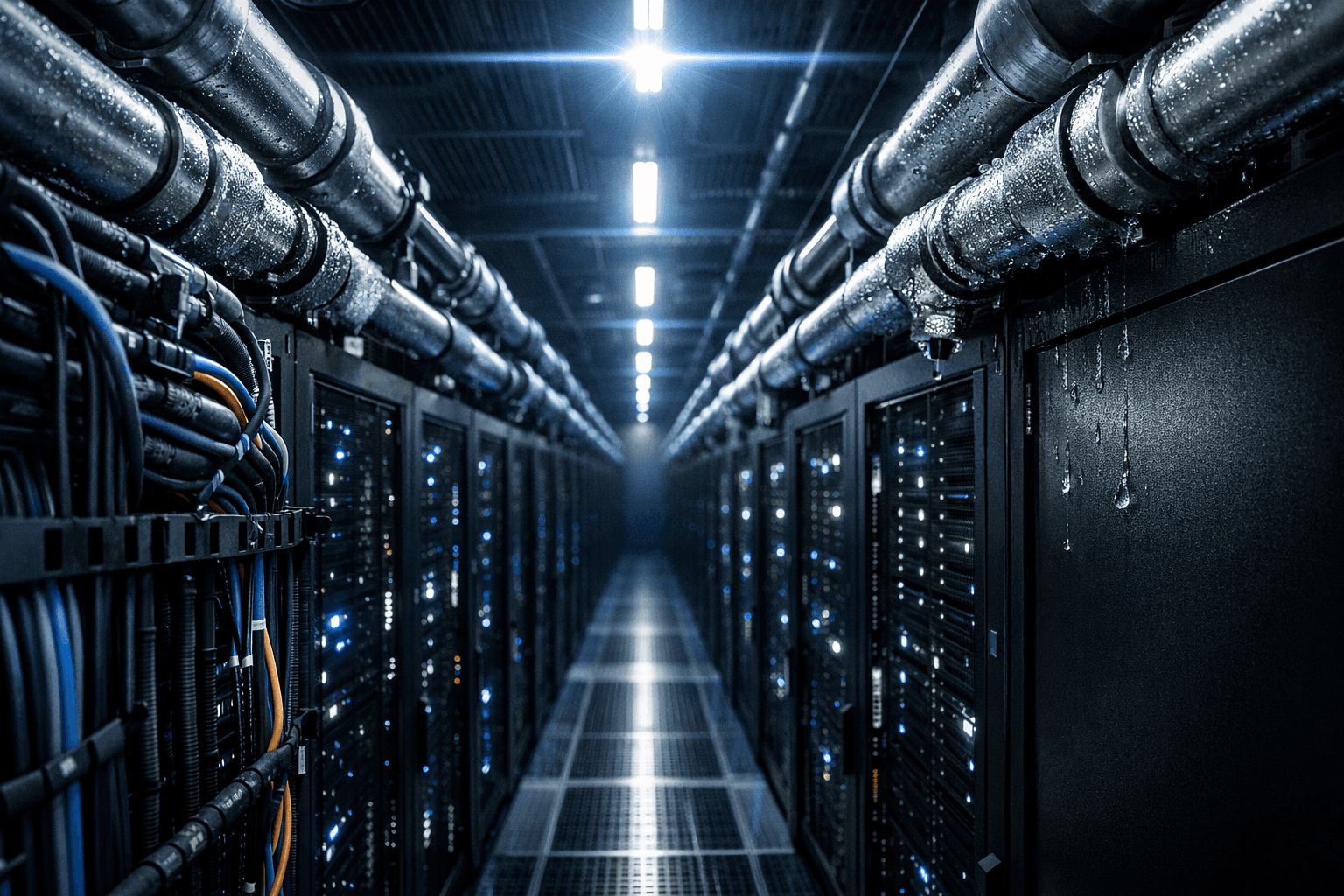
An AI data center is a facility purpose-built to run artificial intelligence workloads: training large language models, processing inference requests, and storing the datasets those models learn from. It is not a general-purpose data center with more servers. The architecture is fundamentally different, built around dense clusters of GPUs or TPUs, ultra-high-bandwidth networking, and cooling systems designed for heat output that standard facilities cannot handle.
The scale of what is being built right now is unlike anything in the history of computing. According to Goldman Sachs Research (2024), AI workloads require 10 times more computational power than traditional applications. That gap is why nearly 3,000 data centers are planned for completion globally by 2030, representing $7 trillion in total investment (IRMI, 2026).
This article explains what makes an AI data center different from a standard one, what the key components are, which companies are building them, what they cost, how they power the AI tools you use every day, and why the energy grid is struggling to keep up.
In This Article
What Is an AI Data Center?
An AI data center is a facility optimized for the specific demands of machine learning training and inference. The distinction from a traditional data center is not just size. It is architecture. A traditional data center stores and retrieves data, runs business applications, and handles web traffic. An AI data center trains models on billions of parameters and then serves predictions at millisecond speed to millions of users simultaneously.
The difference in hardware requirements is stark. A standard server rack draws 3 to 5 kilowatts of power. A rack of NVIDIA H100 GPUs draws 10 to 30 kilowatts. The cooling systems, power feeds, and floor loading that work for a standard rack fail completely for an AI rack. This is why you cannot simply upgrade a traditional data center to handle AI workloads. The building itself needs to be redesigned.
Three properties define an AI data center and separate it from conventional facilities:
- GPU or TPU density: racks are built around AI accelerators, not general-purpose CPUs
- High-bandwidth interconnects: servers communicate at terabit speeds using InfiniBand or custom fabrics, because model training splits work across thousands of GPUs simultaneously
- Advanced cooling: liquid cooling, direct-to-chip cooling, or immersion systems replace standard air handlers, because AI chips generate heat that air alone cannot remove
| Feature | Traditional Data Center | AI Data Center |
|---|---|---|
| Primary workload | Web apps, databases, storage | LLM training, inference, ML pipelines |
| Rack power density | 3-5 kW per rack | 10-30 kW per rack (100+ kW for future racks) |
| Cooling method | Air cooling (CRAC/CRAH units) | Liquid cooling, direct-to-chip, immersion |
| Primary compute | General-purpose CPUs | NVIDIA H100/H200, Google TPUs, custom AI chips |
| Network speed | 10-25 Gbps | 400 Gbps to 1+ Tbps InfiniBand or Ethernet |
| Build cost per MW | $5-8M (pre-2022) | $10-20M+ (2025) |
| Workload scale | Hundreds of virtual machines | Thousands of GPUs running in parallel |
The Key Components Inside an AI Data Center
Every AI data center is built around the same six infrastructure layers. Each layer is specifically designed for AI workloads and cannot simply be borrowed from a standard data center build.
- GPU and TPU compute clusters: the core of the facility. NVIDIA H100 and H200 GPUs are the most common as of early 2026. Google uses its own TPU v5p hardware. Meta uses MTIA chips. Training a single large language model requires thousands of these accelerators running in parallel for weeks.
- High-speed interconnect fabric: GPUs communicate constantly during training. NVIDIA NVLink connects GPUs within a server. InfiniBand or high-speed Ethernet connects servers across the facility. Without terabit-scale networking, GPUs sit idle waiting for data.
- Distributed storage: AI training consumes data at enormous rates. Storage systems must deliver data faster than GPUs can consume it, requiring parallel file systems like Lustre or GPFS and NVMe flash storage arrays.
- Power distribution: AI facilities draw 10 to 30 kW per rack, compared to 3 to 5 kW in traditional setups. This requires heavy electrical infrastructure: large transformers, bus bars rated for thousands of amps, and redundant UPS systems.
- Advanced cooling: air cooling hits a ceiling at around 15 kW per rack. Above that threshold, facilities use direct liquid cooling (chilled water pipes running to each server), immersion cooling (servers submerged in dielectric fluid), or rear-door heat exchangers. Cooling accounts for 15 to 20% of total construction cost.
- Security and physical access control: AI training data and model weights are among the most valuable assets a company can hold. Facilities use biometric access, 24/7 monitoring, and air-gapped network segments for the most sensitive workloads.
Training vs. Inference: Two Different Infrastructure Problems
Training and inference are the two main workload types in an AI data center, and they have different infrastructure needs.
Training builds a model from scratch or fine-tunes an existing one. It runs for days or weeks, uses thousands of GPUs in a tightly coupled cluster, and needs high-bandwidth interconnects above all else. A single training run for a frontier model can consume 50 to 100 megawatt-hours of energy.
Inference serves the trained model to end users in real time. When you send a message to ChatGPT, Claude, or Gemini, that is an inference request. Inference needs low latency above all else, runs across many smaller GPU clusters distributed geographically, and must scale to millions of requests per second. The infrastructure for inference looks more like a distributed cloud than a single facility.
Understanding AI infrastructure?
Get the next data center, chip, and AI infrastructure story explained like this one, every Wednesday and Saturday.
Who Is Building AI Data Centers
Five types of organizations build AI data centers: hyperscale cloud providers, AI-native companies, enterprise operators, colocation providers, and national government initiatives. The largest concentration of investment sits with the four hyperscalers.
| Organization | Role | 2025 AI Capex | Key Locations |
|---|---|---|---|
| Microsoft (Azure) | Cloud + OpenAI infrastructure | $80B announced for FY2025 | US, UK, UAE, Poland |
| Google (GCP) | Cloud + Gemini training | $75B in 2025 | US, Finland, Singapore, Chile |
| Amazon (AWS) | Cloud + Amazon AI services | ~$100B total capex 2025 | 33 countries, 99 AZs |
| Meta | Internal AI + social media | $60-65B in 2025 | US (Louisiana Hyperion campus) |
| Oracle | Cloud + enterprise AI | $40B+ committed 2025-2026 | 77 cloud regions |
"Whoever gets there first with the mostest wins the opening rounds of the AI race." (John Ray, February 2026)
Beyond the hyperscalers, three other categories are building AI data center capacity. Colocation providers like Equinix, Digital Realty, and Iron Mountain are expanding existing facilities with AI-ready halls, selling capacity to companies that want physical infrastructure without the capital commitment of building from scratch. AI-native companies like xAI (Elon Musk's AI lab) are building proprietary facilities: xAI's Memphis cluster contained 100,000 NVIDIA H100 GPUs when it opened in 2024. And national governments, particularly in the EU, Middle East, and Southeast Asia, are funding sovereign AI compute infrastructure to avoid dependency on US hyperscalers.
For a deeper look at how hyperscalers structure their global data center networks, see our article on what hyperscalers are and how they operate.
What It Costs to Build an AI Data Center in 2025
The global average construction cost for a data center reached $10.7 million per megawatt in 2025, up from $6 to $8 million per MW before 2022, according to Turner & Townsend's Data Centre Construction Cost Index 2025-2026. For AI-optimized facilities, the cost exceeds $20 million per MW. A 50 MW AI data center built in 2025 costs more than $1 billion before a single GPU is purchased.
The cost breakdown for a 2025 AI-optimized build:
| Cost Component | Per sq ft (2025) | Share of Budget |
|---|---|---|
| Electrical systems | $280-460 | 40-50% |
| Mechanical and cooling | $125-215 | 15-20% |
| Structural shell and core | Remainder | 30-45% |
| AI GPU fit-out premium | $25M+ per MW | Added on top |
Land adds another layer. Land costs for data center sites averaged $5.59 per square foot ($244,000 per acre) in 2024, a 23% increase year over year, according to Cushman & Wakefield. In constrained markets like Northern Virginia, Santa Clara, and Singapore, land costs are significantly higher.
The Number Most Guides Don't Show
The $77.7 billion in US data center construction starts in 2025 (ConstructConnect, 2025), at $10.7 million per MW, implies approximately 7,260 MW of new capacity broke ground in the US in a single year. The entire US nuclear power fleet generates roughly 100,000 MW. In 2025 alone, the US began building AI and cloud data center capacity equivalent to about 7% of its total nuclear generating fleet. That is the scale of physical infrastructure being committed to AI compute in a single calendar year.
Power costs compound the construction figure over time. American Electric Power (AEP), which serves 11 US states, committed $72 billion in November 2025 to add 28 gigawatts of new generation capacity by 2030 specifically to meet data center demand. At $10.7 million per MW construction cost, the data centers that will consume that power represent approximately $300 billion in construction spending, meaning for every dollar AEP spends on power infrastructure, the data center operators building on that grid spend roughly $4.
"American Electric Power Company increased its capital plan from $16 billion to $72 billion to meet anticipated additional capacity demand in its 11-state service area, with 28 GW of new demand by 2030." (AEP infrastructure announcement, November 2025)
How AI Data Centers Power the Models You Use
Every AI model you interact with runs on GPU hardware inside an AI data center. When you type a message to ChatGPT, the request travels to an Azure data center, gets processed by NVIDIA H100 GPUs, and returns a response in under two seconds. The same applies to Claude (running on AWS and Azure infrastructure), Gemini (Google's own data centers), and Meta AI (Meta's private GPU clusters).
Training those models required even more compute. GPT-4's training run, estimated at around 25,000 NVIDIA A100 GPUs running for 90 to 100 days, consumed roughly 50 million kilowatt-hours of electricity. Meta's Llama 3 405B model required approximately 30,000 H100 GPUs running for several months. These training runs are only possible inside purpose-built AI data centers with the interconnect speed and cooling capacity to run that many GPUs as a single coherent system.
The implication is direct: access to AI data center capacity determines who can train frontier models. As of 2026, only five organizations have demonstrated the ability to train frontier-scale models from scratch: OpenAI, Google, Meta, Anthropic, and xAI. Every one of them either operates its own AI data centers or has a dedicated partnership with a hyperscaler for exclusive compute access.
For anyone wanting to run AI locally rather than using cloud inference, see our guide on running Ollama locally on your own hardware, it shows how to set up GPU-accelerated local LLM inference without a data center.
According to Goldman Sachs Research, inference workloads are growing faster than training as more users interact with deployed models. By 2028, inference is expected to represent a larger share of total AI data center compute consumption than training, which will shift infrastructure priorities toward lower-latency, geographically distributed facilities rather than large centralized training clusters.
The Energy Grid Challenge AI Data Centers Are Creating
AI data centers are straining electricity grids in a way that enterprise cloud computing never did. The core issue is density. A traditional data center drawing 10 to 20 MW is a routine grid customer. An AI training campus drawing 500 MW to 1,000 MW is a new industrial-scale load that takes years to plan and connect.
According to the International Energy Agency's data centers report, global data center electricity consumption was around 240 to 340 TWh in 2022. The IEA projects that figure could double or triple by 2026, driven almost entirely by AI workloads. Goldman Sachs Research (2024) projected that AI data centers alone could account for 4.5% of US electricity consumption by 2030, up from under 2% in 2023.
The grid interconnection queue is the immediate practical constraint. In the US, a new data center project large enough to matter for AI training typically needs a new substation or transmission upgrade, which takes 18 to 36 months to permit and build. This is why hyperscalers are increasingly moving facilities to regions with existing power surplus: Louisiana, Texas, the Pacific Northwest, and rural areas with access to hydroelectric generation.
Three specific grid challenges are driving decisions in 2025 and 2026:
- Power availability over building permits: in most markets, finding available grid capacity is harder than getting construction approval
- Cooling water constraints: liquid-cooled AI facilities use significant water for heat rejection, creating conflicts with water-stressed regions like Arizona and Nevada
- Community opposition: large data centers bring jobs and tax revenue but also noise, traffic, and increased utility rates; several Virginia and Texas counties have imposed zoning restrictions since 2024
The AI Data Center Outlook Through 2030
The volume of construction planned through 2030 reflects a bet by the technology industry that AI demand will continue growing at rates that justify the capital commitment. Whether that bet is correct will shape the technology landscape for a decade.
The numbers are specific. Nearly 3,000 data centers are under construction or planned for completion by 2030, according to IRMI (2026). Virginia alone has 595 projects in the pipeline, Texas has 412. Global investment through 2030 is projected at $7 trillion, with $3 trillion in the US (IRMI, 2026).
The concentration of capacity in a few markets is already creating second-order effects. Electricity prices in Northern Virginia, the largest data center market in the world, have risen as utilities struggle to build generation fast enough. Some hyperscalers have begun investing directly in power generation: Microsoft signed a deal in September 2023 to restart Three Mile Island's nuclear reactor to power its Pennsylvania data centers. Amazon has signed power purchase agreements with nuclear, solar, and wind developers across 12 US states.
So why does all of this matter for someone using AI tools today? Two reasons. First, the availability and price of GPU compute, which determines what AI products exist and what they cost, is a direct function of how much AI data center capacity gets built and where. Second, the energy intensity of AI is becoming a policy issue: governments in the EU, UK, and several US states are beginning to require transparency from data center operators about power consumption and water use.
If you want to reduce your own dependence on cloud AI compute, running models locally is a real option for many workloads. Our guide to setting up DeepSeek R1 locally with Ollama walks through a full local inference setup that runs on a single consumer GPU.
Frequently Asked Questions
What is an AI data center?
An AI data center is a facility purpose-built for artificial intelligence workloads: training large language models, running inference at scale, and storing the datasets those models learn from. It differs from a traditional data center in its hardware (GPU and TPU clusters instead of general-purpose CPUs), networking (terabit-speed InfiniBand or Ethernet for inter-GPU communication), and cooling (liquid cooling or immersion systems for the heat output of AI chips). Traditional data centers cannot handle AI workloads without significant and expensive retrofitting.
How much does it cost to build an AI data center?
Building a standard data center costs $10.7 million per megawatt on average in 2025, according to Turner & Townsend. An AI-optimized facility with liquid cooling and high-density GPU racks costs $20 million per MW or more. A 50 MW AI data center therefore costs upwards of $1 billion in construction alone, before any GPU hardware is purchased. NVIDIA H100 GPUs cost $30,000 to $40,000 each, and a facility training frontier models might install 50,000 to 100,000 of them.
What is the difference between an AI data center and a regular data center?
A regular data center runs general-purpose workloads: websites, databases, email, and business applications on CPU-based servers with air cooling. An AI data center runs GPU clusters drawing 10 to 30 kilowatts per rack (versus 3 to 5 kW for standard racks), requires terabit-speed networking for inter-GPU communication, and uses liquid or immersion cooling for the heat output of AI chips. According to Goldman Sachs (2024), AI workloads need 10 times more compute than traditional applications, which is why existing facilities cannot simply be repurposed for AI.
Which companies operate the largest AI data centers?
The five largest operators of AI data centers as of 2026 are Microsoft (Azure), Amazon (AWS), Google, Meta, and Oracle. Microsoft committed $80 billion in FY2025 capital expenditure, largely for data centers. Google committed $75 billion in 2025, and Amazon's total capex was approximately $100 billion. Meta is building the Hyperion campus in Louisiana, targeting 5 GW of total capacity by 2028. Oracle has committed to expanding to 77 cloud regions globally. Beyond hyperscalers, xAI built a 100,000-GPU H100 cluster in Memphis, Tennessee, in 2024.
How much electricity do AI data centers use?
Global data center electricity consumption was 240 to 340 TWh in 2022, according to the International Energy Agency. The IEA projects this could double or triple by 2026 due to AI workloads. Goldman Sachs Research (2024) projected that AI data centers could account for 4.5% of total US electricity consumption by 2030, up from under 2% in 2023. A single large-scale LLM training run can consume 50 million kilowatt-hours, roughly equivalent to the annual electricity use of 5,000 US homes.
Why are so many AI data centers being built right now?
The surge in AI data center construction is driven by the simultaneous growth of three demand sources: model training (building new AI models), model inference (serving existing models to users), and enterprise AI adoption (businesses integrating AI into their own products). All three are growing at rates that exhaust existing capacity. The IEA and Goldman Sachs both project that AI-related compute demand will grow faster than any previous technology cycle. Companies are building ahead of demand to secure grid capacity, GPU supply, and talent before competitors do.
Related Articles
Want hands-on setup guides?
These step-by-step guides relate to topics covered in this article.