
What Is a Hyperscaler? Hyperscale Data Centers Explained

Key Numbers
Key Takeaways
- 1A hyperscaler is a company that operates data centers with 5,000+ servers and the ability to scale capacity automatically on demand. AWS, Azure, Google Cloud, and Meta are the four largest.
- 2Building a standard hyperscale data center costs $10-12 million per MW in 2025. An AI-optimized facility costs $20 million or more per MW, with campus-scale AI builds reaching $45-55 billion per GW.
- 3All major AI models including GPT-4, Gemini, and Llama 3 are trained on hyperscale infrastructure. AWS, Azure, Google, and Meta plan $290 billion combined in data center investment through 2027.
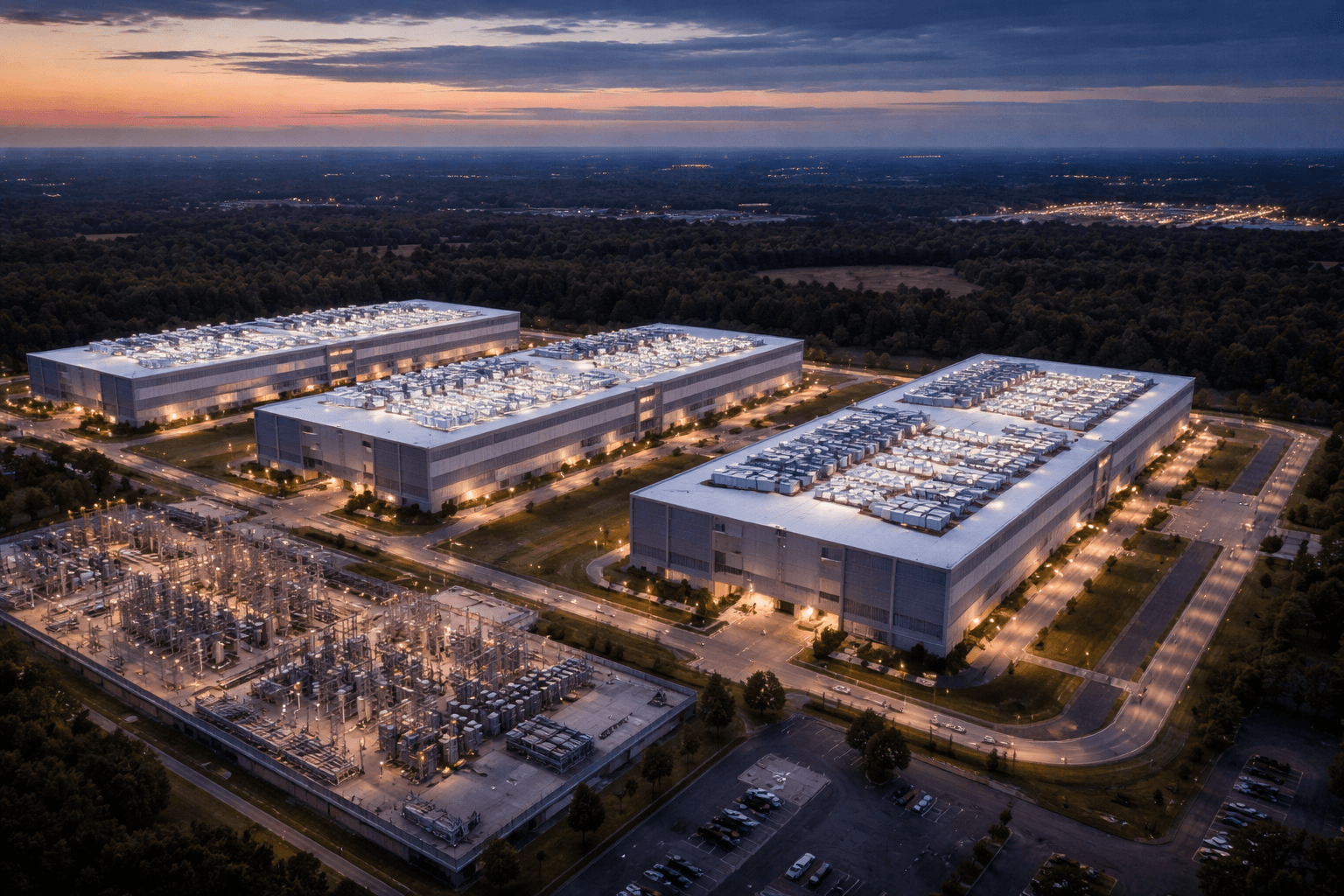
A hyperscaler is a company that designs, builds, and operates data centers at a scale that ordinary enterprise infrastructure cannot reach. The defining threshold is functional: facilities housing 5,000 or more servers across 10,000 or more square feet, with the architecture to add capacity on demand without rebuilding from scratch. Amazon Web Services, Microsoft Azure, Google Cloud, and Meta are the four largest hyperscalers. Apple, IBM, and Alibaba Cloud also operate at hyperscale.
The scale of investment is now extraordinary. According to CBRE Research, AWS, Microsoft, Google, and Meta together plan to spend $290 billion on new data center and IT infrastructure through 2027. In 2025 alone, US data center construction starts reached $77.7 billion, a 190% increase year over year, per ConstructConnect.
This article explains what hyperscalers are, how their facilities differ from standard data centers, which companies operate at hyperscale, what it costs to build these facilities, and why hyperscale infrastructure has become the essential foundation for AI model training and deployment in 2025 and 2026.
In This Article
What Is a Hyperscaler?
A hyperscaler is a company that operates computing infrastructure at a scale large enough to serve millions or billions of users simultaneously, with the ability to expand capacity automatically in response to demand. The term refers to both the company and the type of data center it operates.
The minimum technical threshold, as defined by industry analysts at Nlyte Software and CoreSite, is 5,000 servers and 10,000 square feet of floor space per facility. In practice, the largest hyperscale sites hold hundreds of thousands of servers across campus footprints spanning over one million square feet, consuming 50 megawatts or more of power per site.
Three properties distinguish hyperscale infrastructure from standard enterprise data centers. First, automated operations: servers are provisioned, monitored, and decommissioned by software, not by technicians walking aisles. Second, distributed architecture: workloads run across many machines and can migrate between servers or geographic locations in milliseconds. Third, custom hardware: hyperscalers design their own chips, server racks, networking, and cooling systems rather than purchasing commercial off-the-shelf equipment.
| Feature | Enterprise Data Center | Hyperscale Data Center |
|---|---|---|
| Server count | 100 to 4,999 | 5,000 or more |
| Floor space | Under 10,000 sq ft | 10,000 sq ft to 1M+ sq ft |
| Power capacity | 1 to 10 MW | 20 MW to 5 GW (campus) |
| Hardware design | Commercial off-the-shelf | Custom-built per operator |
| Scaling method | Manual procurement, weeks | Automated, minutes |
| Primary operators | Enterprises, universities | AWS, Azure, Google, Meta |
| Architecture | Centralized, single-site | Distributed, multi-region |
How a Hyperscale Data Center Works
Hyperscale data centers achieve their scale through six core components that work together as an integrated system. Each one is engineered to be replaced, upgraded, or expanded without taking the rest of the facility offline.
- Server rows: Commodity servers are stacked in racks and organized into rows. Each server runs virtual machines or containers that host cloud workloads. Densities in AI facilities reach 10 to 30 kilowatts per rack, compared to 3 to 5 kW in traditional setups.
- Power distribution: Redundant power feeds arrive from the utility grid via transformers and uninterruptible power supplies (UPS). Generators provide backup. Electrical systems account for 40 to 50% of construction cost (Construct Elements, 2025).
- Cooling systems: Hot air from server exhaust is captured and removed, either by air handlers, cold-aisle containment, or direct liquid cooling for high-density AI racks. Cooling accounts for 15 to 20% of construction cost. See our full breakdown of data center cooling methods and costs.
- Networking fabric: A high-speed internal network connects all servers in the facility. Most hyperscalers use 25 Gbps or 100 Gbps links between servers, with 40 Gbps or faster spine links. According to Vertiv, 93% of hyperscale companies expect 40 Gbps or faster network connections across their facilities.
- Software orchestration: Kubernetes, proprietary schedulers, or distributed computing frameworks manage where workloads run. This layer is what makes a hyperscale facility different from a large colocation data center.
- Physical security: Biometric access controls, video monitoring, and perimeter security protect facilities that hold data for millions of customers.
Cooling: The Key Constraint for AI Workloads
AI training servers generate far more heat than standard web servers. A single NVIDIA H100 GPU draws 700 watts. A rack of eight H100 GPUs draws 5.6 kilowatts from the GPU cards alone, before accounting for CPUs, memory, and storage. This forces hyperscalers to retrofit existing facilities with direct liquid cooling or build new AI-optimized halls from the ground up, at a cost premium that reaches $25 million or more per megawatt (Construct Elements, 2025).
The Big Five Hyperscalers: AWS, Azure, Google, Meta, Alibaba
Five companies account for the majority of global hyperscale capacity: Amazon Web Services, Microsoft Azure, Google Cloud, Meta, and Alibaba Cloud. Each operates its own global network of data centers and has invested in custom AI chips to reduce dependency on NVIDIA.
| Company | Primary Cloud Service | Custom AI Chip | Announced 2025 Capex | Key Facility |
|---|---|---|---|---|
| Amazon | Amazon Web Services | Trainium 2 | ~$100B total capex (2025) | AWS regions in 33 countries |
| Microsoft | Azure | Maia 100 | $80B (announced Jan 2026) | 300+ data center locations |
| Google Cloud | TPU v5p | $75B (announced Feb 2025) | 40+ cloud regions | |
| Meta | Meta AI Infrastructure | MTIA v2 | $60-65B (announced Jan 2025) | Hyperion campus, Louisiana |
| Alibaba | Alibaba Cloud | Hanguang 800 | $14B (2025) | 89 availability zones |
Microsoft announced its $80 billion data center investment plan in January 2026, with more than half allocated to facilities inside the United States. Google committed $75 billion in capital expenditure for 2025, a 43% increase over its 2024 spending, according to the company's February 2025 earnings announcement.
Meta is building the most ambitious single facility: a 5-gigawatt AI campus in Louisiana called Hyperion, scheduled for completion by 2028. The site requires three dedicated natural gas power plants with a combined capacity of around $3 billion each.
"The Hyperion data center campus will be almost as large as the footprint of Manhattan." (Meta Infrastructure announcement, January 2025)
Together, AWS, Azure, Google, and Meta account for the $290 billion in combined hyperscale capex planned through 2027 (CBRE Research, 2025). This figure does not include Alibaba, Oracle Cloud, or smaller regional hyperscalers such as OVHcloud and Hetzner.
What It Costs to Build a Hyperscale Data Center
Building a standard hyperscale data center in 2025 costs $10 to $12 million per megawatt of capacity, according to Construct Elements. That figure rises to approximately $11.3 million per MW in 2026. A standard 50-megawatt facility costs between $800 million and $1 billion in total. An AI-optimized facility of the same power capacity exceeds $1 billion.
For campus-scale AI builds targeting 1 gigawatt or more of capacity, construction costs reach $45 to $55 billion per gigawatt (Construct Elements, 2025). Meta's Hyperion campus, targeting 5 GW, represents a total investment in that order of magnitude.
The cost breakdown by component in a 2025 hyperscale build:
| Component | Cost per sq ft | Share of Total Budget |
|---|---|---|
| Electrical systems | $280 to $460 | 40 to 50% |
| Mechanical and cooling | $125 to $215 | 15 to 20% |
| Structural shell and core | Remainder | 30 to 45% |
| AI GPU fit-out premium | $25M+ per MW | Added on top of base cost |
Total average construction cost per square foot reached $1,033 by end-2025, nearly double 2024 levels, per Turner and Townsend's Data Centre Construction Cost Index 2025-2026.
"Data centers will require more than $900 billion in global investment through 2029 to meet the demand for AI and cloud computing." (S&P Global 451 Research, 2025)
The fastest-growing cost driver is AI GPU density. Standard enterprise racks run at 3 to 5 kilowatts each. AI training racks run at 10 to 30 kilowatts each, which requires heavier power feeds, more cooling capacity, and stronger floor loading. Each of these upgrades adds cost and extends build timelines.
Beyond construction, hyperscale operators face rising land and utility costs. Power availability is now the primary constraint on new builds in the United States. Long interconnection queues with utility companies add 18 to 36 months to facility timelines in high-demand markets such as Northern Virginia, Phoenix, and Dallas (DataBank, 2026).
Why Hyperscalers Are the Foundation of AI
Every major AI model in production today was trained on hyperscale infrastructure. GPT-4 was trained on Microsoft Azure. Gemini was trained on Google's TPU clusters. Llama 3 was trained on Meta's internal GPU clusters. No organization outside the five major hyperscalers has trained a frontier AI model from scratch, because the compute requirements exceed what any other infrastructure type can provide.
Training a large language model at the scale of GPT-4 requires thousands of GPUs running in parallel for weeks or months. The communication overhead between GPUs is so high that the servers must be in the same building, connected by high-speed InfiniBand or custom networking fabrics. Only hyperscale data centers with dedicated AI halls meet this requirement.
The infrastructure investment reflects this dependency. According to the Birm Group, AI infrastructure construction will reach $400 billion in 2026 alone, with more than 150 new hyperscale data centers coming online worldwide by the end of that year.
For AI inference (serving predictions to end users rather than training), the same hyperscale infrastructure handles the compute load. When you use ChatGPT, Claude, or Gemini, your request is processed on GPU hardware inside a hyperscale facility. According to Goldman Sachs Research (2024), AI inference workloads will account for a growing share of hyperscale power consumption through 2030, alongside continued training activity.
The shift toward AI has changed what hyperscalers build. Facilities designed in 2018 for 5 to 10 kW per rack are being replaced or augmented by AI halls designed for 20 to 100 kW per rack. This is why construction costs have nearly doubled since 2023 and why power availability has become the primary bottleneck for new capacity. The GPUs filling those racks, primarily NVIDIA A100 and H100 chips, are the direct reason for the power density jump. For a full breakdown of the hardware behind these workloads, see our guide to AI accelerator cards.
Three Things People Get Wrong About Hyperscalers
Misconception 1: Hyperscalers are just very large data centers
Hyperscale facilities are not larger versions of traditional data centers. They use fundamentally different architecture. Standard enterprise data centers rely on commercial servers, proprietary networking gear, and manual operations. Hyperscalers design their own chips, build their own servers, write their own operating systems, and automate everything from server provisioning to fault recovery. According to Data Center Knowledge, this architectural difference means a hyperscale facility can recover from a failed server in seconds through software, while an enterprise facility requires a technician to physically replace hardware.
Misconception 2: Only the largest tech companies can access hyperscale infrastructure
Any organization using AWS, Azure, or Google Cloud is running workloads on hyperscale infrastructure. The entire model of public cloud computing is based on renting fractions of hyperscale capacity. A startup with ten employees can run applications on the same physical infrastructure as a Fortune 500 company. According to CoreSite, hyperscale operators offer "virtually unlimited scalability" for organizations of any size through their public cloud products.
Misconception 3: Energy efficiency is a secondary concern
Power Usage Effectiveness (PUE) is a primary design metric for every hyperscale operator. PUE measures how much total facility power is used versus the power delivered to computing equipment. A PUE of 1.0 is perfect efficiency. The best hyperscale facilities operate at PUE ratings between 1.1 and 1.2, compared to 1.5 to 2.0 for typical enterprise data centers. Google reported an average annual PUE of 1.10 across its global data center fleet in 2024 (Google Environmental Report, 2024). Achieving a low PUE at hyperscale requires constant investment in cooling technology, airflow management, and power distribution design.
The Hyperscale Outlook Through 2028
The hyperscale sector is in a period of rapid physical expansion driven directly by AI compute demand. Three trends define the next two years.
First, construction volume is at record levels. According to the Birm Group, 2026 will see $400 billion in AI infrastructure construction, with more than 150 new hyperscale centers coming online worldwide. In the US, more than 60 projects exceeding $50 billion in total value were scheduled to break ground after October 2025, per programs.com.
Second, power constraints are reshaping where facilities get built. Hyperscalers are moving away from established markets such as Northern Virginia, where utility interconnection queues stretch beyond three years, toward power-rich regions with available grid capacity. States with surplus hydroelectric power, such as Washington and Oregon, and regions with access to natural gas infrastructure, such as Louisiana and Texas, are seeing accelerated development.
Third, the cost gap between standard and AI-optimized facilities is widening. Standard hyperscale construction costs $10 to $12 million per MW. AI-optimized facilities, designed for the 30 to 100 kW rack densities required by GPU clusters, cost $20 million per MW or more. This means the $290 billion combined capex planned by the four major hyperscalers through 2027 will buy significantly less physical capacity than the same sum would have in 2022.
The number of hyperscale data centers worldwide stands at approximately 800 as of 2025 (CoreSite). That figure is expected to grow to well over 1,000 by the end of 2027, with the majority of new builds in the United States, followed by Western Europe and Southeast Asia.
Frequently Asked Questions
What is a hyperscaler?
A hyperscaler is a company that builds and operates data centers at massive scale, typically housing 5,000 or more servers across 10,000 or more square feet per facility, with the ability to expand capacity on demand through automated systems. The main hyperscalers are Amazon Web Services, Microsoft Azure, Google Cloud, Meta, and Alibaba Cloud. These companies operate hundreds of data center locations worldwide and serve millions of customers through public cloud services.
How many hyperscale data centers are there in the world?
There are approximately 800 hyperscale data centers worldwide as of 2025, according to CoreSite. The majority are located in the United States, with significant concentrations in Northern Virginia, Phoenix, Dallas, and the Pacific Northwest. Western Europe (Ireland, Netherlands, Germany) and Southeast Asia (Singapore, Japan) account for most of the remainder. More than 150 new hyperscale facilities are expected to come online in 2026 alone, according to the Birm Group.
What is the difference between a hyperscaler and a cloud provider?
All hyperscalers operate cloud services, but not all cloud providers are hyperscalers. A hyperscaler specifically refers to the physical infrastructure layer: companies that own and operate data centers at the scale of 5,000+ servers per facility with custom hardware. Cloud providers can also be companies that resell capacity from hyperscalers (called managed service providers or resellers) without owning their own data centers. AWS, Azure, and Google Cloud are hyperscalers that also sell public cloud services. A smaller cloud provider might offer virtual machines by renting capacity from one of these hyperscalers.
How much does it cost to build a hyperscale data center?
A standard hyperscale data center costs $10 to $12 million per megawatt of capacity to build in 2025, according to Construct Elements. A standard 50 MW facility costs between $800 million and $1 billion in total. AI-optimized facilities designed for GPU training workloads cost $20 million per MW or more. Campus-scale AI builds targeting 1 gigawatt of capacity cost $45 to $55 billion per GW. The average construction cost per square foot reached $1,033 by end-2025, nearly double 2024 levels, per Turner and Townsend.
Which companies are the biggest hyperscalers?
The five largest hyperscalers by global capacity and revenue are Amazon Web Services, Microsoft Azure, Google Cloud, Meta, and Alibaba Cloud. AWS holds the largest share of the public cloud market, with Azure second and Google Cloud third, according to Synergy Research Group's Q4 2024 cloud infrastructure report. Meta operates hyperscale data centers primarily for its own social media and AI workloads rather than selling cloud services to third parties. Alibaba Cloud is the dominant hyperscaler in Asia.
Why do hyperscalers matter for AI?
All frontier AI models are trained on hyperscale infrastructure. GPT-4 was trained on Microsoft Azure, Gemini on Google's TPU clusters, and Llama 3 on Meta's internal GPU clusters. Training a large language model requires thousands of GPUs running in parallel for weeks, connected by high-speed networking that only hyperscale facilities provide. For AI inference (answering your queries), every major AI service runs on hyperscale GPU hardware. The $290 billion combined capex planned by AWS, Azure, Google, and Meta through 2027 is driven almost entirely by AI compute demand.
Related Articles
Want hands-on setup guides?
These step-by-step guides relate to topics covered in this article.