
What Is an AI Accelerator Card? Types, Specs, and Costs for 2026

Key Numbers
Key Takeaways
- 1An AI accelerator card is dedicated silicon designed to run the matrix math behind AI training and inference. The five main types are GPUs, TPUs, NPUs, FPGAs, and ASICs, each making different trade-offs between programmability and efficiency.
- 2NVIDIA H100 GPUs cost approximately $25,000 to $35,000 per unit as of Q1 2026. AMD MI300X offers 192GB of HBM3 memory at $10,000 to $15,000. The global AI accelerator market is projected to reach $68.38 billion by 2030 (Business Research Company, 2026).
- 3Every frontier AI model in production in 2026, including GPT-5, Gemini 3.1+, Claude 4, and Llama 4, was trained on clusters of thousands of AI accelerators. Inference, not just training, now accounts for approximately 60% of all AI compute cycles in commercial deployments (Lawrence Berkeley National Laboratory, 2024).
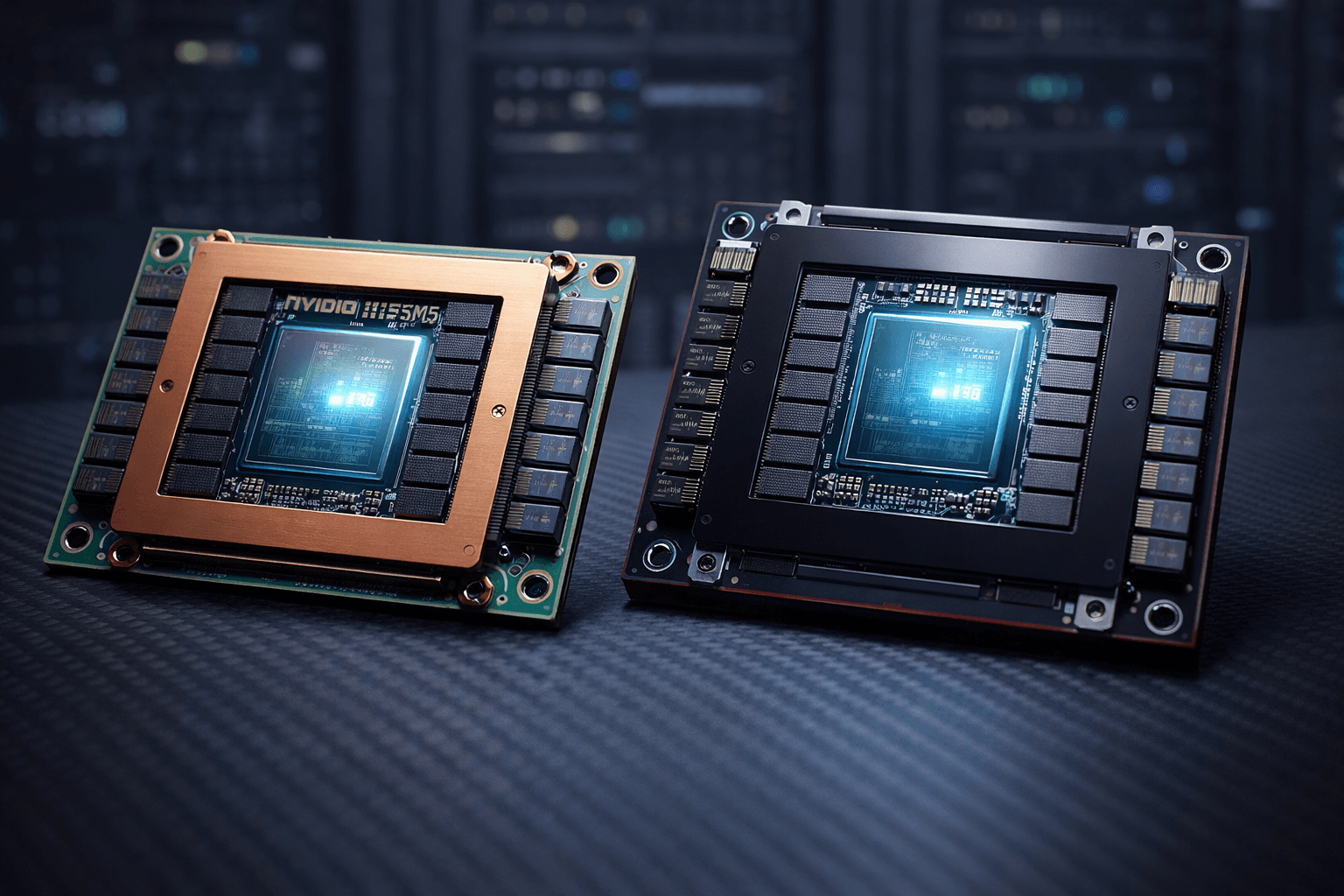
An AI accelerator card is a dedicated processor that handles the mathematical operations behind artificial intelligence. At the core of every AI computation is matrix multiplication: multiplying large arrays of numbers together millions or billions of times. CPUs do this slowly, processing a handful of operations per cycle. AI accelerators do it fast, executing thousands of operations simultaneously across arrays of smaller, simpler processing cores.
The term 'card' comes from the PCIe form factor that most server-grade accelerators use. You install them in a server the way you install a graphics card in a desktop PC. But the category is broader than the name suggests. Some AI accelerators are soldered onto motherboards, others are chips inside smartphones, and some exist only as cloud computing instances you rent by the hour.
The practical result: a task that would take a modern 64-core CPU server weeks to complete on a large language model can finish in days on a system with eight NVIDIA H100 GPUs. The gap in performance-per-dollar for AI workloads is not marginal. It is orders of magnitude.
This article covers all five major types of AI accelerators, explains how they compare on the metrics that matter, and gives the real cost and spec data for 2026.
In This Article
What Is an AI Accelerator Card?
An AI accelerator card is a processor engineered specifically for one category of computation: the matrix math that powers neural networks. Standard CPUs handle diverse tasks sequentially, from running your browser to managing file I/O. AI accelerators narrow their focus to parallel numerical computation, which lets them pack far more processing units onto a chip and execute far more operations per second for AI workloads.
The architecture difference is stark. A high-end server CPU (Intel Xeon or AMD EPYC) has 64 to 192 cores. An NVIDIA H100 GPU has 16,896 CUDA cores. Those cores are simpler than CPU cores, but the sheer count makes them well suited to tasks that run the same operation across enormous arrays of numbers simultaneously.
Three key metrics determine whether an AI accelerator is suitable for a given workload:
- TFLOPS (tera floating-point operations per second): raw compute speed for matrix multiplication. Higher is better for training large models.
- Memory capacity and bandwidth: how much model weight data fits in chip memory and how fast it moves. Critical for inference on large models that must fit entirely in GPU memory.
- TDP (thermal design power): wattage at peak load. Directly determines rack power density and cooling requirements.
| Category | Processing Approach | Parallel Cores | Best For |
|---|---|---|---|
| CPU | Sequential, general-purpose | 8 to 192 cores | Orchestration, I/O, control flow |
| GPU | Massively parallel | 1,000 to 18,000+ cores | Training and large-scale inference |
| TPU or ASIC | Fixed-function parallel | Thousands of specialized units | Specific model architectures at scale |
| NPU | Inference-optimized | Hundreds of cores | On-device inference, mobile and edge |
When you use ChatGPT, Claude, or Gemini, your request is processed in real time on a rack of AI accelerators inside a data center. The chips doing that work are almost certainly NVIDIA GPUs, Google TPUs, or AWS Inferentia chips, depending on which platform you are using.
The Five Types of AI Accelerators
Not all AI accelerators are the same. The category includes at least five distinct hardware types, each making different trade-offs between performance, efficiency, and flexibility.
GPU (Graphics Processing Unit)
GPUs are general-purpose parallel processors originally designed for rendering video game graphics. NVIDIA recognized in the early 2010s that the same parallel architecture suited for rendering pixels is also ideal for matrix math. Today, NVIDIA GPUs (H100, H200, B200) dominate AI training workloads globally. AMD's MI300X is a competitive alternative, particularly for inference workloads that require large amounts of chip memory. GPUs are programmable via CUDA (NVIDIA) or ROCm (AMD), making them compatible with frameworks like PyTorch and TensorFlow without modification.
TPU (Tensor Processing Unit)
Google designed the TPU specifically for TensorFlow neural network computations. The first TPU shipped internally at Google in 2015. TPUs are not sold. You access them only through Google Cloud TPU services. For specific workloads, particularly large transformer models trained with Google's infrastructure and the JAX framework, TPUs outperform GPUs. Teams using PyTorch typically find GPUs easier to adopt because switching requires significant software adaptation.
NPU (Neural Processing Unit)
NPUs are inference-optimized chips built into consumer devices. Apple's Neural Engine, part of every M-series and A-series chip, is the most widely deployed NPU in the world. It runs on-device AI tasks including Face ID, text prediction, and Apple Intelligence features. Qualcomm's Hexagon NPU powers AI features on Android devices. NPUs prioritize power efficiency for inference, not training capacity, and are not the chips used to train large models.
FPGA (Field Programmable Gate Array)
FPGAs are reconfigurable chips. You program their logic after manufacturing, making them adaptable for specialized AI inference tasks in industries that need custom latency profiles, such as high-frequency trading or real-time industrial sensor processing. Intel (via its Altera acquisition) and AMD (via Xilinx) are the main FPGA vendors. Modern FPGA architectures now deliver up to 90% of GPU performance for common AI models while consuming significantly less power (Intel, 2026).
ASIC (Application-Specific Integrated Circuit)
ASICs are purpose-built chips that do one thing extremely well. Google's TPU is technically an ASIC. AWS Trainium2 is an ASIC built specifically for training large models on Amazon's infrastructure. AWS Inferentia2 is optimized for inference. These chips cannot be reprogrammed, but they achieve superior performance-per-watt for the specific workloads they are designed for. Cloud providers build ASICs to reduce dependence on NVIDIA and control their own infrastructure economics.
Major AI Accelerator Manufacturers and Their Products
Six companies account for the majority of AI accelerator production and deployment as of Q1 2026. NVIDIA is the dominant force by revenue and installed units. The others compete on specific use cases, price points, or ecosystem advantages.
| Company | Product(s) | Type | Availability | Primary Strength |
|---|---|---|---|---|
| NVIDIA | H100, H200, B200 (Blackwell) | GPU | Purchase or cloud | Broadest framework support, largest install base |
| AMD | MI300X, MI325X | GPU | Purchase or cloud | 192GB HBM3 memory, competitive inference pricing |
| TPU v5e, TPU v5p | ASIC | Google Cloud only | Optimized for Google's model stack and JAX | |
| AWS | Trainium2, Inferentia2 | ASIC | AWS only | Cost efficiency for training and inference on AWS |
| Intel | Gaudi 3 | AI Accelerator | Purchase or Intel Developer Cloud | Competitive for mid-size inference workloads |
| Apple | M4 Neural Engine | NPU | Integrated (Apple silicon) | Industry-leading performance-per-watt at device scale |
NVIDIA's position in this market is unusual. The company holds approximately 70 to 80% of the datacenter AI accelerator market by revenue as of Q1 2026, based on industry analyst estimates. Their CUDA software ecosystem, built over 15 years, is the primary reason. Switching from NVIDIA to AMD or Intel means rewriting or adapting significant portions of the training and inference software stack. Most teams find the engineering cost of switching higher than the hardware savings.
"We are seeing demand for our Blackwell chips exceed supply in every geography and every vertical." (Jensen Huang, NVIDIA CEO, January 2026)
AMD has made real progress with the MI300X. The chip ships with 192GB of HBM3 memory, compared to 80GB on the H100, which gives it an advantage for inference on large models that need to fit entirely in GPU memory. Several major cloud providers began offering MI300X instances in 2024, and the chip has found a real installed base in inference-focused deployments.
Intel's Gaudi 3, available at roughly $8,000 to $12,000 per unit as of Q1 2026, is a lower-cost option for inference workloads where NVIDIA's CUDA lock-in is less relevant. It does not match NVIDIA's ecosystem, but for teams starting fresh on inference pipelines, the price gap is meaningful.
Cost, Performance, and Specs Compared
Here are the key specifications and estimated prices for the most widely deployed AI accelerators as of Q1 2026. Cloud-only chips (TPU, Trainium, Inferentia) have no purchase price. They are accessed only through hourly cloud rental rates.
| Accelerator | Memory | Peak FP16 TFLOPS | TDP | Est. Purchase Price (Q1 2026) | Form Factor |
|---|---|---|---|---|---|
| NVIDIA H100 SXM5 | 80GB HBM2e | ~1,979 TFLOPS | 700W | $25,000–35,000 | SXM5 module |
| NVIDIA H200 SXM5 | 141GB HBM3e | ~1,979 TFLOPS | 700W | $35,000–45,000 | SXM5 module |
| NVIDIA B200 (Blackwell) | 192GB HBM3e | ~4,500 TFLOPS | ~1,000W | $30,000–40,000 | SXM6 module |
| AMD MI300X | 192GB HBM3 | ~1,307 TFLOPS | 750W | $10,000–15,000 | OAM module |
| Intel Gaudi 3 | 128GB HBM2e | ~1,835 TFLOPS | 600W | $8,000–12,000 | PCIe or OAM |
| Google TPU v5e | N/A | ~197 TFLOPS per chip | N/A | Cloud only | Rack-mounted |
Note: TFLOPS figures use FP16 precision without sparsity. Prices are estimated market rates, not MSRP, and fluctuate with supply. All data as of Q1 2026.
At cloud rental rates, an NVIDIA H100 instance costs approximately $2.00 to $3.50 per GPU-hour depending on the provider. Training a 70-billion-parameter model requires roughly 1,000 GPU-hours at minimum. At $2.50 per hour, the compute cost comes to $2,500 for one training run of a mid-size model, before factoring in storage, networking, or failed runs.
The Number Most Guides Don't Show
According to Business Research Company's 2026 AI Accelerator Market Report, the AI accelerator market is projected at $26.41 billion in 2026. With NVIDIA holding approximately 75% of that market by revenue, NVIDIA's datacenter AI accelerator revenue comes to roughly $19.8 billion in 2026 alone. At a blended average selling price of $30,000 per unit (mixing H100, H200, and B200 pricing), that implies approximately 660,000 NVIDIA datacenter GPUs shipped in that single year.
Each unit draws up to 700W at peak load. If all 660,000 ran simultaneously at full load, the total draw would reach 462 megawatts. That is roughly the output of a mid-size gas-fired power plant, consumed by just one year's shipment of a single company's AI chips, assuming they never turn off. This is why power availability has become the binding constraint on AI infrastructure buildout, not chip availability.
Why AI Accelerators Are Central to Large Language Models
Every large language model deployed in 2026, including GPT-5, Gemini 3.1+, Claude 4, and Llama 4, was trained on clusters of AI accelerators numbering in the thousands. Meta reportedly trained Llama models on clusters of 16,000 to 49,000 NVIDIA H100 GPUs. OpenAI and Microsoft have not disclosed training cluster sizes for GPT-5, but industry estimates place it well above 10,000 GPUs for a model of that scale.
Training is not the only phase that needs accelerators. Inference, the process of generating a response when you send a message to an AI model, also requires dedicated accelerator capacity. Every query you send to Claude, ChatGPT, or Gemini is processed in real time on a rack of GPUs or custom inference chips. As usage has grown, inference costs have become a larger share of total AI infrastructure spending than training costs.
This shift is driving demand for inference-optimized chips. The NVIDIA H200 offers the same compute as the H100 but with 141GB of HBM3e memory, up from 80GB, which matters because larger models need to fit their weights in GPU memory during inference. AMD's MI300X with 192GB of HBM3 targets the same market, allowing inference of models up to around 70 billion parameters in a single GPU without requiring model sharding across multiple chips.
According to Lawrence Berkeley National Laboratory's 2024 US Data Center Energy report, inference now accounts for roughly 60% of all AI compute cycles in commercial deployments, having overtaken training. This is why hyperscalers are investing heavily in inference-optimized infrastructure alongside training capacity, and why chips like AWS Inferentia2 and Google TPU v5e exist as dedicated inference products separate from training chips.
"The inference market will be larger than the training market within two years." (Lisa Su, AMD CEO, AMD Financial Analyst Day, June 2025)
For more on how AI accelerators are deployed at scale, see our overview of what hyperscalers are and how they operate.
Export Controls, Supply Chains, and What Comes Next
The AI accelerator market operates under significant geopolitical constraints. The US government has imposed export controls on NVIDIA's most capable AI chips, restricting sales to China and other designated countries. The controls began with the A100 and H100 in October 2022, were updated in November 2023, and have been tightened further through 2025.
NVIDIA developed China-specific variants, the A800 and H800, to comply with earlier restrictions. Subsequent rule updates caught those chips as well. The impact on NVIDIA's revenue has been material but not crippling. China represented approximately 20 to 25% of NVIDIA's datacenter revenue before the controls. Strong demand from US, European, and Asia Pacific markets has more than offset the reduction in Chinese sales.
China has responded by accelerating domestic AI chip development. Huawei's Ascend 910B is the most capable domestically produced alternative, though it lags the H100 on raw performance and software ecosystem support. Biren Technology and Cambricon are developing competitive chips, but supply chains and software tooling remain immature compared to NVIDIA's CUDA platform.
On the supply side, TSMC manufactures most advanced AI accelerator chips, including NVIDIA's and AMD's. TSMC's advanced packaging capacity (CoWoS, used for HBM memory integration) was the primary bottleneck for H100 supply through 2023 and 2024. TSMC has since expanded CoWoS capacity. The B200 (Blackwell) launch in 2025 created a new round of supply tightness as customers transitioned to the new generation.
The next generation beyond Blackwell is NVIDIA's Rubin architecture, planned for 2026 to 2027. AMD is developing the MI400 series. Both are expected to deliver another 2 to 3x performance improvement over current generations. For context on how these chips fit into the broader datacenter buildout, see our article on AI data centers and how they work and our review of the NVIDIA A100 specs and pricing for the prior generation still widely deployed across cloud infrastructure.
Frequently Asked Questions
What is the difference between a GPU and an AI accelerator?
A GPU is one type of AI accelerator. All GPUs used for AI are AI accelerators, but not all AI accelerators are GPUs. TPUs (Google), ASICs (AWS Trainium), and NPUs (Apple Neural Engine) are AI accelerators that are not GPUs. The term 'AI accelerator' covers any chip designed to speed up AI workloads, while 'GPU' refers specifically to a graphics processing unit, originally designed for rendering graphics, that has been widely adopted for parallel compute tasks including AI training and inference.
What AI accelerators does NVIDIA make?
NVIDIA's main datacenter AI accelerators as of Q1 2026 are the H100 (80GB HBM2e, approximately $25,000 to $35,000 per unit), the H200 (141GB HBM3e, approximately $35,000 to $45,000 per unit), and the B200 (Blackwell architecture, 192GB HBM3e). The A100 is NVIDIA's previous generation chip and is still widely deployed across cloud infrastructure. For consumer and workstation AI inference, NVIDIA's RTX 4090 and 4080 cards are also used for running local models.
How much does an AI accelerator card cost?
Cost ranges widely by type and tier. Consumer GPUs for local AI inference (NVIDIA RTX 4080, 4090) cost $800 to $2,000. Professional datacenter GPUs cost significantly more. NVIDIA H100 SXM5 runs approximately $25,000 to $35,000 per unit, the H200 runs $35,000 to $45,000, and AMD MI300X runs $10,000 to $15,000. Intel Gaudi 3 is available at roughly $8,000 to $12,000. All prices are estimated market rates as of Q1 2026. Cloud-only accelerators (Google TPU, AWS Trainium, AWS Inferentia) have no purchase price and are rented by the hour.
What is a TPU and who uses it?
A TPU (Tensor Processing Unit) is an ASIC designed by Google specifically for neural network computations. Google built the first TPU in 2015 and deployed it internally to power Google Search, Google Translate, and Google Photos AI features. TPUs are not sold to the public. They are available only through Google Cloud TPU services. Google trains its Gemini models on TPU clusters. TPUs are optimized for the JAX and TensorFlow frameworks, so teams using PyTorch typically find GPUs easier to adopt.
What AI chip does Amazon Web Services use?
AWS uses two custom AI ASICs it designed in-house. AWS Trainium2 is built for training large models on AWS infrastructure and claims up to 4x better performance-per-watt than comparable GPU instances for training workloads. AWS Inferentia2 is optimized for inference. Both chips are available through AWS cloud instances (the Trn1 and Inf2 instance families) and are not sold externally. AWS developed these chips to reduce reliance on NVIDIA and lower per-unit compute costs for its own infrastructure.
Are AI accelerator chips affected by US export controls?
Yes. The US has imposed export controls on NVIDIA's H100, H200, A100, and B200 GPUs, restricting their sale to China and other designated countries. Controls began in October 2022 and have been updated multiple times through 2025. NVIDIA developed lower-specification variants (A800, H800) to comply with earlier rules, but subsequent updates restricted those too. AMD's MI300X and Intel's Gaudi products face similar restrictions for China sales. The controls have pushed China to develop domestic alternatives, including Huawei's Ascend 910B.
What is the most powerful AI accelerator available in 2026?
By raw compute throughput, NVIDIA's B200 (Blackwell architecture) is the most capable generally available AI accelerator in 2026, delivering approximately 4,500 TFLOPS in FP16 with 192GB of HBM3e memory. NVIDIA also offers the GB200 NVL72, which pairs 72 B200 GPUs with 36 Grace CPUs in a single rack-scale system, delivering 1.44 exaFLOPS of FP4 compute for inference. For memory capacity, AMD's MI300X matches the B200 at 192GB HBM3 but at a lower compute peak, making it competitive for large-model inference workloads that are memory-bound rather than compute-bound.
Related Articles
NVIDIA A100 GPU: Specs, Price, and Performance in 2026
12 min read
What Is a Hyperscaler? Hyperscale Data Centers Explained
9 min read
What Are AI Data Centers? The Full 2026 Breakdown
10 min read
What Is an LLM? Large Language Models Explained
10 min read
What Is an AI Factory? NVIDIA's Infrastructure Term Explained
9 min read
What Are AI Chips? GPUs, Pricing, and Chip Wars Explained
10 min read