
What Is an LLM? Large Language Models Explained

Key Numbers
Key Takeaways
- 1A large language model is a neural network with billions of parameters, trained on text data to predict the next token in a sequence. GPT-3 had 175 billion parameters when released in 2020; frontier models today are estimated at 1 trillion parameters or more.
- 2Training GPT-4 cost more than $100 million in compute, confirmed by OpenAI CEO Sam Altman in 2023. Training a comparable model has dropped to roughly $25 million by 2026 due to hardware and architecture improvements (localaimaster.com, 2025 analysis).
- 3Every major AI product including ChatGPT, Claude, Gemini, and Microsoft Copilot runs on an LLM. These models generate responses by predicting the most probable next token, not by retrieving stored answers or performing logical reasoning.
A large language model is a neural network trained on hundreds of billions of words of text to predict the most probable next token in a sequence. GPT-3, released by OpenAI in 2020, proved this approach at scale with 175 billion parameters. Every AI chatbot and coding assistant in common use today runs on some variant of this architecture.
The number that surprises most people: training GPT-4 cost over $100 million in compute, according to OpenAI CEO Sam Altman. That is not the server cost, the team, or the operational overhead. That is just the GPU time to run the training job once. Anthropic CEO Dario Amodei said in August 2023 that models costing over $1 billion would appear by 2024, and that "by 2025 we may have a $10 billion model." Training efficiency has improved roughly 40% per year since then, but the frontier keeps moving.
After reading this, you will understand how LLMs actually generate text, why they produce plausible-sounding answers without knowing anything in any real sense, and what the infrastructure behind ChatGPT, Claude, and Gemini actually looks like. The cost tables and model comparison below use the most current figures available for 2026.
In This Article
- 1What Is a Large Language Model?
- 2How LLMs Are Trained: Pre-Training, Fine-Tuning, and RLHF
- 3The Major LLMs: GPT-5.4, Claude, Gemini, and Llama Compared
- 4LLM Training Costs: The Real Numbers for 2026
- 5How LLMs Power the AI Products You Use
- 6What LLMs Cannot Do: The Four Biggest Misconceptions
- 7The LLM Timeline: Key Milestones from 2017 to 2026
What Is a Large Language Model?
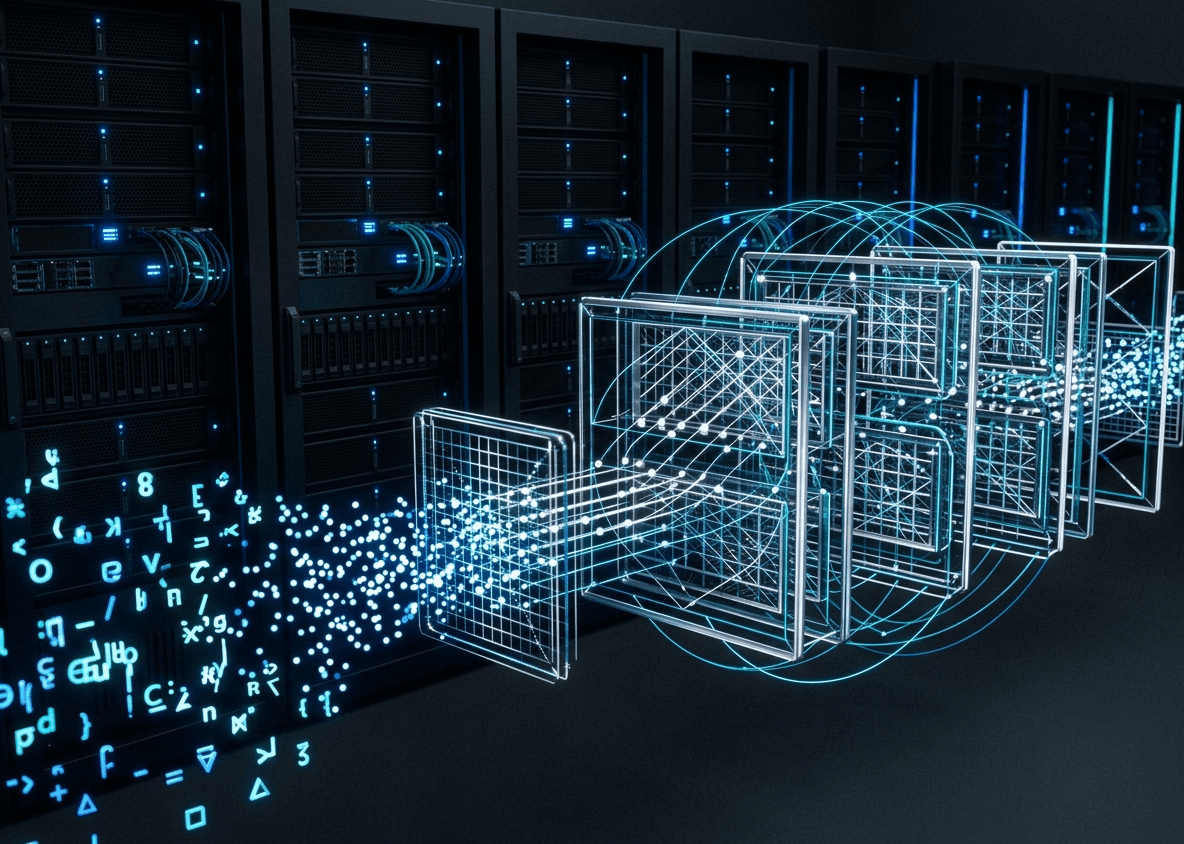
A large language model is a type of deep learning model that takes text as input and generates text as output. It does this by learning statistical patterns across massive amounts of text during training, then using those patterns to predict the most probable continuation of any given input.
The "large" in the name refers to parameter count. Parameters are the numerical weights inside the network that determine how it responds to any input. GPT-3 had 175 billion of them. GPT-4 is estimated at roughly 1 trillion parameters, though OpenAI has not confirmed this publicly. More parameters means more capacity to capture nuance, handle longer context, and produce more accurate predictions, though beyond a certain scale the relationship becomes less predictable.
All modern LLMs use transformer architecture, first described in the 2017 paper "Attention Is All You Need" by Vaswani and colleagues at Google Brain. The key innovation was the self-attention mechanism. Rather than processing tokens sequentially like earlier recurrent networks, transformers let every token in a sequence attend to every other token simultaneously. This makes training parallelizable across thousands of GPUs and dramatically improves performance on long texts.
The practical result: a model that can answer questions, write code, summarize documents, translate languages, and conduct multi-turn conversations using the same underlying mechanism. Given a sequence of tokens, predict what comes next.
Parameters, weights, and what the model actually learns
A parameter is a number. An LLM with 175 billion parameters is a function with 175 billion adjustable numbers. During training, those numbers get tuned through billions of prediction examples until the model's outputs closely match the actual next tokens in the training data.
What the model learns is not facts in any retrievable sense. It learns distributions. Given this sequence of words, these next words are more probable. The model has no index of facts, no database it queries. It has statistical patterns compressed into billions of numbers. This matters enormously for understanding what LLMs can and cannot do reliably.
How LLMs Are Trained: Pre-Training, Fine-Tuning, and RLHF
Training an LLM happens in three stages. The first is the most expensive by a large margin.
Pre-training is the compute-intensive phase where the model processes hundreds of billions of tokens of text: web pages, books, academic papers, code repositories, and other sources. For each token, the model predicts the next one. The prediction error is calculated, and all parameters are adjusted slightly to reduce that error. This process runs across thousands of GPUs in parallel for weeks or months.
GPT-3 was pre-trained on approximately 300 billion tokens, including content from Common Crawl (a web crawl covering over 50 billion web pages), Wikipedia, and digitized books. Training took roughly 355 GPU-years of compute on NVIDIA V100 GPUs, according to Lambda Labs' 2020 analysis. In practice, thousands of GPUs ran in parallel to complete the job in a matter of weeks.
Fine-tuning follows pre-training. The pre-trained model is adapted on a smaller, curated dataset for specific behaviors or tasks. Fine-tuning costs are a fraction of pre-training.
RLHF (Reinforcement Learning from Human Feedback) is the step that turns a text-completion engine into a useful assistant. Human raters score the model's outputs for helpfulness, accuracy, and safety. A reward model is trained on those ratings. The LLM is then trained further to produce outputs that score highly against the reward model. This is what makes ChatGPT respond helpfully rather than simply continuing the statistical pattern of whatever you typed.
Tokenization: how text becomes numbers
Before any of this works, text must be converted to numbers. Tokenization splits text into subword units. Common words become single tokens; rare or complex words are split into two or three. In GPT-style tokenizers, "unbelievable" might become three tokens: "un", "believ", "able". The model never processes letters or words directly. It processes token IDs from a vocabulary of 50,000 to 100,000 entries.
Context window is the maximum number of tokens a model can process in one pass. Early LLMs had context windows of 2,000 to 4,000 tokens. GPT-4 supports 128,000 tokens. Gemini 1.5 Pro supports 1 million tokens (Google, February 2024), allowing it to process an entire book or large codebase in a single call.
More AI infrastructure stories like this
The real hardware, chip, and data center side of AI, explained plainly, every Wednesday and Saturday.
The Major LLMs: GPT-5.4, Claude, Gemini, and Llama Compared
Seven models define the current LLM landscape across open-source and closed-source categories.
| Model | Developer | Parameters | Context Window | Release Date |
|---|---|---|---|---|
| GPT-3 | OpenAI | 175B | 4,096 tokens | June 2020 |
| GPT-4 (discontinued) | OpenAI | ~1T (estimated) | 128,000 tokens | March 2023 |
| GPT-5.4 | OpenAI | Not disclosed | 128,000+ tokens | 2025 |
| Claude 3.5 Sonnet | Anthropic | Not disclosed | 200,000 tokens | June 2024 |
| Gemini 1.5 Pro | Google DeepMind | Not disclosed | 1,000,000 tokens | February 2024 |
| Llama 3.1 405B | Meta | 405B | 128,000 tokens | July 2024 |
| Mistral Large 2 | Mistral AI | ~123B (estimated) | 128,000 tokens | July 2024 |
The shift from 4,096 to 1,000,000 context tokens between 2020 and 2024 is not a marginal improvement. A model with a 1-million-token context can read and reason over an entire book in a single pass. Gemini 1.5 Pro achieved this in February 2024 (Google). Early LLMs lost coherence and produced hallucinations when context exceeded a few thousand tokens; long-context improvements came from both architectural changes and better training data curation.
All closed-source models (GPT-5.4, Claude, Gemini) do not disclose parameter counts publicly. GPT-4 was the previous OpenAI flagship, estimated at 1 trillion parameters before being discontinued. Meta's Llama family is fully open-source and auditable, making Llama 3.1 405B the largest publicly verifiable model as of mid-2024.
"The models that will define the next few years are already being trained right now." (Dario Amodei, Anthropic CEO, August 2023)
The open-source track has narrowed the gap with closed-source frontier models significantly. Llama 3.1 405B outperforms GPT-4 on several benchmarks and can be run on private infrastructure, which is why it has become the default choice for enterprises that cannot send data to external APIs.
LLM Training Costs: The Real Numbers for 2026
Training costs are the largest single expense in bringing a frontier LLM to market. The numbers have changed substantially from 2020 to 2026.
| Model | Training Cost Estimate | Compute Used | Source |
|---|---|---|---|
| GPT-3 (175B) | $500K to $4.6M | 3.14E23 FLOPS, ~355 GPU-years | Lambda Labs, 2020 |
| GPT-4 | $50M to $200M+ | Not disclosed | Sam Altman, 2023; Fortune, April 2024 |
| Gemini Ultra | ~$191M compute | Not disclosed | CUDO Compute, 2024 |
| Llama 3.1 405B | ~$25M (2026 estimate) | 5,000+ NVIDIA B200 GPUs | localaimaster.com, 2025 |
| 405B+ frontier model | $80M to $400M in cloud | 8M to 30M compute hours | localaimaster.com, 2025 |
"It's more than a hundred million dollars, and I think it's probably more than most people realize." (Sam Altman, OpenAI CEO, on GPT-4 training cost, cited in Fortune, April 2024)
Fine-tuning a pre-trained open-source model costs between $500 and $5,000 depending on the model size and task, according to the same analysis. This is why most enterprise deployments start with a fine-tuned Llama or Mistral model rather than training from scratch.
The number most guides don't show
Training efficiency has improved faster than raw model size has grown. GPT-3 cost approximately $4.6 million per training run in 2020. A model achieving equivalent benchmark scores today costs under $500,000 to train, according to localaimaster.com's 2025 cost analysis, which found roughly 40% year-over-year efficiency gains driven by hardware improvements and better data curation. At that pace, training costs halve roughly every two years.
This does not mean frontier AI is getting cheaper. It means the frontier keeps moving. OpenAI, Anthropic, and Google respond to each efficiency improvement by training larger models, so total training spend keeps climbing even as cost-per-unit-of-capability falls. Dario Amodei's 2023 forecast of a $10 billion training run by 2025 reflects this pattern.
For a full comparison of training costs versus the ongoing inference costs once a model is deployed, the AI training vs. inference guide covers both phases in detail.
The hardware running these training jobs is covered in the AI accelerator guide, including H100 and B200 GPU specifications and rental pricing.
How LLMs Power the AI Products You Use
Every major AI product in widespread use today has an LLM as its core component. ChatGPT, Claude, Gemini, Microsoft Copilot, and Perplexity are interfaces built around language models. The infrastructure running these products at consumer scale is one of the most expensive computing operations ever built.
When you type a query into ChatGPT, your text is tokenized and sent to a data center running thousands of NVIDIA H100 or H200 GPUs. The model processes the tokens through its transformer layers, generates a probability distribution over the next token, samples from that distribution, appends the token to the sequence, and repeats until it produces a complete response. On a single H100 GPU, a frontier LLM the size of GPT-5.4 runs inference at roughly 20 to 30 tokens per second. A 500-word response requires approximately 650 tokens, which takes 20 to 30 seconds on one GPU.
ChatGPT processes hundreds of millions of queries per day. At that volume, Microsoft (which runs ChatGPT on Azure) deploys tens of thousands of H100 GPUs purely for inference. OpenAI's monthly inference cost is estimated in the hundreds of millions of dollars. According to Goldman Sachs Research, AI inference workloads will account for an increasing share of global data center power consumption through 2030.
This is why the hyperscale infrastructure behind these products costs tens of billions of dollars to build and operate. AWS, Azure, Google, and Meta have collectively committed $290 billion in data center investment through 2027, driven almost entirely by LLM demand.
The LLM inference cost per query
Inference at consumer scale has its own economics. GPT-4 API pricing (the previous generation) ran at $0.03 per 1,000 input tokens and $0.06 per 1,000 output tokens as of 2024. An average ChatGPT query processes approximately 500 input tokens and generates 500 output tokens, costing roughly $0.045 in API-equivalent compute. At 500 million queries per day (estimated from reported user counts), the daily inference cost across ChatGPT is approximately $22.5 million, or around $8 billion per year. This is a rough estimate, since OpenAI uses proprietary infrastructure rather than the public API, but it illustrates the scale of the compute bill behind a widely used LLM product.
What LLMs Cannot Do: The Four Biggest Misconceptions
The most common misconceptions about LLMs create real problems when businesses deploy them.
LLMs do not know things
They have no memory between sessions by default, no access to live information, and no internal database of facts. They generate plausible-sounding text based on statistical patterns in training data. An LLM that states a specific fact with high confidence may be completely wrong. This is called hallucination: the model produces fluent, confident text that is factually incorrect. It happens because the model is optimized for next-token probability, not factual accuracy.
LLMs cannot reason reliably on novel problems
They appear to reason, but this is a trained pattern, not a mechanism. If you present a problem type the model has seen thousands of times in training, it responds as if it understood. On genuinely novel problems requiring step-by-step logical deduction, current LLMs fail in ways a logical reasoning system would not. Chain-of-thought prompting improves this by forcing the model to generate intermediate steps before a final answer, but the improvement is partial.
LLMs do not think between tokens
There is no deliberation process. The model runs a forward pass through its transformer layers and samples a token. It does not have a working memory or an internal deliberation state beyond what is in the context window. Responses that appear thoughtful are the product of training, not of any reasoning that happens at inference time.
Bigger is not always better
Scaling parameter counts has produced real capability improvements, but diminishing returns have appeared at the frontier. The Chinchilla paper from DeepMind (2022) showed that for a given compute budget, the optimal strategy is to train a smaller model on more data rather than a larger model on less data. Many of the largest models released between 2020 and 2022 were undertrained relative to their parameter counts. This insight drove the efficiency improvements in Llama 2 and 3, which outperform much larger models on compute-matched comparisons.
Retrieval-Augmented Generation (RAG) addresses the knowledge limitation directly by retrieving relevant documents at inference time and including them in the context window. This reduces factual errors on domain-specific queries without requiring a new training run.
These limitations are also why certain jobs remain structurally resistant to AI replacement. Roles requiring physical dexterity in unpredictable environments, emotional trust, or ethical accountability are exactly the gaps LLMs cannot close. For a full breakdown of which occupations carry the lowest automation risk and why, see our guide on jobs AI cannot replace.
The LLM Timeline: Key Milestones from 2017 to 2026
The modern era of large language models spans less than a decade. The pace of change has been rapid enough that models released in 2022 are already considered obsolete for most purposes.
| Year | Milestone |
|---|---|
| 2017 | Google Brain publishes "Attention Is All You Need," describing the transformer architecture that underpins all modern LLMs |
| 2018 | OpenAI releases GPT-1 (117M parameters). Google releases BERT (340M parameters), introducing bidirectional pre-training |
| 2019 | OpenAI releases GPT-2 (1.5B parameters), initially withheld citing misuse concerns |
| 2020 | GPT-3 released (175B parameters). Lambda Labs estimates training cost at $4.6M |
| 2022 | ChatGPT launches in November. Reaches 1 million users in 5 days, 100 million users in 2 months (Reuters, 2023), the fastest consumer app to 100M users in recorded history |
| 2023 | GPT-4 released in March. Sam Altman confirms training cost exceeded $100M. Meta open-sources Llama 2. Dario Amodei forecasts $1B+ training runs by 2024 |
| 2024 | Gemini 1.5 Pro launches with 1M token context window (Google, February). GPT-4o released (OpenAI, May). Claude 3.5 Sonnet released (Anthropic, June). Meta releases Llama 3.1 405B open-source model (July) |
| 2025 | Frontier training runs approach $1 billion. Agentic frameworks using LLMs as reasoning engines become standard in enterprise software |
| 2026 | Context windows extend beyond 2 million tokens. Multimodal LLMs handling text, image, audio, and video in a single forward pass become widely available |
The four years between ChatGPT's launch in November 2022 and early 2026 compressed more capability improvement than the previous five years of LLM research combined. A model available today through an API for a few cents per query would have required millions of dollars of dedicated infrastructure to approximate in 2020.
The cost and capability trajectory suggests that the models available in 2028 will be to GPT-5.4 roughly what GPT-5.4 is to GPT-2. The infrastructure required to train them will cost more, but accessing them through an API will cost less.
Frequently Asked Questions
What does LLM stand for?
LLM stands for large language model. It refers to neural network models with billions of parameters trained on large text datasets to generate and process natural language. The "large" distinguishes them from earlier, smaller language models. Modern LLMs include GPT-5.4 (OpenAI), Claude (Anthropic), Gemini (Google DeepMind), and Llama (Meta).
What is the difference between an LLM and ChatGPT?
ChatGPT is an application built on top of an LLM. The current underlying model is GPT-5.4 (OpenAI). ChatGPT adds a chat interface, session memory, plugins, image input, and safety guardrails on top of the base model. The LLM is the core technology that generates text. ChatGPT is the product users interact with. Other applications built on LLMs include Microsoft Copilot (built on GPT-5.4), Claude.ai (built on Anthropic's Claude models), and Gemini (built on Google's Gemini models).
How many parameters does GPT-5.4 have?
OpenAI has not publicly disclosed GPT-5.4's parameter count. Its predecessor GPT-4, released in March 2023 and now discontinued, was estimated at 1 trillion to 1.76 trillion parameters using a Mixture-of-Experts architecture. GPT-5.4 is OpenAI's current flagship model; no architecture details have been published. GPT-3 had 175 billion parameters, confirmed by OpenAI in their 2020 paper. Llama 3.1 405B has 405 billion parameters, confirmed by Meta.
How much does it cost to train an LLM?
Training costs vary enormously by model size and year. GPT-3 (175B parameters) cost an estimated $500K to $4.6M in compute in 2020 (Lambda Labs). GPT-4 cost more than $100 million according to Sam Altman in 2023. Training a 405B-parameter model in 2026 costs approximately $25 million in cloud compute according to localaimaster.com's 2025 analysis. Costs have fallen roughly 40% per year due to hardware efficiency improvements, but frontier model training spend has increased because model sizes keep growing.
Can an LLM understand language?
No, not in the way humans understand language. LLMs generate statistically probable token sequences based on patterns in training data. They do not have world knowledge, persistent memory, or comprehension in any cognitive sense. They can produce outputs that appear to demonstrate understanding because they have been trained on millions of examples of that type of exchange. Tasks requiring genuine logical deduction, real-time factual accuracy, or multi-step reasoning outside training data remain unreliable without techniques like chain-of-thought prompting or Retrieval-Augmented Generation.
What is the difference between LLM training and inference?
Training is the process of building the model: running the pre-training job on hundreds of billions of tokens, updating billions of parameters over weeks or months, at a cost of millions to hundreds of millions of dollars. Inference is using the trained model to generate responses. Every time you use ChatGPT or Claude, that is inference. Inference cost per query is small (fractions of a cent to a few cents) but multiplies to hundreds of millions of dollars per month at consumer scale. OpenAI's inference bill for ChatGPT is estimated in the hundreds of millions of dollars per month.
Related Articles
AI Training vs Inference: What's the Difference and Why the Cost Gap Is Growing
10 min read
Can AI Companies Run Out of Training Data?
11 min read
What Is an AI Accelerator Card? Types, Specs, and Costs for 2026
10 min read
What Is a Hyperscaler? Hyperscale Data Centers Explained
9 min read
Jobs AI Cannot Replace: 12 Careers Under 5% Risk in 2026
11 min read
Want hands-on setup guides?
These step-by-step guides relate to topics covered in this article.