
Jobs AI Cannot Replace: 12 Careers Under 5% Risk in 2026

Key Numbers
Key Takeaways
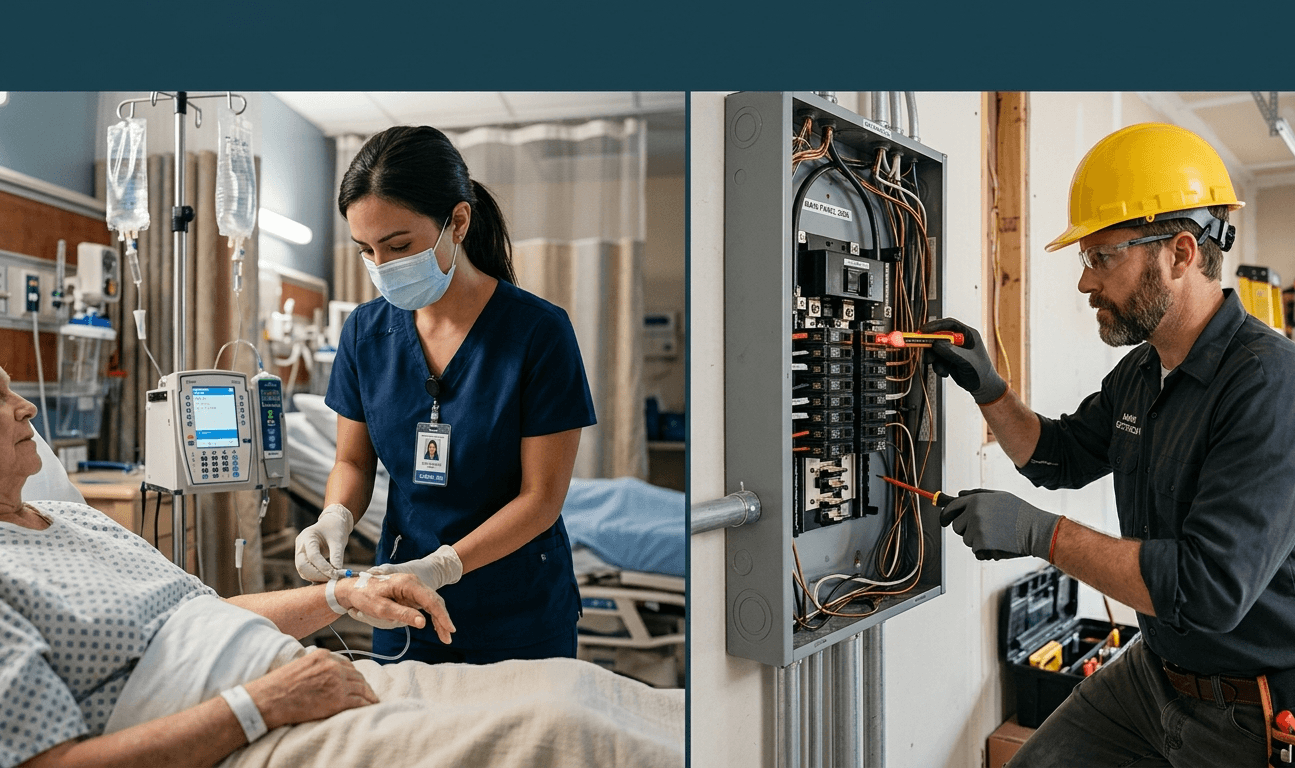
- 1A job AI cannot replace is one where core tasks require empathy, physical dexterity in unpredictable settings, or ethical judgment AI cannot replicate. Registered nurses carry 0.9% automation risk; electricians carry 1.2%, according to Oxford Martin School research.
- 2MIT economist Daron Acemoglu found AI can technically perform tasks in 11.7% of US jobs. Actual adoption is below 5%, blocked by economic barriers, liability frameworks, and social requirements for human practitioners (MIT, 2024).
- 3The WEF reported AI created 119,900 US jobs in 2024 while eliminating 12,700, a net gain concentrated in the highest-empathy and highest-dexterity roles. Healthcare alone adds roughly 40,000 jobs per month in the US.
A registered nurse carries a 0.9% chance of being replaced by AI. An electrician, 1.2%. A surgeon, 0.4%. These are not estimates from optimistic career advisors. They come from the Oxford Martin School's foundational automation study, the most-cited framework for measuring job displacement risk, updated with 2024 and 2025 data from the U.S. Bureau of Labor Statistics and MIT.
The honest picture is more nuanced than most guides suggest. MIT economist Daron Acemoglu found in 2024 that AI can technically perform tasks in about 11.7% of US jobs. But actual adoption is below 5%. The gap between what AI could automate and what is actually being automated is enormous, and it comes down to cost, liability, and the physical or social complexity that makes certain jobs uneconomical to replace.
After reading this guide, you will understand exactly which jobs carry the lowest automation risk, why AI cannot replicate core tasks in healthcare, skilled trades, and therapy, and what the research actually says about the gap between AI's technical capability and its real-world employment impact. The BLS growth projections, salary figures, and automation percentages are all here.
In This Article
- 1What makes a job AI cannot replace?
- 212 jobs AI cannot replace: automation risk, salary, and growth data
- 3Healthcare: the largest AI-proof sector
- 4Skilled trades: the physical jobs AI cannot enter
- 5The real numbers on AI and job replacement
- 6Jobs people assume are safe from AI (but aren't)
- 7What happens to work as AI continues to grow?
What makes a job AI cannot replace?
Jobs with the lowest automation risk share three properties. First, they require physical dexterity in unpredictable, non-repeating environments. Second, they depend on emotional attunement and trust-building that society requires to be human. Third, they involve ethical decisions where accountability must sit with a licensed person, not a system.
The Oxford Martin School's foundational 2013 study assessed 702 US occupations using expert surveys focused on bottleneck skills: perception and manipulation, creative intelligence, and social intelligence. Jobs scoring low on all three bottlenecks carried the highest replacement risk. Jobs scoring high on even one carried substantially lower risk.
According to Anthropic's 2025 research on AI task coverage, some jobs fall into a "zero-exposure" category: roles where AI completes fewer than 10% of core tasks even when given full access to tools. Examples include motorcycle mechanics (tactile diagnosis from sound and vibration), lifeguards (physical rescue in uncontrolled aquatic environments), and cooks (knife dexterity combined with sensory tasting and real-time menu adaptation). For context on where AI task coverage is highest, see our explainer on what large language models are and how they work.
The key distinction is not education level or salary. A data entry clerk earning $35,000 faces near-100% automation risk (Oxford 2013). A licensed electrician earning $61,590 faces 1.2% risk. What separates them is the nature of the work itself.
The three reasons AI cannot replace certain jobs
- Physical unpredictability: Residential plumbing, electrical work, and emergency medicine involve non-standard environments where every job site differs. Industrial robots are cost-effective in controlled factory lines. They are not economically viable in a 1960s house with three different pipe standards.
- Relational legitimacy: Society requires that certain decisions and forms of care be delivered by humans. A therapist who is "actually a chatbot" would lose patient trust regardless of output quality. That is a social enforcement of human roles, not just a technical limitation.
- Ethical liability: When a surgeon makes a wrong call, liability sits with a licensed professional and a hospital. When an AI system makes a wrong call, the liability chain is unclear, expensive to enforce, and politically unacceptable in high-stakes settings. This legal structure protects human roles in medicine, law, and public safety.
12 jobs AI cannot replace: automation risk, salary, and growth data
The table below draws from three sources: the Oxford Martin School automation probability model (2013, updated); the U.S. Bureau of Labor Statistics Occupational Outlook Handbook (2025 projections to 2033); and Anthropic's 2025 AI task-coverage study. All salary figures are US medians as of 2025.
| Job | Automation Risk | Why AI Cannot Replace | Median Salary (US) | BLS Growth to 2033 |
|---|---|---|---|---|
| Registered Nurse | 0.9% | Physical care, emotional support, adaptive bedside judgment | $89,010 | +6% |
| Surgeon | 0.4% | Micro-dexterity, ethical decisions, live emergency response | $236,000 | +3% |
| Electrician | 1.2% | Non-repeating physical environments, on-site code judgment | $61,590 | +6% |
| Plumber | ~2% | Tactile diagnosis, unpredictable residential conditions | $61,550 | +4% |
| Speech-Language Pathologist | 8.69% | Patient-specific tactile assessment, emotional coaching | $89,290 | +18% |
| Emergency Management Director | 0.0% | Crisis coordination, rapid human decision-making in chaos | $81,200 | +4% |
| Physical Therapist | 5-10% | Hands-on manipulation, patient motivation, personalized rehab | $99,710 | +15% |
| Occupational Therapist | 5-10% | Adaptive daily-living coaching, sensory integration therapy | $96,370 | +12% |
| Childcare Worker / Early Educator | <5% | Child development judgment, emotional attunement, safety | $31,080 | +3% |
| Firefighter | <5% | Unpredictable fire environments, physical rescue | $54,650 | +4% |
| Security Manager | 0.0% | Dynamic threat assessment, interpersonal trust management | $100,430 | +5% |
| Mental Health Counselor | <5% | Therapeutic relationship, trauma-informed care | $53,710 | +18% |
Sources: Oxford Martin School (2013, updated); BLS Occupational Outlook Handbook (2025); Anthropic AI task coverage study (2025).
The 18% growth projections for speech-language pathologists and mental health counselors stand out. These are roles where AI is adding administrative efficiency: note-taking, session summaries, and intake forms. This does not reduce demand for the human practitioner. AI tools in therapy practices are increasing practitioner productivity, allowing therapists to see more patients, which increases total demand for licensed practitioners.
Healthcare: the largest AI-proof sector
Healthcare is the single clearest example of a sector AI cannot replace. The U.S. Bureau of Labor Statistics projects healthcare will add roughly 40,000 jobs per month in the US through 2025 and beyond. That growth is happening at the same time as widespread AI adoption in radiology, diagnostics, and administrative processing.
The reason is straightforward. Nursing requires physical presence, hands-on assessment, and real-time emotional calibration. A nurse reading a patient's body language while adjusting medication dosage or explaining a diagnosis performs a task involving dozens of simultaneously-processed non-verbal signals. No current AI operates at that level of sensory integration in a live patient environment.
"Social and emotional skills are the hardest to automate and among the fastest-growing in demand through 2030, with healthcare roles showing rising demand rather than replacement." (McKinsey Global Institute, 2024)
Surgeons face 0.4% automation risk not because AI lacks surgical robotics capability. Systems like the da Vinci surgical robot are already widespread. The real barrier is that the ethical liability of autonomous surgical decisions cannot currently sit with a machine. When a surgeon makes an intraoperative judgment call, that decision has a licensed human accountable for it. That accountability structure is built into hospital credentialing, malpractice law, and patient consent frameworks in ways that preclude autonomous AI surgery.
The World Economic Forum's 2025 Future of Jobs report identifies health professionals as a top growth category through 2030. The specific roles cited, including nursing, physical therapy, and mental health counseling, are expanding precisely because AI is handling administrative and diagnostic support, freeing practitioners to see more patients.
Automation risk by healthcare role
- Registered nurses: 0.9% risk (Oxford Martin School). Fastest-growing segment in US healthcare employment.
- Physicians and surgeons: 0.4% risk. AI augments diagnosis; it does not replace the physician.
- Speech-language pathologists: 8.69% risk. 18.4% projected BLS growth by 2033.
- Mental health counselors: Under 5% risk. 18% projected BLS growth by 2033.
- Physical therapists: 5-10% risk. 15% projected BLS growth by 2033.
Every healthcare role that requires direct human contact and physical-emotional interaction is growing. The healthcare roles already partially automated, including medical transcription, routine radiology pre-reads, and insurance pre-authorization, are administrative and pattern-recognition tasks, not care delivery.
Skilled trades: the physical jobs AI cannot enter
Electricians carry 1.2% automation risk according to the Oxford Martin School. Plumbers carry roughly 2%. These figures might seem counterintuitive. Physical tasks are often assumed to be easy to automate. The reason skilled trades resist automation is not the education level involved. It is the environment.
A robot designed to replace an electrician would need to navigate a different house layout on every job. It would need to identify non-standard wiring from prior decades, adapt to code variations between municipalities, diagnose faults from visual inspection and touch, and make judgment calls about what "to code" means in a building partially modified over 40 years. The cost of building and maintaining a robot capable of that adaptive dexterity far exceeds the cost of paying a licensed electrician.
This is not a temporary gap. The McKinsey Global Institute noted in 2024 that 30% of tasks in administration and manufacturing could be automated by 2030. Blue-collar trade roles, including electricians, plumbers, and HVAC technicians, were specifically identified as among the least exposed, due to the physical variability of their work sites.
"Skilled trades are the clearest examples of physical jobs AI cannot replace, with 85-95% automation resistance due to unpredictable settings." (PrometAI, 2025)
The economics make this concrete. A licensed US electrician earns $61,590 median annually (BLS, 2024). The capital cost of a robot with comparable dexterity runs $100,000-200,000 per unit, plus maintenance, plus the inability to navigate a unique residential or commercial site. There is no business case for replacing electricians with robots in most settings.
Skilled trade job openings are projected at roughly 500,000 per year through 2030 (BLS). The shortage is not due to AI displacement. It is due to a workforce aging out of trades faster than new apprentices are entering.
The real numbers on AI and job replacement
Most coverage of AI and jobs focuses on the headline risk figures. The numbers that rarely make it into guides are the ones that change the entire debate.
"AI can technically perform work equivalent to approximately 11.7% of U.S. jobs; however, the actual implementation is slowed by economic, regulatory, and social barriers." (Daron Acemoglu, MIT, 2024)
That gap between 11.7% technically feasible and under 5% actually implemented represents more than 11 million US jobs. These are roles where AI could theoretically handle the tasks, but businesses have not deployed AI because of cost, liability, regulatory barriers, or because customers and patients require a human in the role.
The number most guides don't show
The US workforce has approximately 168 million employed workers. At 11.7% technical feasibility (MIT, Acemoglu 2024), AI could theoretically automate tasks in roughly 19.7 million jobs. At under 5% actual adoption, fewer than 8.4 million jobs are currently seeing meaningful AI task replacement.
The gap is over 11 million jobs that are technically automatable but not being automated, larger than the entire US healthcare workforce. It exists because automation requires upfront capital, workflow integration, liability coverage, regulatory approval in many sectors, and customer or patient acceptance. For hospital nursing, customer acceptance alone blocks automation regardless of technical capability.
The World Economic Forum reported in 2025 that AI created 119,900 new US jobs in 2024 while eliminating 12,700, a net gain of roughly 107,200 jobs. Those created roles concentrated in data annotation, AI operations, AI-adjacent technical support, and high-empathy service roles where AI drove increased demand for human practitioners.
Goldman Sachs projected in 2023 that AI could affect up to 300 million full-time jobs globally. That figure, often cited as an alarm, represents possible task changes over a decade across 40 countries. It includes roles where AI handles 10% of tasks, not roles being fully replaced. At the per-country level, it translates to gradual task shifts.
According to the McKinsey Global Institute's 2024 Future of Work research, the occupations with the highest displacement risk share one feature: repetitive, predictable tasks with well-defined inputs and outputs. That description does not match nursing, electrical work, surgery, or therapy.
Jobs people assume are safe from AI (but aren't)
The assumption that white-collar jobs are safer than blue-collar jobs is exactly backwards for some roles. Anthropic's 2025 task-coverage study found that AI completes approximately 75% of core programmer tasks when given full access to a codebase. Customer service representatives, previously considered mid-risk, are now estimated at 70-80% automation exposure by 2027 (Davron Research, 2025).
The jobs most at risk share a different property than physical labor. They involve repetitive cognitive tasks with predictable inputs: data entry (99% risk, Oxford 2013), bookkeeping (94% risk), and customer service (67-80% risk). These are roles where the task structure is well-defined enough for an AI system to handle reliably at scale.
Previously "safe" roles now facing real pressure:
- Radiologists: Oxford 2013 rated this as low risk due to medical expertise requirements. AI image analysis now handles 15% of routine radiology reads. Full replacement remains unlikely because of diagnostic accountability, but task erosion is real.
- Accountants and bookkeepers: 94% automation risk per Oxford 2013. Tools like QuickBooks AI and Intuit Assist now handle routine categorization, reconciliation, and payroll reporting. The CPA handling complex tax strategy faces much lower risk than the bookkeeper handling standard month-end close.
- Customer service representatives: 67% risk in 2013 has risen to 70-80% estimated exposure by 2027 as large language models handle tier-1 support at scale. The human role shifts toward de-escalation and complex case management.
- Entry-level creative roles: Pew Research (2024) estimated 30% of entry-level creative positions face risk by 2035. This applies to certain copywriting, basic graphic design, and social media scheduling, not to senior creative roles requiring strategic judgment.
The pattern: risk follows task structure, not job prestige. A $150,000-per-year accountant doing routine reconciliation is more exposed than a $55,000-per-year electrician doing residential wiring. For a profession-by-profession breakdown of exactly what AI can and cannot do in programming, law, medicine, and accounting specifically, see our companion guide on will AI take over your job.
What happens to work as AI continues to grow?
The long-term picture is not mass unemployment. It is task redistribution. AI replaces specific tasks within jobs, which reshapes what those jobs involve, rather than eliminating the roles.
For nurses, AI is handling documentation: clinical notes, discharge summaries, and medication schedules, saving roughly 30-40 minutes per shift. The result is not fewer nurses. It is nurses spending more time on direct patient care, which has driven up demand for nursing hours in facilities that have adopted AI documentation tools.
For electricians, AI-enabled building management systems now handle fault monitoring and predictive maintenance remotely. This has not reduced demand for electricians. It has created a subspecialty: smart building technicians who install, configure, and maintain AI-enabled electrical systems. BLS projects electrician employment will grow 6-8% through 2030.
The careers that will genuinely shrink are those built on tasks AI performs well: high-volume, predictable, document-based work. The careers that will grow are those built on physical presence, relational trust, and ethical accountability in high-stakes situations.
"The World Economic Forum identifies leadership, critical thinking, resilience, and people management as the top required skills for 2025-2030. Health professionals face rising demand, not displacement." (WEF Future of Jobs Report, 2025)
For anyone planning a career change, the BLS data points to three sectors with strong long-term demand despite rising AI adoption: healthcare (40,000 jobs added monthly), skilled trades (500,000 openings per year), and mental health services (18% projected growth through 2033). These sectors are growing because of social demand that AI cannot meet, not despite AI's capabilities. For context on what AI is actually trained to do and where its task limits sit, see our guide on how AI training differs from AI inference.
Frequently Asked Questions
What job AI can't replace?
The jobs AI cannot replace share one of three properties: physical dexterity in unpredictable environments (electricians, plumbers, surgeons), emotional attunement where the human relationship is the product (therapists, nurses, counselors), or ethical accountability that must sit with a licensed person (judges, surgeons, emergency managers). Registered nurses carry 0.9% automation risk. Electricians carry 1.2%. Emergency management directors carry 0.0%, according to Oxford Martin School data updated through 2025.
Will AI replace nurses?
No, not in any meaningful near-term timeframe. Registered nurses carry a 0.9% automation risk according to Oxford Martin School research, one of the lowest figures of any occupation studied. The BLS projects nursing employment to grow 6-9% through 2033, and the US adds roughly 40,000 healthcare jobs per month. AI is being adopted in nursing for documentation and administrative tasks, but this is increasing nurse productivity and demand for nursing hours, not replacing nurses. The physical care, emotional support, and adaptive bedside judgment that defines nursing cannot be replicated by current or foreseeable AI systems.
Are electricians safe from AI?
Yes. Electricians carry 1.2% automation risk according to Oxford Martin School research. The reason is environmental: every residential or commercial electrical job involves a different layout, non-standard wiring from prior decades, code variations between municipalities, and judgment calls about what "to code" means in a building modified multiple times over decades. The capital cost of building a robot with that level of adaptive dexterity far exceeds the cost of paying a licensed electrician. BLS projects 6-8% electrician job growth through 2030, with roughly 500,000 trade job openings per year nationwide.
Which jobs will AI never replace?
The jobs with the lowest and most durable automation resistance include: surgeons (0.4% risk), registered nurses (0.9%), electricians (1.2%), plumbers (~2%), emergency management directors (0.0%), and security managers (0.0%), according to Oxford Martin School data. These jobs combine physical unpredictability, ethical liability, or relational trust in ways that current AI cannot replicate. Physical therapists (5-10% risk), mental health counselors (under 5%), and skilled tradespeople generally are also among the most durable AI-proof career categories through at least 2033 based on BLS projections.
Is being a therapist safe from AI?
Yes. Mental health counselors carry under 5% automation risk, and speech-language pathologists carry 8.69%, both among the lowest rates across professional occupations. The BLS projects 18% job growth for mental health counselors through 2033 and 18.4% for speech-language pathologists, driven partly by AI handling administrative work which allows therapists to see more patients. The therapeutic relationship itself, which requires sustained trust, emotional attunement, trauma-informed presence, and session-by-session adaptation, is one of the tasks Anthropic's 2025 research classifies as AI-inaccessible at its core.
What is the complete list of jobs AI won't replace?
No list will remain accurate indefinitely as AI capabilities expand. But the jobs with durable, research-backed AI resistance include: registered nurses, surgeons, emergency room physicians, speech-language pathologists, physical therapists, occupational therapists, mental health counselors, licensed electricians, plumbers, HVAC technicians, motorcycle mechanics, firefighters, emergency management directors, security managers, early childhood educators, and skilled construction tradespeople. What unites them is physical unpredictability, relational trust, or ethical liability: the three properties that make automation economically or socially unfeasible regardless of AI capability.
What makes a job safe from AI?
Three properties make a job reliably safe from AI replacement. First, physical dexterity in unpredictable environments: jobs like plumbing, electrical work, and surgery involve non-repeating physical contexts where every situation differs. Second, relational legitimacy: society requires certain roles to be human, including therapy, childcare, and primary care, regardless of AI output quality. Third, ethical liability: roles where a wrong decision requires a licensed human accountable for it (surgeons, judges, emergency managers) are structurally protected by legal and institutional frameworks. MIT economist Daron Acemoglu (2024) found that even where AI is technically capable of performing job tasks, actual adoption is blocked by these barriers in the majority of cases.
Related Articles
Will AI Replace Programmers, Engineers, Writers, and Accountants? The Real Answer
13 min read
Is AI Bad for the Environment? The Real Numbers
10 min read
What Is an LLM? Large Language Models Explained
10 min read
AI Training vs Inference: What's the Difference and Why the Cost Gap Is Growing
10 min read