
How Do AI Companies Make Money? The Real Revenue Story in 2026

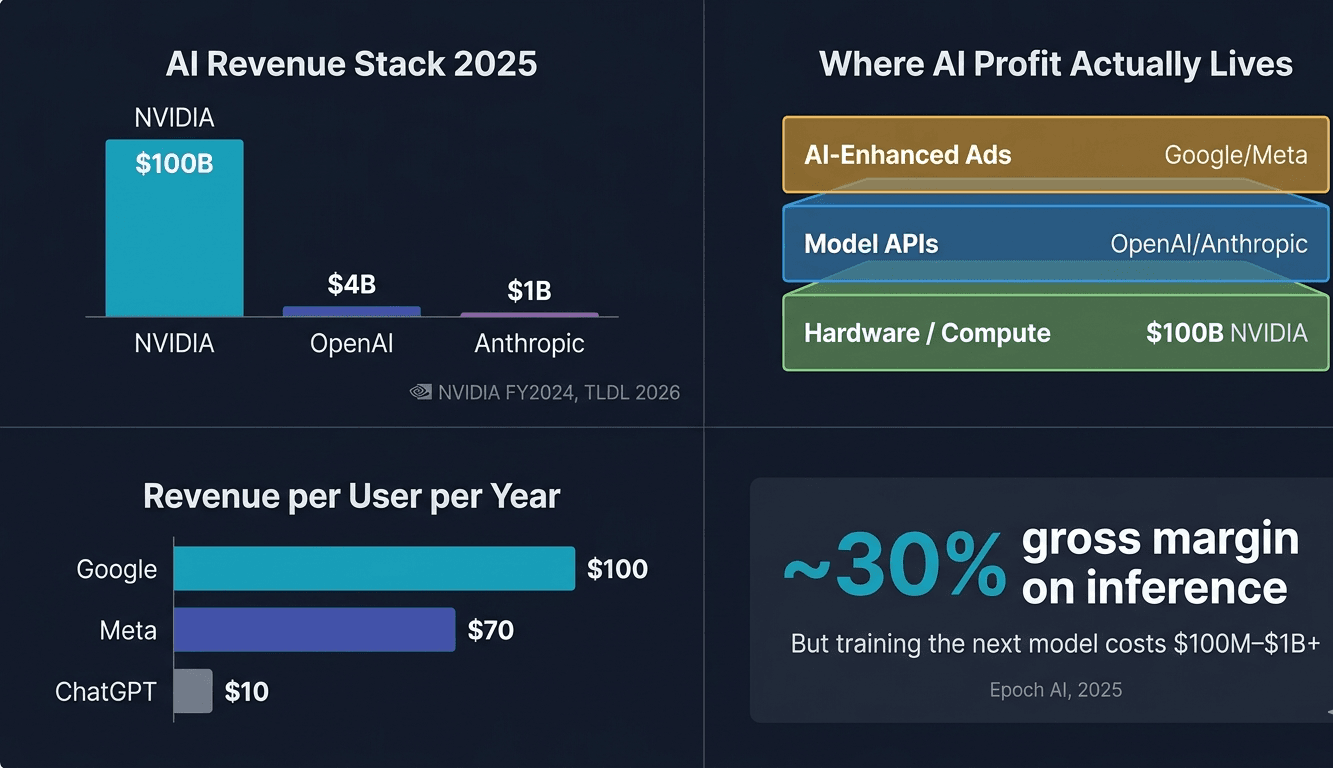
Key Numbers
Key Takeaways
- 1AI companies make money through four main channels: API usage fees charged per token, monthly subscriptions ($20/month consumer, $30/user enterprise), multi-year enterprise contracts, and selling the compute infrastructure AI runs on. The most profitable layer today is hardware and cloud, not model access.
- 2OpenAI estimated $4B ARR in 2025 at approximately 30% gross margin on inference. That gross profit is largely consumed by training the next model generation, which is why AI labs are revenue-rich but not yet consistently GAAP profitable at the company level.
- 3ChatGPT generates approximately $10 per user per year. Google generates $100 per user per year from the same population. That 10x gap explains why every major AI company prioritises enterprise contracts over consumer scale: one $1M enterprise deal replaces 100,000 consumer subscribers.
ChatGPT has over 900 million weekly active users. It generates approximately $10 per user per year. Google reaches 4 billion users and generates $100 per user per year, almost entirely through advertising that AI makes more accurate. That gap is the defining fact of AI business models in 2026.
There are four layers in the AI revenue stack, and they do not earn money at the same rate. At the bottom, chip makers and cloud providers selling the compute AI runs on are already generating large, confirmed profits. In the middle, model providers like OpenAI and Anthropic are growing fast but spending their gross profits on training the next generation. At the top, applications built on AI are growing quickly but competing intensely on price.
According to analysis by Epoch AI, running a frontier AI model can generate a gross margin of around 30%, which sounds healthy until you account for the cost of training the next model. A single training run for a frontier model now costs hundreds of millions of dollars. The margin from one year of inference can be consumed by one training campaign. Understanding which businesses are actually profitable, and why, requires looking at each layer of the stack separately.
In This Article
- 1The Four Layers of the AI Revenue Stack
- 2API Token Pricing: How Pay-Per-Query Revenue Works
- 3Subscriptions and Enterprise Contracts: Where Bulk Revenue Sits
- 4Hardware and Cloud Infrastructure: The Most Profitable AI Business
- 5Are AI Companies Profitable? The Unit Economics Explained
- 6The Per-User Revenue Gap: Why AI Needs Enterprise More Than Consumer
- 7AI Revenue Projections: What Analysts Forecast Through 2030
The Four Layers of the AI Revenue Stack
AI revenue does not flow from a single source. It flows through a stack of four distinct layers, each with different margins, business models, and profitability profiles.
Layer one is hardware and compute infrastructure. NVIDIA sells the GPUs that train and run AI models. Cloud providers (AWS, Azure, Google Cloud) rent that compute by the hour. These are the most clearly profitable AI businesses in 2026. NVIDIA's data center revenue exceeded $100 billion in fiscal year 2024, driven almost entirely by demand for H100 and H200 GPUs from AI labs and cloud providers (NVIDIA Q4 FY2024 earnings). The cloud providers add their own margins on top of hardware cost, selling managed AI infrastructure to companies that cannot or do not want to run their own GPU clusters.
Layer two is foundation model access. OpenAI, Anthropic, Google DeepMind, xAI, and Mistral sell access to large language models via APIs (per-token pricing), subscriptions ($20-30/month per user), and enterprise contracts. This is the most visible layer publicly but is not yet the most profitable.
Layer three is AI-enhanced software. Microsoft sells Copilot as an add-on to Office 365 at $30 per user per month. Google bundles Gemini into Workspace at $10-30 per user per month depending on tier. These are AI features layered onto already-profitable software businesses.
Layer four is AI-optimised advertising. Google and Meta use AI to improve ad targeting, content ranking, and fraud detection. This is the least visible form of AI monetisation and arguably the most profitable. Google generates approximately $100 per user per year (New Yorker, 2024) largely through advertising made more valuable by AI.
| Revenue Layer | Who Earns Here | Business Model | Profitability (2026) |
|---|---|---|---|
| Hardware and compute | NVIDIA, AMD, cloud providers | GPU sales, hourly compute rental | High: NVIDIA >$100B data center revenue |
| Foundation model access | OpenAI, Anthropic, xAI, Mistral | API tokens, subscriptions, enterprise | Mixed: ~30% gross margin, not yet GAAP profitable |
| AI-enhanced software | Microsoft, Google Workspace | SaaS add-ons and premium tier pricing | High: layered onto profitable existing products |
| AI-optimised advertising | Google, Meta | Ad targeting improvements, no separate cost | Very high: pure margin enhancement on existing revenue |
The practical implication: if you use ChatGPT, you are in layer two. If you use Google Search, you are in layer four. The company making the most money from AI in both cases is NVIDIA, which sold the hardware that processes your query.
API Token Pricing: How Pay-Per-Query Revenue Works
The API layer is where AI models are sold as a metered utility. Companies pay per token, where one token is roughly three to four characters of text. Pricing varies by model tier and has been falling steadily as competition increases.
As of March-April 2026, the major model providers charge the following for their flagship models:
| Model | Input per million tokens | Output per million tokens |
|---|---|---|
| GPT-4.1 (OpenAI) | $5.00 | $15.00 |
| GPT-4o (OpenAI) | $2.50 | $5.00 |
| Claude 4 Sonnet (Anthropic) | ~$3.00-5.00 | ~$15.00 |
| Gemini 1.5 Pro (Google) | ~$3.50 | ~$10.50 |
| Mistral Large (Mistral) | ~$2.00 | ~$6.00 |
To put those numbers in context: a typical business document processing task, reading a 10-page contract (~8,000 input tokens) and producing a 500-token summary, costs approximately $0.05 at GPT-4.1 pricing. At one million documents per day, that is $50,000 per day or $18 million per year, which explains why legal, insurance, and financial services are among the largest enterprise API customers.
The Subscription Math
A typical ChatGPT conversation uses roughly 1,500 input tokens and 500 output tokens. At GPT-4.1 pricing, that is about $0.015 per conversation in raw compute cost. A ChatGPT Plus subscriber paying $20 per month and having 100 conversations generates approximately $1.50 in compute cost, a 13x revenue-to-compute ratio at the conversation level. The actual gross margin across the full user base is far lower because of infrastructure overhead, the free-tier users who generate cost without revenue, and the expense of running other model types, but it illustrates that the per-conversation economics of subscriptions are not inherently broken.
OpenAI has cut API prices multiple times since 2023. GPT-4-class models that cost $60 per million tokens at launch now cost $5-15 per million. This price compression is driven by hardware efficiency improvements (newer GPU generations run inference cheaper), model optimisation (quantisation and distillation reduce compute per token), and competitive pressure from Anthropic, Google, and open-source alternatives. Cheaper tokens mean more usage but narrower margins on each unit sold.
Subscriptions and Enterprise Contracts: Where Bulk Revenue Sits
For the companies with the most AI revenue, subscriptions and enterprise contracts matter more than public API access. Consumer subscriptions at $20/month generate predictable recurring revenue. Enterprise contracts at six to eight figures annually are where the revenue concentrates.
Consumer Subscriptions
The major AI consumer subscription prices as of Q1-Q2 2026:
| Product | Price | Provider | Key features |
|---|---|---|---|
| ChatGPT Plus | $20/month | OpenAI | GPT-4.1, DALL-E 3, Sora access, priority capacity |
| Claude Pro | $20/month | Anthropic | Claude 4, priority access, extended context |
| Gemini Advanced | $19.99/month | Gemini Ultra, bundled with 2TB Google One storage | |
| GitHub Copilot | $10-19/month | Microsoft | Code completion, chat in IDE, PR summarisation |
| Copilot for M365 | $30/user/month | Microsoft | AI in Word, Excel, Teams, Outlook |
| ChatGPT Team | ~$25-30/user/month | OpenAI | Admin controls, higher limits, workspace features |
The $20/month price point is not accidental. OpenAI set it in early 2023 and Anthropic matched it. At a roughly 30% gross margin on inference, $20/month covers the compute cost of a reasonably active user and leaves margin for overhead.
Enterprise: The Largest Revenue Pool
Enterprise contracts are where AI companies generate their largest individual deals. ChatGPT Enterprise is sold on custom pricing that typically involves per-seat licensing plus usage commitments. OpenAI has confirmed enterprise customers across financial services, legal, and technology sectors but does not publish specific contract values.
For Microsoft, Copilot at $30/user/month represents a 27% price premium over the common Office 365 E3 license ($22/user/month). Microsoft has an estimated 400 million Office 365 users. If 10% convert to Copilot, that is 40 million users at $30/month, or $14.4 billion in annualised Copilot revenue. Analysts treating Microsoft's AI monetisation as the most credible near-term enterprise AI revenue story are pointing at exactly this conversion math (Liontrust AI Revenue Report, 2026).
"We make money from our API, from subscriptions, and from our enterprise products. The challenge is that compute costs are enormous, and we are reinvesting everything into the next generation." (Sam Altman, CEO OpenAI, Lex Fridman Podcast, March 2024)
Hardware and Cloud Infrastructure: The Most Profitable AI Business
The clearest, most confirmed AI revenue story is not in model subscriptions. It is in the hardware and cloud infrastructure that model training and inference require. For a look at what that infrastructure physically looks like and how much power it consumes, see AI data center power consumption.
NVIDIA's data center segment generated over $100 billion in fiscal year 2024. That is more than the estimated combined ARR of every frontier AI model lab in existence.
"We are at the beginning of a new industrial revolution where companies are racing to build AI factories." (Jensen Huang, CEO NVIDIA, GTC Keynote, March 2024)
NVIDIA's role as the primary supplier of AI accelerators means it collects revenue from every layer of the stack: model labs training new models, cloud providers running inference, and enterprises deploying private AI infrastructure.
The Picks-and-Shovels Calculation
TLDL AI Companies Landscape 2026 estimates combined ARR across the major frontier model labs:
- OpenAI: approximately $4 billion ARR (2025)
- Anthropic: approximately $1 billion ARR (2025)
- xAI: approximately $100 million ARR (2025)
- Mistral AI: approximately $100 million ARR (2025)
- Combined: approximately $5.2 billion
NVIDIA's data center revenue alone was over $100 billion in fiscal 2024. The company selling hardware to train and run AI models earns roughly 20 times more than all frontier AI model companies combined. This is the picks-and-shovels dynamic from gold rush history applied to AI: the companies selling equipment to the miners profit more than the miners.
Cloud Provider AI Revenue
AWS, Microsoft Azure, and Google Cloud all generate substantial revenue from AI infrastructure, though none publishes a standalone AI revenue line:
- AWS runs Trainium (training) and Inferentia (inference) chips on its platform, offers Amazon Bedrock for managed model access, and rents NVIDIA GPU time from its GPU-equipped instances.
- Microsoft Azure hosts OpenAI models under an exclusive partnership and resells API access; the Intelligent Cloud segment grew 21% year-over-year in FY2025 with AI explicitly cited as a growth driver.
- Google Cloud sells Vertex AI and GPU-enabled compute; Google Cloud revenue grew 28% year-over-year in Q4 2024, with AI workloads cited as a primary driver.
NVIDIA and the cloud providers are, as of 2026, the clearest financial beneficiaries of the AI investment cycle. That money flows from AI labs training models, from enterprises deploying inference workloads, and from cloud providers building their own AI infrastructure to serve both groups. Understanding what AI data centers actually are helps clarify why the infrastructure layer captures so much of the revenue.
AI Revenue Comparison by Company: Confirmed and Estimated 2025 (USD Billions)
NVIDIA is confirmed reported revenue (FY2024). All other figures are analyst estimates from TLDL AI Companies Landscape 2026 and have not been independently audited.
| Category | Value | Unit |
|---|---|---|
| NVIDIA (data center) | 100 | B USD |
| OpenAI (est. ARR) | 4 | B USD |
| Anthropic (est. ARR) | 1 | B USD |
| xAI (est. ARR) | 0.1 | B USD |
| Mistral (est. ARR) | 0.1 | B USD |
Are AI Companies Profitable? The Unit Economics Explained
The answer depends entirely on which layer you are asking about.
Hardware and cloud providers (NVIDIA, AWS, Azure, Google Cloud): profitable. These companies report real operating income. NVIDIA's data center gross margins are above 70%. Cloud AI is a positive-margin business for all three major hyperscalers.
Big Tech using AI to enhance advertising (Google, Meta): profitable. AI makes existing ad platforms more effective with no separate cost line on the income statement. This is the purest form of AI monetisation.
Independent model labs (OpenAI, Anthropic, xAI, Mistral): growing revenue, not yet consistently GAAP profitable. Research from Epoch AI explains the mechanism clearly.
The Gross Margin Trap
"Each model generation can be profitable at the gross-margin level, but total company profits may still be negative because R&D for the next model generation is so expensive." (Epoch AI, Can AI Companies Become Profitable?, 2025)
According to Epoch AI's analysis of AI company economics, running a frontier model can achieve a gross margin of approximately 30%. At $4 billion in revenue, that is around $1.2 billion in gross profit from inference. That sounds viable. The problem is the cost of the next model.
Training GPT-4 was estimated to cost between $100 million and $500 million. Training frontier models in 2025-2026 costs more. Anthropic has reportedly spent over $1 billion on model training in a single year. If gross profit from running the current model is $1.2 billion and training the next one costs $1-2 billion, the company is investing all its operational gross profit into the next generation of R&D, leaving operating income near zero.
The Number Most Guides Don't Show
Here is the calculation that makes the economics clear. OpenAI prices GPT-4.1 at $5 per million input tokens and $15 per million output tokens. A typical API query uses roughly 2,000 tokens total. The compute cost per query at those prices, assuming 30% gross margin, means OpenAI earns $0.02 per query in revenue and retains $0.006 in gross profit.
To generate $1 billion in gross profit from API calls at $0.006 per query, OpenAI would need approximately 167 billion queries annually. At 900 million weekly users each making one query per week, that is 46.8 billion queries per year. Reaching $1 billion in gross profit from API economics alone requires approximately 3.5 times the current ChatGPT query volume at current pricing, before accounting for free-tier queries that generate no revenue.
This is a scale problem, not a fundamental economics failure. AI query volume is growing fast. But it explains why OpenAI needs subscription revenue, enterprise contracts, and continued external capital alongside API revenue. Any company relying on consumer API revenue alone is unlikely to reach operating profit at current prices.
The Per-User Revenue Gap: Why AI Needs Enterprise More Than Consumer
The most revealing comparison in AI business models is per-user revenue, and the numbers are stark.
ChatGPT has over 900 million weekly active users. According to analysis cited in The New Yorker's Financial Page (2024), it generates approximately $10 per user per year. Alphabet reaches approximately 4 billion users and generates approximately $100 per user per year, almost entirely through advertising that AI makes more effective. Meta reaches 3.5 billion users and generates approximately $70 per user per year through the same mechanism.
ChatGPT has a similar-sized user base to a large ad platform. It monetises at one-tenth the rate.
This gap is structural. Google and Meta have had decades to build the advertising infrastructure that turns user attention into revenue: ad auction systems, measurement tools, agency relationships, and targeting data developed across billions of interactions. ChatGPT is three years old.
AI chat is also not an advertising surface in the same way. A Google search results page runs four to eight paid ads. A ChatGPT response does not (yet) run ads. Until AI assistants introduce advertising or another high-volume per-user monetisation mechanism, the revenue-per-user gap with ad platforms will persist.
The enterprise math is more direct. A single enterprise contract at $1 million per year replaces 100,000 consumer subscribers generating $10 per year each. A contract at $10 million replaces 1 million subscribers. This is why every major AI company's commercial strategy in 2025-2026 concentrates on enterprise: the per-customer revenue is orders of magnitude higher, and the churn rate is lower.
According to NVIDIA's State of AI 2026 survey, 88% of enterprises report that AI has increased annual revenue, and 87% say it has reduced annual costs. That two-sided value proposition is the sales argument that justifies large enterprise contracts that small per-user consumer fees cannot replicate.
Revenue Per User Per Year: AI Chat vs Ad Platforms (2024)
Google and Meta figures are total advertising revenue divided by monthly active users. ChatGPT figure is an estimate based on reported ARR and user count, not a disclosed per-user revenue figure.
| Category | Value | Unit |
|---|---|---|
| Google (Alphabet) | 100 | $/user/year |
| Meta | 70 | $/user/year |
| ChatGPT (OpenAI) | 10 | $/user/year |
AI Revenue Projections: What Analysts Forecast Through 2030
The market size projections for AI vary widely depending on how "AI revenue" is defined, but the directional trend from every major analyst firm is the same: large and fast-growing.
Grand View Research estimates the global AI market at approximately $196 billion in 2023, projecting growth to around $1.8 trillion by 2030, a compound annual growth rate of approximately 37-38%.
McKinsey estimates that generative AI could add $2.6 to $4.4 trillion annually to the global economy across use cases, though this is economic impact including productivity gains and cost savings, not vendor software revenue.
Goldman Sachs projects that AI could drive a 7% increase in global GDP and lift productivity growth by approximately 1.5 percentage points annually over a decade.
Gartner forecasts AI software markets expanding at over 20% CAGR through 2030, with foundation model platforms and AI application services among the fastest-growing segments.
For individual companies, the near-term revenue targets circulating in 2026 are:
| Company | 2025 ARR Estimate | 2026 Revenue Target | Source |
|---|---|---|---|
| OpenAI | ~$4B | $30B | TLDL AI Companies Landscape 2026 |
| Anthropic | ~$1B | $12B | TLDL AI Companies Landscape 2026 |
| Google (AI-attributed) | $5B+ explicitly attributed | Not separately disclosed | TLDL and Google filings |
| xAI | ~$100M | Not disclosed | TLDL |
| Mistral | ~$100M | Not disclosed | TLDL |
The gap between 2025 ARR and 2026 targets is striking. OpenAI's $30 billion target represents roughly a 7x increase on 2025 ARR in a single year. Most independent analysts treat those targets as aspirational rather than firm forecasts. The more conservative projection that analysts broadly agree on: AI software and cloud AI services will be a multi-hundred-billion-dollar market by the late 2020s, with infrastructure and cloud capturing the largest confirmed revenue, and model access companies still establishing sustainable unit economics.
Frequently Asked Questions
How does OpenAI make money?
OpenAI makes money through three main channels: API access (charging per token for GPT-4.1 at $5/M input and $15/M output), consumer subscriptions (ChatGPT Plus at $20/month and ChatGPT Team at roughly $25-30/user/month), and enterprise contracts (ChatGPT Enterprise on custom pricing for large organisations). Industry estimates place OpenAI's 2025 ARR at approximately $4 billion, with a stated 2026 revenue target of $30 billion (TLDL AI Companies Landscape 2026). Gross margin on inference is estimated at approximately 30%, but model training costs for the next generation consume most of that gross profit, leaving overall operating income near zero.
Is AI profitable?
Profitability depends on which layer you are asking about. Hardware and cloud infrastructure (NVIDIA, AWS, Azure, Google Cloud) are clearly profitable. NVIDIA's data center revenue exceeded $100 billion in fiscal 2024 with gross margins above 70%. Big Tech companies using AI to enhance advertising (Google, Meta) are also profitable, because AI improves their ad platforms with no separate cost line. Independent frontier model labs (OpenAI, Anthropic, xAI) generate $1B to $4B in annual revenue but are not yet consistently GAAP profitable: they run approximately 30% gross margins on inference but can spend $1B or more of that gross profit on training the next model generation, leaving operating income at or near zero. The Harvard Business Review analysis (2025) describes AI model labs as having compelling revenue growth but an unproven path to consistent operating profit.
How much does it cost to use an AI API per query?
The cost depends on the model and the length of the request and response, measured in tokens. At GPT-4.1 pricing ($5/M input, $15/M output), a typical query with 1,500 input tokens and 500 output tokens costs approximately $0.015 (1.5 cents). A 10-page document analysis using 8,000 input tokens costs about $0.04. More affordable models are significantly cheaper: Mistral Large starts at around $2/M input, and open-source models run on self-hosted hardware cost near zero per query in marginal terms. Google Gemini and Anthropic Claude are priced in a similar range to GPT-4-class models, roughly $3-15 per million tokens depending on input vs. output and model version.
Why do so many AI companies lose money?
Most frontier AI companies lose money at the operating level because training the next model costs more than the gross profit from running the current one. At an estimated 30% gross margin on inference (Epoch AI, 2025), a company with $4 billion in revenue generates around $1.2 billion in gross profit. Training a frontier model in 2025-2026 costs hundreds of millions to over $1 billion. Operating expenses including staff, offices, and non-compute costs add further. The result: revenue grows fast, gross margins are positive, but total operating profit is near zero because the business continuously reinvests in the next generation. This pattern is structurally similar to pharmaceutical R&D: high development costs, positive product margins, delayed total profitability until scale is reached.
What is the difference between how OpenAI and Google make money from AI?
OpenAI makes money by selling direct access to its models: subscriptions ($20/month), API tokens ($5-15/million), and enterprise contracts. AI is OpenAI's core product. Google primarily makes money through advertising, and uses AI to make that advertising more valuable: better search ranking, more accurate ad targeting, and more relevant content recommendations increase the value of ads served to 4 billion users. Google generates approximately $100 per user per year (New Yorker, 2024), compared to approximately $10 per user per year for ChatGPT. Google also sells direct AI access through Gemini Advanced ($19.99/month) and Google Cloud AI APIs, but this is a smaller share of total revenue than AI-enhanced advertising.
How much does Microsoft Copilot cost and how does it generate revenue?
Microsoft Copilot for Microsoft 365 is priced at $30 per user per month, added on top of existing Office 365 or Microsoft 365 licenses. GitHub Copilot costs $10 to $19 per user per month depending on the plan. Copilot functions as an AI add-on to Microsoft's existing software stack: Word, Excel, Teams, Outlook, and PowerPoint gain AI-generated draft suggestions, meeting summaries, and data analysis features. The $30/user/month price is a 27% premium over the common Office 365 E3 license price. If Microsoft converts 10% of its estimated 400 million Office 365 users to Copilot, that generates approximately $14.4 billion per year in additional subscription revenue, making it one of the largest discrete AI revenue opportunities in enterprise software.
How does NVIDIA make money from AI?
NVIDIA makes money from AI by selling the GPUs and AI accelerators used to train and run AI models. Its H100, H200, and B200 GPU series are the standard hardware for frontier model training at OpenAI, Anthropic, Google, Meta, and Microsoft. NVIDIA also sells NVLink networking, DGX servers, and its CUDA and TensorRT software stack. Data center revenue exceeded $100 billion in NVIDIA's fiscal year 2024, its largest and fastest-growing segment. Cloud providers (AWS, Azure, Google Cloud) are NVIDIA's largest customers, buying GPUs to rent back to AI companies and enterprises. NVIDIA does not charge per query or per token: it sells hardware upfront, capturing value regardless of whether AI products built on that hardware become profitable.