
What Is Vibe Coding? How AI-Assisted Coding Actually Works

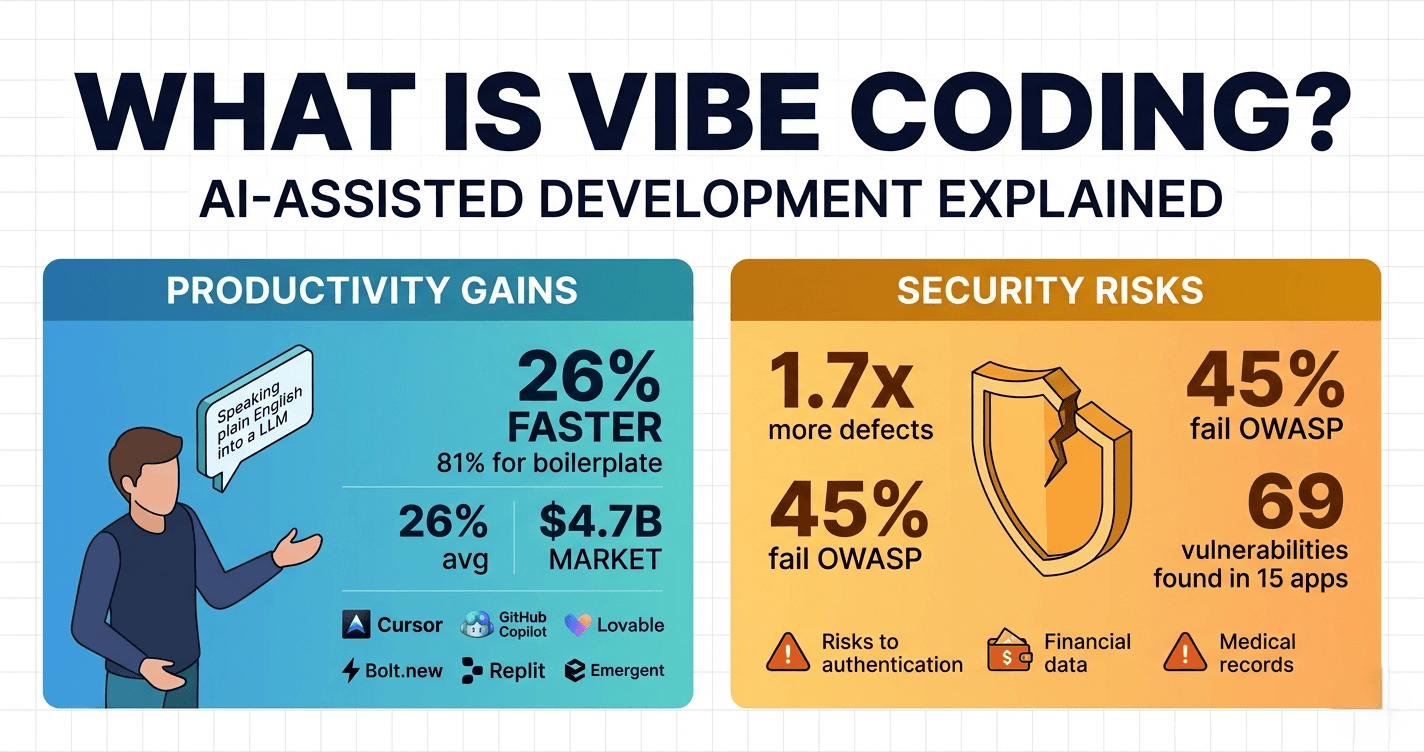
Key Numbers
Key Takeaways
- 1Vibe coding is a programming approach coined by Andrej Karpathy in February 2025 where you describe what you want in plain English and an LLM generates the code. By 2026, 92% of US developers use AI coding tools daily, and Gartner projects 60% of all new code will be AI-generated by year end.
- 2The vibe coding market reached $4.7 billion in 2026 at 38% CAGR. Cursor hit $2 billion in annual recurring revenue by February 2026 (Bloomberg). GitHub Copilot serves 20 million+ developers globally.
- 3AI-generated code is 26% faster on average but contains 1.7 times more major issues than human-written code (CodeRabbit, 2025), and 45% of samples fail OWASP Top-10 security benchmarks. Best suited for prototypes and internal tools, not security-critical production systems.
Vibe coding is programming by conversation. You describe what you want in plain English, a large language model writes the code, and you test and refine through natural language prompts rather than typing syntax manually.
Andrej Karpathy, former head of AI at Tesla and a founding researcher at OpenAI, coined the phrase in February 2025 on X. He described it as "fully giving in to the vibes" when building with AI tools, accepting generated code without reviewing every line and debugging through conversation. Within 18 months, the concept went from a single post to a Merriam-Webster dictionary entry, a $4.7 billion market, and a workflow that 92% of US developers now use daily, according to the Taskade State of Vibe Coding 2026 report.
If you want a grounded, data-based explanation rather than an enthusiast overview, this is it.
In This Article
What Is Vibe Coding?
Vibe coding is an AI-assisted approach to software development where you specify desired behavior in plain language and a large language model generates the corresponding code. You then run, test, and refine through further prompts rather than manual line-by-line editing.
The term was coined by Andrej Karpathy in February 2025 on X. He described the experience as "fully giving in to the vibes": accepting AI-generated code without reviewing every line, letting the LLM fix errors through conversation, and focusing on product behavior rather than implementation details. The phrase spread fast because it named something developers were already doing but had no shorthand for.
Merriam-Webster now defines vibe coding as "the act or practice of using an artificial intelligence system to generate computer code," noting that practitioners "do not need to understand how or why the code works." That last clause captures both the appeal and the risk in a single sentence.
The distinction from earlier AI coding tools is intent versus suggestion. GitHub Copilot, launched in 2021, autocompletes lines or functions while you type, keeping the developer in the driver's seat. Vibe coding flips the model entirely: you describe the goal, and the AI produces a complete implementation.
| Dimension | Traditional coding | GitHub Copilot style | Vibe coding |
|---|---|---|---|
| Who writes code | Developer | AI suggests, developer types | AI generates complete blocks |
| Developer role | Author | Co-author | Director and reviewer |
| Input format | Syntax | Code context plus inline prompts | Natural language intent |
| Review cadence | Every line | Every suggestion | Output-level testing |
| Best for | Full control | Speed boost while coding | Prototyping and exploration |
IBM, SAP, Cloudflare, and Replit all publish official explainers treating vibe coding as a recognized programming paradigm. A 2025 research preprint described it as "an emerging programming paradigm where developers primarily write code by interacting with code-generating large language models rather than writing code directly."
How Vibe Coding Actually Works
Vibe coding runs on a four-step loop that repeats throughout a project: specify, generate, test, and refine. Each step is conversational rather than syntactic.
Step 1: Specify
You describe what you want in plain language. The more specific you are about inputs, outputs, and edge cases, the better the first-pass output. "Build a form that collects user email and name, validates both fields, and submits to a POST endpoint at /api/subscribe" produces a much more usable result than "make a contact form." Vague prompts produce vague code.
Step 2: Generate
The LLM processes your description within its context window, the maximum amount of text it can hold at once. For most 2026 vibe coding tools, context windows range from 32,000 tokens to 200,000 tokens. The model draws on patterns from its training data to produce code that matches your intent. The output is usually a complete file or component, not just a snippet.
Step 3: Test
You run the code, observe behavior, and note what is wrong or missing. Testing in vibe coding is execution-first: you run the app and see what breaks rather than reviewing code line by line before running. This is faster but introduces risk because logical errors that do not surface as crashes go undetected until they matter.
Step 4: Refine
You feed observed problems back to the model in plain language: "The form submits but does not show a success message," or "This crashes if the email field is empty." The model updates its output. You repeat until the behavior matches intent.
The LLM at the center of this workflow is the infrastructure layer that makes vibe coding possible. For a detailed breakdown of how large language models are trained, what drives their capabilities, and why some models outperform others for coding tasks, see our guide to open source LLMs and the models behind modern AI tools.
Vibe coding does not make programming knowledge irrelevant. It compresses the distance between intent and working code. Developers who can recognize bad AI output and write precise specifications get better results. The tool is a multiplier, not a substitute for judgment.
More AI infrastructure stories like this
The real hardware, chip, and data center side of AI, explained plainly, every Wednesday and Saturday.
The Leading Vibe Coding Tools in 2026
Six tools dominate the vibe coding space in 2026. Each takes a different position in the workflow: some are code editors, some are browser-based app generators, some handle the full stack from prompt to deployed URL.
| Tool | Type | Best for | Key stat (2026) | Pricing |
|---|---|---|---|---|
| Cursor | AI code editor | Experienced developers, existing codebases | $2B ARR (Bloomberg, Feb 2026) | $20/month Pro |
| GitHub Copilot | AI code assistant | Teams already on GitHub | 20M+ users | $19/month |
| Bolt.new | Browser app builder | Fast prototypes, no setup needed | StackBlitz product, no download required | Free tier available |
| Lovable | AI app builder | Non-developer founders, SaaS MVPs | $400M ARR (Bloomberg 2026) | Free tier, paid from $20/month |
| Replit Agent | Cloud IDE with AI | Beginners, students, quick experiments | 25M+ Replit platform users | Free tier available |
| Emergent | No-code AI builder | Full-stack apps without code | Y Combinator-backed, 1.5M+ users | Free to start |
Cursor
Cursor is where professional developers land when they want vibe coding capabilities inside a real IDE. It is an AI-native code editor built on VS Code, meaning existing extensions, keyboard shortcuts, and workflows transfer intact. The model sees your full codebase as context, not just the open file. Bloomberg reported in March 2026 that Cursor surpassed $2 billion in annualized recurring revenue, doubling its revenue in a single quarter. That trajectory reflects adoption by professional engineering teams, not just hobbyists experimenting with side projects.
GitHub Copilot
GitHub Copilot remains the largest AI coding tool by user count at 20 million+ developers in 2026. Its strengths are deep GitHub integration, Microsoft enterprise procurement channels, and trust from a three-year track record. Its limitation is that it operates more as advanced autocomplete than a full vibe coding environment: it generates functions and explains code well, but does not manage full application-level prompting as naturally as Cursor or dedicated app builders.
Bolt.new and Lovable
Both tools target the user who wants to describe an entire app and receive a working first version without configuring a development environment. Lovable reached $400 million in ARR by 2026 (Bloomberg), which signals real customers generating real value, not just free-tier experiments. The sweet spot for both is consumer-facing MVPs and small SaaS products where the founder is not a developer.
Emergent
Emergent takes a distinct approach among no-code AI builders: you describe your application in natural language and it generates a fully deployable product including backend logic, database connections, and a production URL. Y Combinator-backed with 1.5 million+ users, it is well-suited to founders and domain experts who want to ship a working product without a developer on the team. Unlike tools that output code you are expected to host yourself, Emergent handles deployment as part of the workflow.
For an honest picture of which tools the developer community actually prefers from real usage, including which ones produce maintainable code and which produce spaghetti that works once and breaks on iteration, see our vibe coding Reddit guide based on discussions across 89,000+ community members.
Which tool to use
The choice depends on your starting point. If you write code professionally, Cursor gives the most control and the highest ceiling. If you are prototyping without prior coding experience, Lovable or Emergent will get you from concept to deployed URL in a single session. GitHub Copilot makes sense if your team is already on GitHub and prefers not to change editors.
What the Productivity Data Actually Shows
The productivity case for vibe coding is real but uneven. The headline figure, a 26% overall improvement in task completion speed, comes from GitHub's own research on AI-assisted coding. That is the average. The actual distribution tells a more interesting story.
For boilerplate code, scaffolding, and API integration, vibe coding tools deliver up to 81% time savings (Taskade State of Vibe Coding 2026). Tasks like wiring a login flow, generating CRUD endpoints, and connecting a payment API follow predictable patterns that LLMs model reliably. IBM reported a 60% reduction in development time for enterprise internal apps built with AI-assisted coding (Hashnode, 2026).
Complex, novel architecture work goes the other way. Kristian Larsen's 2026 "Vibecoding Statistics" compilation found that complex software work can be up to 19% slower with AI tools, because iterating through bad AI-generated approaches costs more time than writing a correct implementation directly.
According to the Taskade State of Vibe Coding 2026, 78% of startups use vibe coding for MVP development, and developers report a median 20-45% reduction in task completion time for greenfield feature work, particularly where the cost of bugs is low and the priority is speed of validation.
The Number Most Guides Don't Show
The ROI math is straightforward, which is why adoption is not slowing down.
GitHub research shows a 26% improvement in task completion speed. Applied to a US developer at the median fully-loaded cost of $100 per hour (Bureau of Labor Statistics 2024 developer compensation data with standard overhead multiplier), a 40-hour work week effectively generates 10.4 additional hours of productive output. That is worth $1,040 per week, or roughly $54,000 per year in additional output per developer.
GitHub Copilot's subscription is $19 per month, or $228 per year. At $54,000 in annual productivity value per developer, the tool pays back its entire annual cost in under one working day. Cursor at $20 per month pays back in the same timeframe. That arithmetic, not enthusiasm about AI, is why Cursor reached $2 billion in ARR by February 2026 with far fewer users than Copilot: the value delivered per developer is high enough that price sensitivity is low.
The same logic explains the market size projections. The Taskade report values the vibe coding market at $4.7 billion in 2026 and projects $12.3 billion by 2027. The broader AI coding assistant category reached $7.65 billion in 2025 and is projected to reach $22.2 billion by 2030 at 23.8% CAGR (The Business Research Company, cited in Hostinger 2026).
The Security Problem Most Guides Ignore
Speed and security move in opposite directions with vibe coding. The same workflow that compresses development time also increases the rate of defects and vulnerabilities in the code produced.
CodeRabbit analyzed 470 open-source GitHub pull requests containing AI-coauthored code and found that AI-generated code had 1.7 times more major issues than human-written code, including a 2.74 times higher rate of security vulnerabilities. These are documented rates in real production-bound code, not theoretical predictions.
Security firm Tenzai ran a direct test in 2025: using five vibe coding tools including Claude Code, OpenAI Codex, Cursor, Replit, and Devin, they built 15 identical simple applications. The results were 69 vulnerabilities across those 15 apps, with six rated critical. Multiple 2026 sources confirm that 45% of AI-generated code samples fail OWASP Top-10 security benchmarks (Hostinger 2026, Hashnode 2026).
Developer trust in AI-generated code has responded accordingly. The Stack Overflow Developer Survey tracked trust in AI-generated code dropping from 77% to 60% as teams encountered real-world quality and security failures.
The reasons for elevated vulnerability rates are structural:
- LLMs generate code based on statistical patterns from training data, not from understanding security intent. They reproduce common patterns reliably, including insecure ones.
- Vibe coding workflows encourage accepting output without thorough review, particularly for non-developer users building production-facing applications.
- 63% of vibe coding users in 2026 are non-developers (Taskade 2026), a population without the background to recognize OWASP-class vulnerabilities in code they did not write.
What to do about it
The rule of thumb is proportional review: the higher the cost of a security failure, the more human review is required before the code ships.
For production systems handling user authentication, financial transactions, medical data, or any regulated information: treat every block of AI-generated code as untrusted by default. Run static analysis (Semgrep, Snyk, or CodeQL) on the output before deploying. For internal tools and prototypes where data sensitivity is low, the elevated defect rate is an acceptable tradeoff for the speed gain.
The error organizations make is applying vibe coding uniformly across all project types. High-iteration, low-stakes projects and security-critical production infrastructure are very different risk environments.
Who Vibe Coding Works For (and Who It Does Not)
Vibe coding works well for specific project types and poorly for others. The difference between those two cases matters more than most guides admit.
Where vibe coding delivers the most value
Front-end development is where vibe coding performs most reliably. 44% of all vibe-coded projects target front-end work (Subhrajyoti Mahato, 2026). UI components, forms, layouts, and interactive elements follow predictable patterns that LLMs model well. A designer who can describe a component clearly often gets a working React component faster than waiting for a developer to build it.
Prototyping and MVP work is the other obvious fit. Taskade Genesis had 150,000+ apps built on it by mid-2026 (Taskade 2026). Those are real people validating ideas at speed. The 78% startup adoption figure reflects how useful vibe coding is for early-stage founders who need something to show before they have engineering resources.
Internal tools land in the same category. IBM's 60% development time reduction for internal enterprise apps confirms it: tools built for internal use have lower security exposure, more tolerance for iteration, and enough internal feedback to guide refinement.
Where vibe coding creates problems
Security-critical systems are the obvious no-go. The 1.7x defect rate and 45% OWASP failure rate documented above apply equally to payment flows, authentication systems, and data handling pipelines. Any application handling financial transactions, medical records, or user credentials should treat AI-generated code as untrusted until independently reviewed.
Large, long-lived codebases are harder than they look. Applications with complex state management and performance constraints are where AI models most often produce plausible-looking code that is subtly wrong. The execution-first feedback loop in vibe coding does not catch silent logical failures until they surface as production incidents.
There is also a domain knowledge problem. Vibe coding can generate code for any domain, including ones the user knows nothing about. When something breaks in unfamiliar territory, you have no framework for diagnosing the cause beyond asking the AI to fix it, which can introduce new problems while patching the original one.
| Use case | Vibe coding fit | Reason |
|---|---|---|
| Front-end UI and forms | High | Predictable patterns, easy visual verification |
| Prototypes and MVPs | High | Speed more important than perfection |
| Internal tools | High | Lower security stakes, high iteration value |
| Boilerplate and scaffolding | High | LLMs excel at repetitive structural code |
| Security-sensitive backends | Low | 1.7x defect rate, 45% OWASP failure rate |
| Complex system architecture | Low | Can be 19% slower than direct implementation |
| Long-lived production codebases | Medium | Requires heavier review overhead |
Where Vibe Coding Is Heading
The direction is clear: more AI-generated code, tooling that non-developers can actually use, and mounting pressure to govern it as it reaches production at scale.
Gartner projects that 60% of new code written globally will be AI-generated by the end of 2026, up from 41-46% in mid-2026. A majority of new software, written through AI interaction. The implication is not that developers disappear. It is that the role shifts: less syntax production, more specification writing, code review, and architectural judgment. The developers who will matter most are those who can write precise requirements and catch what the AI got wrong.
The market numbers reflect that shift. The vibe coding market is on a trajectory from $4.7 billion in 2026 to $12.3 billion by 2027 at 38% CAGR (Taskade 2026). The broader AI coding assistant market is projected at $22-30 billion by 2030-2032 from multiple analyst estimates.
Three things will shape where this goes in the near term.
Agentic coding will grow. Current vibe coding tools generate code that the developer then runs and reviews. Agentic systems run and test code autonomously, fixing failures in a loop until output meets a specification. GitHub Copilot Workspace, Devin, and OpenAI Codex agents demonstrate this model already. In an agentic workflow, the developer's primary contribution is writing the specification precisely enough that the agent can verify success.
Security tooling will become native to the workflow. The gap between generation speed and review quality is a market gap that IDE builders and security vendors are filling. AI-native static analysis, automated OWASP scanning, and test generation are moving from separate tools to built-in features in vibe coding environments.
Governance will enter enterprise procurement requirements. As organizations deploy more AI-generated code to production, the questions of who is responsible for defects, how AI contributions are tracked, and what audit trails exist for regulatory compliance become concrete buying criteria. Tools that answer those questions cleanly will capture the enterprise market.
For developers entering the field now, the question is not whether to use vibe coding. It is whether you can tell good AI output from bad. Speed is only an advantage when the reviewer knows what to look for.
Frequently Asked Questions
What is vibe coding?
Vibe coding is an AI-assisted approach to software development where you describe what you want in plain English and a large language model generates the code. You then test and refine through natural language prompts rather than editing syntax manually.
Andrej Karpathy coined the phrase in February 2025 on X, describing it as "fully giving in to the vibes" when building with AI tools. By 2026, 92% of US developers use AI coding tools daily (Taskade State of Vibe Coding 2026), and Merriam-Webster added it to the dictionary.
Who invented vibe coding?
Andrej Karpathy coined the term "vibe coding" in February 2025 on X (Twitter). Karpathy was former head of AI at Tesla and a founding researcher at OpenAI. He used the phrase to describe accepting AI-generated code without reviewing every line and debugging through conversation rather than manual code inspection. The phrase spread quickly because it named a workflow that developers were already practicing.
What are the best vibe coding tools in 2026?
The leading vibe coding tools in 2026 are:
- Cursor: $2B ARR (Bloomberg, Feb 2026), AI-native code editor, best for professional developers
- GitHub Copilot: 20M+ users, best for teams already on GitHub
- Lovable: $400M ARR (Bloomberg 2026), AI app builder for non-developer founders
- Bolt.new: Browser-based full-stack prototyping, no setup required
- Replit Agent: 25M+ Replit users, best for beginners and students
- Emergent: Y Combinator-backed, 1.5M+ users, full-stack without code including deployment
Tool choice depends primarily on whether you write code professionally. If yes, Cursor. If no, Lovable or Emergent.
Is vibe coding safe to use in production?
Vibe coding introduces elevated security risk for production systems. CodeRabbit's analysis of 470 GitHub pull requests found AI-coauthored code contains 1.7 times more major issues than human code, including a 2.74 times higher security vulnerability rate. Security firm Tenzai built 15 identical apps using vibe coding tools and found 69 vulnerabilities, with 6 rated critical. Multiple 2026 sources report that 45% of AI-generated code samples fail OWASP Top-10 security benchmarks.
For internal tools and prototypes, the elevated defect rate is an acceptable tradeoff for speed. For systems handling user authentication, financial data, or medical records, treat AI-generated code as untrusted until independently reviewed and run through static analysis tools.
How much faster is vibe coding than traditional coding?
On average, 26% faster overall (GitHub research). The distribution is wider than the average suggests:
- Boilerplate and API integration: up to 81% faster (Taskade 2026)
- Greenfield feature development: median 20-45% faster (Taskade 2026)
- Enterprise internal tools: 60% reduction in development time (IBM, via Hashnode 2026)
- Complex novel architecture: up to 19% slower (Kristian Larsen 2026)
The biggest gains come from repetitive, predictable patterns. The smallest gains, and occasional regressions, come from novel problems where the AI generates plausible but incorrect approaches that require more iteration than writing a direct solution.
Can someone with no programming experience use vibe coding?
Yes. 63% of vibe coding users in 2026 are non-developers (Taskade 2026). Tools like Lovable, Bolt.new, and Emergent are specifically built for this use case, handling everything from UI generation to backend logic to deployment without requiring the user to read the generated code.
Merriam-Webster's definition explicitly states the coder "does not need to understand how or why the code works." The practical caveat is that non-developers building production applications face higher security risk because they cannot identify vulnerabilities in code they did not write. For prototypes, portfolios, and internal tools, non-developer vibe coding is broadly effective.
What is the difference between vibe coding and traditional programming?
Traditional programming requires writing code in a programming language, understanding syntax, and debugging by reading code. Vibe coding inverts the model: you describe intent in plain language, the LLM produces an implementation, and you verify behavior by running the application rather than reading the code.
The developer role shifts from author to director: specifying goals, testing outputs, and refining through conversation rather than writing every line. GitHub Copilot occupies the middle ground, offering AI suggestions while keeping the developer in a traditional typing workflow. Vibe coding, by contrast, treats the code as a byproduct of describing what you want rather than the primary work product itself.
What are the main limitations of vibe coding?
The main limitations are:
1. Security risk: 1.7x higher defect rate and 45% OWASP failure rate in AI-generated code (CodeRabbit 2025, Hostinger 2026) 2. Complex work can be slower: up to 19% less efficient for novel architecture problems (Kristian Larsen 2026) 3. Context window limits: AI tools lose coherence across very large codebases that exceed the context window 4. Plausible but incorrect outputs: AI generates confident-sounding code for edge cases and novel domains that may have subtle logic errors 5. Maintainability: 63% of vibe coding users are non-developers, who may generate code that works initially but is hard to evolve or debug later
What programming languages work best with vibe coding?
JavaScript and TypeScript with React are the most reliable languages for vibe coding in 2026. They dominate the training data across all major LLMs, and front-end UI is the most common vibe coding use case at 44% of projects. Python is well-supported for scripts, data processing, and automation. SQL generation is one of the most consistently reliable AI-assisted coding tasks across all tools. Languages with smaller training corpora or stricter type systems, such as Rust and Haskell, produce less reliable AI output and require more careful review.
Is vibe coding just prompt engineering?
They overlap but are not the same. Prompt engineering is the discipline of crafting effective inputs to AI systems across any domain, including text generation, image generation, and data analysis. Vibe coding specifically refers to AI-assisted software development, with a workflow built around running, testing, and refining code through conversation. Good vibe coding involves effective prompting, but also requires judgment about code quality, testing, security, and specification precision. A skilled prompter who cannot evaluate whether generated code is correct or secure is not a skilled vibe coder.
Related Articles
Want hands-on setup guides?
These step-by-step guides relate to topics covered in this article.