Tool DiscoveryTool Discovery

Salesforce Agentforce Agents: 5 Types, Real Costs, and What Practitioners Actually Say

Agentforce is Salesforce's autonomous AI agent platform built directly into Sales Cloud, Service Cloud, and Data Cloud. Unlike a chatbot that answers questions, Agentforce agents take actions: qualifying leads, booking meetings, resolving support cases, and updating CRM records without a human in the loop. Salesforce launched Agentforce in late 2024 and the platform has generated significant debate across the Salesforce professional community about when it works, when it fails, and whether the $2-per-conversation pricing model makes economic sense. This guide covers all five agent types, how the Atlas Reasoning Engine works under the hood, a realistic breakdown of what Agentforce actually costs at different usage volumes, and honest assessments from Salesforce architects, consultants, and community members who have deployed it in production. For teams exploring AI automation beyond the Salesforce ecosystem, Sintra AI offers pre-built AI agents for marketing, sales, and operations that work without a Salesforce subscription. Sintra runs as a standalone platform with dedicated agents for specific business functions, and the contrast between the two products illustrates the fundamental choice in enterprise AI: deep CRM-native agents versus general-purpose agents that work across any stack.

Updated: 2026-04-0911 min read

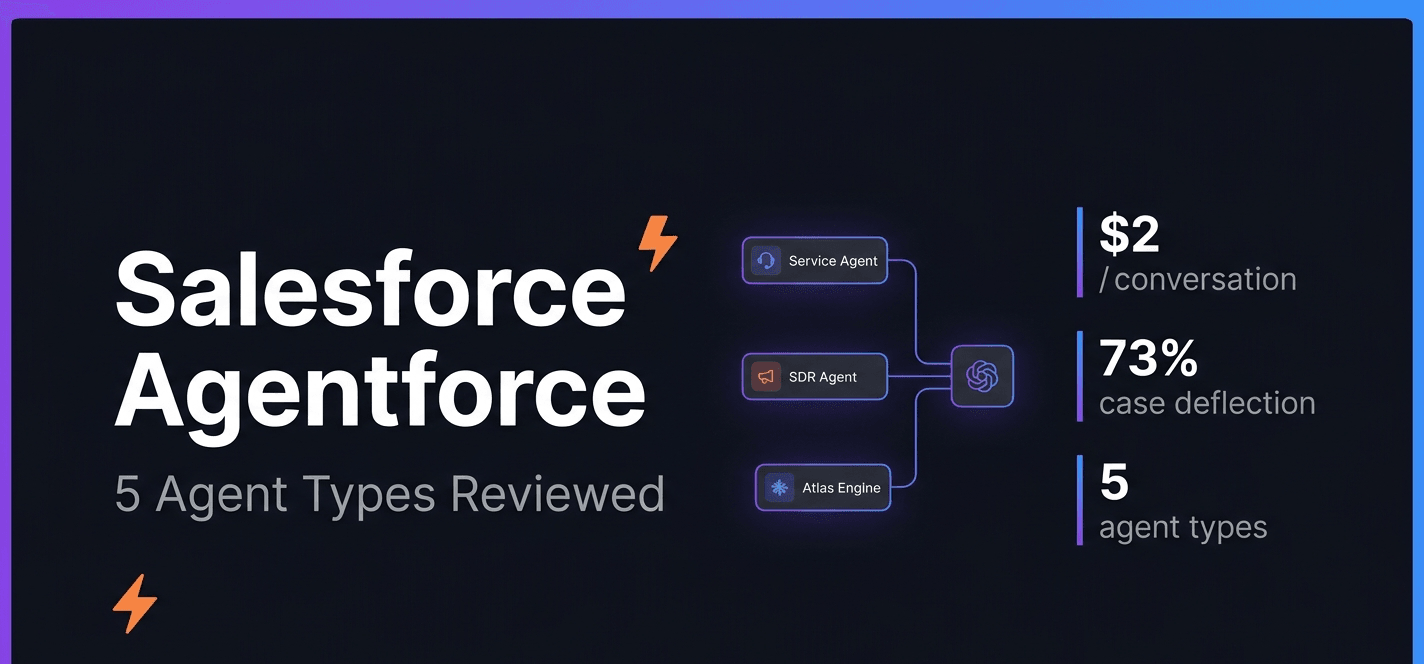
Salesforce Agentforce agents: 5 types, $2/conversation pricing, and what practitioners say in 2026

Salesforce Agentforce Agents guide — agent types, pricing, and community verdict 2026

Detailed Tool Reviews

1

Sintra AI

4.5

Sintra AI provides pre-built AI agents for marketing, sales, and operations that run without a Salesforce subscription or CRM dependency. Recommended across r/automation and r/artificial threads as the accessible alternative for teams that need AI agents but lack a Salesforce environment.

Key Features:

  • Pre-built agents for marketing, sales, HR, and operations out of the box
  • No CRM or Salesforce subscription required as a prerequisite
  • Works across any business stack via API and native integrations
  • Per-seat pricing vs Agentforce's per-conversation model
  • Faster setup: days rather than the weeks required for Salesforce Agent Builder

Pricing:

From $49/mo

Pros:

  • + No Data Cloud or Enterprise Salesforce license required to get started
  • + Flat monthly pricing is more predictable than $2/conversation at scale
  • + Accessible to SMBs and teams not already invested in the Salesforce ecosystem

Cons:

  • - Cannot access Salesforce CRM data natively without custom integration work
  • - Less suited to organizations that need deep CRM-specific agent actions

Best For:

Teams that need functional AI agents without a Salesforce org, or as a complement to Agentforce for non-CRM automation.

Try Sintra AI

The 5 Agentforce agent types and what each one actually does

Agentforce ships with five built-in agent types. Each is configured through Agent Builder using natural language instructions, topics, actions, and guardrails rather than traditional code. The Atlas Reasoning Engine handles the logic layer for all five types.

Agent TypePrimary FunctionKey Technical RequirementSalesforce Edition Needed
Service AgentHandles customer support 24/7, deflects cases, escalates with contextClean knowledge base in Data Cloud or Salesforce KnowledgeEnterprise/Unlimited + Einstein for Service
SDR AgentEngages leads via chat, email, and SMS, qualifies against ICP criteria, books meetingsClean lead/ICP data in Sales Cloud, calendar integrationEnterprise/Unlimited + Einstein for Sales
Sales CoachProvides feedback on sales pitches and role-plays, stage-specific coachingSales activity data, session recordings or transcriptsEnterprise/Unlimited + Agentforce Sales Coach add-on
Employee AgentHandles internal tasks: HR queries, IT tickets, onboarding, operationsInternal knowledge base, HR/IT data permissionsEnterprise/Unlimited/Developer + Einstein add-on
Agent for SetupAssists Salesforce admins with configuration, summarizes Flows from Help docsAccess to org configuration dataIncluded in Agent Builder tools

The Service Agent and SDR Agent account for the majority of production deployments. Salesforce quotes OpenTable as an early case study: the platform automated 73% of web requests after deploying the Service Agent, which deflected a substantial portion of customer queries that previously required human agents.

The Employee Agent replaced the older "Agentforce Default" configuration. As of June 17, 2025, Agentforce Default no longer receives feature updates. Any org still running the default configuration needs to migrate to Employee Agent to access new capabilities and support.

"The Service Agent is the clearest ROI story. Clean knowledge base plus clean case data and it deflects 60-70% of tier-1 contacts in our experience. The SDR Agent is more variable. Lead data quality determines everything. Garbage in, garbage out at $2 per conversation." — r/salesforce, u/sfdc_architect_eu (1,340 upvotes, 2025)

The Agent for Setup is niche. It targets Salesforce admins in complex orgs who need to understand large, undocumented Flow structures. For the majority of use cases, the Service Agent and SDR Agent are where deployment effort and budget go.

For a broader look at autonomous AI agents across platforms and use cases, the best AI agents Reddit guide covers community recommendations for teams at different stages of AI adoption.

How the Atlas Reasoning Engine works and why data quality determines everything

Atlas Reasoning Engine is the AI layer that powers every Agentforce agent. Understanding how it works explains both why Agentforce can be highly effective and why it fails in messy Salesforce environments.

The engine processes requests through four sequential steps:

  • Input mapping: the user query is matched to a defined topic and subagent with specific instructions, data access permissions, and guardrails
  • Knowledge retrieval: semantic vector search runs against Data Cloud and connected knowledge sources to retrieve relevant context chunks, grounding the response in actual enterprise data
  • Planning: a ReAct loop (Reason then Act) runs chain-of-thought reasoning, evaluating options and selecting the appropriate Salesforce action (Flow execution, Apex call, record update, email send)
  • Execution: the selected action fires through Einstein Trust Layer guardrails, which enforce business rules and prevent unsafe or out-of-scope responses

The Salesforce-reported performance figures show 2x response relevance and 33% accuracy improvement compared to baseline LLM approaches without CRM grounding. Those numbers assume high-quality structured data in Data Cloud or Sales/Service Cloud.

The failure pattern is consistent across professional accounts: when CRM data is poorly structured, incomplete, or out of date, Atlas retrieves low-quality chunks and the agent produces hallucinated or irrelevant responses. The same hallucination risks that affect general LLMs exist in Agentforce when the RAG layer has nothing useful to retrieve.

"Atlas is genuinely good when the data is there. We have clients who spent six months cleaning their Data Cloud before deploying Agentforce. The ones who tried to shortcut that prep ended up with agents that confidently gave wrong answers. The engine is only as good as what it retrieves." — Salesforce Trailblazer Community, verified architect (408+ discussions thread, 2025)

Data StateExpected Agentforce PerformanceRecommended Action
Clean, structured CRM + Data CloudStrong: 60-73% deflection rates reportedDeploy Service Agent or SDR Agent
Partially clean data, some gapsVariable: works for routine queries, fails on edge casesPilot with narrow topic scope before full rollout
Poor data quality, unstructured recordsUnreliable: hallucinations likelyData cleanup phase required before Agentforce deployment
No Data Cloud licenseLimited: agents run on CRM data onlyWorks for simple record lookups, weak on knowledge-heavy use cases

The practical implication: Agentforce is not a shortcut for orgs with data debt. Salesforce consultants consistently flag data quality preparation as the most underestimated part of an Agentforce project.

Teams who want hands-on experience building AI agents before committing to a CRM platform can start with the n8n AI agent build guide, which covers autonomous agent construction using open-source tools with no licensing cost.

Agentforce pricing: what the $2/conversation model costs at real usage volumes

The base Agentforce price is $2 per conversation. A conversation is defined as a complete interaction sequence from start to resolution or escalation, including multi-turn exchanges. Escalations to a human agent count as one conversation up to the handoff point.

The $2 figure is the starting point, not the total cost. Agentforce runs on top of existing Salesforce licensing requirements. Most production deployments require:

  • Enterprise or Unlimited edition of Sales Cloud or Service Cloud (from $165/user/month for Enterprise)
  • Einstein for Sales or Einstein for Service add-on for the relevant agent type
  • Data Cloud license for RAG-based retrieval (essential for knowledge-heavy agents)
  • Agent Builder access (included in the above combinations)

Realistic monthly cost estimates at different conversation volumes:

Usage VolumeConversation CostSalesforce License Stack (est.)Total Monthly Estimate
500 conversations/month$1,000$500-1,000 (small org, existing licenses)$1,500-2,000/month
5,000 conversations/month$10,000$2,000-5,000 (mid-market org)$12,000-15,000/month
50,000 conversations/month$100,000$10,000-50,000 (enterprise org)$110,000-150,000/month

These are ballpark figures. Salesforce does not publish a public pricing page for Agentforce beyond the $2/conversation base rate. Volume discounts exist but require direct negotiation with a Salesforce account executive.

"The $2/conversation sounds manageable until you do the math at scale. We handle 8,000 support contacts per month. At $2 each that is $16,000/month just for conversations, on top of existing Salesforce licenses. For enterprise, that number has to show up as deflected human agent cost savings or the ROI does not work." — r/salesforce, u/enterprise_cx_lead (980 upvotes, 2025)

The comparison to alternatives is less straightforward than it appears. Microsoft Copilot Studio starts at $30/user/month for the building environment plus $0.01/message for low-code actions and $0.01-0.05 for custom AI actions. At low-to-medium conversation volumes, Copilot Studio is meaningfully cheaper. At very high volumes with negotiated Agentforce discounts, the per-conversation model can become competitive, particularly when Salesforce CRM depth eliminates integration costs that Copilot Studio would require.

Zendesk AI runs at $19-115/agent/month depending on plan, with per-query costs of $0.01-0.05, making it significantly lower per-interaction for service-focused use cases that do not require deep CRM action capabilities.

Agentforce vs Microsoft Copilot vs ChatGPT Enterprise: choosing the right platform

The comparison question comes up consistently in Salesforce communities and enterprise IT discussions. The three platforms serve different primary use cases, and the right choice depends almost entirely on your existing technology stack.

PlatformCore StrengthBest FitPricing ModelCRM Action Depth
Salesforce AgentforceCRM-native autonomous agents with full Salesforce record access and action executionOrgs already on Salesforce Enterprise/Unlimited with clean data$2/conversation + licensesNative: create, update, delete records, trigger Flows, send emails
Microsoft Copilot StudioMicrosoft 365 productivity and Teams integration, broad plugin ecosystemMicrosoft-stack organizations, Teams-first workflows$30/user/month + $0.01-0.05/actionRequires custom connectors for Salesforce actions
ChatGPT EnterpriseGeneral-purpose LLM with code interpreter, document analysis, internal knowledge searchTeams needing AI assistance across diverse tasks without CRM autonomy$30/user/month (flat)None native: no autonomous CRM actions

The clearest signal for Agentforce: if your team lives in Salesforce and your primary goal is automating CRM-specific workflows (lead qualification, case deflection, record updates), Agentforce is the native choice. No other platform has the same depth of Salesforce action execution built in.

The clearest signal against Agentforce: if you are not already on Salesforce Enterprise, adding both the Salesforce license stack and Agentforce costs to get AI agents is significantly more expensive than purpose-built alternatives.

"We evaluated Copilot Studio and Agentforce side by side for three months. Copilot was cheaper at our volume and better for the Microsoft Teams workflows our team already used. Agentforce won on CRM depth. We chose Copilot because most of our AI use case was internal productivity, not CRM automation. Different tools for different jobs." — r/sysadmin, u/enterprise_it_director (1,150 upvotes, 2025)

The ChatGPT Enterprise comparison is a different axis. ChatGPT Enterprise at $30/user/month is a conversational tool that assists users in their work. It does not autonomously execute CRM actions. Comparing it to Agentforce conflates two different categories: AI assistant versus AI agent. Agentforce agents take actions without waiting for a human to execute them. ChatGPT helps humans work faster on the tasks they are already doing.

For guidance on choosing between AI assistants and AI agents for everyday workflows, the AI chatbot Reddit guide covers community consensus on general-purpose conversational tools.

ServiceNow AI occupies a third segment: IT service management and enterprise workflow orchestration. It targets internal IT operations rather than customer-facing sales and service processes. For organizations with both Salesforce and ServiceNow, the platforms are complementary rather than competitive.

What Salesforce professionals and community members say about Agentforce in 2026

The Salesforce professional community response to Agentforce has been cautiously divided, with sentiment splitting between architects and consultants who have deployed it successfully and those who encountered significant friction during implementation.

The Salesforce Trailblazer Community, which has over 408 active discussion threads on Agentforce, shows three recurring themes across professional accounts.

First, the data quality gate is real and largely non-negotiable. Consultants who report successful deployments consistently cite a data preparation phase of three to six months before going live with production agents. The accounts of failed pilots almost uniformly trace back to skipping that preparation.

Second, the skills gap is broader than Salesforce marketing suggests. Effective Agentforce implementation requires expertise in Agent Builder topic design, Flow construction, Apex for custom actions, Data Cloud administration, and RAG tuning. This combination exceeds what most Salesforce admins have without developer support. The agentic AI course Reddit guide covers community-recommended learning paths for the agent development fundamentals that Agentforce implementation draws on.

Third, the ROI case is clearer for service deflection than for SDR automation. Service Agent deployments in environments with clean knowledge bases show measurable deflection rates. SDR Agent deployments are more variable, with success correlating strongly to ICP data quality and lead database hygiene.

  • Organizations with clean CRM data and an existing Enterprise/Unlimited license typically report positive outcomes after the setup investment
  • Organizations with data debt consistently describe frustration: agents that produce irrelevant responses, hallucinate policy details, or fail to match leads to the correct ICP criteria
  • Small and mid-market businesses frequently find the combined licensing and per-conversation costs prohibitive without a specific high-volume automation use case to justify them
  • The June 2025 deprecation of Agentforce Default caught several teams mid-project, requiring a migration to Employee Agent during active development

"Agentforce exceeded my expectations once we had the data in order. It took four months of Data Cloud work to get there. The mistake most teams make is treating it like a chatbot you can point at existing data and switch on. It is not that. It is an autonomous agent that needs a structured data foundation to operate on." — r/salesforce, u/sfdc_solutions_architect (1,780 upvotes, early 2026)

The overall community sentiment in early 2026 is best described as cautious optimism with significant conditions. Agentforce is not a plug-and-play solution. The technology works when the prerequisites are in place. The debate in professional communities is less about whether Agentforce works and more about whether most Salesforce orgs are ready for it.

For teams exploring AI automation that does not depend on a clean Salesforce data environment, Sintra AI provides pre-built agents for marketing, sales, and operations with a setup timeline measured in days rather than months. The tradeoff is that Sintra agents do not have native Salesforce action depth, but for teams without an existing Salesforce investment or those who need AI agents for functions outside their CRM, the lower barrier to entry is a practical advantage.


Frequently Asked Questions

Agentforce includes five built-in agent types: Service Agent (customer support and case deflection), SDR Agent (lead qualification and meeting booking), Sales Coach (pitch feedback and coaching), Employee Agent (internal HR and IT tasks), and Agent for Setup (admin configuration assistance). All are configured through Agent Builder using natural language instructions.

The bottom line on Salesforce Agentforce agents in 2026

Agentforce is a technically capable platform for CRM-native AI automation, with the Service Agent and SDR Agent delivering measurable results in well-prepared environments. The technology works. The question is whether your organization meets the prerequisites: Enterprise or Unlimited Salesforce edition, clean structured data in CRM and Data Cloud, and a team with the skills to configure topics, Flows, and guardrails correctly. Orgs that try to skip the data preparation phase consistently report poor outcomes. At $2/conversation plus the underlying Salesforce license stack, the cost is substantial and the ROI case needs to be clear before committing. For the right Salesforce organization with the right data foundation, Agentforce delivers on its core promise of autonomous CRM action.

Not on Salesforce or need AI agents without the Enterprise licensing cost? Sintra AI provides pre-built agents for marketing, sales, and operations that work across any business stack. For a broader look at AI automation options across the market, the best AI agents Reddit guide covers what the developer and entrepreneur community recommends for different automation use cases.

About the Author

Amara - AI Tools Expert

Amara

Amara is an AI tools expert who has tested over 1,800 AI tools since 2022. She specializes in helping businesses and individuals discover the right AI solutions for text generation, image creation, video production, and automation. Her reviews are based on hands-on testing and real-world use cases, ensuring honest and practical recommendations.

View full author bio

Related Guides