
Tool DiscoveryTool Discovery

Build a Side Project with AI: What r/SideProject Actually Recommends in 2026

Updated: 2026-07-1814 min read

r/SideProject has become the default place builders go to compare notes on shipping something real with AI, and the tool stack that keeps coming up looks nothing like a single all-in-one app. A senior developer's breakdown titled "The AI tools I actually use daily as a senior dev (work + side projects)" describes a five-tool routine: Cursor for the editor, ChatGPT as a sounding board for architecture and error messages, GitHub Copilot for boilerplate, Notion AI for planning, and Kubernetes once deployment becomes unavoidable. That is a lot of separate subscriptions and a lot of separate places for things to break. For builders who want one tool that handles the frontend, backend, database, and deployment together instead of stitching five of them by hand, Emergent has been showing up in r/indiehackers threads specifically because it removes that stitching problem, and its multi-model setup lets you switch between Claude, GPT-5.2, and Gemini inside the same project instead of picking one model and living with its limits. When the side project needs a pitch deck or a landing page fast, Gamma comes up too, though Reddit's honest complaint about it is that the output can look "too AI-like" without manual editing. This guide breaks down what r/SideProject, r/sidehustle, and r/OpenAI actually recommend for building with AI in 2026, what it costs, and where it falls apart.

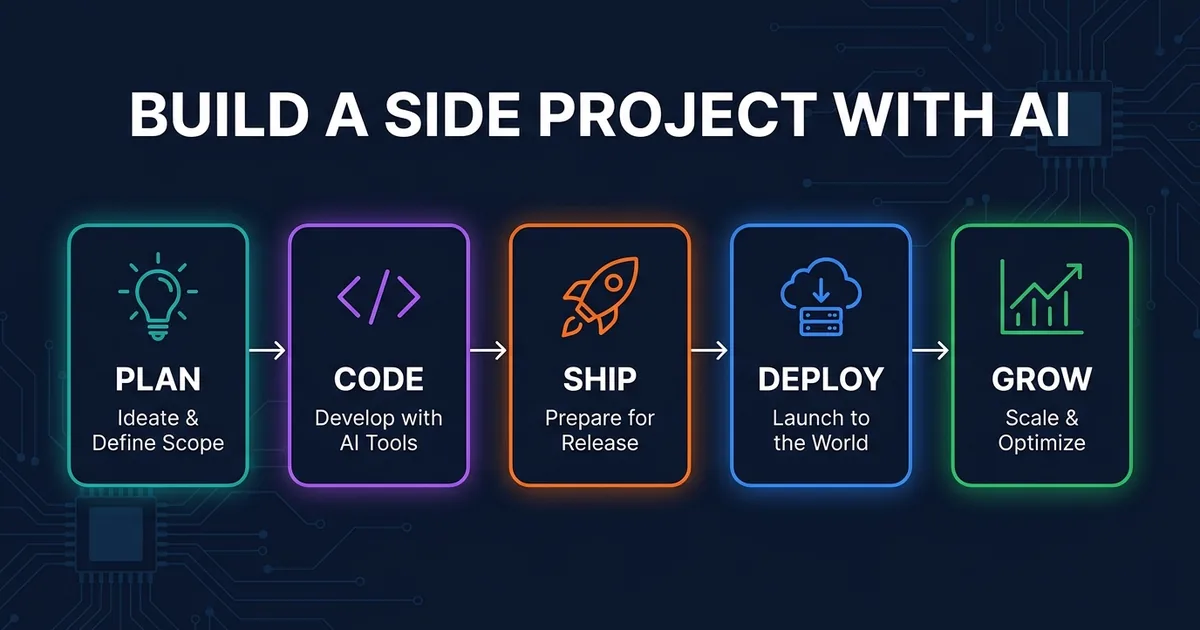
The 5-stage AI side project pipeline Reddit builders actually follow: plan, code, ship, deploy, grow

Build a side project with AI - 5-step plan, code, ship, deploy, grow pipeline 2026

Detailed Tool Reviews

1

Emergent

4.7

Emergent shows up in r/indiehackers threads specifically when builders want a full side project shipped, not just a frontend demo. One person's daily-tool breakdown in r/SideProject listed five separate subscriptions to cover coding, planning, and deployment. Emergent folds that into one project with frontend, backend, database, and hosting generated together. The multi-model setup lets you switch between Claude, GPT-5.2, and Gemini inside the same build instead of being stuck with one model's blind spots, and the free tier's 5 credits a month is enough to test it on a real idea before paying anything.

Key Features:

  • Full-stack generation in one pass: frontend, backend, database, and deployment together
  • Multi-model architecture switches between Claude, GPT-5.2, and Gemini per task
  • 1.5M+ users across 180 countries, 2M+ apps built, Y Combinator backed
  • Free tier with 5 credits a month to test before paying
  • Agentic build process handles an entire app from one description

Pricing:

Free (5 credits/month), Standard $20/month, Pro $200/month

Pros:

  • + Removes the multi-subscription stacking problem Reddit complains about (Cursor plus Copilot plus hosting plus more)
  • + Handles real backends and databases, not just static frontend prototypes
  • + Free tier lets you validate before committing money
  • + Y Combinator backing and 1.5M+ user base give it more track record than newer entrants

Cons:

  • - Less mainstream Reddit mention volume today than Cursor or ChatGPT
  • - Pro plan at $200/month is a real cost for a side project with no revenue yet
  • - 5 free credits a month cap how much you can test before paying

Best For:

Builders who want the whole side project, frontend, backend, database, and deployment, generated and hosted together instead of assembling five separate tools and subscriptions by hand.

Try Emergent
2

Cursor

4.7

Cursor is the tool a senior developer named first in a widely read r/SideProject breakdown of their daily AI stack, describing it as "my primary code editor" for grasping legacy codebases fast, refactoring messy code with confidence, and generating the boring parts (configs, validators, small utilities) without touching the logic that actually matters. It sits on top of your existing codebase rather than replacing it, which is why builders who already write code reach for it before anything else.

Key Features:

  • Full codebase indexing so you can ask questions about the entire project, not one file
  • Refactors and understands legacy or unfamiliar code quickly
  • Generates boilerplate (configs, validators, DTOs) while leaving core logic to you
  • Multi-model support switching between Claude, GPT-5.2, and Gemini per task

Pricing:

Free limited, Pro $20/month

Pros:

  • + Preferred by developers who want control over the codebase, not a black-box generator
  • + Strong at legacy code comprehension and safe refactors, per Reddit's daily-use threads
  • + Free tier available to try before the $20/month Pro plan

Cons:

  • - $20/month stacks with whatever else you are already paying for (ChatGPT, hosting, etc.)
  • - Assumes you can read and evaluate the code it writes, not built for zero-code builders
  • - Credit system for fast versus slow requests confuses new users per Reddit reports

Best For:

Builders who already write code and want AI embedded in their existing editor for refactors, boilerplate, and navigating a codebase, rather than generating an entire app from a prompt.

Try Cursor
3

DeepSeek

4.3

DeepSeek gets recommended in Reddit's "best platforms" threads as the option for builders who do not want to pay for GPT-Plus but still need serious reasoning power. One widely shared comparison called it "comparable to OpenAI's best model, with no message limits and free access," then immediately noted the tradeoff in the same breath: it "lacks additional features such as memory, voice, or search, and its servers frequently suffer outages." That combination, strong and free but occasionally unreliable, is exactly why Reddit treats it as a budget option to lean on, not a full replacement.

Key Features:

  • Free access with no published per-message caps, unlike Claude's tighter limits
  • Reasoning quality Reddit compares directly to top-tier paid models
  • No memory, voice, or search features built in
  • Open weights available for anyone who wants to self-host

Pricing:

Free, no published message caps

Pros:

  • + Zero cost for heavy coding or analysis sessions during an active build sprint
  • + No message-limit throttling that Claude users specifically complain about
  • + Good enough reasoning quality that Reddit treats it as a real GPT-Plus alternative, not a toy

Cons:

  • - Servers "frequently suffer outages" per Reddit reports, a real risk mid-session
  • - No memory, voice, or search means pairing it with another tool for those features
  • - Fewer built-in product features than ChatGPT or Claude

Best For:

Builders who are already paying for two or three other tools and want a genuinely free option for heavy coding and reasoning sessions, accepting occasional downtime as the tradeoff.

Try DeepSeek

The AI Tools Reddit Actually Uses to Build Side Projects

Reddit's side project builders are not using one AI tool, they are running a small stack, and the exact mix shows up consistently across r/SideProject threads.

Before the tools, the subreddits: this is where side-project builders actually compare notes.

SubredditMembersFocus
r/SideProject200,000+Building, shipping, and getting feedback on real projects
r/sidehustle3,000,000+Monetization, pricing, and whether a side project can become income
r/OpenAI200,000+Model choice, API alternatives, what people are building with GPT
r/MachineLearning3,000,000+Technical ML projects, portfolio pieces, research-adjacent builds
r/NoCode100,000+No-code and low-code AI app building for non-developers
ToolRole in the StackReddit Signal
ChatGPT / GPT-PlusCoding help, architecture sounding board, content and planningNamed first in nearly every "what tools do you use" thread in r/SideProject
CursorPrimary code editor for refactors and navigating existing code"This has become my primary code editor," r/SideProject
GitHub CopilotInline boilerplate, DTOs, test generationUsed for "repetitive tasks" while critical logic stays hand-written
Notion AITurning rough notes into specs and project plansKeeps planning "straightforward without overwhelming" documentation
EmergentFull-stack generation: frontend, backend, database, deploy togetherCited in r/indiehackers when the goal is a shipped app, not a prototype
DeepSeekFree heavy reasoning and coding when paid limits get hit"Comparable to OpenAI's best model, with no message limits and free access"

The pattern across nearly every "what's your stack" post is the same: one tool for planning, one for the editor, one for boilerplate, and increasingly, one tool that just does the whole build so the other four become unnecessary.

"Cursor. This has become my primary code editor. I use it for quickly grasping large or legacy codebases, refactoring disorganized code with confidence, and creating mundane items like configurations, validators, and small utility functions." -- r/SideProject, from a senior developer's daily AI tools breakdown, 2026

That quote comes from a thread that also listed ChatGPT, Copilot, and Notion AI as parts of the same person's daily routine, four separate tools for four separate jobs. That is the exact stacking problem more builders are now asking how to avoid. For a deeper breakdown of the coding-specific tools in that stack, Claude Code, Cursor, Bolt.new, and Lovable, see our vibe coding Reddit guide.

How Reddit Actually Builds a Side Project with AI, Step by Step

Reddit's advice on process is more consistent than its advice on tools. The same sequence shows up across r/SideProject and r/sidehustle threads from people who actually shipped something.

  • Write the exact spec before opening any AI tool: features, user flow, database fields, edge cases
  • Pick one clear, boring problem instead of a vague idea. Threads titled "I built a full SaaS this weekend" almost always start with one specific user problem, not a feature list
  • Use ChatGPT or Claude to pressure-test the architecture before writing code, not after
  • Let Cursor or Copilot handle the boilerplate while you keep the core logic yours
  • Ship a rough version and get one real user before adding anything else
  • Use Git from day one. Skipping version control is one of the most repeated regrets in these threads

A prompt pattern that keeps showing up when builders ask an AI to sanity-check their plan before building:

"Here is my side project idea: [one sentence]. Here is who it's for and the one problem it solves: [detail]. Before I write any code, tell me what's missing from this spec, what could break at scale, and whether this is actually one project or secretly three."

One r/sidehustle poster summarized the lesson after a year of running an AI side project: regular code review and cleanup, understanding the actual use cases well enough to fix logic issues, and reaching for established libraries instead of reinventing basic functionality. None of that is AI-specific advice. It is software discipline that AI tools do not replace.

Where AI-Built Side Projects Actually Break

The honest Reddit answer to "does this actually work" is: it works until one of four specific things goes wrong.

RiskRisk LevelWhat HappensReddit's Workaround
Token or message limits mid-buildHighSessions hit caps during active work, losing progress or forcing a pauseSplit work into smaller sessions, keep DeepSeek as a free backup model
Messy, unmaintainable codeHighAI ships something that works once but breaks when you ask for a small change laterKeep critical logic hand-written, use AI mainly for boilerplate and scaffolding
Context loss on larger projectsMediumAI "forgets" earlier decisions and regenerates code that conflicts with existing modulesWritten specs and Git history to remind the AI, and you, what already exists
Deployment and ops complexityMediumServer setup, CI, scaling, and monitoring become the stage builders procrastinate on mostTools with built-in deployment (Emergent, Kubernetes) instead of manual server configuration

The clearest description of the code-quality risk comes from a senior developer's own admission in their r/SideProject stack breakdown: they still write the critical logic themselves and only hand AI the repetitive parts, DTOs, test generation, simple mappings, precisely because handing over the important logic is where things go wrong.

"While I still write the critical logic myself, this tool saves considerable time on tedious coding tasks." -- r/SideProject, senior developer's AI tools breakdown, 2026

The practical rule Reddit converges on: use AI to remove the boring 80% of the work, and keep your own hands on the 20% that decides whether the app actually works.

Emergent vs Stitching Together Your Own AI Stack

Most of the tools Reddit names solve one piece of the build, which is exactly why builders end up paying for four or five of them at once. Emergent's pitch is specifically to collapse that into one.

Entity by entity, here is what a typical Reddit-recommended stack actually costs and does versus a single Emergent subscription:

  • ChatGPT Plus: architecture sounding board and content, roughly $20/month, no code execution or deployment
  • Cursor Pro: code editor with codebase indexing, $20/month, requires you to already know how to evaluate code
  • Hosting and deployment (database, monitoring, a platform like Vercel): commonly $20 to $30/month once combined, plus setup time
  • Emergent Standard: $20/month for full-stack generation, database, and deployment together, or free with 5 credits a month to test first

Stack it up and a Reddit-typical setup lands at $60 to $70 a month before anyone writes a line of business logic, a number one r/indiehackers thread calculated explicitly when adding up Claude Pro, Cursor Pro, and hosting together. Emergent's Standard tier at $20/month is priced to replace three of those subscriptions at once, not to sit alongside them.

The tradeoff Reddit is honest about: Emergent has less mention volume today than Cursor or ChatGPT, simply because it is newer to these communities. The multi-model architecture, switching between Claude, GPT-5.2, and Gemini inside one project, is the specific feature r/indiehackers threads point to when explaining why it handles full-stack complexity that frontend-first tools start to break on.

"I utilize the Pro plan to create intelligent surveys, sign-up forms, and lead capture pages." -- a builder describing a $29/month SaaS tool layered on top of their AI stack, r/SideProject, 2026

That quote is a good example of the stacking pattern in miniature: even a single extra feature, forms, meant another subscription. A platform that includes forms, backend, and database as part of one build removes that specific decision entirely.

Does Building a Side Project with AI Actually Work?

Reddit's answer is not a clean yes or no, it splits by what "actually work" means to the person asking.

For validation and learning, the consensus is strongly positive. r/SideProject and r/MachineLearning threads are full of shipped chatbots, recommendation systems, sentiment analyzers, and small SaaS tools that took days instead of months, and plenty of posters report a first paying customer within the first few weeks of shipping.

For long-term, revenue-generating businesses, the community is more careful. Debates in r/sidehustle and r/Entrepreneur return to the same open questions again and again: whether AI SaaS is still an approachable market for solo builders or already saturated by well-funded competitors, and whether a $10 to $30 monthly subscription can realistically cover the AI API costs behind it at small scale.

The success patterns that separate the shipped projects from the abandoned ones, based on repeated threads:

  • A specific, named problem instead of a vague idea or feature list
  • Version control from day one, since AI-generated code gets rewritten in ways handwritten code usually is not
  • A working version shown to one real user before anything else gets added
  • Someone who can read the generated code well enough to know where to look when it breaks

The test one r/SideProject regular applies before trusting any AI-built side project to hold up: can you explain, in one sentence, exactly what problem it solves and for whom, without naming a single feature. If the answer is only a feature list, the idea usually is not ready to build yet, AI tool or not.

The practical takeaway across r/SideProject, r/sidehustle, and r/OpenAI: AI genuinely removes the coding bottleneck. It does not remove the product bottleneck. Reddit's most useful advice, repeated in different words across dozens of threads, is to spend the time saved on the coding side back on understanding the problem, not on adding more features.

Frequently Asked Questions

Reddit's most repeated stack pairs ChatGPT or Claude for architecture and planning with Cursor or GitHub Copilot for the actual code, plus Notion AI to keep the project plan organized. For builders who want to skip assembling that stack entirely, Emergent generates the frontend, backend, database, and deployment together in one project, which is why it comes up specifically in r/indiehackers threads about full-stack side projects rather than quick prototypes.

The Real Stack for Building a Side Project with AI in 2026

Reddit's side project builders are not looking for one magic AI tool, they are describing a stack: ChatGPT or Claude for architecture and planning, Cursor or Copilot for the actual code, Notion AI to keep the plan from turning into chaos, and increasingly, Emergent to collapse the backend, database, and deployment pieces that used to mean three more subscriptions and a weekend lost to server configuration. The clearest signal across r/SideProject, r/sidehustle, and r/OpenAI is that the tool choice matters less than the discipline around it: write the spec first, use Git from day one, keep the critical logic in your own hands, and ship to one real user before adding anything else. For builders tired of stitching together Cursor, Copilot, and separate hosting just to get one project live, Emergent's free tier is a low-risk way to test whether one tool can actually replace four.

Try Emergent free and ship a full side project without stitching five tools together

About the Author

Amara - AI Tools Expert

Amara

Amara is an AI tools expert who has tested over 1,800 AI tools since 2022. She specializes in helping businesses and individuals discover the right AI solutions for text generation, image creation, video production, and automation. Her reviews are based on hands-on testing and real-world use cases, ensuring honest and practical recommendations.

View full author bio

Related Guides