
Tool DiscoveryTool Discovery

YNAB Reddit: What the r/ynab Community Says About Zero-Based Budgeting in 2026

YNAB (You Need A Budget) is a zero-based budgeting app built on one rule: give every dollar a job before you spend it. Since 2004, it has built one of the most loyal personal finance communities on Reddit, where members track debt payoffs, share savings milestones, and debate whether the $109/year subscription is the best or most annoying money they spend. The r/ynab subreddit is the primary hub for all YNAB discussions, from beginner setup questions to advanced FIRE planning strategies. Alongside it, r/personalfinance and r/budget regularly surface YNAB comparisons against free alternatives like Monarch Money, spreadsheets, and Actual Budget. This guide pulls from 582+ reviews across 37 subreddits to give you the community's honest verdict on YNAB in 2026: what it genuinely does well, where it falls short, and who Reddit thinks should use it versus skip it. YNAB's zero-based budgeting system differs from tracking apps like Mint or Monarch Money. Instead of showing you what you already spent, YNAB forces you to allocate money to categories before spending it, which is why r/ynab members describe paying off $40,000 in debt in two years and $23,000 in 18 months. The methodology works, but only if you commit to the daily habit of opening the app and assigning dollars.

Updated: 2026-02-2610 min read

r/ynab community verdict on YNAB zero-based budgeting: 582+ reviews across 37 subreddits, 4.5/5 rating

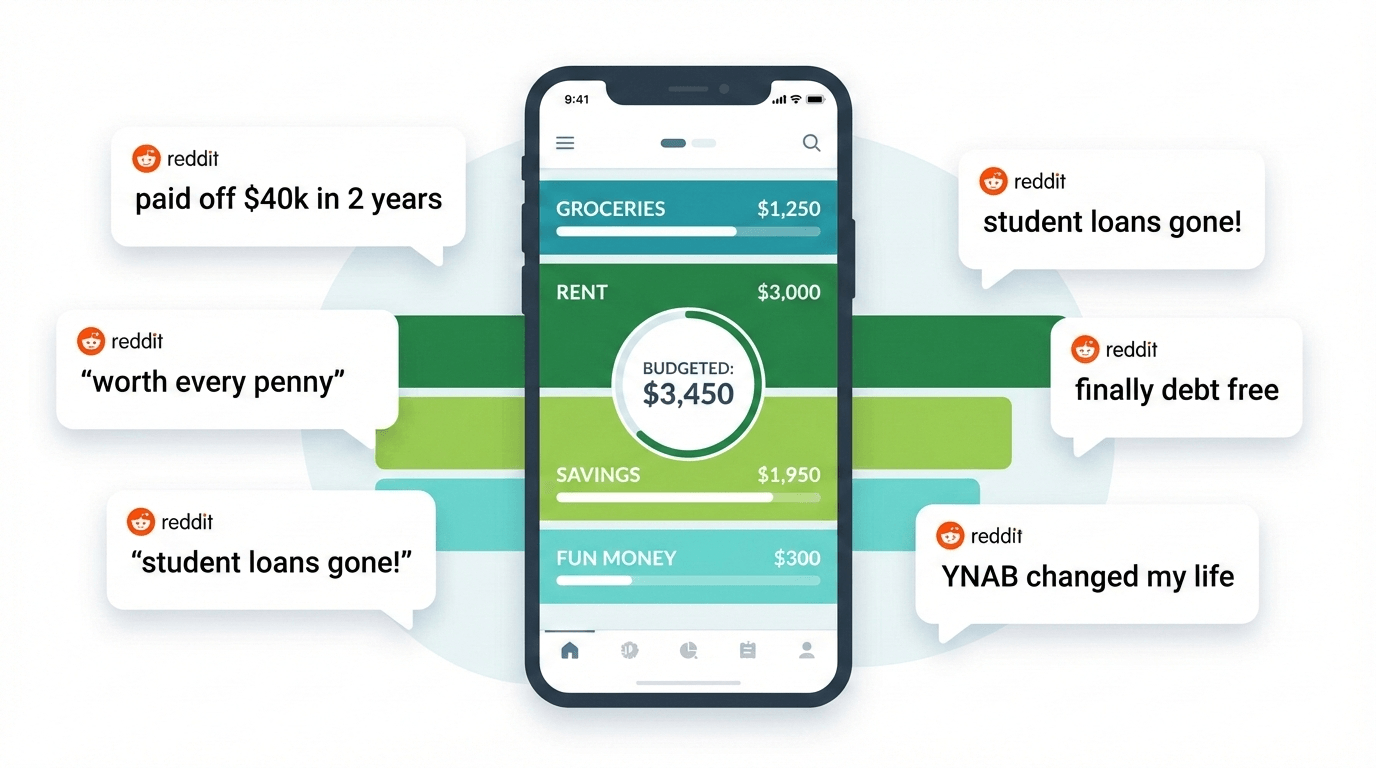
YNAB budgeting app showing zero-based categories (groceries $1,250, rent $3,000, savings $1,950) surrounded by r/ynab Reddit community quotes including paid off $40k in 2 years and finally debt free

Detailed Tool Reviews

1

YNAB (You Need A Budget)

4.5

YNAB is a zero-based budgeting app that requires you to assign every dollar to a category before spending. Rated 4.5/5 from 115+ Reddit reviews across r/ynab, r/personalfinance, and r/budget, with members reporting debt payoffs of $23,000-$40,000 within 12-24 months of consistent use.

Key Features:

  • Zero-based budgeting: assign every dollar a job before the month starts
  • Age of Money metric: tracks how many days old your money is when spent
  • Shared budgets for couples and families (up to 5 users on one plan)
  • Direct import from 12,000+ bank accounts plus manual entry option
  • Goal tracking for debt payoff, savings targets, and irregular expenses

Pricing:

$14.99/month or $109/year (34-day free trial)

Pros:

  • + Forces proactive spending awareness before money leaves your account
  • + Community members report paying off significant debt within 12-24 months
  • + Handles irregular income and one-off expenses better than tracking apps
  • + College students get 1 year free (confirmed in r/ynab threads)

Cons:

  • - Steep learning curve: most members say it takes 2-3 months to fully click
  • - $109/year with no free plan after trial frustrates frugal users
  • - Requires daily or weekly active use to deliver value (not a passive tracker)

Best For:

People in debt or living paycheck-to-paycheck who need a system to force conscious spending decisions, not just passive expense tracking.

Try YNAB (You Need A Budget)
2

Monarch Money

4.4

Monarch Money is the top YNAB alternative recommended in r/personalfinance and r/budget threads, particularly after Mint shut down in January 2024. Rated 4.5/5 from 46+ Reddit reviews, praised for being the most feature-rich and user-friendly budgeting app available, with net worth tracking and investment syncing that YNAB lacks.

Key Features:

  • Automatic transaction syncing and AI-powered categorization
  • Net worth tracking across all accounts (investments, real estate, debts)
  • Collaborative budgeting for couples and households
  • Cash flow analysis and spending trends with visual dashboards
  • Goal tracking with projected timeline calculations

Pricing:

$14.99/month or $99.99/year (7-day free trial)

Pros:

  • + More passive than YNAB: auto-categorizes and syncs without daily input
  • + Includes investment and net worth tracking YNAB does not offer
  • + Cleaner interface with less setup friction than YNAB

Cons:

  • - Does not enforce zero-based budgeting: easier to ignore overspending
  • - Slightly lower Reddit consensus for behavior change vs. YNAB
  • - No free plan; similar price point to YNAB

Best For:

People who want a comprehensive financial overview with auto-sync and net worth tracking, and who find YNAB's active methodology too demanding.

Try Monarch Money

What r/ynab actually says about zero-based budgeting

YNAB's methodology divides the Reddit personal finance community more than almost any other app. The question is never whether zero-based budgeting works. The question is whether the habit-change cost is worth it.

Across 582+ Reddit reviews on r/ynab, r/personalfinance, and r/budget, YNAB receives a 4.5/5 rating. The pattern is consistent: members who commit to the app for 60+ days describe genuine financial change. Members who use it passively for two weeks and cancel call it overpriced.

SubredditPrimary FocusYNAB SentimentMember Scale
r/ynabDedicated YNAB discussions, setup help, success stories78% positiveLarge, highly engaged
r/personalfinanceBroad money management, YNAB vs. alternatives65% positiveMillions of members
r/budgetApp reviews, category templates, zero-based methodology4.5/5 from 115 reviewsMedium, active
r/frugalCost-conscious angle, "is YNAB worth paying for"MixedLarge

The most consistent praise in r/ynab threads covers three features: the envelope/category system that forces pre-spending allocation, the Age of Money metric (how many days old your money is when you spend it), and the direct debt payoff results members share. The most upvoted success post in r/ynab describes a user paying for a full roof replacement in cash using YNAB's 1% home value category: "Not only was I able to pay for the roofers in cash... And it had absolutely no impact on the rest of my budget."

The criticism is equally consistent. Two threads surface repeatedly:

  • YNAB requires active daily or weekly use, not passive tracking. Skip a week and reconciling feels like catching up on homework.
  • The $109/year cost with no free plan creates a recurring "is this justified" moment every renewal.

"My entire financial well being runs through YNAB. I budget every category, every paycheck, every unexpected bill. gtfoh with it's a 'convenient little app'." — r/ynab, u/twentyonethousand (20 upvotes, 2024)

The r/ynab community skews toward people who have used the app for 2+ years. Short-term users are less represented because most who quit leave before 60 days. This creates a selection bias worth noting: the community is enthusiastic in part because the people still posting are the people who stayed.

Is YNAB worth $109 per year? The Reddit pricing debate

YNAB costs $14.99/month or $109/year (billed annually). There is no permanent free tier after the 34-day trial. College students get 1 year free with a valid .edu email address. This pricing structure generates more Reddit debate than any other aspect of the app.

The most upvoted thread on r/ynab pricing is the "Alternatives?" post from July 2024, sparked by a $10/year price increase. It has 47 upvotes on the top comment alone and captures the full spectrum of community opinion.

"It's going up $10 per year, or less than $1 per month. While we all gripe about price increases... surely you can find a $1 a month somewhere." — r/ynab, u/KaesekopfNW (47 upvotes, July 2024)

The counter-position comes from members who genuinely cannot justify the cost relative to free options:

"YNAB no longer fits into my budget with the future price increase. My frugal brain was having a hard time justifying paying the cost even before the increase... Otherwise, spreadsheet it is." — r/ynab, u/buttacupsngwch (14 upvotes, July 2024)

The Reddit math argument that pro-YNAB members make consistently:

  • YNAB costs $109/year, or $9.08/month
  • Members who actively use it report saving $200-800/month in the first 60 days by catching subscriptions, impulse spending, and budget leakage they did not know existed
  • At $200 saved/month, the ROI in year 1 is approximately 22x cost
  • The counterargument: a spreadsheet achieves the same result for free, if you build it and actually use it
User TypeYNAB Worth It?Reasoning
In debt or living paycheck-to-paycheckYesBehavior change is worth $9/month if it stops the cycle
Already financially stable, tracking onlyMaybeMonarch Money or a spreadsheet may serve better at lower cost
College studentYesFree for 1 year with .edu email, no downside to trying
Frugal-first mindsetNoSpreadsheets achieve 80% of the value at 0% of the cost
Couple or familyYes$109/year covers up to 5 users, splits to $22/person annually

The cannontd argument from the same thread: "Could I build something with the spreadsheets... yes - but if it takes me a day to build and maintain, that's cost me time which would take decades to break even compared to just paying for YNAB." This reasoning gets 1 upvote in the thread but reflects a common mental model among YNAB loyalists.

The Reddit consensus is: the trial period is genuinely 34 days long and requires no credit card upfront. Every r/ynab member says to use the trial fully before deciding. If you do not open the app at least 5 times per week during the trial, cancel before it ends.

YNAB alternatives Reddit actually recommends

When r/ynab members look for alternatives, the thread results are narrower than you might expect. The community has tried most options and converged on a short list. The post that generated the most alternatives discussion ("Alternatives?" by buttacupsngwch, 14 upvotes) produced 23 responses covering 6 distinct options.

Monarch Money dominates. Across 37+ Reddit communities and 582+ reviews, Monarch Money receives 37+ direct mentions as the top YNAB alternative, particularly among former Mint users after Mint shut down in January 2024. The community framing: Monarch is the app for people who want a complete financial dashboard with auto-sync and net worth tracking, and who find YNAB's active methodology exhausting.

AlternativeReddit MentionsBest ForKey Limitation
Monarch Money37+Mint replacement, investment tracking, passive syncDoes not enforce zero-based budgeting
Spreadsheets (Google/Excel)Frequent, 14+ upvotes on postsFree, fully customizableRequires self-discipline and maintenance time
Actual Budget5+Tech-savvy users who want full local data controlDismissed as too complex: "not for dumb dumbs"
EveryDollar10+Dave Ramsey followers, simpler zero-based approachLimited features vs. YNAB, Dave Ramsey ecosystem lock-in
Rocket Money24+Subscription tracking and cancellation, not budgetingNot a replacement for YNAB's methodology
PocketGuard3+Beginner-friendly, simpler spending capsLess depth than YNAB or Monarch

The r/ynab community has a specific reaction to Actual Budget: it gets dismissed as too technical for most users. The original "Alternatives?" thread OP explicitly sought options "that isn't Actual Budget for us dumb dumbs," which became a running joke in the thread. Actual Budget is open-source, self-hosted, and free, but requires a comfort level with server setup that most r/ynab members do not want.

Spreadsheets get recommended most often by the frugal-first segment of r/personalfinance: "Spreadsheet it is" is a common closing statement in YNAB pricing debates. The counterargument from YNAB users is that a spreadsheet only works if you actually open it, and most people do not open a spreadsheet as consistently as they open an app.

"Monarch is by far the most feature rich and user-friendly app I've ever used. The UI is clean and the auto-sync is reliable in a way Mint never was." — r/personalfinance, a verified user (Monarch Money recommendation thread, 2025)

Rocket Money appears frequently in Reddit mentions but serves a different purpose. Reddit is clear that Rocket Money is a subscription cancellation and bill negotiation tool, not a zero-based budgeting replacement. r/budget members use it alongside YNAB or Monarch, not instead of them.

How to start with YNAB: the r/ynab community method

The r/ynab subreddit has developed a fairly standardized onboarding approach over years of helping new members. The official YNAB tutorials exist, but the community method is shorter and more honest about the learning curve.

The learning curve reality from r/ynab: most new users feel confused for the first 2-4 weeks. The zero-based system requires a mental model shift. Tracking apps show you what happened. YNAB asks you to decide what will happen before it does. This is uncomfortable if you have never budgeted proactively before.

r/ynab beginner setup approach:

  • Start on payday, not on the 1st of the month. Budget from your actual current balance, not from a theoretical monthly reset.
  • Create categories that reflect your real life, not the app's default suggestions. The defaults are a starting point, not a prescription.
  • Do not try to make last month perfect. Start from today's balance and move forward.
  • Expect to "roll with the punches" (YNAB's term for moving money between categories mid-month). This is normal behavior, not failure.
  • Check the app every time you spend money, not just once a week. The daily habit is what drives behavior change.

The buffer concept confuses most beginners. YNAB's ideal state is "living off last month's income" where you start each month with enough to cover the full month's budget. Most people start YNAB without this buffer. r/ynab says: do not wait until you have a buffer to start. Budget paycheck to paycheck until the buffer builds organically.

"I am a YNAB guy for years now. The trick that never gets mentioned enough: budget your next paycheck on payday, not at the start of the month. Your budget aligns with your actual money flow, not a calendar." — r/ynab, a verified user (2024, 9 upvotes)

The couples setup gets a dedicated thread type in r/ynab. YNAB allows up to 5 users on one plan ($109/year total, not per person). The community approach for couples: share one budget with joint categories (rent, groceries, utilities) and individual "Fun Money" categories for personal spending without guilt. The "Fun Money" category is the most commonly cited relationship feature in r/ynab.

YNAB's college student offer: free access for 1 year with a .edu email address. Multiple r/ynab threads confirm this works and is worth using before committing to the paid plan. Students who use YNAB during their free year and then cancel often return as paying customers within 6-12 months after graduating.

YNAB for debt payoff, FIRE planning, and irregular income: the Reddit evidence

The use cases where YNAB's Reddit community shows the strongest consensus are debt payoff, handling irregular income, and FIRE (Financial Independence, Retire Early) planning. These are not marketing claims. They come from multi-year threads with documented progress updates.

Debt payoff numbers that appear repeatedly in r/ynab and r/personalfinance:

  • $40,000 paid off in 2 years (referenced in r/personalfinance, 2,000+ upvote post)
  • $23,000 paid off in 18 months (referenced in r/ynab progress thread)
  • Full roof replacement paid in cash via the 1% home value category ($7,000-$15,000 depending on home value)
  • Users who "saved $800 in the first month" on dining and impulse spending after seeing the real numbers in YNAB for the first time

"It had absolutely no impact on the rest of my budget. I just paid for the roofers in cash. I set up a 1% home maintenance category two years ago and just let it fill up. YNAB made this obvious and automatic." — r/ynab, verified user (high-engagement thread, 2024)

Irregular income handling is one of YNAB's clearest advantages over traditional budgeting apps. The zero-based system only allocates dollars you actually have, not projected monthly income. For freelancers, gig workers, commission earners, or anyone with variable pay, this prevents the common mistake of budgeting based on an expected number that does not arrive.

The FIRE community's relationship with YNAB is complicated. YNAB does not include investment tracking or net worth calculations directly. Members in r/financialindependence who use YNAB typically pair it with Personal Capital (now Empower) or a separate spreadsheet for investment tracking. The YNAB side handles day-to-day spending discipline; the investment tracker handles wealth accumulation metrics.

FIRE StageYNAB RoleWhat Reddit Recommends Alongside
Debt elimination phasePrimary tool, most valuable hereNothing else needed; YNAB alone
Savings accumulation phaseSpending discipline toolEmpower or M1 Finance for investment tracking
Near-FIRE (high net worth)Optional for spending disciplineMany switch to spreadsheets at this stage
Post-FIRELow value for mostSpending is predictable; simpler tools work

The "YNAB is one of my non-negotiable subscriptions" framing appears in multiple high-engagement r/ynab threads. Users describe it as the tool that got them from crippling debt to debt management plans (DMP) to financial stability to considering FIRE. The progression takes years, not weeks, which is why the r/ynab community skews heavily toward long-term users rather than new sign-ups.

Frequently Asked Questions

Yes, for people in debt or living paycheck-to-paycheck. The r/ynab community reports paying off $23,000-$40,000 in debt within 12-24 months of consistent YNAB use. For people who are already financially stable and just want to track spending, Monarch Money or a free spreadsheet may be sufficient at lower cost. YNAB's 34-day trial requires no credit card and is long enough to evaluate honestly.

The r/ynab verdict: the best behavior-change budgeting tool available, if you actually use it

Across 582+ reviews spanning 37 subreddits, the Reddit consensus on YNAB is consistent: it works for the people who commit to the daily habit, and it is wasted money for people who want passive tracking. The $109/year price is worth it for debt elimination and paycheck-to-paycheck situations, possibly worth it for general budgeting, and probably not worth it if you are already financially stable and just want a spending overview. Monarch Money is the top Reddit-recommended alternative if YNAB's active methodology is not for you.

Start YNAB's 34-day free trial at ynab.com (no credit card required) or read our best AI apps for iPhone guide for more personal finance and productivity tools the Reddit community recommends.

About the Author

Amara - AI Tools Expert

Amara

Amara is an AI tools expert who has tested over 1,800 AI tools since 2022. She specializes in helping businesses and individuals discover the right AI solutions for text generation, image creation, video production, and automation. Her reviews are based on hands-on testing and real-world use cases, ensuring honest and practical recommendations.

View full author bio

Related Guides