
AI Data Centers: Land Use, E-Waste, and Environmental Carbon Impact in 2026

Key Numbers
Key Takeaways
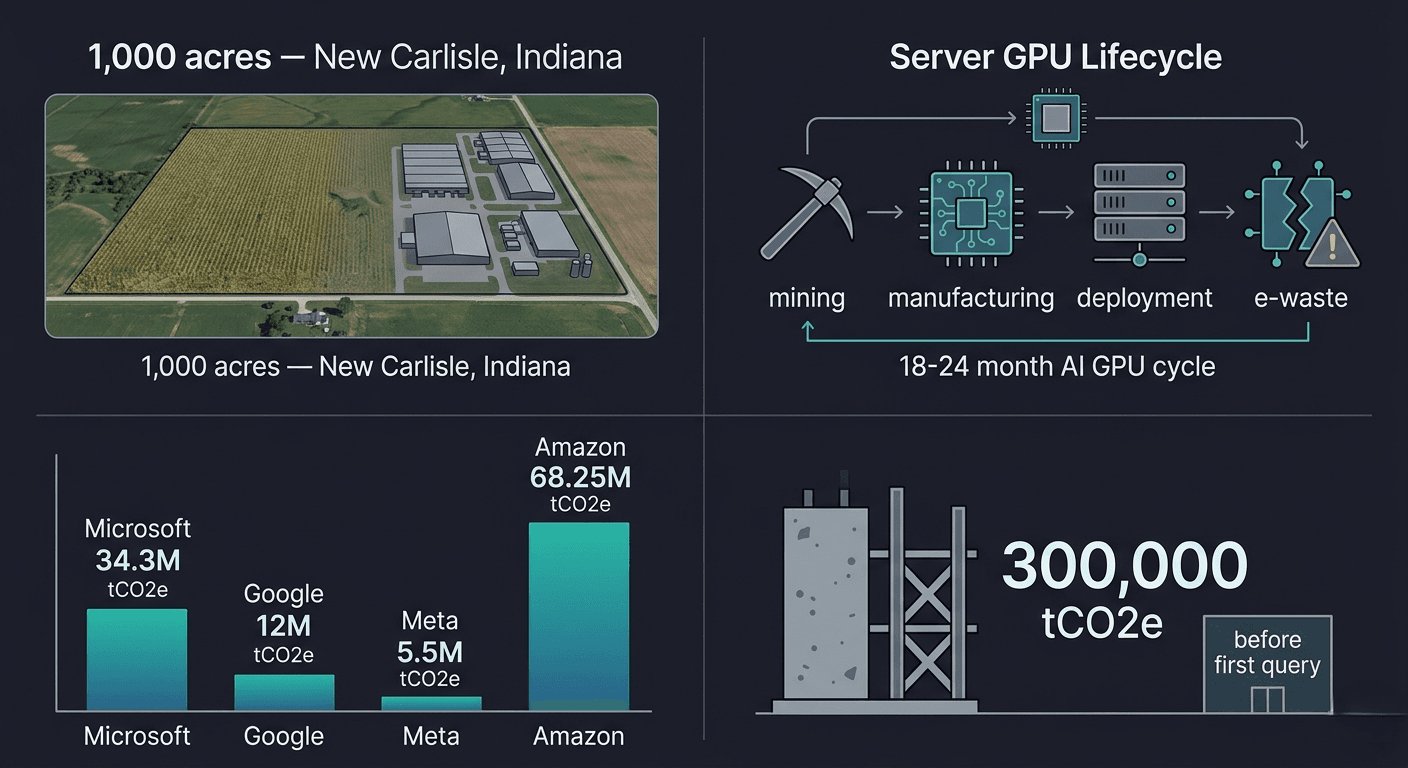
- 1AI data center campuses routinely cover 500-1,000 acres of former farmland or forest. Amazon's planned New Carlisle, Indiana campus will destroy 10 acres of wetlands and is built primarily on agricultural land.
- 2Building one 100-150 MW AI data center generates 150,000-300,000 tonnes of embodied CO2 from concrete, steel, and mechanical equipment before a single server is powered on.
- 3AI GPU replacement cycles run 18-24 months, far shorter than the standard 3-5 year server lifecycle, generating millions of decommissioned units annually containing rare earth elements, lead, and copper with no universal recycling standard.
AI data centers have a physical footprint that extends well beyond the electricity they consume. Every facility starts as hundreds of acres of land, often farmland or forest, converted into a campus of concrete buildings, power substations, and cooling infrastructure. Before it processes a single query, a 150-megawatt hyperscale data center has already emitted up to 300,000 tonnes of CO2 through the concrete, steel, and mechanical systems used to build it.
The numbers behind that construction are rarely discussed in the same breath as electricity or water use. According to a 2025 review in Cell Reports Sustainability, embodied carbon in data center buildings and IT equipment can account for 15-40% of a facility's total lifetime greenhouse gas emissions, depending on how long it operates and what energy it runs on. For campuses built on renewable energy, the construction phase dominates the lifetime carbon picture.
The environmental costs that rarely appear in corporate press releases are the physical ones: 1,000 acres of farmland converted to a single campus, 300,000 tonnes of CO2 embedded in concrete before a server powers on, and millions of AI GPUs cycling through 18-month replacement windows with no universal recycling standard. Those are the subjects here, along with Scope 1, 2, and 3 emissions data for Microsoft, Google, Meta, and Amazon. For electricity consumption numbers, see AI data center power consumption. For water volumes, see how much water does AI use.
In This Article
- 1The Four Phases of a Data Center's Environmental Footprint
- 2Land Use: How Many Acres AI Data Centers Consume
- 3E-Waste: What Happens When AI Servers Are Decommissioned
- 4Embodied Carbon: The CO2 Locked into Construction
- 5Community Impacts: Noise, Heat, and Local Water Quality
- 6Scope 1, 2, and 3: How the Four Largest AI Companies Report Their Emissions
- 7What the Industry Is Doing, and Where the Gaps Remain
The Four Phases of a Data Center's Environmental Footprint
Data centers create environmental impacts across four distinct phases, and most public discussion covers only one of them.
The Hoosier Environmental Council describes the lifecycle this way: "Data centers have a multifaceted impact on the environment which can be thought of in four phases: mining and manufacturing for raw materials, construction of the actual data center, operation of the data center, and the end use of the computer hardware, or e-waste." Each phase has a different geographic reach, a different set of affected communities, and a different timescale.
Phase one happens in mines and semiconductor fabs. Rare earth elements, copper, cobalt, aluminum, and high-purity silicon are extracted and processed to build the chips, circuit boards, and power hardware that go inside servers. Metal extraction and processing contribute roughly 10% of global greenhouse gas emissions, driven by demand for IT equipment, energy infrastructure, and construction (Cell Reports Sustainability, 2025).
Phase two is construction. Steel and concrete arrive on site, substations are built, cooling towers go up. The carbon locked into these materials is emitted before the facility operates.
Phase three is the operational phase: electricity, water, and chemical use during the years the facility runs.
Phase four is end-of-life, when servers are decommissioned, resold, or recycled, and when the building infrastructure eventually reaches the end of its useful life.
| Phase | Primary Impact | Affected Geography | Timescale |
|---|---|---|---|
| 1. Mining and manufacturing | CO2, water, land, toxic waste | Global supply chain | Years before opening |
| 2. Construction | Embodied carbon, land conversion, habitat loss | Local (campus site) | Months during build |
| 3. Operation | Electricity, water use, noise, heat, chemical discharge | Local community + global grid | Years of operation |
| 4. End-of-life | E-waste, rare earth recovery failure, toxic materials | Regional ITAD facilities | After decommissioning |
Most environmental reporting by hyperscalers focuses on phase three, the operational phase, because that is where renewable energy commitments apply. Phases two and four receive far less disclosure.
Land Use: How Many Acres AI Data Centers Consume
Every AI data center campus starts as land. The scale of the current build-out is converting farmland, forest, and wetlands into industrial facilities at a pace that has alarmed land-use researchers and local communities.
Amazon's planned AI data center in New Carlisle, Indiana covers approximately 1,000 acres. The project will destroy roughly 10 acres of wetlands and is built primarily on farmland. That is a single facility. According to the Lincoln Institute of Land Policy, "Construction of a data center will inevitably require land, and while development footprints of data centers can vary widely, emerging AI data centers are unusually land consumptive."
Northern Virginia: The World's Largest Data Center Cluster
Loudoun County, Virginia hosts more than 30 million square feet of data centers, much of it on former farmland and greenfield sites near transmission infrastructure. The density is so high that the region has earned the nickname "Data Center Alley." The proposed Prince William Digital Gateway, a planned corridor for new AI-oriented data center development, would span approximately 2,100 acres adjoining Manassas National Battlefield Park. Conservation groups have raised concerns about wetland fragmentation, altered stormwater patterns, and habitat loss for wildlife species dependent on the corridor between the battlefield and surrounding forest.
Texas, Iowa, and the Agricultural Conversion Pattern
Texas has become one of the fastest-growing data center markets in the United States. Individual campuses in the Dallas-Fort Worth and San Antonio regions typically cover 100 to 500 or more acres, converting ranchland and agricultural fields near transmission lines into low-rise industrial buildings surrounded by acres of mechanical equipment.
Iowa has concentrated major data center investment around Des Moines and Council Bluffs, drawn by inexpensive land and wind power. Microsoft operates multiple campuses near Des Moines, with individual sites exceeding 300 to 500 acres of once corn and soybean farmland. Tech firms collectively spent roughly $580 billion in 2025 building data centers, converting what the IR Insider describes as "empty fields, deserts, and abandoned factories into mini cities of data centers."
The Chile Case: When Communities Say No
Not every proposed data center gets built. Google abandoned plans for a data center in Chile after environmental protests over aquifer depletion in a watershed already under stress. That case illustrates a pattern beginning to emerge: communities with limited water resources are pushing back against large-scale data center development before it starts. In Newton County, Georgia, after Meta began constructing a $750 million data center, local residents reported dry wells and concerns over water quality, and county projections showed a water deficit by 2030, with water rates expected to increase 33% over two years (Newton County Water and Sewerage Authority, 2024).
| Campus / Region | Acreage | Prior Land Use | Notable Impact |
|---|---|---|---|
| Amazon New Carlisle, Indiana | ~1,000 acres | Farmland | 10 acres of wetlands destroyed |
| Prince William Digital Gateway, Virginia | ~2,100 acres (proposed corridor) | Forest and rural land | Adjacent to Manassas Battlefield |
| Loudoun County, Virginia | 30 million sq ft total | Mixed farmland and commercial | World's densest data center cluster |
| Microsoft Iowa campuses | 300-500 acres each | Corn and soybean farmland | Conversion of agricultural land |
| Google Chile (cancelled) | Not disclosed | Watershed land | Cancelled after aquifer concerns |
Land Footprint of Major AI Data Center Campuses (Acres)
Microsoft Iowa and Google Oregon figures are estimated ranges from Lincoln Institute of Land Policy reporting. Prince William Digital Gateway is a proposed corridor, not a single approved facility.
| Category | Value | Unit |
|---|---|---|
| Prince William Gateway (proposed) | 2100 | acres |
| Amazon New Carlisle, Indiana | 1000 | acres |
| Microsoft Iowa (per campus) | 400 | acres (est.) |
| Google Oregon sites | 200 | acres (est.) |
E-Waste: What Happens When AI Servers Are Decommissioned
The rapid pace of AI hardware development means servers are retired faster than in any previous generation of data center equipment. Standard hyperscale server replacement cycles run three to five years for performance and reliability reasons. AI GPU clusters are replaced faster still: NVIDIA's GPU generations move from A100 to H100 to B100 to B200 on roughly 18-to-24-month cycles in high-end deployments. Operators often cascade older accelerators to lower-priority workloads, but the overall replacement rate is accelerating.
Global e-waste reached 62 million metric tons in 2022, with data center and IT equipment among the fastest-growing categories (Global E-waste Monitor, 2024). There are an estimated 8,000 to 10,000 large data centers worldwide, with total server counts measured in the tens of millions. Assuming three-to-five year lifetimes, that implies millions of server units decommissioned annually, each containing components that require careful handling.
What an AI Server Contains
A high-end data center GPU in the class of the NVIDIA H100 or B200 carries approximately 0.5 to 1.0 kilograms of copper across its heatsinks, cold plates, and power distribution traces. The card and cooling solution together weigh roughly one to two kilograms. Rare earth elements appear in the neodymium-iron-boron magnets used in fans, with a single fan motor containing a few grams of neodymium, praseodymium, and dysprosium. Gold appears in bonding wires and edge connectors at several hundred milligrams per unit.
As sustainability researcher Amin Bashir told Smithsonian Magazine: "The GPUs that power AI data centers are made with rare earth elements, the extraction of which is resource intensive and can cause environmental degradation."
A complete data center server, including CPUs, memory, storage, and chassis, weighs 15 to 25 kilograms. Most of that mass is bulk metals: steel, aluminum, and copper. Printed circuit boards, plastics, and small quantities of critical metals make up the balance, but those are the components current recycling processes struggle to recover.
The Recycling Gap
Decommissioned hardware typically goes through one of three pathways: resale or redeployment to less demanding workloads, processing by IT asset disposition (ITAD) firms for parts harvesting, or formal recycling for metals recovery.
Current recycling technology recovers bulk metals reliably. Copper, aluminum, and steel can be extracted efficiently. The problem is semiconductor content. GPU boards contain intricate multilayer substrates with trace amounts of rare earth elements, tantalum, indium, and gallium that existing smelters and refiners recover incompletely. A 2025 review in Cell Reports Sustainability notes that "current recycling technologies recover primarily bulk metals but leave much of the high-value semiconductor content and many rare elements unrecovered."
Older equipment also contains lead, mercury, cadmium, and brominated flame retardants, classified as hazardous waste requiring controlled handling and disposal. Because AI servers are physically heavier and more complex than standard rack servers, with multiple GPUs, liquid cooling hardware, and larger power supplies, the per-unit e-waste mass is substantially higher than earlier generations.
Embodied Carbon: The CO2 Locked into Construction
Before an AI data center runs a single inference job, construction has already emitted up to 300,000 tonnes of CO2-equivalent through the concrete, steel, and cooling systems used to build it. This pre-operational carbon, called embodied carbon, comes from cement production, steel manufacturing, aluminum fabrication, and the mechanical and electrical systems installed during construction.
A 2025 review in Cell Reports Sustainability finds that embodied carbon in data center buildings, IT equipment, and infrastructure can account for 15 to 40% of a facility's total lifetime greenhouse gas emissions. For a data center running on renewable electricity, the construction phase becomes the dominant source of emissions over the building's life.
Engineering and lifecycle assessment literature converges on the following benchmarks for data center construction:
- Building materials (structure and envelope): 500 to 800 kgCO2e per square meter of gross floor area
- With typical ratios of 10 to 12 square meters of gross floor area per kilowatt of IT load (to account for support spaces, power infrastructure, and cooling plant), embodied carbon runs approximately 5,000 to 10,000 tonnes of CO2e per megawatt of IT capacity
For a 100-to-150-megawatt hyperscale AI data center, those figures translate to roughly 150,000 to 300,000 tonnes of CO2e from construction alone, before the facility powers on.
The major contributors:
- Concrete (foundations, slabs, structural walls): cement production emits 0.6 to 0.9 tonnes of CO2 per tonne of cement, making it the largest single source in most builds
- Steel (framing, racks, rebar): primary steel production emits 1.8 to 2.0 tonnes of CO2 per tonne of steel
- Aluminum (cable trays, components): primary aluminum production can exceed 10 tonnes of CO2 per tonne of product, depending on the electricity mix used in the smelter
- Mechanical and electrical systems (chillers, cooling towers, switchgear, transformers): often comparable in embodied carbon to the building shell, because of the volume and complexity of equipment
The Number Most Guides Don't Show
Published reporting on data center spending and embodied carbon allows a calculation that is rarely made explicit. AI data center construction runs roughly $10 to $15 million per megawatt of IT load. Embodied carbon runs roughly 5,000 to 10,000 tonnes of CO2e per megawatt. That means for every $1 million spent building an AI data center, construction emits approximately 333 to 1,000 tonnes of CO2 before the facility processes a single request.
IR Insider reports that tech companies collectively spent roughly $580 billion building data centers in 2025, with total investment potentially reaching $3 trillion through 2030. Applying the construction carbon range to that investment figure produces an estimate of 1 to 3 billion tonnes of CO2 locked into data center construction between now and 2030. Germany's total annual national CO2 emissions are approximately 675 million tonnes. The embodied carbon from the planned global data center build-out equals roughly 1.5 to 4.5 times Germany's annual emissions, released not through operation but through materials and construction.
This figure is not equivalent to annual operational emissions and should not be added to them directly. But it illustrates the scale of pre-operational commitment that is invisible in any discussion of AI energy use.
Community Impacts: Noise, Heat, and Local Water Quality
For the people who live near AI data center campuses, the experience is often defined by three things: constant noise, local heat, and concern about what is going into the water.
Noise: 24/7 at 65 to 80 Decibels
Data centers run continuously. Hundreds or thousands of fans, chillers, cooling towers, and backup diesel generators operate around the clock, seven days a week. Residents in Indiana living near data centers have measured noise levels around 65 decibels at night from server equipment, HVAC systems, cooling towers, and exhaust infrastructure. The Citizens Action Coalition of Indiana cites Boston University School of Public Health research: "At only 65 decibels, about as loud as a car going by for someone standing on the side of the road, research has shown that people begin experiencing increased risk of hypertension and heart attack."
Closer to mechanical yards, where compressors and cooling towers are located, the picture is worse. Net Zero Insights cites noise levels near data center mechanical infrastructure exceeding 80 dBA, comparable to a leaf blower operating continuously. "Communities living near large data centers frequently report health concerns linked to the unceasing background noise. Chronic exposure causes sleep disturbance, headache, hearing loss, elevated stress hormone levels, hypertension, anxiety, and even cardiovascular risks," the analysis notes.
Cooling Tower Chemistry and Water Discharge
Evaporative cooling systems, the standard approach for hyperscale data centers, require chemical treatment to prevent scale, corrosion, and biological growth in cooling towers. Operators add biocides, algaecides (chlorine compounds, bromine compounds), corrosion inhibitors (often phosphate-based), and anti-scalants to the circulating water. Cooling towers periodically discharge concentrated water, called blowdown, to maintain water quality. This blowdown water carries elevated concentrations of treatment chemicals, dissolved salts, and biological control agents.
A 2025 academic review notes that blowdown water "may lead to soil and groundwater contamination near data center sites" when improperly managed, and calls for improved monitoring and disclosure. Documented contamination events at named AI data center sites are rare in the public record, largely because operators and regulators treat water quality data as proprietary. The data gap itself is a concern: communities cannot assess the risk they cannot measure.
Local Grid Strain: Indiana as a Case Study
The utility Indiana Michigan Power (I&M) projects that just a handful of planned AI data centers in its service territory will, by 2030, use more electricity than all 6.8 million Indiana residents use in their homes today. A single 1,000-megawatt AI data center, I&M estimates, will use 52% more electricity than all 420,000 of I&M's residential customers combined used in 2023. To serve that demand, the utility plans major expansions of natural gas power plants, new transmission lines, and substations, adding physical infrastructure with its own land use, air quality, and noise footprint near communities that never consented to host AI compute capacity.
Scope 1, 2, and 3: How the Four Largest AI Companies Report Their Emissions
The four hyperscalers that operate the world's largest AI data centers, Microsoft, Google, Meta, and Amazon, all publish greenhouse gas inventories. The structure of those disclosures matters for understanding where the real climate impact sits.
Scope 1 covers direct emissions from sources the company controls: on-site fuel burning, backup diesel generators, refrigerant leaks from cooling systems. For data center operators, Scope 1 is relatively small in absolute terms but matters locally, because diesel generator testing and emergency operation emit nitrogen oxides and particulate matter near the communities hosting the facilities.
Scope 2 covers indirect emissions from purchased electricity and heat. All four companies have purchased large volumes of renewable energy to reduce their reported market-based Scope 2 figures. Those purchases do not eliminate physical grid emissions, but they represent real investment in new renewable generation.
Scope 3 covers everything in the supply chain: the emissions from manufacturing the servers and GPUs, shipping them, constructing the buildings, and ultimately disposing of them. Scope 3 is the largest category for all four companies, and it is growing fastest as they build out AI infrastructure.
| Company | Total Emissions (latest report) | Reporting Year | Scope 2 Market-Based | Scope 3 Notes |
|---|---|---|---|---|
| Microsoft | ~34.3 million tCO2e total | FY 2023 (reported 2024) | Near zero (renewable PPAs) | Scope 3 dominates; up ~30% from 2020 |
| Google (Alphabet) | ~12 million tCO2e total | 2023 | ~1.2 million tCO2e | Scope 3 is the majority; rising with AI growth |
| Meta | ~5-5.5 million tCO2e Scope 3 | 2023 | ~0.17 million tCO2e (market) | Low Scope 2 via renewables; Scope 3 growing from hardware and construction |
| Amazon | 68.25 million tCO2e total | 2024 | Partially offset by renewables | Up from 64.38 million in 2023; supply chain and AWS expansion drive Scope 3 |
The pattern across all four is the same: Scope 2 market-based emissions appear low or near zero because of renewable energy contracts, while Scope 3 emissions, driven by server procurement, construction, and supply chain manufacturing, are the largest and fastest-growing category.
Microsoft's total corporate footprint grew approximately 30% between 2020 and 2023, driven primarily by data center expansion and the associated supply chain. For a company with a stated 2030 carbon-negative commitment, the trajectory of Scope 3 emissions tied to AI infrastructure is the central challenge.
Amazon's 2024 total of 68.25 million tCO2e compares to 64.38 million in 2023. That is a year-on-year increase of 3.87 million tonnes, more than the annual emissions of a mid-size country. AWS expansion and equipment procurement are the primary drivers.
Meta reports relatively low market-based Scope 2 emissions because it matches data center electricity with renewable energy purchases. But its Scope 3 emissions from supply chain and hardware are growing as it builds new AI-ready campuses. The construction of a $750 million Meta data center in Newton County, Georgia pushed the county toward a projected water deficit by 2030, with local water rates rising 33% in two years, a local fiscal impact that appears nowhere in Meta's Scope 1, 2, or 3 reporting.
Total Scope 1+2+3 Emissions: Major AI Data Center Operators (2023-2024)
Amazon and Microsoft figures cover 2024 and 2023 respectively. All figures include Scope 1, 2, and 3 emissions across all business operations, not data centers alone.
| Category | Value | Unit |
|---|---|---|
| Amazon | 68.25 | million tCO2e |
| Microsoft | 34.3 | million tCO2e |
| 12 | million tCO2e | |
| Meta | 5.5 | million tCO2e |
What the Industry Is Doing, and Where the Gaps Remain
Several major operators have launched programs to reduce the physical environmental footprint of their data centers. The scale of the commitments varies, and the transparency around outcomes is inconsistent.
On hardware circularity, Microsoft operates a server refurbishment program that extends the usable life of decommissioned equipment before it reaches recycling. AWS runs an IT equipment refurbishment service and has published circularity targets. Google has committed to zero e-waste to landfill at its data center sites and publishes asset disposition data in its environmental reports.
On cooling and heat recovery, some European data center operators have implemented district heating: capturing waste heat from cooling systems and distributing it to nearby homes and buildings. This approach is uncommon in the United States, where most data centers dump waste heat into the air. The United Nations Environment Programme has identified waste heat recovery as one of the primary levers for reducing the community impact of data centers, alongside longer equipment lifetimes and improved recycling standards.
On land use and biodiversity, few companies publish systematic data on how much land their campuses convert, what ecosystems are displaced, or what mitigation is applied. The Lincoln Institute of Land Policy identifies this as a significant transparency gap, noting that land-use impacts are under-reported or treated as confidential in planning documents.
The structural challenge is that improvement programs operate at the asset level, while the expansion is happening at the portfolio level. A company can refurbish more servers at existing facilities while simultaneously building ten new campuses on greenfield sites. The net physical footprint continues to grow.
The commitments that attract the most press coverage, renewable energy matching and carbon-neutrality pledges, address only one phase of the problem: operations. They leave construction carbon, e-waste, land conversion, and Scope 3 supply chain largely untouched. Any honest count of AI data centers' environmental impact has to include all four phases, not just the one where renewable purchasing provides a credible answer.
Frequently Asked Questions
What is the carbon footprint of building an AI data center?
Building a 100-to-150-megawatt hyperscale AI data center generates approximately 150,000 to 300,000 tonnes of CO2-equivalent from construction materials and equipment, before the facility processes a single query. This embodied carbon comes from cement production (0.6-0.9 tCO2 per tonne), steel manufacturing (1.8-2.0 tCO2 per tonne), aluminum fabrication (up to 10 tCO2 per tonne depending on the electricity mix), and mechanical systems including chillers, cooling towers, and switchgear. A 2025 review in Cell Reports Sustainability found that embodied carbon can account for 15-40% of a data center's total lifetime greenhouse gas emissions. For facilities running on renewable electricity, construction becomes the dominant source of lifetime emissions.
How much land does an AI data center use?
AI data center campuses typically cover 100 to 1,000 or more acres depending on the scale of the facility. Amazon's planned AI campus in New Carlisle, Indiana covers approximately 1,000 acres, built primarily on farmland, and will destroy roughly 10 acres of wetlands. Loudoun County, Virginia alone hosts more than 30 million square feet of data centers. The proposed Prince William Digital Gateway data center corridor would cover approximately 2,100 acres adjoining Manassas National Battlefield Park. Microsoft's Iowa campuses individually exceed 300 to 500 acres of former agricultural land. The Lincoln Institute of Land Policy describes AI data centers as "unusually land consumptive" compared to earlier generations of data center development.
What happens to old AI servers and GPUs?
Decommissioned AI servers typically go through one of three pathways: resale or redeployment to lower-priority workloads, processing by IT asset disposition (ITAD) firms for parts harvesting, or formal recycling for metals recovery. Current recycling processes recover bulk metals reliably, primarily copper, aluminum, and steel. However, semiconductor content, rare earth elements, tantalum, indium, and gallium, are largely unrecovered in standard recycling streams. A 2025 Cell Reports Sustainability review notes that "current recycling technologies recover primarily bulk metals but leave much of the high-value semiconductor content and many rare elements unrecovered." Older hardware may also contain lead, mercury, cadmium, and brominated flame retardants classified as hazardous waste. AI GPUs are replaced on roughly 18-24 month cycles, faster than the standard 3-5 year server lifecycle, accelerating the volume of decommissioned hardware.
How do AI data centers affect local communities?
Local communities near AI data centers typically experience three categories of impact. First, noise: cooling towers, fans, chillers, and generators operate 24/7 at 65-80 decibels near residential areas, with chronic exposure at 65 dB linked to increased risk of hypertension and heart attack (Boston University School of Public Health). Second, water and chemical discharge: cooling systems use biocides, corrosion inhibitors, and anti-scalants that appear in discharge water and can affect local waterways if not managed correctly. Third, utility strain: in Indiana, Indiana Michigan Power projects that planned AI data centers will consume more electricity than all 6.8 million Indiana residents use in homes by 2030, driving the utility to expand natural gas capacity. In Newton County, Georgia, a Meta data center project pushed county projections to show a water deficit by 2030 and water rates rising 33% over two years.
What is the difference between Scope 1, 2, and 3 emissions for data centers?
Scope 1 covers direct emissions from sources the company controls, primarily on-site fuel combustion in backup diesel generators and refrigerant leaks from cooling systems. For data center operators, Scope 1 is relatively small. Scope 2 covers indirect emissions from purchased electricity. Hyperscalers reduce market-based Scope 2 through renewable energy purchasing, though physical grid emissions from electricity consumed are not eliminated. Scope 3 covers supply chain emissions including manufacturing of servers and GPUs, construction of buildings, equipment shipping, and disposal. For all four major AI data center operators (Microsoft, Google, Meta, Amazon), Scope 3 is the largest and fastest-growing emissions category, driven by AI hardware procurement and the construction of new campuses. Microsoft's total emissions grew approximately 30% from 2020 to 2023, with Scope 3 as the primary driver.
Are AI companies required to disclose their environmental impact?
There is no universal mandatory disclosure standard for AI data center environmental impact as of 2026. In the United States, the SEC has proposed but not yet fully implemented climate disclosure rules that would require large public companies to report Scope 1 and 2 emissions. Scope 3 reporting remains largely voluntary. In the EU, the Corporate Sustainability Reporting Directive (CSRD) requires large companies to report environmental data including emissions, water use, and waste under the European Sustainability Reporting Standards. For site-level data on noise, water quality, and land use, requirements are local: municipalities and state environmental agencies handle permitting for cooling systems and noise, but there is no national registry of data center environmental impacts. The Lincoln Institute of Land Policy and several academic reviews have identified this disclosure gap as a significant obstacle to public oversight of AI data center expansion.
How does embodied carbon compare to operational carbon for AI data centers?
A 2025 review in Cell Reports Sustainability found that embodied carbon, the CO2 emitted producing construction materials and IT equipment, can account for 15-40% of a data center's total lifetime greenhouse gas emissions. For facilities running primarily on renewable electricity, the construction phase dominates the lifetime carbon picture because operational Scope 2 emissions are reduced while embodied carbon from concrete, steel, and GPU manufacturing remains fixed. At approximately 5,000 to 10,000 tonnes of CO2e per megawatt of IT capacity for construction alone, a 500-megawatt AI campus can lock in 2.5 to 5 million tonnes of CO2e before opening. That is equivalent to the annual greenhouse gas emissions of a small country. The ratio shifts in carbon-intensive electricity grids, where operational emissions dominate.