
What Is a Colocation Data Center? Costs and How It Works

Key Numbers
Key Takeaways
- 1A colocation data center rents physical space, power, and cooling to businesses for their own servers. Unlike cloud, the customer owns and manages all hardware; the provider operates the building. Tier 3 facilities guarantee 99.982% uptime per Uptime Institute standards.
- 2Average US wholesale colocation costs $195.94 per kW per month as of H2 2025 (CBRE), up 6.5% year-over-year. A 5 MW deployment costs $11.76 million per year in colocation fees. At current US construction costs of $10.7M/MW (JLL 2026), the break-even on building versus renting takes 7 to 9 years.
- 3AI GPU racks draw 20 to 90 kW each versus 3 to 5 kW for standard servers. This is forcing colocation providers to redesign power distribution and install liquid cooling infrastructure. Facilities unable to deliver 20 kW or more per rack are losing AI customers to purpose-built GPU cloud providers.
A colocation data center rents physical space, dedicated power, cooling infrastructure, and network connectivity to businesses for housing their own servers. The building belongs to the provider; the hardware belongs to the customer. This fundamental arrangement separates colocation from cloud computing, where you rent virtual compute from machines you never physically access.
What surprises most people first encountering colocation: the average US wholesale rate reached $195.94 per kilowatt per month in the second half of 2025, up 6.5% from the first half of the year (CBRE, H2 2025). Power has become the scarce resource in colocation, not floor space. AI workloads draw 5 to 15 times more power per rack than the traditional enterprise servers these facilities were originally designed for.
By the end of this article, you will understand what a colocation contract actually includes, how pricing is structured per kilowatt and per rack, why the break-even on building your own data center versus renting colocation space is further away than most CFOs expect, and how the rise of AI GPU workloads is reshaping the colocation market.
In This Article
- 1What Is a Colocation Data Center?
- 2What a Colocation Contract Covers
- 3Major Colocation Providers: Equinix, Digital Realty, and Others
- 4Colocation Pricing in 2026: What You Actually Pay
- 5Colocation vs. Cloud vs. On-Premises: How to Choose
- 6How AI Is Changing Colocation Requirements
- 7Three Things People Get Wrong About Colocation
What Is a Colocation Data Center?
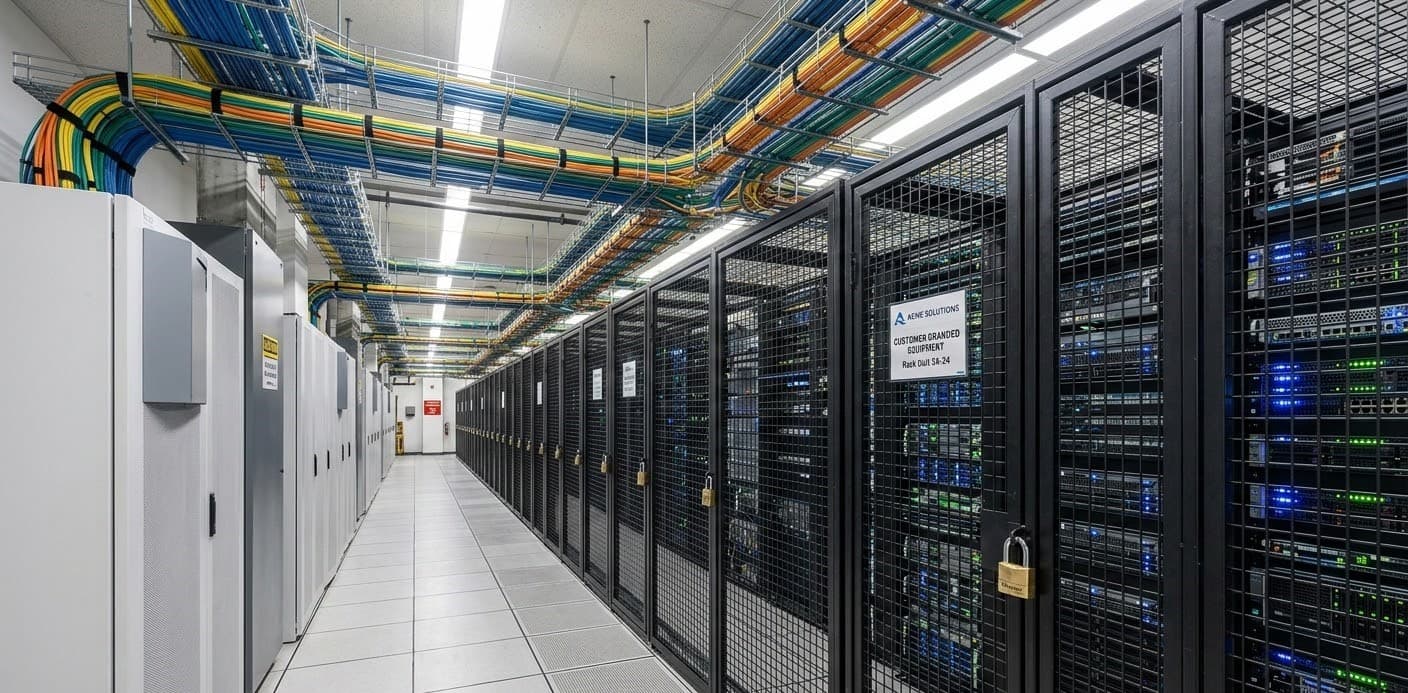
A colocation data center, abbreviated as "colo," is a third-party facility where multiple businesses house their own servers, storage systems, and networking equipment in a shared building. The colocation provider builds and operates the facility: the physical structure, power systems, cooling infrastructure, fire suppression, and physical security. The tenant owns and manages all hardware inside.
Colocation sits between two more familiar options. On-premises computing means owning and running your own facility with all the capital expense, staffing, and maintenance that entails. Public cloud (AWS, Azure, Google Cloud) means renting virtual compute from machines you never physically touch. Colocation is the middle ground: you retain physical ownership of your hardware and complete administrative control over your servers, while offloading the complexity and cost of operating a data center building to a specialist provider.
The model achieves its value through economies of scale. A colocation facility serving 300 tenants spreads the costs of power redundancy systems, cooling infrastructure, security staffing, and network connectivity across all of them. Each tenant pays a fraction of what equivalent redundancy would cost in a private data center.
Colocation comes in three forms, based on deployment size:
| Type | Minimum Size | Who Uses It | Typical Power Density |
|---|---|---|---|
| Retail colocation | Single server or 1 rack | SMBs, startups, mid-market | 3-10 kW/rack |
| Wholesale colocation | 250 kW to 10 MW | Large enterprises, cloud providers | 10-30 kW/rack |
| Hyperscale colocation | 10 MW+ | AI companies, cloud platforms | 20-100+ kW/rack |
Retail colocation uses per-rack or per-cabinet pricing, typically on monthly or annual terms. Wholesale colocation uses per-kilowatt pricing on 3- to 10-year contracts. For a broader view of the data center landscape, including the hyperscale facilities that run AI model training, see our overview of AI data centers.
What a Colocation Contract Covers
A standard colocation contract covers five categories of service. Understanding what is and is not included avoids the most common pricing surprises when comparing provider quotes.
- Physical space: The customer receives dedicated rack space (measured in U units, where 1U equals 1.75 inches of vertical rack height), a full 42U cabinet, a private cage (a locked section of the floor with multiple racks), or a private suite (an enclosed room for large deployments). The space allocation determines which provider personnel can physically access the customer's equipment.
- Power: Dedicated circuits measured in kilowatts or amps deliver power to the customer's racks. Contracts specify the committed power draw and any burst allowances. Redundant power feeds are standard at Tier 3 and Tier 4 facilities. An N+1 configuration has one backup unit for every active unit. A 2N configuration has a complete duplicate power chain, end to end.
- Cooling: The facility maintains ambient temperature and humidity in server rooms. High-density AI deployments increasingly require in-row liquid cooling, direct-to-chip water loops, or rear-door heat exchangers, which most providers offer as premium add-ons.
- Physical security: Biometric access controls, CCTV monitoring, mantraps at entry points, and 24/7 on-site staffing protect the facility. Tier 3 and Tier 4 sites maintain single-tenant cage access logs that satisfy SOC 2, HIPAA, and PCI DSS audit requirements.
- Network connectivity: Access to multiple telecommunications carriers without a separate contract with each one. Carrier-neutral facilities allow tenants to connect directly to any network provider on-site via a cross-connect, typically at $100 to $300 per month per connection.
What colocation does not include
The customer is responsible for all servers, switches, storage devices, operating systems, and software licensing. Hardware maintenance, including physical repairs and drive replacements, belongs to the customer. If a server requires a physical fix, the customer's team must travel to the facility or purchase remote hands services from the provider, typically at $100 to $250 per hour for on-site labor.
This ownership structure is what separates colocation from managed hosting or cloud. The colocation provider has no visibility into the workloads running on customer hardware unless the customer explicitly grants access.
Major Colocation Providers: Equinix, Digital Realty, and Others
Equinix and Digital Realty are the two largest colocation providers globally by revenue and footprint. Below them, a tier of large regional and specialized providers serves enterprise and government customers with specific geographic or compliance requirements.
| Provider | Data Centers | Global Footprint | Key Differentiator |
|---|---|---|---|
| Equinix | 260+ IBX facilities | 33 countries, 70+ metros | Carrier-neutral interconnection fabric |
| Digital Realty | 300+ facilities | 50+ metros globally | Wholesale and hyperscale deployments |
| NTT Global Data Centers | 160+ facilities | 20+ countries | Dominant Asia-Pacific presence |
| Iron Mountain | 45+ facilities | North America, Europe | Regulated industries, compliance-heavy workloads |
| CyrusOne | 55+ facilities | US, Europe | Mid-market enterprise and financial services |
| DataBank | 65+ facilities | US regional markets | Edge locations and managed services |
| Flexential | 40+ facilities | US regional | Hybrid cloud integration |
Equinix's competitive advantage is its interconnection model. Its IBX (International Business Exchange) facilities act as neutral exchange points where internet service providers, cloud platforms, financial networks, and enterprises exchange traffic directly, bypassing the public internet. Equinix reported approximately $8.7 billion in revenue for full-year 2024 and serves more than 10,000 customers globally (Equinix FY2024 earnings).
"The value of a colocation facility is not just the space and power inside it. It is the fabric of 400 networks and 3,000 cloud and IT services you can reach from inside our IBX." (Equinix corporate overview, 2025)
Digital Realty focuses on large-scale, long-duration deployments for enterprise and cloud provider customers. Its PlatformDIGITAL strategy targets enterprises building hybrid multi-cloud architectures. Digital Realty reported approximately $5.7 billion in full-year 2024 revenue (Digital Realty FY2024 earnings).
For context on how hyperscalers such as AWS, Microsoft, and Google use colocation facilities alongside their owned infrastructure, see our explanation of what hyperscalers are and how they operate.
Colocation Pricing in 2026: What You Actually Pay
Colocation pricing uses two models depending on deployment scale: retail pricing (per rack or cabinet) and wholesale pricing (per kilowatt of committed power).
Retail colocation covers 1 to 50 racks and suits businesses that want predictable monthly costs without long-term power commitments. Typical monthly rates as of 2026:
- Standard rack (3-5 kW): $500 to $1,500 per month
- High-density rack (10-20 kW): $1,500 to $4,000 per month
- AI/GPU rack (20-40 kW): $3,900 to $8,000 per month
- Single 1U server slot: $79 to $599 per month
Wholesale colocation covers 250 kW and above, priced per kilowatt with multi-year contracts. The US wholesale market averaged $195.94 per kW per month for 250-500 kW deployments in H2 2025, up from $184/kW in H1 2025, a 6.5% year-over-year increase. According to Cushman and Wakefield's Data Center Power and Lease Pricing Outlook, power availability, not floor space, is the binding constraint on new colocation supply in every major US market in 2026.
Prices vary significantly by geography, driven by local power grid capacity and proximity to internet exchange points:
| Market | Wholesale Rate (H2 2025) | Market Conditions |
|---|---|---|
| Silicon Valley | $230-$270/kW/month | Power-constrained, limited new supply |
| Northern Virginia | $180-$210/kW/month | Largest US market, long utility queues |
| Dallas-Fort Worth | $170-$200/kW/month | Competitive pricing, growing supply |
| Atlanta | $160-$185/kW/month | Lower-cost alternative to Northern Virginia |
| Chicago | $175-$205/kW/month | Large financial services base |
The Number Most Guides Don't Show
Most comparisons of colocation versus build-to-own stop at headline construction costs. Here is the complete break-even calculation.
Building a 5 MW private data center in the US in 2025:
- Construction cost: $53.5 million (5 MW x $10.7M per MW, per JLL's 2026 Global Data Center Outlook)
- Land and site preparation: $8 to $15 million
- Annual facility maintenance and operations staffing: $3 to $5 million
- Construction timeline: 18 to 24 months before a single server goes live (JLL, 2026)
Total capital outlay: $60 to $70 million, before a single server is installed.
Colocation for the same 5,000 kW:
- Monthly cost: $979,700 (5,000 kW x $195.94/kW per month, CBRE H2 2025)
- Annual cost: $11.76 million
After subtracting $3 to $5 million in annual maintenance costs that disappear when you own rather than rent, the net annual saving from owning is roughly $7 to $9 million. At that rate, recovering the $60 to $70 million capital outlay takes approximately 7 to 9 years.
Most enterprise hardware cycles run 5 to 7 years. By the time the break-even on a self-built facility arrives, the servers inside it are typically due for a complete replacement. This is the core reason why even large enterprises with stable, predictable workloads often continue choosing colocation over build-to-own.
Colocation vs. Cloud vs. On-Premises: How to Choose
The right infrastructure model depends on workload stability, compliance requirements, and the cost structure that fits your planning horizon.
| Factor | Colocation | Cloud (AWS, Azure, Google) | On-Premises |
|---|---|---|---|
| Hardware ownership | Customer owns hardware | Provider owns hardware | Customer owns hardware |
| Capital expense | Low (no facility build) | None | High (facility and hardware) |
| Monthly cost | Per kW/rack fees | Per compute and storage unit | Maintenance and staffing only |
| Scalability | Add racks in weeks | Seconds to minutes | Months to years |
| Physical control | Full (your servers, your access) | None | Full |
| Network diversity | High at carrier-neutral sites | Provider-dependent | Limited to on-site circuits |
| Compliance | Supports physical data sovereignty | Depends on region and contract | Full control of data location |
When colocation is the better choice:
1. Compliance requirements mandate physical control of hardware, as in financial services, healthcare (HIPAA), and certain government contracts. 2. Latency-sensitive workloads need guaranteed sub-5ms response times that shared cloud infrastructure cannot reliably deliver. 3. High-bandwidth workloads where cloud egress fees (typically $0.08 to $0.15 per GB transferred out) exceed the cost of colocation bandwidth at scale. 4. Existing hardware investments are not fully depreciated, and moving to cloud would mean paying twice for the same compute capacity.
When cloud is the better choice:
1. Workloads are variable or unpredictable, such as development environments, batch processing, or seasonal traffic spikes. 2. The organization lacks engineering resources to manage physical infrastructure and hardware failures. 3. Global deployments across many regions are needed within weeks rather than months. 4. The team is pre-revenue and cannot justify the capital commitment of hardware ownership.
How AI Is Changing Colocation Requirements
AI workloads are forcing a fundamental redesign of what colocation providers need to deliver. The shift started in 2023 and accelerated through 2025.
Standard enterprise IT racks drew 3 to 5 kW of power. A single NVIDIA H100 GPU server (with 8x H100 SXM5 cards) draws approximately 10 to 11 kW under full load. A GPU cluster of eight such servers, configured in a dense full rack, needs 80 to 90 kW from the facility. Most colocation facilities built before 2020 were designed for 3 to 8 kW per rack. Serving AI compute in those facilities requires expensive power infrastructure retrofits and cooling system upgrades.
As a result, the colocation market has split into two tracks:
1. Standard colocation (3-10 kW per rack): Handles traditional enterprise compute, networking, and storage. This segment faces increasing price pressure as supply has grown relative to demand.
2. High-density AI colocation (20-100+ kW per rack): Purpose-built or retrofitted for GPU clusters. Requires liquid cooling systems (direct-to-chip or rear-door heat exchangers) and dedicated high-capacity power distribution. Monthly rack costs range from $4,000 to $8,000+, plus separate power circuit charges.
According to the JLL 2026 Global Data Center Outlook, AI is the dominant driver of new US data center construction. Construction starts reached $26.9 billion through July 2025, nearly triple 2024 levels. The supply response is concentrated in high-density AI-capable facilities.
Hyperscalers such as AWS, Microsoft Azure, and Google handle the majority of their AI training on owned infrastructure, but use colocation for network exchange points and edge deployments. Mid-market enterprises, AI inference startups, and companies building private AI models are the primary buyers of high-density AI colocation space in 2025 and 2026.
Power, not square footage, limits AI colocation growth in every major US market. In Northern Virginia, utility interconnection queues extend beyond three years. In Silicon Valley, available grid capacity has been effectively exhausted for new large-scale deployments. This constraint is pushing some AI companies toward purpose-built GPU cloud rental for inference workloads that do not require dedicated hardware ownership.
Three Things People Get Wrong About Colocation
Misconception 1: You lose control of your hardware in colocation
The opposite is true. Customers retain complete ownership and administrative control of all hardware in a colocation facility. The provider has no access to customer servers unless the customer explicitly grants it through a remote hands service agreement. Physical access to a customer's cage or cabinet requires customer-provided credentials. The provider logs power consumption data but cannot access, view, or touch customer hardware without authorization.
Misconception 2: Colocation is only for large enterprises
Retail colocation starts with a single 1U server slot from $79 per month and scales from there. Regional providers such as DataBank, Zayo, and dozens of smaller operators serve startups and mid-market businesses that want predictable infrastructure costs without cloud pricing variability. A 5-person engineering team can colocate a single rack for under $1,000 per month and gain enterprise-grade power redundancy, physical security, and network diversity that no private office building can match.
Misconception 3: Colocation SLAs guarantee 100% uptime
Standard Tier 3 colocation SLAs guarantee 99.982% uptime, which allows 1.6 hours of unplanned downtime per year. Tier 4 facilities guarantee 99.995% uptime, roughly 26 minutes per year. No commercially available colocation product guarantees 100% uptime.
Tier classifications are defined by the Uptime Institute. Tier 3 uses N+1 redundancy: one backup for every active power and cooling component. Tier 4 uses 2N+1: a complete duplicate of every system, plus one additional spare. The distinction matters for AI workloads. A GPU training run lasting 72 hours can be invalidated by a 90-minute power event. Companies running long AI training jobs in colocation typically use Tier 4 facilities, or implement model checkpointing to cloud storage to resume from the last saved state after any unexpected interruption.
Frequently Asked Questions
What is a colocation data center?
A colocation data center (or "colo") is a third-party facility that rents physical space, dedicated power circuits, cooling infrastructure, and network connectivity to businesses for housing their own servers and IT equipment. The business owns and manages all hardware; the colocation provider operates the building. This arrangement gives tenants enterprise-grade reliability, redundancy, and security without the capital cost of building a private data center. Colocation contracts typically include guaranteed uptime SLAs, carrier-neutral network access, and physical security certifications that satisfy SOC 2, HIPAA, and PCI DSS requirements.
How much does colocation cost per month?
Colocation pricing depends on power draw and scale. Average US wholesale rates reached $195.94 per kW per month for 250-500 kW deployments in H2 2025, up 6.5% year-over-year (CBRE, H2 2025). Retail pricing for a standard 3-5 kW rack runs $500 to $1,500 per month. High-density racks (10-20 kW) cost $1,500 to $4,000 per month. AI/GPU racks drawing 20-40 kW typically cost $3,900 to $8,000 per month, plus dedicated power circuit charges. Single-server colocation starts from $79 to $599 per month depending on provider and location. Silicon Valley rates run 20 to 30% above the national average due to power constraints.
What is included in colocation?
Standard colocation includes rack, cage, or suite space; dedicated power circuits with N+1 or 2N redundancy; cooling infrastructure; physical security (biometric access, CCTV, mantraps, 24/7 staffing); and carrier-neutral network connectivity with access to multiple ISPs via cross-connects at $100-$300 per month per connection. It does not include servers, networking hardware, operating systems, or software. Hardware maintenance, including physical repairs and drive replacements, is the customer's responsibility. Providers offer remote hands services at $100-$250 per hour for on-site tasks such as reboots, cable changes, and hardware swaps.
What is the difference between colocation and cloud hosting?
In colocation, you own physical servers that you place in the provider's facility and manage yourself. In cloud hosting (AWS, Azure, Google Cloud), you rent virtual compute capacity from shared hardware you never physically access or own. Colocation gives you full hardware control, predictable long-term costs, and consistent performance for stable workloads. Cloud gives you near-instant elasticity, no hardware management, and global distribution. The key economic tradeoff: cloud tends to cost less for variable or unpredictable workloads; colocation tends to cost less at scale for steady workloads running continuously.
Is colocation cheaper than building your own data center?
For most organizations, yes. At current US construction costs of $10.7M per MW (JLL, 2025) and colocation rates of $195.94/kW/month (CBRE, H2 2025), the break-even on building a 5 MW private data center versus renting colocation space sits at approximately 7 to 9 years, not accounting for the 18 to 24 month construction delay before any server goes live. Most enterprise hardware cycles run 5 to 7 years, so the break-even often arrives only when the servers inside the self-built facility are already due for replacement. Very large enterprises operating 10 MW or more of stable, long-lived infrastructure are the primary candidates where build-to-own eventually makes financial sense.
What is the difference between retail and wholesale colocation?
Retail colocation serves smaller deployments, typically 1 to 50 racks, with per-rack pricing of $500 to $3,000 per month and flexible monthly or annual contract terms. Wholesale colocation covers deployments of 250 kW or more, priced per kilowatt at an average $195.94/kW/month in the US (CBRE, H2 2025), on 3- to 10-year contracts with dedicated cage, suite, or private hall space. Wholesale pricing is lower per kilowatt because of the scale and duration committed, but requires larger minimum orders and longer contracts. Most enterprise and cloud provider deployments above 2-3 MW are wholesale agreements.
What uptime does colocation guarantee?
Tier 3 colocation, the industry standard, guarantees 99.982% uptime per the Uptime Institute framework, allowing approximately 1.6 hours of unplanned downtime per year. Tier 4 facilities guarantee 99.995% uptime, roughly 26 minutes per year. Tier 3 uses N+1 redundancy, meaning one backup for every active power and cooling component. Tier 4 uses 2N+1, meaning a fully duplicated system plus one additional spare. No commercially available colocation product guarantees 100% uptime. For AI training workloads running for multiple days, even a Tier 3-allowed 1.6 hours of downtime per year can invalidate a long training run, which is why model checkpointing is considered standard practice for serious AI workloads in colocation.
How are AI workloads changing colocation requirements?
AI and GPU workloads draw 4 to 20 times more power per rack than standard enterprise servers. A standard rack drew 3 to 5 kW in 2020. A rack of NVIDIA H100 GPU servers draws 20 to 90 kW today. This requires colocation providers to upgrade power distribution infrastructure, install liquid cooling (direct-to-chip systems or rear-door heat exchangers), and redesign floor layouts for denser, heavier hardware. As of 2025, purpose-built AI colocation facilities typically require minimum commitments of 1 MW per customer and include liquid cooling as a standard offering. Facilities that cannot deliver 20 kW or more per rack are losing AI customers to GPU cloud rental providers that offer dedicated high-density AI compute on demand.
Related Articles
What Are AI Data Centers? The Full 2026 Breakdown
10 min read
What Is a Hyperscaler? Hyperscale Data Centers Explained
9 min read
How Much Water Does AI Use? The Real Numbers for 2026
9 min read
What Is an Enterprise Data Center? Cost and Scale in 2026
9 min read