
How Equinix Works: IBX Data Centers, Pricing and AI Infrastructure in 2026

Key Numbers
Key Takeaways
- 1Equinix is the world's largest colocation REIT, operating 260+ IBX (International Business Exchange) data centers across 33 countries. It is not a cloud provider. It sells physical rack space, power, and interconnection to enterprises and cloud providers who colocate their own hardware.
- 2A standard full cabinet at Equinix costs $1,500-$3,000 per month in Tier 1 metros like New York and Silicon Valley, including 5kW of power. Cross-connect fees add $50-$100 per connection per month. These are 2026 market transaction ranges, not published list prices (Vendr, 2026).
- 3AWS, Microsoft Azure, and Google Cloud all host equipment in Equinix IBX facilities and use them as cloud on-ramp interconnection points. Equinix's xScale program extends this with hyperscale-grade wholesale campuses specifically designed for AI training and large cloud deployments.
Equinix is the world's largest neutral colocation company, operating 260+ IBX (International Business Exchange) data centers across 33 countries and 77 metropolitan markets. It is not a cloud provider. It sells physical rack space, dedicated power, and interconnection services to enterprises, cloud providers, and network operators who place their own hardware inside facilities that connect directly to hundreds of carriers and every major cloud platform. AWS, Microsoft Azure, Google Cloud, and approximately 10,000 other companies all host equipment in Equinix IBX facilities.
What separates Equinix from a generic data center is interconnection density. A standard colocation facility gives you space and power. An Equinix IBX gives you those plus a cross-connect to any of the thousands of companies already in the same building, including cloud on-ramps for AWS Direct Connect, Azure ExpressRoute, and Google Cloud Interconnect, all via a short dedicated fiber cable inside the same facility. That proximity is what organizations pay for, and it is why Equinix charges more than most colocation competitors.
Equinix reported approximately $9.2 billion in revenue in 2025, with 94% recurring under long-term contracts. Below: how the IBX model works, what colocation actually costs in 2026, how Equinix stacks up against Digital Realty and Iron Mountain, and where AI fits.
In This Article
- 1What Is Equinix and How Does It Make Money?
- 2How Platform Equinix Works: IBX, Cross-Connects, Fabric and xScale
- 3Equinix Colocation Pricing in 2026: What You Actually Pay
- 4Equinix vs Digital Realty vs Iron Mountain: How They Compare
- 5Equinix and AI Infrastructure: xScale, AI-Ready IBX and Enterprise AI Demand
What Is Equinix and How Does It Make Money?
Equinix is a Real Estate Investment Trust (REIT) that owns and operates carrier-neutral data centers. Unlike Amazon Web Services or Microsoft Azure, Equinix does not sell managed compute or storage. It sells space, power, and connections inside buildings it controls, a model called colocation, and earns recurring monthly revenue from customers who put their own servers there.
The business has three main revenue streams. Colocation is the largest: customers pay monthly fees for cabinet or cage space, power circuits, and physical security access. Interconnection is the highest-margin line: customers pay for cross-connects (dedicated fiber cables between two parties inside an IBX) and Equinix Fabric (software-defined virtual connections between Equinix locations globally). Managed services account for the remainder, covering remote hands, compliance documentation, and infrastructure monitoring.
Why is REIT structure relevant? As a REIT, Equinix is required to distribute at least 90% of its taxable income as dividends to shareholders. This shapes the business toward predictable recurring revenue and long-term contracts, rather than growth-at-any-cost capital deployment. It also means Equinix's financial model differs from hyperscalers: the priority is stable cash flow, not revenue growth through discounted cloud services.
| Provider | Type | 2024 Revenue | Facilities | Countries | Core Business |
|---|---|---|---|---|---|
| Equinix | Colocation REIT | ~$8.35B | 260+ IBX | 33 | Retail colocation + interconnection |
| Digital Realty | Data center REIT | ~$5-6B | 300+ | 25+ | Wholesale + retail colocation |
| Iron Mountain | Diversified REIT | ~$1B+ DC segment | 20-30+ DC | Multiple | Records management + data centers |
| Vantage DC | Private operator | Not disclosed | 30+ campuses | Multiple | Hyperscale wholesale |
| AWS | Hyperscaler | $107B (AWS segment) | 100+ AZs | 30+ | Managed cloud compute |
Sources: Company annual reports, 10-K filings, 2024-2025.
"Equinix is well positioned as the interconnection hub where AI ecosystems will connect to data and networks globally." (Charles Meyers, Equinix CEO, 2024 Investor Day)
Equinix's interconnection revenue accounts for approximately 18% of 2025 total revenue and is growing faster than the colocation line, according to MatrixBCG's 2025 company analysis. Interconnection is also the highest-margin product in the portfolio because it generates recurring fees from a physical cable that, once installed, costs very little to maintain.
How Platform Equinix Works: IBX, Cross-Connects, Fabric and xScale
Platform Equinix is Equinix's name for the full product stack. Four components sit inside it, each targeting a different tier of infrastructure need.
IBX Colocation
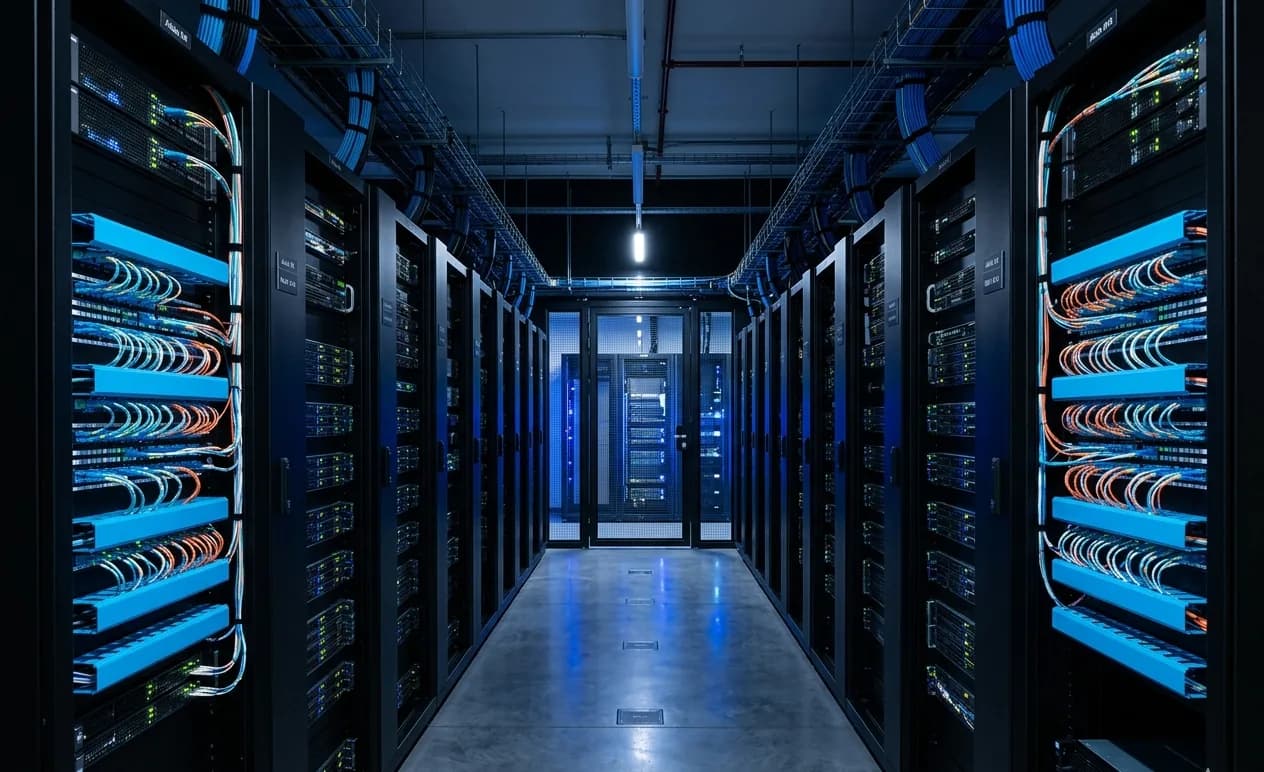
An IBX (International Business Exchange) is Equinix's branded retail colocation data center. Each IBX is designed to house multiple independent customers, networks, and cloud providers simultaneously, with strict physical separation between them. Security runs five layers deep: perimeter, lobby, colocation zone, private cages, and individual cabinets, each with separate access controls and continuous CCTV monitoring.
The standardized IBX design means a customer deploying in Equinix's Frankfurt FR5 gets the same access controls, audit documentation, and operational procedures as one in Singapore SG1 or New York NY5. For multinationals managing compliance across regions, that consistency is not a minor detail.
Cross-Connect
A cross-connect is a dedicated, physical fiber cable connecting two separate parties within the same IBX. It is the simplest form of interconnection: a direct layer-1 path between two racks, bypassing the public internet entirely.
As of March 2024, Equinix standardized cross-connects on single-mode fiber only, discontinuing copper and multi-mode fiber options, according to Equinix's cross-connect product documentation. Common use cases include direct connections from customer equipment to an AWS Direct Connect or Azure ExpressRoute port in the same building, private peering between two networks, or secure links between enterprise applications and cloud platforms.
Cross-connects provide guaranteed latency and throughput without variable internet routing. When an enterprise connects its own router to AWS's Direct Connect port inside an Equinix IBX via a cross-connect, the traffic between them never touches the public internet.
Equinix Fabric
Equinix Fabric is the software-defined layer on top of IBX. It provides virtual connections between Equinix locations globally, without requiring physical cross-connects at each endpoint. An IT team can provision a private 10 Gbps virtual circuit between Equinix Frankfurt and Equinix Chicago in minutes via an API, connecting their European and US infrastructure with deterministic, private links across Equinix's backbone.
xScale
xScale is Equinix's hyperscale data center portfolio, distinct from retail IBX. These are large-footprint, high-power wholesale facilities built specifically for cloud providers and very large platforms. xScale facilities are typically structured as joint ventures with infrastructure investors like GIC (Singapore's sovereign wealth fund), which allows Equinix to deploy capital into hyperscale capacity without taking full balance sheet risk.
The strategic logic: hyperscalers need large blocks of power-dense space near Equinix's existing IBX ecosystems. By building xScale adjacent to IBX, Equinix offers both hyperscale capacity and direct connectivity to the thousands of enterprises already in the neighboring IBX, strengthening both products simultaneously.
Equinix Metal
Equinix Metal is a bare-metal-as-a-service offering, letting customers provision physical servers on demand inside Equinix facilities. It bridges colocation (where customers bring their own hardware) and cloud (where providers manage everything). Metal servers sit physically adjacent to IBX interconnection ecosystems, making it possible to build low-latency hybrid architectures without shipping and installing equipment.
Equinix Colocation Pricing in 2026: What You Actually Pay
Equinix does not publish a standard price list. All quotes require an RFP directly with Equinix or through a colocation broker. However, multiple industry sources including Vendr's 2026 pricing analysis of anonymized customer contracts and Metrocolo Advisory's 2026 colocation pricing guide provide reliable market benchmarks.
Cabinet and Cage Pricing
| Item | Tier 1 Metro (NYC, Silicon Valley, London) | Tier 2 Metro (Dallas, Atlanta, Amsterdam) |
|---|---|---|
| Standard full cabinet (5kW power) | $1,500-$3,000/month | $1,000-$2,000/month |
| Additional power (per kW above base) | $150-$300/kW/month | $100-$200/kW/month |
| High-density cabinet (15+ kW, AI/ML) | Premium rate + custom cooling required | Premium rate + custom cooling required |
| Private cage (sq ft basis) | $150-$400/sq ft/month | Lower |
| Cross-connect setup (one-time) | $100-$300 | $100-$300 |
| Cross-connect monthly fee | $50-$100+/month | $50-$100+/month |
Sources: Vendr 2026 Equinix pricing analysis; Metrocolo Advisory colocation pricing guide 2026; DataCenterHawk 2026.
The base 5kW power allocation per cabinet is adequate for most enterprise server configurations. AI inference or GPU-accelerated workloads often require 15kW or more per cabinet, which triggers additional power charges and typically requires custom cooling infrastructure on top of that.
Equinix's pricing premium versus regional providers reflects ecosystem value, not just real estate. A cabinet in a suburban wholesale data center at $800/month gets you power and cooling. A cabinet in Equinix NY5 at $2,500/month gets you those plus on-site access to cross-connects for every major cloud provider, dozens of tier-1 ISPs, and hundreds of enterprise peers, all via short dedicated fiber runs rather than internet transit.
The Number Most Guides Don't Show
Equinix's 2024 revenue was approximately $8.35 billion (midpoint of reported $8.2-$8.5B range) across approximately 475,000 installed cabinets globally, including both IBX retail and xScale wholesale capacity. That works out to roughly $17,579 in annual revenue per installed cabinet, or approximately $1,465 per month.
At an 80% global utilization rate (consistent with Equinix's reported occupancy across recent quarters), the revenue per occupied cabinet rises to approximately $1,831 per month. Given that Tier 1 market cabinet pricing starts at $1,500/month and averages higher, this cross-check is internally consistent.
The more revealing number: Equinix's interconnection revenue was approximately $1.5 billion in 2025 (18% of $9.2B). Spread across roughly 475,000 installed cabinets at 80% utilization (380,000 occupied), that implies approximately $3,947 in interconnection revenue per occupied cabinet per year, or about $329 per month, on average. That $329/month from interconnection sits on top of the cabinet colocation fee, at near-100% gross margin since the physical infrastructure is already paid for. This is why interconnection is growing faster than colocation in Equinix's revenue mix and why it generates structurally higher returns.
Equinix vs Digital Realty vs Iron Mountain: How They Compare
Equinix sits alongside two other publicly traded data center REITs that get compared to it constantly: Digital Realty and Iron Mountain. They are not the same thing.
Digital Realty (DLR)
Digital Realty is the closest competitor to Equinix in scale, with 300+ facilities across 25+ countries. The key difference is product focus. Equinix built its business around retail colocation and interconnection density. Digital Realty built around wholesale colocation: large blocks of data center space leased to a single tenant for longer terms at lower per-unit prices.
Digital Realty's acquisition of Interxion in 2020 added retail interconnection capabilities in Europe and brought the company into more direct competition with Equinix's IBX model. But the core footprint remains more wholesale-oriented. For enterprises that need a private dedicated hall rather than shared colocation, Digital Realty often wins on total cost. For enterprises that need carrier-neutral interconnection, Equinix typically has deeper ecosystems.
Iron Mountain (IRM)
Iron Mountain is primarily a records management and secure document storage company that expanded into data centers. Its data center segment had a $1 billion-plus run rate by 2024 and continues to grow, but it represents a minority of Iron Mountain's $5-6 billion total company revenue. Data center customers choosing Iron Mountain often do so for regulatory and compliance continuity: the company's records management relationships give it positioning with financial services and healthcare firms that need colocation alongside physical document archiving under the same vendor.
The Strategic Difference
| Factor | Equinix | Digital Realty | Iron Mountain |
|---|---|---|---|
| Market cap (early 2025) | ~$80-85B | ~$40-45B | ~$20-30B |
| Core product | Retail colocation + interconnection | Wholesale + retail colocation | Records mgmt + data centers |
| Interconnection density | Industry-leading (18% of revenue) | Secondary (Interxion footprint) | Minimal |
| AI positioning | xScale + AI-ready IBX | Large campus wholesale | Limited |
| EBITDA margin | ~48-52% adjusted | Similar range | Lower (diversified) |
| Geographic reach | 33 countries, 77 metros | 25+ countries | Multiple, data centers subset |
For most IT buyers deciding between Equinix and Digital Realty, the question comes down to interconnection. If the architecture requires private, low-latency access to multiple clouds and networks in the same facility, Equinix IBX is typically the stronger choice. For pure rack space at lower cost, Digital Realty and many wholesale providers offer better economics.
The US colocation market is growing at 16.5% annually through 2026, according to ResearchAndMarkets' 2026 US Data Center Colocation Databook, and at 11.5% from 2026 to 2030, reaching $72.37 billion by 2030. Both will grow with that market. They serve different parts of it.
Equinix and AI Infrastructure: xScale, AI-Ready IBX and Enterprise AI Demand
AI is creating two separate demand signals for Equinix. One comes from hyperscalers and large AI companies that need massive, dense capacity near existing network ecosystems. The other comes from enterprises that need to connect on-premises data to cloud AI services privately, without routing sensitive workloads over the public internet. The two signals look different in practice but they both land at Equinix.
xScale for Hyperscale AI
Equinix's xScale program addresses the first category. xScale facilities are joint ventures, typically with infrastructure investors like GIC, that build hyperscale campuses adjacent to existing IBX ecosystems. These are large wholesale deployments running tens of megawatts, structured for major cloud provider leases rather than multi-tenant retail colocation.
Charles Meyers stated in the 2024 annual earnings call that AI is "rapidly becoming a meaningful incremental demand vector" for Equinix's business, with "strong AI-related demand across our global platform, especially in network-dense metros." He described xScale as allowing Equinix to "capture hyperscale demand while preserving the attractive returns of our retail business."
For AI specifically, the colocation value of being adjacent to an IBX ecosystem matters because training workloads and inference workloads are distinct. Large-scale GPU training clusters often run in wholesale or hyperscale facilities. Inference, which needs to serve users at low latency, benefits from placement inside or adjacent to IBX facilities that connect directly to enterprise networks, ISPs, and CDNs. Equinix's architecture accommodates both.
Enterprise AI Adoption and Interconnection
The enterprise AI architecture most commonly discussed in 2025-2026 involves connecting on-premises infrastructure (databases, proprietary datasets, existing applications) to cloud-hosted AI services like Azure OpenAI, AWS Bedrock, and Google Vertex AI, via private, low-latency links rather than public internet connections.
Equinix IBX with a cross-connect is what makes this work. An enterprise with sensitive data places networking equipment in an Equinix IBX and connects via cross-connect directly to an AWS Direct Connect port and an Azure ExpressRoute port in the same building. AI inference requests from the enterprise applications flow over dedicated private links to cloud AI endpoints, without exposing data to the internet. For regulated industries like financial services and healthcare, this architecture often meets compliance requirements that public internet AI access does not.
See our full analysis of hyperscaler infrastructure and how AWS, Azure, and Google operate their data center networks for context on the hyperscaler side of these interconnection relationships.
AI-Ready Power Density
Standard IBX cabinets support 5-8kW per cabinet. AI-ready IBX deployments require 15-30kW per cabinet or more for GPU-accelerated inference servers. Equinix has been retrofitting certain IBX facilities with high-density power and liquid cooling to accommodate these workloads. In some markets, high-density AI cabinet space in Equinix facilities is constrained, with waitlists reported in certain Tier 1 metros as of 2025.
For enterprises deploying AI inference at scale in colocation, Equinix competes with specialized AI colocation providers and cloud-native GPU options. Our breakdown of cloud GPU rental providers and current pricing covers the cloud GPU alternative for AI compute workloads that do not require on-premises hardware.
According to Equinix's investor relations materials, the company is committing billions of dollars annually in development capex to AI and cloud-driven capacity, while keeping AFFO growth and REIT capital discipline intact.
Frequently Asked Questions
What is Equinix and what does it do?
Equinix is the world's largest neutral colocation REIT, operating 260+ IBX (International Business Exchange) data centers across 33 countries. It sells physical rack space, dedicated power, and interconnection services to enterprises, cloud providers, and network operators who place their own hardware inside Equinix facilities.
Equinix does not sell managed cloud compute or storage. It provides the data center infrastructure where AWS, Azure, Google Cloud, and thousands of enterprises colocate equipment and connect to each other via dedicated fiber links called cross-connects. Revenue was approximately $9.2 billion in 2025, with 94% recurring under long-term contracts.
How much does Equinix colocation cost per month?
Equinix does not publish a standard price list, but 2026 market benchmarks from Vendr's pricing analysis and Metrocolo Advisory show:
- Standard full cabinet with 5kW power in Tier 1 metros (New York, Silicon Valley, London): $1,500-$3,000 per month
- Same configuration in Tier 2 metros (Dallas, Atlanta, Amsterdam): $1,000-$2,000 per month
- Additional power above 5kW base: $150-$300 per kW per month
- Cross-connect setup: $100-$300 one-time fee
- Cross-connect monthly fee: $50-$100+ per month
High-density AI/ML cabinets requiring 15kW+ incur premium rates and often require custom cooling infrastructure, significantly increasing total monthly costs.
What is an Equinix IBX data center?
IBX stands for International Business Exchange. It is Equinix's branded carrier-neutral colocation data center. IBX facilities are designed to house multiple independent customers, networks, and cloud providers simultaneously, with strict physical separation between tenants and five layers of physical security.
The defining feature of an IBX is carrier neutrality and interconnection density. Equinix does not favor any single network or cloud provider, so hundreds of carriers, ISPs, and cloud platforms maintain equipment inside each IBX. This creates dense ecosystems where customers can connect directly to multiple cloud on-ramps (AWS Direct Connect, Azure ExpressRoute, Google Cloud Interconnect) via short dedicated fiber cables in the same building.
What is Equinix xScale?
xScale is Equinix's hyperscale data center portfolio, distinct from retail IBX colocation. xScale facilities are large-footprint, high-power wholesale campuses built specifically for major cloud providers and AI companies that need tens of megawatts of capacity in a single deployment.
xScale facilities are typically structured as joint ventures with infrastructure investors like Singapore's GIC sovereign wealth fund, allowing Equinix to build large campuses without taking full balance sheet risk. They are positioned adjacent to Equinix IBX ecosystems so hyperscale tenants gain proximity to the thousands of enterprises and networks already present in neighboring IBX facilities. The xScale program is Equinix's primary vehicle for capturing AI and hyperscale cloud growth.
Does Equinix compete with AWS, Azure, and Google Cloud?
No. Equinix is a neutral data center provider that colocates customers' own hardware. AWS, Azure, and Google Cloud are cloud providers that sell managed compute as a service. The two models are complementary, not competitive.
AWS, Azure, and Google Cloud are among Equinix's largest customers and partners. Hyperscalers maintain equipment inside Equinix IBX facilities to operate their cloud on-ramp ports (AWS Direct Connect, Azure ExpressRoute, Google Cloud Interconnect), which enterprises use to connect their own colocation environments privately to cloud services. Equinix's xScale program also builds hyperscale-grade wholesale capacity that major cloud providers lease for large deployments.
What is an Equinix cross-connect and how does it work?
A cross-connect is a dedicated physical fiber cable connecting two parties within the same Equinix IBX facility. It provides a direct, private layer-1 connection that bypasses the public internet entirely, with guaranteed latency and no variable internet routing.
As of March 2024, Equinix standardized cross-connects on single-mode fiber only. Common uses include connecting customer equipment directly to an AWS Direct Connect port, establishing private peering with an ISP, or linking two companies' racks for direct application-level communication. Setup costs $100-$300 one-time, with monthly recurring fees of $50-$100+ depending on the market.
Is Equinix a good investment as a data center REIT?
Equinix (EQIX) trades on Nasdaq as a REIT with a market cap of approximately $80-85 billion in 2025. Investment considerations include:
Positives: 94% recurring revenue, adjusted EBITDA margins of approximately 48-52%, global scale in 33 countries with significant switching costs, and AI/cloud tailwinds driving both colocation and xScale demand. Interconnection revenue (18% of total) is the highest-margin product and growing faster than colocation.
Risks: Premium pricing pressure from wholesale competition, capital intensity of the xScale program, energy cost inflation, power availability constraints in top markets like Northern Virginia, and the risk that hyperscalers build more of their own capacity over time.
Investors should consult Equinix's investor relations materials at investor.equinix.com for current financials and guidance.
How does Equinix fit into AI infrastructure in 2026?
Equinix serves AI workloads in two ways. For enterprises adopting AI, IBX colocation provides the interconnection hub where on-premises data and applications connect privately to cloud AI services like Azure OpenAI and AWS Bedrock via cross-connects, avoiding public internet routing that fails compliance requirements in regulated industries.
For hyperscale AI builders, the xScale program provides large wholesale campuses adjacent to IBX ecosystems, giving cloud providers and large AI companies the power density needed for GPU training clusters alongside the network connectivity needed to serve enterprise customers. Equinix CEO Charles Meyers described AI as "rapidly becoming a meaningful incremental demand vector" and Equinix as "well positioned as the interconnection hub where AI ecosystems will connect to data and networks globally" (2024 earnings call).