
NVIDIA DGX Spark: Specs, Price, and Who Should Buy It

Key Numbers
Key Takeaways
- 1NVIDIA DGX Spark is a compact desktop AI computer (150mm x 150mm x 50.5mm, 1.2kg) built on the GB10 Grace Blackwell Superchip. It delivers 1 petaFLOP of FP4 AI compute and 128GB of unified coherent memory. It went on sale October 15, 2025 at $3,999.
- 2The 128GB unified memory architecture lets DGX Spark run 70B-parameter models in FP16 without quantization, something no standalone H100 or RTX GPU can do because no single standard GPU has enough VRAM. This is the core technical advantage over all consumer and prosumer alternatives.
- 3DGX Spark suits AI developers, researchers, and data scientists who need to prototype, fine-tune, and run inference on large models locally without cloud compute costs or data privacy concerns. It is not a training cluster replacement.
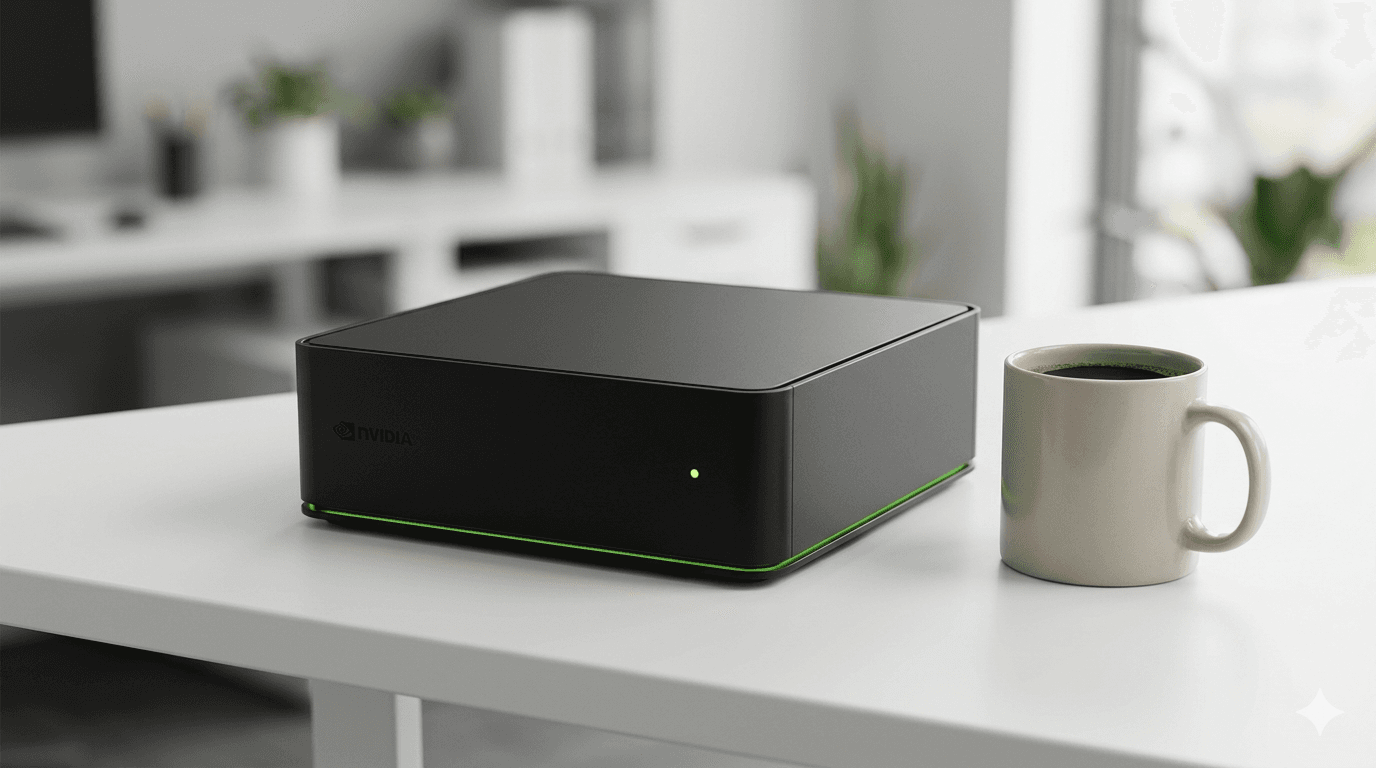
The NVIDIA DGX Spark is the smallest AI supercomputer NVIDIA has ever built. Announced at GTC Spring on March 19, 2025 and available for purchase from October 15, 2025, it packs 1 petaFLOP of FP4 AI compute and 128GB of unified coherent memory into a 150mm square form factor that weighs 1.2 kilograms and draws 240W from a standard wall outlet. The starting price is $3,999.
The 128GB unified memory is what makes DGX Spark different from anything in the consumer or prosumer GPU market. Standard GPUs have a hard VRAM ceiling: an RTX 4090 has 24GB, an H100 80GB has 80GB. DGX Spark's unified architecture, powered by NVIDIA's NVLink-C2C interconnect, makes the entire 128GB of system memory available to both the CPU and GPU simultaneously with 5x the bandwidth of fifth-generation PCIe. Two DGX Spark units can be linked via ConnectX-7 to share 256GB and run models up to 405 billion parameters.
This article covers the full technical specifications, the pricing breakdown, how DGX Spark compares to the DGX Station and to renting H100s on the cloud, and which buyers the system actually serves well.
In This Article
What Is the NVIDIA DGX Spark?
NVIDIA DGX Spark is a personal AI supercomputer: a desktop system that integrates the NVIDIA AI software stack, enterprise-grade connectivity, and the GB10 Grace Blackwell Superchip into a unit small enough for a desk, lab, or office. It is not a gaming PC, not a workstation GPU in a tower, and not a scaled-down data center server. It is a new product category positioned between consumer AI laptops and cloud GPU clusters.
The name "DGX" has historically applied to NVIDIA's data center systems. DGX H100 servers cost $250,000-$400,000 and are designed for enterprise AI training. Applying the DGX branding to a $3,999 desktop signals that NVIDIA wants to extend data-center-grade software access to individual developers and research labs. Every DGX Spark ships with NVIDIA DGX OS and a 90-day NVIDIA AI Enterprise license, giving users access to the same NIM microservices, NeMo framework, and CUDA libraries that run on DGX data center systems.
The GB10 Grace Blackwell Superchip co-developed with MediaTek is the technical heart of DGX Spark. It combines a Blackwell-generation GPU (fifth-generation Tensor Cores with FP4 support) with a 20-core Arm CPU (10x Cortex-X925 performance cores and 10x Cortex-A725 efficiency cores) connected via NVLink-C2C. The NVLink-C2C interconnect is why unified memory works: the CPU and GPU share the same physical memory pool with coherent access, eliminating the memory copy overhead that limits discrete GPU systems.
Who Makes DGX Spark?
NVIDIA designs the GB10 Superchip and the DGX software stack. The physical units are manufactured by OEM partners including ASUS, Dell, HP, Lenovo, and Acer, as well as NVIDIA's own Founder's Edition. The Founder's Edition launched at $3,999; OEM variants may carry different pricing. As of early 2026, units are available at Micro Center, Newegg, Best Buy, and the NVIDIA Marketplace.
NVIDIA DGX Spark Full Technical Specifications
| Component | Specification |
|---|---|
| Superchip | NVIDIA GB10 Grace Blackwell (co-designed with MediaTek) |
| GPU Architecture | Blackwell, 5th-gen Tensor Cores with FP4 support |
| CPU | 20-core Arm (10x Cortex-X925 + 10x Cortex-A725) |
| AI Performance | 1 petaFLOP FP4 (inference and fine-tuning) |
| System Memory | 128GB LPDDR5x unified coherent CPU-GPU memory |
| Memory Interconnect | NVLink-C2C (5x bandwidth vs PCIe Gen 5) |
| Storage | 4TB NVMe M.2 SSD (self-encrypting) |
| Networking (external) | 10GbE RJ-45, ConnectX-7 200Gbps Smart NIC |
| Wireless | Wi-Fi 7 (802.11be), Bluetooth 5.4 |
| Video Output | 1x HDMI 2.1a |
| Video Encode/Decode | NVENC / NVDEC |
| Power Consumption | 240W (standard wall outlet adapter) |
| Form Factor | 150mm x 150mm x 50.5mm |
| Weight | 1.2 kg |
| Operating System | NVIDIA DGX OS (Linux-based, pre-optimized AI stack) |
| Software Bundle | 90-day NVIDIA AI Enterprise license |
| Max Single-Unit Inference | 200B parameter models (INT4/INT8 quantized) |
| Max Fine-Tuning | 70B parameter models |
| Dual-Unit Config | Two units via ConnectX-7: 256GB unified memory, 405B parameters |
Sources: NVIDIA DGX Spark product page, Micro Center product listing, NVIDIA developer blog (2025).
The NVLink-C2C Memory Architecture
On a standard discrete GPU system, the GPU has its own VRAM pool (e.g., 24GB on RTX 4090, 80GB on H100). Loading a model means transferring weights from system RAM across the PCIe bus into VRAM. The PCIe bus is the bottleneck: even PCIe Gen 5 x16 offers ~64 GB/s bandwidth, which means loading a 70GB model takes over a second. When the model is larger than VRAM, the GPU cannot run it at all.
DGX Spark's NVLink-C2C architecture removes the VRAM ceiling entirely. The 128GB is a single coherent pool accessible by both the CPU and GPU. The interconnect bandwidth is substantially higher than PCIe, enabling fast model loading and eliminating the split between "system memory" and "GPU memory." The practical result: any model that fits in 128GB can run on DGX Spark at full speed.
DGX Spark Price: What the $3,999 Buys
The Founder's Edition NVIDIA DGX Spark launched at $3,999 in October 2025 (Micro Center, NVIDIA Marketplace). Retail pricing varies:
| Retailer | Price (as of Q4 2025) |
|---|---|
| Micro Center (Founder's Edition) | $3,999 |
| NVIDIA Marketplace | $4,699 (includes DLI course) |
| Newegg | $4,399 |
| Best Buy | $5,404 (standard price before discounts) |
OEM variants from ASUS, Dell, HP, and Lenovo are expected to carry different pricing depending on configuration and support tiers.
The Number Most Guides Don't Show
A 70B parameter model in FP16 precision requires approximately 140GB of GPU memory (70 billion parameters x 2 bytes per FP16 weight). No single standard GPU has 140GB VRAM. NVIDIA H100 SXM5 has 80GB HBM3, A100 has 80GB, RTX 4090 has 24GB. Running a 70B FP16 model without quantization on standard GPU hardware requires at least two H100 80GB units connected via NVLink, which costs roughly $60,000-$70,000 in hardware plus a server chassis.
DGX Spark runs the same 70B FP16 model on a single $3,999 unit because its 128GB unified memory is a single coherent pool. The cost-per-parameter-accessible is vastly lower for DGX Spark than for any multi-GPU H100 configuration. This is not a speed comparison; it is a capability comparison. DGX Spark cannot match the throughput of an H100 cluster. But for developers who need to load and test large models locally without quantization artifacts, DGX Spark provides access that no $4,000 alternative offers.
For teams comparing DGX Spark against cloud GPU rental, the math depends heavily on usage patterns. At $3,999 purchase cost, DGX Spark amortizes over three years to roughly $111/month in hardware cost. Adding electricity at 240W continuous and $0.12/kWh, full-time operation adds about $25/month. An equivalent cloud workload running 8 hours per day on an A100 on Vast.ai at $0.29/hr costs approximately $71/month. For teams running AI workloads throughout the working day, local compute becomes cost-competitive within 6-12 months.
DGX Spark vs DGX Station vs H100: Where Each Fits
NVIDIA's personal AI computer lineup has two tiers as of 2026. DGX Spark is the entry unit; DGX Station is the higher-performance desktop system for demanding workloads.
| Specification | DGX Spark | DGX Station |
|---|---|---|
| Superchip | GB10 Grace Blackwell | GB300 Grace Blackwell Ultra |
| AI Performance | 1 petaFLOP FP4 | 20 petaFLOPs FP4 |
| Unified Memory | 128GB | 784GB |
| Multi-Unit Networking | ConnectX-7 (200 Gb/s) | ConnectX-8 SuperNIC (800 Gb/s) |
| Form Factor | 150mm square desktop | Larger desktop tower |
| Target | Individual developers, researchers | Enterprise teams, large model training |
| Max Model (single unit) | 200B parameters (inference) | 1T+ parameters |
Source: NVIDIA investor relations and product announcements, 2025.
Compared to cloud GPU alternatives:
| Option | H100 PCIe cloud (Lambda Labs) | Vast.ai A100 40GB | DGX Spark (owned) |
|---|---|---|---|
| Cost | $2.49-$3.44/hr | $0.29/hr | $3,999 one-time |
| Memory available | 80GB VRAM | 40GB VRAM | 128GB unified |
| Runs 70B FP16? | No (single GPU) | No | Yes |
| Connectivity | Cloud latency | Cloud latency | Local, zero latency |
| Data privacy | Cloud provider's infrastructure | Independent host | Fully local |
"Powered by the NVIDIA GB10 Grace Blackwell Superchip, NVIDIA DGX Spark delivers 1 petaFLOP of AI performance in a power-efficient, compact form factor." (NVIDIA Marketplace, 2025)
For teams working with sensitive data, patient records, proprietary code, or unreleased model weights, the local compute argument is strong regardless of cost. Cloud GPU rental requires sending model inputs to external infrastructure. DGX Spark runs inference entirely on-premises.
For context on how cloud GPU pricing compares across providers, the cloud GPU providers comparison covers the full competitive field including CoreWeave, Lambda Labs, and RunPod.
Who Should Buy a DGX Spark?
DGX Spark has a narrow and well-defined target. Understanding who it serves well avoids buying the wrong tool.
Clear Fit
AI developers and ML researchers who need to prototype with 30B-70B parameter models locally and cannot justify cloud compute costs for interactive development. Running a model locally for 8 hours of development testing costs essentially nothing on owned hardware. The same workload on cloud GPU costs $2-$15 depending on the GPU.
Data scientists working with sensitive or regulated datasets who cannot use external cloud infrastructure for compliance reasons. Healthcare AI, financial modeling, and government AI applications frequently require that data never leave on-premises hardware.
Research labs and universities where researchers need persistent compute access without cloud usage budgets. A $3,999 capital purchase sits in a different budget category than recurring cloud spend.
AI product teams running local inference APIs for testing before deploying to production. DGX Spark can serve as a development inference endpoint with zero latency and full model control.
Poor Fit
Teams that need to train large models from scratch. DGX Spark's 1 petaFLOP is excellent for inference and fine-tuning but cannot compete with 8x H100 clusters for multi-week pre-training runs of models above 70B parameters.
Hobbyist or enthusiast users. The $3,999 price is hard to justify for casual use when consumer alternatives (RTX 4090, Apple M4 Max) handle most consumer-scale AI tasks at lower cost. NVIDIA's own RTX Spark, a Windows laptop chip announced for fall 2026, targets this exact buyer with a similar 128GB unified memory ceiling at a lower estimated starting price.
Teams with unpredictable GPU needs. Cloud GPU marketplaces like Vast.ai scale up and down on demand. DGX Spark is fixed capacity.
Organizations that need the largest models. Running 405B+ parameter models requires dual DGX Spark units (256GB total) or DGX Station (784GB). GPT-3 175B in FP16 would require more than 350GB of memory, exceeding what a single DGX Spark can provide.
DGX Spark Software Stack and Getting Started
DGX Spark ships with NVIDIA DGX OS, a Linux-based operating system pre-configured with the NVIDIA AI stack. The 90-day NVIDIA AI Enterprise license includes access to:
- CUDA and cuDNN (deep learning libraries)
- NVIDIA NIM microservices (optimized inference containers)
- NeMo framework (LLM fine-tuning and alignment)
- NVIDIA Triton Inference Server
- NVIDIA Omniverse (3D simulation and robotics)
- NVIDIA Isaac and Metropolis (robotics and computer vision)
Pre-optimized models available on DGX Spark at launch include DeepSeek reasoning models, Meta Llama variants, Google Gemma, and Qwen series. As of a CES 2026 software update, GPT-OSS-120B and FLUX 2 (image generation at full precision) are also optimized for the platform.
Multi-Node Configuration
Two DGX Spark units can be connected directly via their ConnectX-7 NICs using a standard 200 Gbps cable. This creates a 256GB unified memory pool and enables inference of models up to 405 billion parameters. No switch is required for the two-unit configuration; the direct peer connection is sufficient. Scaling beyond two units requires a ConnectX-7-compatible switch.
For teams planning DGX deployments at larger scale, NVIDIA's official DGX Spark product page has current software documentation and system builder information. The AI accelerator card explainer provides useful background on the architecture differences between AI-optimized chips and standard GPUs.
Frequently Asked Questions
What is the NVIDIA DGX Spark?
The NVIDIA DGX Spark is a compact desktop AI computer (150mm x 150mm, 1.2kg) powered by the NVIDIA GB10 Grace Blackwell Superchip. It delivers 1 petaFLOP of FP4 AI compute and 128GB of unified coherent memory. Announced March 19, 2025 at GTC Spring, it became available for purchase on October 15, 2025 at a starting price of $3,999.
How much does the NVIDIA DGX Spark cost?
The NVIDIA DGX Spark Founder's Edition launched at $3,999 in October 2025 (Micro Center). Retail pricing varies: NVIDIA Marketplace lists it at $4,699 (including DLI course), Newegg at $4,399, and Best Buy at $5,404 before discounts. OEM variants from ASUS, Dell, HP, Lenovo, and Acer are available at varying price points depending on configuration and support tier.
What is the difference between DGX Spark and DGX Station?
DGX Spark and DGX Station are both personal AI supercomputers but target different scales of workload. DGX Spark uses the GB10 Grace Blackwell Superchip and delivers 1 petaFLOP with 128GB unified memory. DGX Station uses the GB300 Grace Blackwell Ultra Desktop Superchip and delivers 20 petaFLOPs with 784GB unified memory. DGX Station can run 1 trillion+ parameter models on a single unit; DGX Spark handles up to 200 billion parameters per unit, or 405 billion in a two-unit linked configuration.
Can NVIDIA DGX Spark run LLaMA 3 70B?
Yes. DGX Spark can run LLaMA 3 70B in FP16 (full precision) without quantization because its 128GB unified memory exceeds the ~140GB required for 70B FP16 weights. No single standard GPU (H100, RTX 4090, A100) can run LLaMA 3 70B in FP16 because their VRAM tops out at 80GB for H100 and 24GB for RTX 4090. DGX Spark can also fine-tune 70B models due to the same memory capacity.
Is DGX Spark better than renting cloud GPUs?
It depends on usage intensity. At $3,999 purchase cost amortized over three years plus ~$25/month electricity, DGX Spark costs roughly $136/month of total compute cost for always-on operation. An equivalent workload on cloud GPU rental (A100 at $0.29/hr on Vast.ai for 8 hr/day) costs about $70-80/month. For teams running continuous AI workloads, local compute becomes cost-competitive within 12-18 months. The additional benefits of local compute: no cloud latency, full data privacy, and the ability to run 70B FP16 models that no single cloud GPU can host.
What software runs on NVIDIA DGX Spark?
DGX Spark ships with NVIDIA DGX OS (Linux-based) and a 90-day NVIDIA AI Enterprise license covering CUDA, cuDNN, NVIDIA NIM microservices, NeMo (LLM fine-tuning), Triton Inference Server, and access to Omniverse, Isaac, and Metropolis frameworks. Pre-optimized models include DeepSeek, Meta Llama, Google Gemma, Qwen series, GPT-OSS-120B, and FLUX 2 for image generation. Standard PyTorch and TensorFlow workloads run via CUDA without additional configuration.
When was DGX Spark announced and when is it available?
NVIDIA announced DGX Spark at the GTC Spring 2025 keynote on March 19, 2025. The product became available for purchase on October 15, 2025, with the Founder's Edition at $3,999. OEM variants from ASUS, Dell, HP, Lenovo, and Acer were announced alongside the Founder's Edition and are available through those manufacturers' channels.
Related Articles
NVIDIA RTX Spark: Specs, Price, and Release Date
11 min read
NVIDIA H100 GPU: Full Specs, Price, and Cloud Rates for 2026
11 min read
NVIDIA A100 GPU: Specs, Price, and Performance in 2026
12 min read
What Is an AI Accelerator Card? Types, Specs, and Costs for 2026
10 min read