
Vast.ai Review: GPU Rental Prices, Reliability, and Who It Suits

Key Numbers
Key Takeaways
- 1Vast.ai is a peer-to-peer GPU marketplace founded in 2018 where independent hosts and data centers list idle GPUs for rent. It is not a managed cloud provider. Prices are set by hosts and fluctuate with supply and demand.
- 2H100 PCIE GPUs start at $1.47/hr on Vast.ai versus $6.16/hr on CoreWeave and $2.49/hr on Lambda Labs (Q1 2026). A 4-GPU H100 cluster running full-time costs roughly $4,200-$6,500/month on Vast.ai versus $17,700/month on CoreWeave.
- 3Vast.ai suits ML researchers, fine-tuning workloads, batch inference, and rendering. It is not suited for latency-sensitive production serving, regulated workloads, or multi-node training requiring InfiniBand interconnects.
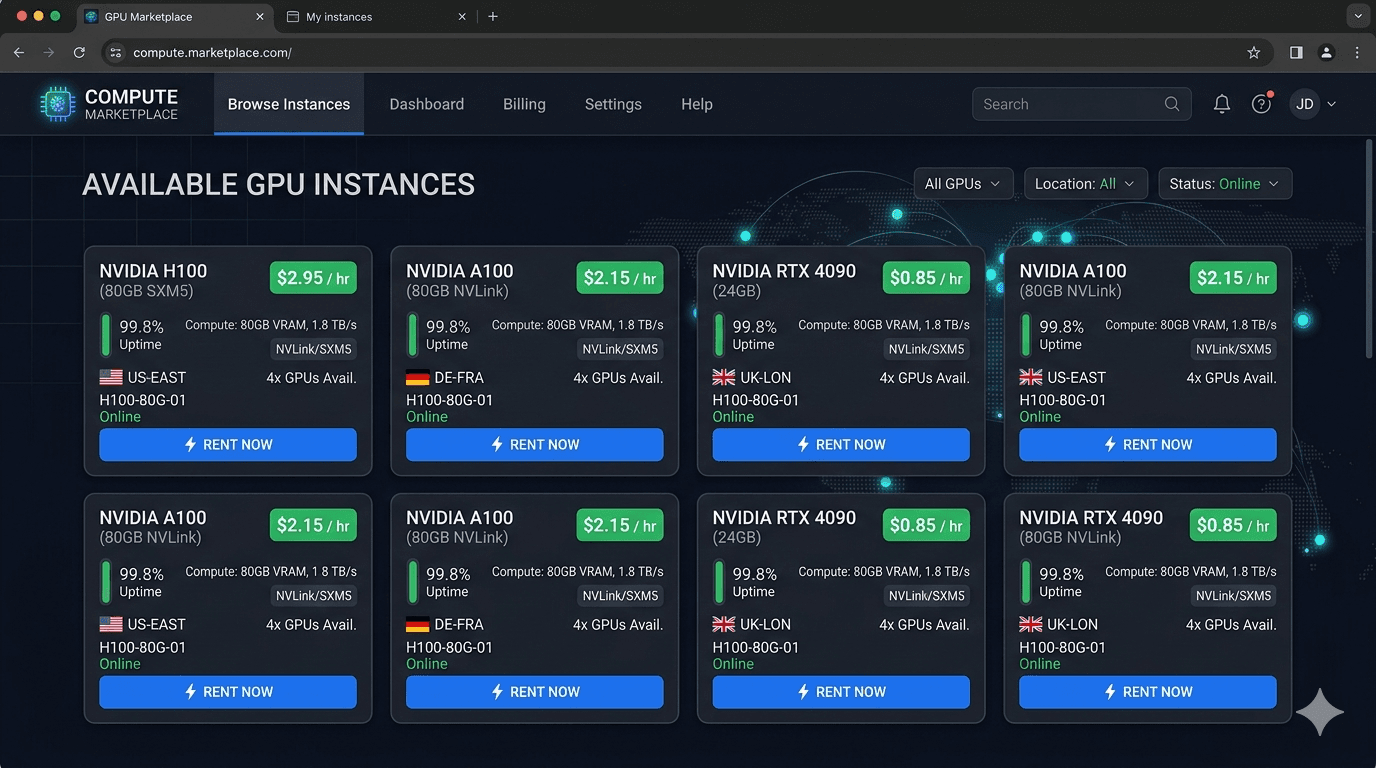
Vast.ai is a GPU rental marketplace where independent hosts, small data centers, and GPU farms list compute capacity for rent. You browse available machines the way you would browse a flight search engine, filter by GPU type, price, reliability rating, and network speed, then launch a container in seconds. There is no managed cloud overhead because Vast.ai does not own the hardware.
The price difference between Vast.ai and traditional cloud providers is not marginal. An RTX 4090 rents for $0.29-$0.59/hr on Vast.ai versus approximately $2.79/hr on comparable AWS instances (Q1 2026 market rates). An H100 PCIE starts at $1.47/hr on Vast.ai versus $6.16/hr on CoreWeave. That gap exists because hosts are renting out capacity they would otherwise leave idle, and Vast.ai takes a marketplace commission rather than building and owning facilities.
This article covers Vast.ai's pricing structure, how the interruptible and on-demand instance types differ, which workloads belong on Vast.ai and which do not, and how reliability actually works on a host-variable marketplace. By the end you will know whether Vast.ai is the right infrastructure choice for your specific use case.
In This Article
What Is Vast.ai?
Vast.ai is a cloud GPU marketplace, not a cloud provider. Jake Cannell founded it in 2018 in Los Angeles with the goal of connecting people who own GPU hardware but leave it idle with people who need compute and do not want to pay hyperscaler prices. Every GPU listed on Vast.ai belongs to an independent host: a gamer with a spare RTX 3090, a crypto mining operation that switched workloads, or a colocation facility that signed up to monetize unused rack space.
The company itself does not build or own data centers. It operates the marketplace software, handles payments, enforces the rental contract, and maintains the SOC2 Type II certification that lets enterprise teams use the platform without violating security policies. As of 2025, Vast.ai serves 200,000 daily users and lists 10,000+ GPUs across 40+ data center locations worldwide (Vast.ai, 2025).
The supply side is genuinely diverse. On any given day you can find RTX 3090s from home miners, A100s from academic computing centers, and H100s from commercial GPU farms that prefer the marketplace model over direct sales. This diversity is why pricing is so variable and why filtering by host reliability score matters as much as filtering by price.
How Vast.ai Differs From Managed Cloud GPU Providers
| Factor | Vast.ai | CoreWeave / Lambda Labs | AWS / Azure |
|---|---|---|---|
| Hardware ownership | Independent hosts | Provider-owned | Provider-owned |
| Minimum commitment | Per-second, no minimum | Per-second (CoreWeave), hourly (Lambda) | Per-second |
| SLA guarantees | None on interruptible; host-level on on-demand | Provider-backed SLAs | 99.5-99.9% SLA |
| Setup time | Seconds (pre-built templates) | Minutes to hours | Minutes |
| SOC2 certification | Yes (platform-level) | Yes | Yes |
| On-demand availability | Dependent on host supply | High (dedicated inventory) | High |
How the Vast.ai Marketplace Works
Vast.ai offers three rental types, each with a different price-to-reliability tradeoff. Understanding which type to use for which workload determines whether the platform works well or frustrates you.
Interruptible Instances
Interruptible instances are the cheapest option and the source of Vast.ai's most dramatic price comparisons. A host can reclaim an interruptible instance with a few minutes' notice if they need the GPU back. This makes them unsuitable for long training runs that would lose progress, but excellent for inference jobs that can checkpoint, batch tasks that restart cleanly, and experimental work where interruptions are acceptable. Interruptible prices are typically 30-50% lower than on-demand rates from the same host.
On-Demand Instances
On-demand instances behave more like traditional cloud rentals. The host commits to providing uninterrupted access, and Vast.ai enforces that commitment through the platform's review and rating system. On-demand instances cost more than interruptible but less than equivalent managed cloud options. If a host kicks you off an on-demand instance, they receive negative ratings that affect their future bookings. This market incentive provides a practical form of SLA enforcement, though it is not a contractual guarantee.
Reserved Instances
Reserved instances let you lock in a machine for a fixed period at a discounted rate. They suit workloads with predictable resource needs: production inference servers, ongoing fine-tuning pipelines, or rendering farms with steady throughput requirements.
Per-Second Billing and Cost Components
Billing on Vast.ai is per second, but there are three separate cost streams to understand:
- Active GPU rental: charged only while the instance is running
- Storage: charged continuously while the instance exists, even when stopped
- Bandwidth: charged for data transferred in and out
The practical implication: if you stop an instance to save money and forget it exists, storage fees accumulate. Deleting the instance rather than stopping it clears storage charges. Vast.ai's dashboard makes instance management straightforward, but this billing structure surprises users who expect a single line-item charge.
Vast.ai GPU Pricing in 2026
Pricing on Vast.ai is dynamic. The figures below reflect marketplace rates from Q1 2026 based on available listings. Actual prices vary by host, region, and current supply. The lowest interruptible rates represent bottom-of-market instances that may carry lower reliability scores.
| GPU Model | Vast.ai (from) | Vast.ai (range) | RunPod | Lambda Labs | CoreWeave | AWS equiv. |
|---|---|---|---|---|---|---|
| RTX 3090 | $0.12/hr | $0.12-$0.22/hr | $0.22/hr | Not listed | Not listed | Not listed |
| RTX 4090 | $0.29/hr | $0.29-$0.59/hr | $0.34/hr | Not listed | Not listed | ~$2.79/hr |
| A100 40GB PCIE | $0.29/hr | $0.29-$0.60/hr | ~$0.79/hr | $1.29-$1.79/hr | Not listed | Higher |
| H100 PCIE | $1.47/hr | $1.47-$2.27/hr | $2.69/hr | $2.49-$3.44/hr | ~$6.16/hr | Higher |
Sources: Vast.ai pricing page, Spheron.network GPU pricing comparison, Northflank cheapest cloud GPU providers guide (all Q1 2026).
The RTX 4090 figures are the clearest illustration of the marketplace model's impact. At $0.29/hr on Vast.ai versus ~$2.79/hr on equivalent AWS instances, a researcher running 100 hours of fine-tuning pays $29 on Vast.ai and $279 on AWS. The hardware is functionally identical; what differs is who owns the rack and how much overhead they carry.
For H100 compute, the gap narrows but remains substantial. Vast.ai's $1.47/hr starting rate represents instances that pass minimum reliability screening; the $2.27/hr upper range reflects higher-rated hosts with better uptime histories. CoreWeave's $6.16/hr rate includes enterprise SLA guarantees, persistent storage, InfiniBand networking, and Kubernetes orchestration that Vast.ai does not provide.
Note: Vast.ai prices listed on external comparison sites may lag behind live marketplace rates by days or weeks. Always check Vast.ai's live pricing page for current listings before budgeting a workload.
Vast.ai vs Competitors: The Full Cost Calculation
The pricing table above shows per-hour rates. The real number that matters for budget planning is monthly total cost, which depends on how many GPUs you need, how many hours you run them, and what reliability level you need.
The Number Most Guides Don't Show
Consider a team running a continuous inference service on four H100 GPUs, 24 hours a day, every day of the month. That is 720 GPU-hours per machine, or 2,880 total GPU-hours across the cluster.
| Provider | H100 rate | 4x GPU, 720 hrs/month | Annual cost |
|---|---|---|---|
| CoreWeave | $6.16/hr | $17,740/month | $212,880 |
| Lambda Labs | $2.49-$3.44/hr | $7,171-$9,907/month | $86,052-$118,884 |
| Vast.ai on-demand (avg $1.87/hr) | $1.87/hr | $5,386/month | $64,630 |
| Vast.ai interruptible (avg $1.47/hr) | $1.47/hr | $4,234/month | $50,808 |
Calculations: monthly cost = 4 GPUs x rate x 720 hrs.
The gap between CoreWeave and Vast.ai on-demand is $12,354/month, or $148,248 per year for a four-GPU cluster. That figure does not account for the differences in what each platform provides. CoreWeave includes InfiniBand networking, persistent volumes, Kubernetes, and contractual SLAs. Vast.ai on-demand provides none of those. The savings are real, but so is the operational difference.
For teams whose workloads do not require multi-node InfiniBand training or guaranteed uptime SLAs, the $148K/year difference easily justifies building checkpoint-tolerant inference pipelines and monitoring scripts.
"GPU rental costs are the single largest variable expense for most AI startups in the inference stage. The choice of provider is effectively a pricing decision, not just an infrastructure decision." (Northflank engineering blog, 2026)
For reference on how cloud GPU providers structure their offerings more broadly, the cloud GPU providers comparison covers the full competitive landscape including reserved capacity options.
What Vast.ai Is Good For and Not Good For
Vast.ai is not a general-purpose cloud replacement. The marketplace model has specific strengths and specific failure modes. Knowing which workloads fit determines whether you save money or lose work.
Good Fit for Vast.ai
- Fine-tuning pre-trained models: runs are bounded in time, can checkpoint, and do not require InfiniBand multi-node networking for smaller models. A fine-tuning job on a single H100 at $1.47/hr costs the same as 42 minutes on CoreWeave at $6.16/hr.
- Batch inference pipelines: processing a dataset in chunks where each chunk completes independently before the instance is potentially interrupted. ComfyUI image generation, Whisper transcription at scale, and offline embedding generation all fit this pattern.
- ML research and experimentation: hyperparameter sweeps, architecture comparisons, and proof-of-concept training where interruptions are acceptable and the goal is results at low cost.
- Rendering: GPU rendering is naturally parallel and checkpoint-friendly. Studios that process independent frames can use interruptible instances without risk.
- Consumer GPU access: RTX 3090 and RTX 4090 instances are available at price points that make Vast.ai the practical choice for personal projects, student work, and small startup inference.
Poor Fit for Vast.ai
- Production serving with latency SLAs: an interruptible instance that gets reclaimed during peak traffic causes outages. On-demand instances reduce this risk but do not eliminate it the way a managed provider SLA does.
- Multi-node distributed training: Vast.ai hosts are independent machines with standard internet connections. They lack the InfiniBand or RoCE networking that makes training across dozens of H100s efficient. For workloads that require 32+ GPU clusters with tight coupling, CoreWeave or AWS P5 instances are the practical options.
- Regulated industries: healthcare, finance, and government workloads that require HIPAA, FedRAMP, or similar certifications cannot rely on Vast.ai's marketplace model. The SOC2 certification covers the platform; it does not certify individual hosts.
- Stateful persistent applications: anything that requires persistent block storage, predictable IP addresses, or integration with managed databases belongs on a provider with proper persistent volume support.
Vast.ai Reliability, Security, and Platform Limitations
Reliability on Vast.ai is host-specific, not platform-wide. A host running enterprise data center hardware with redundant power and a 99.5% uptime history is genuinely reliable. A solo miner with a gaming rig is not. The platform gives you the tools to distinguish between them.
Reading Host Reliability Metrics
Vast.ai shows several reliability signals for each listed instance:
- Reliability score: a 0-1 rating calculated from the host's historical uptime and interruption frequency
- DLPerf score: measured deep learning performance, letting you confirm advertised FLOPS against actual benchmark results
- Network speed: tested upload and download speeds, which matter for loading large model weights
- Host rating and review history: user-submitted feedback on past rentals
As a practical starting point, filter for reliability scores above 0.95 for on-demand instances and above 0.90 for interruptible workloads you can tolerate losing.
SOC2 Certification
Vast.ai holds SOC2 certification, which covers the platform's security controls: access management, encryption in transit, audit logging, and operational security. What SOC2 does not cover is the individual host's physical security or network configuration. Hosts sign an agreement with Vast.ai but are not themselves audited to SOC2 standards.
For teams where the distinction matters, this is a real limitation. Enterprise teams at regulated companies should confirm with their security team whether marketplace-hosted compute is permissible before deploying sensitive model weights or training data.
Common User Complaints
- Price volatility: a host can change pricing at any time. Instances you launch at $0.29/hr may cost $0.39/hr after the host updates their listing during your rental. Check whether the current pricing locks in at rental time or floats.
- Storage billing after stopping: instances stop accumulating active GPU charges when stopped but continue accumulating storage charges until deleted.
- Host variability in practice: the DLPerf and reliability scores help but do not eliminate all variation. Running a 5-minute benchmark job on a new host before committing to a multi-hour run is good practice.
- Limited orchestration: Vast.ai provides basic container management but lacks the Kubernetes scheduling, autoscaling, and load balancing that managed providers include. Teams managing large inference fleets will build their own orchestration layer on top.
For the full market context on what competing providers offer, the CoreWeave review covers the enterprise end of the GPU cloud spectrum, where managed services and SLAs replace marketplace flexibility.
How to Get Started on Vast.ai
Starting on Vast.ai requires a minimum $5 credit top-up and no credit card unless you add funds. The onboarding path is straightforward.
Step-by-Step Launch
1. Create an account at Vast.ai and add at least $5 in credits 2. Go to the instance search page and set your filters. Start with GPU type (e.g., RTX 4090), minimum reliability score (0.95 for production work, 0.90 for experiments), minimum internet speed (500 Mbps upload if loading large models), and maximum price per hour 3. Select a template from the pre-built library. PyTorch, TensorFlow, CUDA, ComfyUI, Whisper, and Open Sora templates are available and launch with the correct CUDA drivers already installed 4. Select on-demand (not interruptible) for your first rental to understand the platform without risk of interruption 5. Launch and connect via the web terminal or SSH. The instance is typically accessible within 30-60 seconds
Cost Control Best Practices
- Delete instances you are not using. Stopping saves GPU costs but storage continues. Deleting clears all charges.
- Use interruptible only for resumable workloads. Configure your training or inference job to checkpoint every 10-20 minutes.
- Filter by current pricing rather than historical pricing. The marketplace page shows live rates per instance.
- Test new hosts with a short benchmark before committing to multi-hour runs. A 10-minute PyTorch benchmark confirms DLPerf and network speed claims.
Ready to rent your first GPU? Start on Vast.ai now -- no credit card required to browse, $5 minimum to launch an instance.
For teams deciding between Vast.ai and other budget cloud GPU options, the AI training vs inference explainer helps clarify which compute profile your workload actually needs, which in turn determines how much the interruptibility risk matters for your use case.
Frequently Asked Questions
Is Vast.ai safe and legitimate?
Vast.ai is a legitimate and operational GPU marketplace that has served 200,000 daily users since 2018. The platform holds SOC2 certification and handles payments securely. The main safety consideration is that individual hosts are not audited to SOC2 standards; they sign Vast.ai's terms but are independent operators. For general AI research and inference workloads, Vast.ai is safe. For regulated industries requiring HIPAA or FedRAMP compliance, verify with your security team before using marketplace compute.
How does Vast.ai compare to RunPod?
Both Vast.ai and RunPod are GPU rental marketplaces operating on similar peer-to-peer models. Key differences as of Q1 2026: Vast.ai offers RTX 4090 from $0.29/hr versus RunPod from $0.34/hr. Vast.ai lists 10,000+ GPUs across 40+ data centers; RunPod is comparable in scale. RunPod offers a serverless API product with pay-per-request billing that Vast.ai does not have, which suits teams building APIs on top of GPU compute. Vast.ai's filtering and DLPerf benchmark scores give more transparency into host quality. Both platforms have similar reliability profiles: host-variable with no provider-level SLAs on standard instances.
What GPUs are available on Vast.ai?
Vast.ai lists 30+ GPU models. The most commonly available include RTX 3090 (from $0.12/hr), RTX 4090 (from $0.29/hr), A100 40GB and 80GB PCIE (from $0.29/hr), H100 PCIE (from $1.47/hr), RTX 3080, RTX 4080, and various older NVIDIA models. H100 SXM5 instances appear occasionally but are less common than on managed providers like CoreWeave. Availability changes with marketplace supply, so checking the live listing is more reliable than any static list.
Can I use Vast.ai for production AI inference serving?
Vast.ai on-demand instances can run production inference, but there are practical limitations. There are no provider-level SLAs, meaning if a host machine fails, Vast.ai does not guarantee replacement within a time window. Interruptible instances can be reclaimed by the host with short notice. For low-traffic or batch-oriented inference where brief downtime is acceptable, Vast.ai on-demand works. For latency-sensitive APIs with uptime guarantees, CoreWeave, Lambda Labs, or AWS with managed Kubernetes are more appropriate.
How does Vast.ai billing work?
Vast.ai charges three separate cost streams: active GPU rental (per second, only while the instance runs), storage (per GB/hour, while the instance exists whether running or stopped), and bandwidth (for data transferred in and out). Credits are pre-purchased; the minimum top-up is $5. Billing is per second with no minimum hourly commitment. The key operational rule: stop an instance to save GPU costs, but delete it to stop storage charges entirely.
What is an interruptible instance on Vast.ai?
An interruptible instance on Vast.ai is one where the host can reclaim their GPU at any time with short notice, typically a few minutes. These instances are 30-50% cheaper than on-demand instances from the same host. They suit workloads that can checkpoint and restart: batch inference jobs, rendering pipelines, hyperparameter searches, and any training that saves progress frequently. They are not suitable for long uninterrupted training runs without checkpointing or for any serving application that cannot tolerate downtime.
Why is Vast.ai cheaper than AWS or Azure?
Vast.ai is cheaper because it does not own hardware. Hosts are independent GPU operators renting out idle capacity at whatever price covers their electricity and generates profit. They do not carry the overhead of building and operating purpose-built data centers, maintaining enterprise network infrastructure, or employing large operations teams. AWS and Azure charge for all of that overhead plus margin on top. Vast.ai takes a marketplace commission instead. The tradeoff is fewer managed services, no provider-level SLAs, and host-variable reliability.