
NVIDIA RTX Spark: Specs, Price, and Release Date

Key Numbers
Key Takeaways
- 1RTX Spark is NVIDIA's Arm-based Grace-Blackwell superchip for Windows AI PCs, not a rebrand of the developer-focused DGX Spark. The flagship N1X chip packs a 20-core Grace CPU, 6,144 Blackwell CUDA cores, and up to 128GB of unified memory for roughly 1 petaflop of on-device FP4 AI compute.
- 2Analyst estimates put RTX Spark N1X systems starting around $2,899, working out to about $22.65 per gigabyte of unified memory, roughly 38% cheaper per gigabyte than the $4,699 starting price on DGX Spark.
- 3RTX Spark targets AI work that used to require the cloud. NVIDIA demoed it running 120-billion-parameter models with roughly 1-million-token context windows entirely on a laptop, ahead of OEM shipments expected in fall 2026.
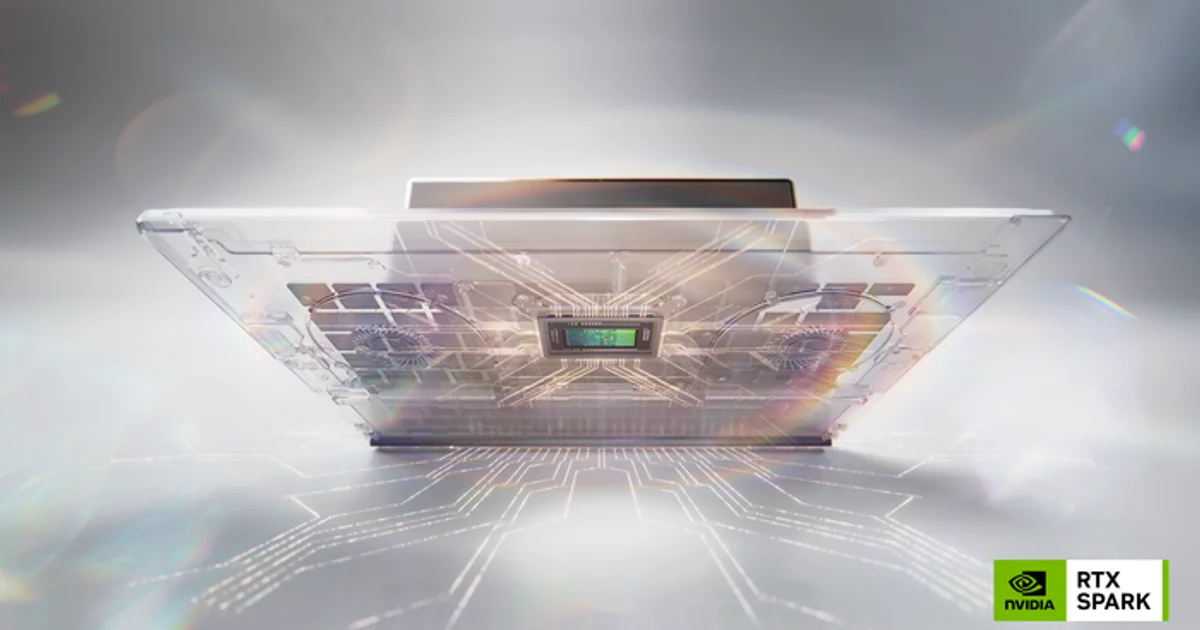
NVIDIA RTX Spark is an Arm-based Grace-Blackwell superchip that NVIDIA unveiled at Computex 2026 to power a new class of Windows AI PCs, not a rebrand of the 2025 DGX Spark developer desktop. The flagship N1X configuration packs a 20-core Grace CPU, a Blackwell GPU with 6,144 CUDA cores, and up to 128GB of unified LPDDR5X memory on a single chip, delivering roughly 1 petaflop of FP4 AI compute inside a laptop that weighs about 3 pounds. FP4 is the low-precision number format that lets AI chips trade some numerical accuracy for more operations per second.
Here's the detail most early coverage glosses over: despite sharing Grace-Blackwell engineering, RTX Spark and DGX Spark sit in very different price-to-compute brackets. Morgan Stanley's Computex channel checks put RTX Spark's flagship N1X systems at roughly $2,899, while NVIDIA's own DGX Spark workstation now starts at $4,699 after a memory-driven price increase earlier in 2026.
Below: the real spec gap between the N1X and lower-tier N1 chips, how RTX Spark's per-gigabyte memory pricing actually compares to DGX Spark once you run the math, which OEMs are shipping it this fall, and the misconception that keeps tripping up early coverage of NVIDIA's first Windows superchip.
In This Article
What Is NVIDIA RTX Spark?
NVIDIA RTX Spark is an Arm-based Grace-Blackwell superchip and PC platform that NVIDIA revealed at Computex 2026, built to bring roughly datacenter-class AI throughput into Windows laptops, desktops, and workstations. It is not the same product as the 2025 NVIDIA DGX Spark, even though both trace back to related Grace-Blackwell engineering.
The two chips solve different problems. DGX Spark is a Linux developer desktop aimed at researchers training and fine-tuning models locally. RTX Spark is a Windows-first platform built into laptops from major PC makers, aimed at gamers, creators, and people who want to run AI agents on-device without paying for cloud compute.
| Aspect | RTX Spark (2026) | DGX Spark (2025) |
|---|---|---|
| Target OS | Windows on Arm | Linux |
| Form factor | Laptops, desktops, workstations | Desk-side developer workstation |
| Audience | Consumers, creators, gamers | AI researchers, developers |
| Memory | Up to 128GB unified LPDDR5X | Up to 128GB unified memory |
| AI compute | About 1 petaflop FP4 | About 1 petaflop FP4 |
| Starting price | ~$2,899 (N1X, estimated) | $4,699 (as of 2026) |
NVIDIA CEO Jensen Huang introduced RTX Spark during the company's Computex 2026 keynote in Taipei, framing it as the start of a "superchip era" for Windows PCs and describing the goal as turning Windows into what NVIDIA calls an agentic AI operating system, according to NVIDIA's official Computex 2026 announcement.
Who builds RTX Spark PCs?
NVIDIA is not selling RTX Spark systems itself the way it sells DGX Spark. Instead, it supplies the chip to PC makers:
- Microsoft, reportedly using the Surface Laptop Ultra as a flagship reference design
- Dell, expected to bring RTX Spark to its XPS line
- ASUS, HP, Lenovo, MSI, Acer, and Gigabyte, all confirmed as launch partners
- TSMC, manufacturing the chip on its 3nm process
- MediaTek, co-designing the Arm CPU integration alongside NVIDIA
No OEM has published final retail pricing or full spec sheets as of mid-June 2026. The numbers in this article come from analyst estimates and hands-on reporting, not an NVIDIA price list.
RTX Spark Technical Specifications
RTX Spark ships in two configurations: N1X, the flagship chip, and N1, a lower-tier variant for thinner and cheaper machines. The specs below come from NVIDIA's Computex 2026 disclosures and corroborating hands-on reports, since NVIDIA has not published a full official spec sheet for either chip.
| Spec | RTX Spark N1X | RTX Spark N1 |
|---|---|---|
| CPU | 20-core Grace (Arm): 10x Cortex-X925 + 10x Cortex-A725 | 12-core Grace (Arm): 8x Cortex-X925 + 4x Cortex-A725 |
| GPU | Blackwell-class RTX, 6,144 CUDA cores | Blackwell-class RTX, CUDA core count not yet public |
| Graphics class | Roughly RTX 5070 laptop GPU | Roughly RTX 5050 laptop GPU |
| Unified memory | Up to 128GB LPDDR5X | Up to 64GB LPDDR5X |
| Memory bandwidth | About 300GB/s | Not yet disclosed |
| AI compute | About 1 petaflop FP4 | Lower than N1X, exact figure undisclosed |
| Process node | TSMC 3nm | TSMC 3nm |
| Transistor count | About 70 billion | Not yet disclosed |
The unified memory architecture, and why it matters
Both chips use a single pool of LPDDR5X memory shared between the CPU and GPU instead of the split setup found in a typical gaming laptop, where the CPU draws on system RAM and the GPU has its own separate VRAM. That split is normally where memory ceilings come from: a discrete laptop GPU might have 16GB of VRAM no matter how much system RAM sits next to it.
RTX Spark removes that ceiling. A 128GB N1X chip can dedicate most of its pool to a single large language model if that's what the workload calls for, the same general approach Apple uses in its M-series chips and NVIDIA uses in DGX Spark. The tradeoff is bandwidth: LPDDR5X tops out around 300GB/s, well below the 2,000GB/s-plus you get from GDDR7 on a discrete desktop GPU. For gaming and short AI tasks that gap matters less. For loading a 70B-parameter model into memory in one shot, it matters a great deal.
NVIDIA built the chip in partnership with MediaTek, which contributed Arm CPU integration experience from its existing PC SoC business, and manufactures it on TSMC's 3nm process across a two-chiplet design.
Key Players Behind RTX Spark
Three companies make the RTX Spark chip possible, and a fourth determines whether anyone wants to buy a laptop built around it.
| Company | Role | Key detail |
|---|---|---|
| NVIDIA | Designs the Grace-Blackwell superchip and the RTX/AI software stack | First NVIDIA chip built specifically for Windows PCs |
| MediaTek | Co-designs the Arm CPU integration | Brings PC SoC experience NVIDIA lacked in-house |
| TSMC | Manufactures the chip | 3nm process, two-chiplet design, about 70 billion transistors |
| Microsoft | Windows on Arm, Copilot+ integration | Surface Laptop Ultra is the flagship reference design |
Adobe has already rebuilt Photoshop, Premiere, and Firefly to use RTX Spark's unified memory and NPU, with reports of up to 2x faster AI and graphics workflows compared to prior RTX laptop chips. Blackmagic, Blender, and CapCut showed RTX Spark-optimized builds at Computex too, which matters more than it sounds: a chip is only as useful as the software that actually runs well on it.
"RTX Spark reinvents Windows PCs for the age of personal AI, bringing full RTX gaming capabilities, including ray tracing and DLSS 4, together with up to 1 petaflop of local AI compute." (NVIDIA and Microsoft joint announcement, June 2026)
That quote captures the pitch well. This isn't a chip NVIDIA expects buyers to choose for AI alone. It has to win on gaming and content creation too, or the premium price won't hold up against cheaper Windows-on-Arm machines from Qualcomm.
RTX Spark Price and Value
NVIDIA has not announced official RTX Spark pricing. Every figure below comes from analyst channel checks or press estimates, not an NVIDIA price list, and that distinction matters given how much these numbers could still shift before systems ship.
| Product | Configuration | Estimated/actual price | Source |
|---|---|---|---|
| RTX Spark N1 | 12-core Grace, up to 64GB unified memory | ~$1,799 starting | Morgan Stanley via TechTimes, June 2026 |
| RTX Spark N1X | 20-core Grace, up to 128GB unified memory | ~$2,899 starting | Morgan Stanley via TechTimes, June 2026 |
| NVIDIA DGX Spark | Fixed config, up to 128GB unified memory | $4,699 (raised from $3,999 in early 2026) | Techolam, 2026 |
| RTX 5090 (desktop GPU) | Discrete card, not RTX Spark | Unannounced | N/A |
The Morgan Stanley numbers, attributed to analyst Max Weinbach's channel checks with PC brands at Computex, are the most-cited figures in early coverage. TechTimes' own reporting calls this a "first-generation risk": no confirmed battery life, unproven Windows-on-Arm compatibility, and pricing that could move once OEMs finalize bills of materials closer to the fall 2026 launch.
The number most guides don't show
Run the per-gigabyte math and RTX Spark looks like the better deal than its own sibling product, which isn't the story most coverage tells. At an estimated $2,899 for a 128GB N1X system, you're paying about $22.65 per gigabyte of unified memory. DGX Spark, at its current $4,699 starting price for the same 128GB ceiling, works out to about $36.71 per gigabyte, roughly 38% more expensive per gigabyte than the laptop chip built to sell at consumer-friendly prices.
That gap is the real story buried in these numbers. NVIDIA isn't pricing RTX Spark as a cut-down DGX Spark. It's pricing a full Windows laptop, complete with a display, battery, keyboard, and RTX gaming stack, below the per-gigabyte cost of a bare desktop AI workstation. Whether that holds once final OEM pricing lands in the fall is the open question, but the early math suggests NVIDIA is using RTX Spark's volume to subsidize memory costs that DGX Spark, a much lower-volume product, can't absorb the same way.
Why RTX Spark Matters for AI
RTX Spark matters for AI because it pushes a meaningful chunk of inference work off the cloud and onto a machine you own outright. NVIDIA demoed RTX Spark laptops running 120-billion-parameter language models with roughly 1-million-token context windows entirely on-device: no API calls, no subscription, no data leaving the laptop.
That's a different pitch than most "AI PC" marketing of the last two years, which mostly meant a small NPU running background features like live captions. RTX Spark's unified memory pool is large enough to hold a genuinely large model, the kind you'd otherwise rent GPU time in the cloud to run. If you currently pay per token for hosted inference, or run smaller open models locally because that's what your hardware can hold, RTX Spark targets exactly that gap. For more on how local inference economics compare to cloud GPU rental, see our breakdown of AI training versus inference.
It also matters competitively. Intel, AMD, and Qualcomm have spent two years building Windows AI PCs around modest NPUs paired with conventional CPU and GPU designs. RTX Spark answers with a unified architecture borrowed from datacenter thinking, the same logic behind NVIDIA's DGX Spark developer desktop, repackaged for a laptop chassis. If RTX Spark performs as advertised, it resets what "AI PC" is supposed to mean for the entire Windows-on-Arm category, not just NVIDIA's own lineup.
Common Misconceptions About RTX Spark
Four claims about RTX Spark keep circulating since the Computex 2026 reveal, and three of them don't hold up.
"RTX Spark is just a rebrand of DGX Spark." Not accurate. They share Grace-Blackwell engineering, but DGX Spark is a Linux developer workstation aimed at researchers, while RTX Spark is a Windows consumer and creator platform sold inside laptops from third-party OEMs. NVIDIA itself describes RTX Spark as built on the same underlying system as DGX Spark, optimized for a different platform and audience, not a renamed version of the same product.
"RTX Spark is an RTX 5090 laptop GPU." Also wrong, and a comparison that doesn't even make structural sense. RTX Spark is a complete system-on-chip combining CPU, GPU, and unified memory on one piece of silicon. A 5090 would be a discrete GPU card. NVIDIA's only public performance comparison places RTX Spark's graphics roughly at the level of an RTX 5070 laptop GPU, well below a 5090.
"It's an AI chip, so gaming performance will be weak." RTX Spark ships with the full RTX feature set, including ray tracing, DLSS 4, and Reflex, and NVIDIA showed AAA titles running at 1440p with ray tracing on 3-pound laptops during Computex demos. It's positioned closer to a high-end creator and gaming notebook than a low-power Copilot+ device.
"You'll still need the cloud for serious AI work." Partially true, but mostly outdated for the use case NVIDIA is targeting. RTX Spark demoed 120B-parameter models with million-token context entirely on-device. For models in the multi-trillion-parameter range or enterprise multi-node training, you still need server-class hardware like the kind covered in our guide to what an AI accelerator actually is. For a single user running today's large consumer-grade models, RTX Spark is built to skip the cloud entirely.
RTX Spark Availability and What Comes Next
The first RTX Spark laptops are scheduled to ship in fall 2026 from Microsoft, Dell, ASUS, HP, Lenovo, MSI, Acer, and Gigabyte, based on OEM commitments confirmed at Computex. Desktop and workstation variants built on the same architecture are planned but haven't been dated beyond that general window.
Two open questions will decide whether RTX Spark lives up to its launch hype:
- Windows-on-Arm compatibility. Non-x86 Windows laptops have struggled with software compatibility for over a decade. RTX Spark runs native apps directly on its Arm cores, and falls back to Microsoft's Prism emulation layer, software that translates older x86 program instructions into Arm instructions on the fly, for everything else. How much performance that translation costs in practice is still unknown outside NVIDIA's own demos.
- Battery life under mixed workloads. NVIDIA hasn't published TDP figures for either chip, only qualitative claims of "all-day efficiency." Running a large local LLM alongside RTX-class graphics draws more power than the Copilot+ PCs currently on shelves, and real battery numbers won't exist until review units ship.
NVIDIA also confirmed a multi-generation roadmap at Computex, with future Windows AI PC chips code-named Rubin, Rosa, and Feynman following RTX Spark, signaling this is meant to be the first entry in an ongoing product line rather than a one-off experiment. Whether that line succeeds depends less on petaflop counts and more on whether Adobe, game studios, and everyday Windows software actually run well on Arm silicon once millions of these laptops reach people's hands this fall.
Frequently Asked Questions
What is NVIDIA RTX Spark?
NVIDIA RTX Spark is an Arm-based Grace-Blackwell superchip and Windows PC platform that NVIDIA unveiled at Computex 2026. The flagship N1X chip combines a 20-core Grace CPU, a Blackwell GPU with 6,144 CUDA cores, and up to 128GB of unified memory to deliver roughly 1 petaflop of on-device FP4 AI compute inside laptops, desktops, and workstations from OEMs like Microsoft, Dell, ASUS, HP, and Lenovo.
What is the difference between RTX Spark and DGX Spark?
RTX Spark and DGX Spark share related Grace-Blackwell engineering but target completely different products. DGX Spark, launched in 2025, is a Linux developer desktop priced at $4,699 aimed at AI researchers. RTX Spark is a Windows-first platform built into third-party laptops, desktops, and workstations, aimed at gamers, creators, and everyday users who want local AI without a separate developer machine.
How much does RTX Spark cost?
NVIDIA has not announced official pricing. Analyst channel checks from Morgan Stanley, reported by TechTimes in June 2026, estimate RTX Spark N1 systems starting around $1,799 and flagship N1X systems starting around $2,899. Final retail prices from OEMs are expected closer to the fall 2026 launch and could move from these early estimates.
When is RTX Spark coming out, and which laptops will have it?
RTX Spark laptops are scheduled to ship in fall 2026 from Microsoft, Dell, ASUS, HP, Lenovo, MSI, Acer, and Gigabyte. Microsoft's Surface Laptop Ultra has been shown publicly as a flagship reference design, and Dell's XPS line is expected to carry RTX Spark as well. No OEM has confirmed exact launch dates or full model names beyond the fall 2026 window.
What is the difference between RTX Spark N1X and N1?
N1X is the flagship chip: a 20-core Grace CPU, a Blackwell GPU with 6,144 CUDA cores roughly equivalent to an RTX 5070 laptop GPU, and up to 128GB of unified memory. N1 is the lower tier: a 12-core Grace CPU, a Blackwell GPU roughly equivalent to an RTX 5050 laptop GPU, and up to 64GB of unified memory. N1X targets creators and power users; N1 targets more mainstream, lower-cost systems.
Is RTX Spark the same as an RTX 5090?
No. RTX Spark is a complete system-on-chip combining CPU, GPU, and unified memory on one piece of silicon, built for laptops and compact desktops. The RTX 5090, where it exists as a discrete desktop GPU, is a standalone graphics card with its own dedicated GDDR7 VRAM. NVIDIA's only public comparison places RTX Spark's graphics performance roughly at the level of an RTX 5070 laptop GPU, well below a 5090.
Can RTX Spark run large AI models without an internet connection?
Yes, that's the core pitch. NVIDIA demoed RTX Spark laptops running 120-billion-parameter language models with roughly 1-million-token context windows entirely on-device, with no cloud API calls and no subscription. The 128GB unified memory pool on the N1X chip is what makes holding a model that large in memory possible on a laptop.
Will RTX Spark laptops run normal Windows software?
Mostly, through two paths. Apps built natively for Arm run directly on RTX Spark's Grace CPU cores. Older x86 software runs through Microsoft's Prism emulation layer, the same approach used on existing Windows-on-Arm devices like Snapdragon X laptops. How much performance Prism emulation costs on real-world apps hasn't been independently tested yet, since no review units had shipped as of mid-2026.
Related Articles
NVIDIA DGX Spark: Specs, Price, and Who Should Buy It
10 min read
NVIDIA H100 GPU: Full Specs, Price, and Cloud Rates for 2026
11 min read
What Is an AI Accelerator Card? Types, Specs, and Costs for 2026
10 min read
AI Training vs Inference: What's the Difference and Why the Cost Gap Is Growing
10 min read