
OpenAI Stargate Project: The $500B AI Data Center Plan Explained

Key Numbers
Key Takeaways
- 1Stargate is a $500B joint venture between OpenAI, SoftBank, Oracle, and MGX, announced January 21, 2025. It is a network of AI data centers across the US targeting 10 GW of total compute capacity by 2029, with $400B already secured by October 2025.
- 2The flagship Abilene, Texas site (Stargate I) covers approximately 4 million square feet at 1.2 GW. At $500B for 10 GW, the implied build cost is $50M per MW, roughly 4-5x more than conventional data center construction, reflecting the density of NVIDIA GB200 GPU racks and liquid cooling systems.
- 3OpenAI is building Stargate because its existing Microsoft Azure arrangement cannot provision GPU infrastructure at the density and speed required for frontier AI model training. Stargate runs NVIDIA GB200 Blackwell racks at a scale that no single hyperscaler currently offers.
Stargate is OpenAI's $500 billion joint venture to build the largest AI computing infrastructure in history. Announced on January 21, 2025, with US President Donald Trump alongside OpenAI CEO Sam Altman and SoftBank chairman Masayoshi Son, the project targets 10 gigawatts of AI data center capacity across the United States by 2029.
To put 10 GW into context: that is roughly 10 times the electricity consumption of San Francisco. All of it dedicated to running NVIDIA GPUs for AI training and inference.
The project is not a single data center. Stargate is a network of dedicated AI campuses with sites in Texas, New Mexico, Ohio, Wisconsin, and internationally in the UAE, Norway, and the UK. After reading this article, you will understand who is building Stargate, what each partner contributes, how the scale compares to existing hyperscaler capacity, and why OpenAI needed to build its own infrastructure rather than rely on Microsoft Azure alone.
In This Article
- 1What the Stargate Project Is
- 2Stargate Sites: Texas, Ohio, and the US Rollout
- 3Who Is Behind Stargate: Partners, Roles, and Money
- 4How Stargate Compares to Existing AI Infrastructure
- 5Why OpenAI Needed Stargate (and Why Azure Was Not Enough)
- 6International Stargate: UAE, Europe, and OpenAI for Countries
- 7Controversies, Cost Concerns, and Open Questions
What the Stargate Project Is
Stargate is a joint venture structured as Stargate LLC, with OpenAI as the operational lead and SoftBank as the financial lead and chairman. Oracle and MGX are the other two initial equity funders. NVIDIA, Microsoft, Arm, and Cisco serve as technology partners with no equity stake in the joint venture itself.
The project was formally announced at the White House on January 21, 2025. The $500B figure is a commitment over four years, not a single upfront payment. The initial $100B was deployed immediately to begin construction on the Abilene, Texas flagship site.
Three things make Stargate different from standard hyperscale data center projects:
- Purpose-built for AI: Every facility is designed around NVIDIA GB200 GPU racks, liquid cooling, and high-bandwidth InfiniBand networking. Standard data centers are built for mixed compute workloads. Stargate is built exclusively for AI training and inference at frontier scale.
- Single-tenant scale: Each Stargate facility is dedicated to OpenAI's workloads, not shared multi-tenant infrastructure. This allows the power density and interconnect configuration that frontier model training requires.
- Speed of build: With 6,000 daily construction workers at the West Texas site alone, the build rate is deliberately faster than typical enterprise data center timelines. OpenAI's model training roadmap depends on compute being available on schedule.
According to the official OpenAI Stargate announcement, the project is designed to "secure American AI leadership" and provide the compute needed to develop AI systems up to and including artificial general intelligence.
Stargate Sites: Texas, Ohio, and the US Rollout
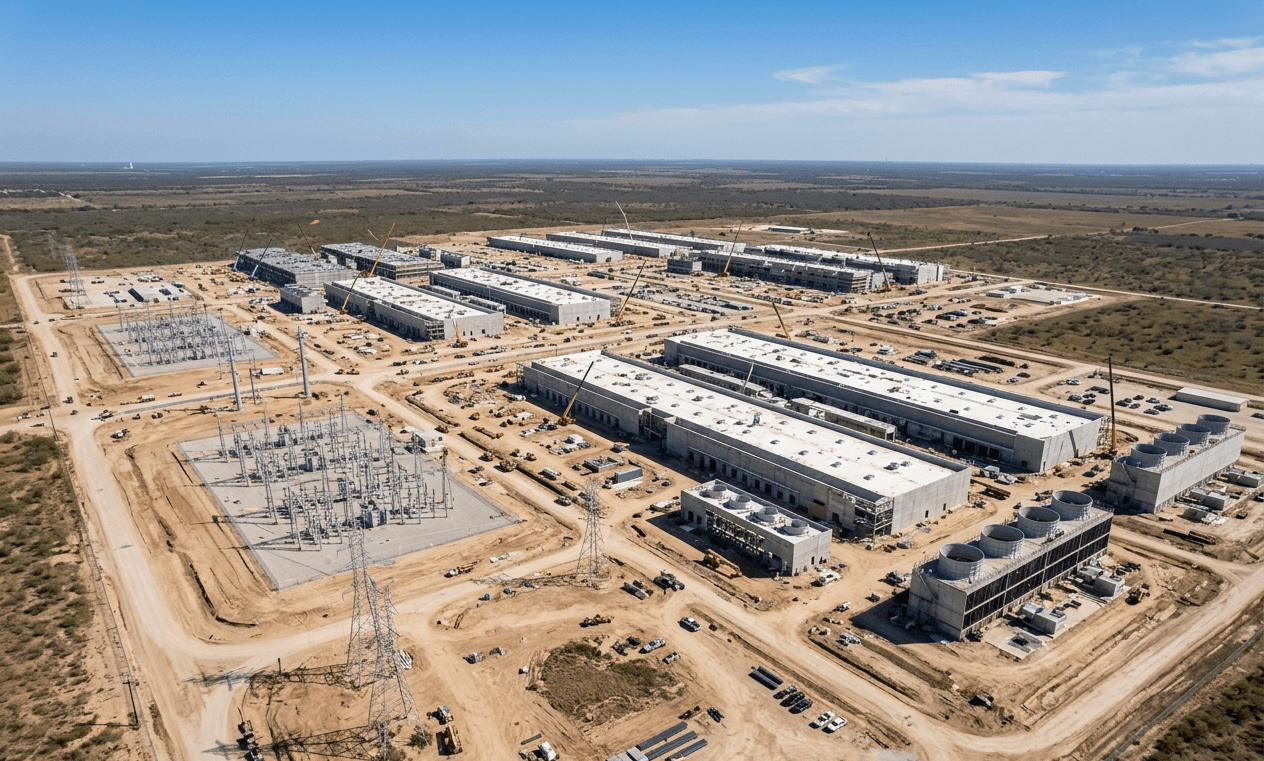
The Abilene, Texas site is the first and largest Stargate facility. Known as Stargate I, it covers approximately 4 million square feet with a planned capacity of 1.2 GW. NVIDIA GB200 racks were delivered in June 2025, and the site was partially operational by late 2025 with early AI training workloads running. Full operations are expected by mid-2026.
Five additional US sites were announced on October 22, 2025, bringing total planned US capacity to nearly 7 GW:
| Site | State | Capacity | Partner | Status (Q1 2026) |
|---|---|---|---|---|
| Stargate I (Abilene expansion) | Texas | 1.2 GW+ | OpenAI, Oracle | Partially operational |
| Shackelford County | Texas | TBD | OpenAI, Oracle | Construction |
| Doña Ana County | New Mexico | TBD | Oracle | Construction |
| Lordstown | Ohio | 1.5 GW (target) | SoftBank | Ground broken |
| Midwest site | Wisconsin | TBD | Oracle, Vantage | Construction |
Sources: OpenAI five new Stargate sites announcement, October 22, 2025; Data Center Dynamics, 2025.
JPMorgan Chase provided a $2.3 billion project finance loan for the Abilene facilities in May 2025, confirming that major institutional lenders view the project as creditworthy at scale.
The Ohio site at Lordstown is SoftBank's flagship contribution. SoftBank CEO Masayoshi Son has stated a target of 1.5 GW operational within 18 months of groundbreaking, which would make it one of the largest single AI campuses in the world. For context on what hyperscale data center construction of this magnitude involves, see our guide to hyperscale data centers.
Tracking big AI infrastructure bets?
Get the next story like Stargate explained clearly, every Wednesday and Saturday.
Who Is Behind Stargate: Partners, Roles, and Money
Stargate brings together four equity partners and several technology partners with distinct roles. The equity structure gives SoftBank financial leadership and OpenAI operational leadership, which means SoftBank controls the money and OpenAI controls what gets built and how it runs.
| Partner | Role | Financial Contribution |
|---|---|---|
| OpenAI | Operational lead: technical design, workload requirements, site specifications | Co-equity funder |
| SoftBank | Financial lead and chairman: capital deployment, site development for Ohio | Lead equity funder |
| Oracle | Data center development: builds and operates sites in Texas, New Mexico, Wisconsin | $300B+ over 5 years for 4.5 GW (announced July 2025) |
| MGX | Equity funder | Abu Dhabi sovereign investment vehicle |
| NVIDIA | Technology partner: supplies GB200 and GB300 GPUs, InfiniBand networking | Hardware only, no equity |
| Microsoft | Cloud partner: Azure continues as complementary compute | No equity in Stargate LLC |
| Arm | Technology partner: CPU architecture | No equity |
| Cisco | Technology partner: UAE site networking | No equity |
The Oracle partnership, announced in July 2025, is the single largest component: $300B committed over five years for 4.5 GW of additional capacity across three sites. Oracle runs over 2 million chips across Stargate sites as of late 2025 (Oracle Cloud Infrastructure press release, 2025).
"This is a historic investment in American AI infrastructure that will create hundreds of thousands of jobs." (Donald Trump, White House announcement, January 21, 2025)
Microsoft's position is notable. OpenAI has an existing multi-year compute arrangement with Azure, and that continues alongside Stargate. Stargate does not replace Azure for OpenAI; it supplements it. The reason: Microsoft Azure's shared infrastructure model cannot provision the dedicated 10,000+ GPU cluster topology that training GPT-5-class models requires.
How Stargate Compares to Existing AI Infrastructure
Ten gigawatts is a number that needs context. The four largest hyperscalers (AWS, Azure, Google Cloud, Meta) collectively announced approximately $290B in AI infrastructure capex through 2027 (CBRE Research, 2025). Stargate commits $500B for a single customer's compute needs. That is not a data center project. It is a national AI infrastructure program.
Comparing compute capacity:
| Infrastructure | Power Capacity | Purpose | Timeline |
|---|---|---|---|
| Stargate (all US sites) | 10 GW (target 2029) | OpenAI exclusive | 2025-2029 |
| Microsoft Wisconsin campus | ~0.3 GW | Azure multi-tenant | 2025 |
| Google total data center fleet | ~3-5 GW (est.) | Multi-tenant cloud | Existing |
| AWS total data center fleet | ~5-7 GW (est.) | Multi-tenant cloud | Existing |
| Typical hyperscale facility | 0.05-0.3 GW | Multi-tenant | Standard |
Sources: CBRE Research 2025; OpenAI announcements 2025; public analyst estimates for hyperscaler capacity.
The Number Most Guides Don't Show
Stargate's $500B committed for 10 GW implies a build cost of $50M per megawatt. Standard hyperscale data center construction runs $10-12M per MW (Construct Elements, 2025). AI-optimized facilities with GPU racks, liquid cooling, and InfiniBand fabric typically cost $20-30M per MW.
Stargate's $50M per MW figure is 4-5x the conventional rate and 2-2.5x the AI-optimized hyperscale rate. The premium reflects several factors: the speed of construction (6,000 workers at a single site compresses the timeline but raises labor costs), the density of GB200 racks which require specialized power and cooling infrastructure not yet at commodity pricing, and the land, substation, and grid interconnection costs at the scale of 1+ GW per site.
Put differently: for every $50M OpenAI and its partners spend, they get one megawatt of AI compute. At 10 GW, that is compute capacity equivalent to powering a small country, dedicated entirely to running AI models. For a broader view of what AI data centers cost to build and operate, see our AI data centers explained guide.
Why OpenAI Needed Stargate (and Why Azure Was Not Enough)
OpenAI has used Microsoft Azure as its primary compute provider since 2019, and that relationship continues. So why build Stargate at all?
The answer comes down to three constraints that shared-infrastructure cloud cannot solve at OpenAI's scale.
First, GPU cluster topology. Training GPT-4-class and larger models requires thousands of GPUs connected by high-bandwidth, low-latency InfiniBand fabric, all within a single physical building to minimize signal latency. AWS and Azure are built as distributed multi-tenant infrastructure. Physically allocating 10,000+ H100s or GB200s to a single tenant in a single dedicated fabric is not something the shared-infrastructure model is optimized to do.
Second, procurement speed. NVIDIA GPU production is constrained. OpenAI, via Stargate's NVIDIA partnership, secures direct access to GB200 and GB300 allocations at scale. A company buying GPU capacity through a hyperscaler competes with thousands of other customers for available inventory. Stargate's direct hardware pipeline eliminates that queue.
Third, cost at scale. At hundreds of thousands of GPU-hours per day, the difference between $4/hr (specialized) and $7/hr (hyperscaler) for an H100 is hundreds of millions of dollars per year. At Stargate's scale, owning the infrastructure is cheaper than renting it, even after accounting for construction and operations.
"We need to own our own infrastructure if we want to reach AGI on the timeline we believe is necessary." (Sam Altman, OpenAI CEO, paraphrased from investor communications, 2024)
CoreWeave, which holds an $11.9B, five-year compute deal with OpenAI, complements Stargate for burst capacity and interim compute while Stargate sites come online. For more on CoreWeave's role in OpenAI's infrastructure stack, see our CoreWeave review.
International Stargate: UAE, Europe, and OpenAI for Countries
Stargate is not limited to the United States. OpenAI announced an international expansion beginning in May 2025.
The UAE Stargate was announced in May 2025, involving NVIDIA, Cisco, OpenAI, G42 (Abu Dhabi AI company), Oracle, and SoftBank. Construction began in 2025 and the facility is expected to be operational in 2026. MGX, the Abu Dhabi sovereign investment vehicle and equity partner in Stargate LLC, is the strategic backer of the UAE site.
Countries with announced or reported Stargate investments as of early 2026:
- UAE: Announced May 2025, 2026 opening
- UK: OpenAI and Oracle in discussions as of April 2025 (Financial Times report)
- Norway: Site selection underway
- Argentina: Site selection underway
- South Korea: Engagement begun
- India and Japan: Under discussion
In February 2026, OpenAI launched "OpenAI for Countries," an initiative targeting 10 global Stargate projects with national governments as co-investors. The model gives governments a stake in the AI infrastructure built on their territory in exchange for permitting, grid access, and co-investment.
The international expansion reflects a strategic reality: AI compute is becoming a geopolitical asset. Countries that host Stargate facilities gain proximity to frontier AI infrastructure, while OpenAI gains access to lower-cost power markets and favorable regulatory environments outside the US.
Controversies, Cost Concerns, and Open Questions
Stargate's announcement was not without immediate pushback.
Elon Musk, CEO of xAI (a competitor to OpenAI), publicly claimed on social media in January 2025 that the $500B commitment was not backed by sufficient financing and that "they don't actually have the money." Sam Altman publicly denied this, and Arm CEO Rene Haas stated the financial backing was "quite solid." By October 2025, with $400B+ secured and construction underway at multiple sites, the financing concern appeared resolved.
Cost escalation is a real consideration. Some reports from 2025 cited total Stargate buildout estimates approaching $850B when factoring in land, grid interconnection, and long-term operations, versus the $500B investment figure. The $500B commitment covers construction and hardware; it does not include the ongoing operational costs of power, cooling, and maintenance over the facilities' lifetimes.
Power grid strain is the most substantive open question. Ten gigawatts of new AI compute load represents a significant addition to the US grid. The Texas sites draw from ERCOT, the state's independent grid, which has faced capacity concerns during peak summer demand. Ohio and Wisconsin sites fall under different grid operators (PJM), with greater interconnection capacity but still requiring new transmission infrastructure.
Three questions that analysts are watching as of Q1 2026:
1. Power sourcing: No formal power purchase agreements for nuclear or renewable energy have been publicly announced for Stargate sites. The energy source and cost for 10 GW at full operation remains an open question.
2. Timeline risk: The October 2025 update showed progress ahead of schedule, but scaling from 7 GW planned to 10 GW operational by 2029 requires a construction pace with no comparable precedent in data center history.
3. OpenAI's financial position: Stargate LLC is an independent joint venture, but OpenAI's ability to fulfill its obligations depends on continued revenue growth. OpenAI's 2025 revenue was estimated at $3-4B against significant operating costs; the model must continue scaling to justify the infrastructure investment.
Frequently Asked Questions
What is the OpenAI Stargate Project?
Stargate is a $500B joint venture between OpenAI, SoftBank, Oracle, and MGX to build AI data centers across the US and internationally. Announced January 21, 2025, it targets 10 GW of total AI compute capacity by 2029. OpenAI is the operational lead and SoftBank is the financial lead.
Where are the Stargate data centers located?
As of Q1 2026, confirmed US Stargate sites include Abilene, Texas (flagship, 1.2 GW), Shackelford County (Texas), Doña Ana County (New Mexico), Lordstown (Ohio), and a Midwest site in Wisconsin. International sites include the UAE (opening 2026), with UK, Norway, Argentina, and South Korea in development.
Who is funding the Stargate Project?
The four equity funders are SoftBank (financial lead), OpenAI (operational lead), Oracle, and MGX (Abu Dhabi sovereign investment vehicle). Oracle committed $300B+ over five years in July 2025 for 4.5 GW of capacity. JPMorgan Chase provided a $2.3B project finance loan for the Abilene site in May 2025.
How much power will Stargate use?
Stargate targets 10 GW of total AI compute capacity by 2029. Ten gigawatts is equivalent to the electricity consumption of roughly 8-10 million US homes. The Texas sites draw from ERCOT (the Texas grid), while Ohio and Wisconsin sites fall under the PJM grid. No formal renewable energy or nuclear power purchase agreements have been publicly announced as of Q1 2026.
Is Stargate replacing Microsoft Azure for OpenAI?
No. OpenAI continues to use Microsoft Azure alongside Stargate. The two serve different purposes: Azure handles existing product traffic and overflow compute, while Stargate provides the dedicated high-density GPU clusters needed for training frontier AI models. Microsoft remains a technology partner in Stargate but does not hold equity in Stargate LLC.
When will Stargate be fully operational?
The Abilene, Texas flagship site (Stargate I) was partially operational by late 2025, with full operations targeted for mid-2026. The Ohio site is expected to be operational in 2026. Full 10 GW capacity across all sites is targeted by 2029. As of October 2025, OpenAI reported the project was ahead of schedule.
What GPUs does Stargate use?
Stargate uses NVIDIA GB200 (Blackwell generation) GPU racks as the primary hardware, with delivery to the Abilene site confirmed in June 2025. NVIDIA is a technology partner in Stargate and has a direct hardware supply relationship. The GB200 NVL72 rack configuration, which connects 72 GPUs per rack via NVLink, is the primary Stargate compute unit.