
Will AI Replace Programmers, Engineers, Writers, and Accountants? The Real Answer

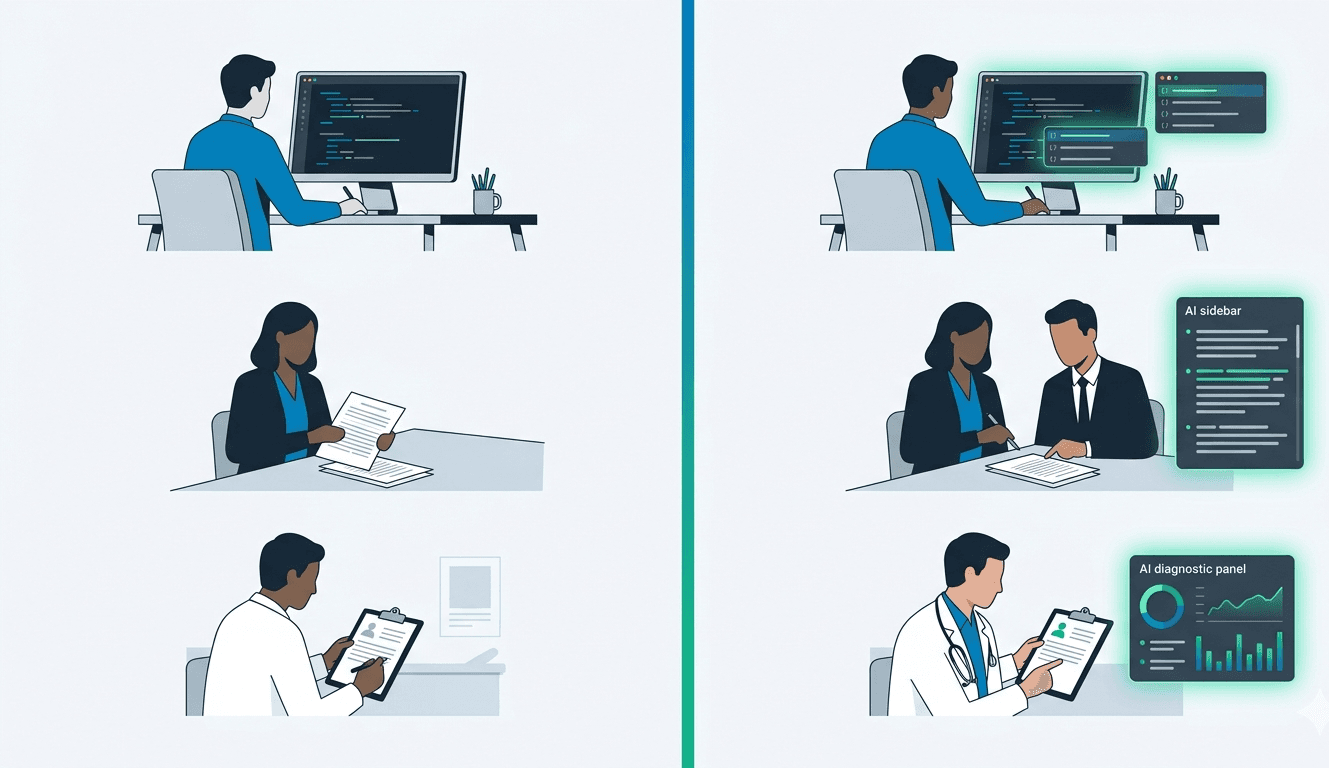
Key Numbers
Key Takeaways
- 1AI can technically perform 74.5% of coding tasks and 70.1% of customer service tasks, per Anthropic 2025. But MIT Acemoglu (2024) found AI currently performs only 5% of actual US work across all professions, blocked by cost, liability, and organizational barriers.
- 2The WEF 2025 Future of Jobs Report projects 92M jobs displaced globally by 2030, but 170M new ones created, a net gain of 78M. Accounting/bookkeeping clerks decline 18%; AI/ML specialists grow 45%.
- 3The pattern across every profession is the same: entry-level, template-based, and routine-task roles face compression first. Senior, judgment-based, and client-facing roles stay stable or grow. Task displacement is real; full job replacement is rare in most professions through 2030.
AI performs 74.5% of the tasks that make up a software engineer's job, according to Anthropic's 2025 analysis of occupation-level AI exposure. That figure is the highest for any profession they measured. Customer service workers sit at 70.1%. Financial advisors at 57.2%. These numbers sound alarming until you understand what they actually measure: tasks AI can technically perform, not jobs AI has eliminated.
MIT economist Daron Acemoglu published research in April 2024 finding that AI currently performs around 5% of actual work tasks across the US economy. The gap between what AI can do technically and what it is doing in practice is enormous, blocked by implementation costs, liability frameworks, and the reality that most jobs involve far more than any single task category.
The picture changes profession by profession. A junior software developer faces meaningfully more near-term risk than a senior architect. A copywriter producing template content faces more disruption than an investigative journalist. A paralegal doing document review faces more displacement than a trial attorney. This guide covers each major profession with the specific data on what changes, what stays, and what the realistic timeline looks like.
In This Article
- 1What "AI replacing jobs" actually means
- 2Will AI replace programmers, software engineers, and coders?
- 3Will AI replace writers and content creators?
- 4Will AI replace graphic designers?
- 5Will AI replace accountants and financial analysts?
- 6Will AI replace doctors, nurses, and radiologists?
- 7Will AI replace lawyers?
- 8Will AI replace teachers?
- 9Will AI replace artists and musicians?
- 10Will AI replace marketing, customer service, and financial advisor jobs?
- 11How many jobs will AI replace? The total numbers
- 12Which jobs will AI replace vs. augment? A profession-by-profession summary
What "AI replacing jobs" actually means
The phrase "AI will replace jobs" conflates two very different things. Task displacement and full job replacement are not the same event, and the difference determines how you should think about your own career.
Task displacement occurs when AI automates specific, discrete tasks within a job while the profession itself continues. A lawyer still practices law, but AI now handles the first pass on document review. A financial analyst still makes recommendations, but AI processes the underlying data. A programmer still architects systems, but AI generates the boilerplate. In each case, the job changes; it doesn't disappear.
Full job replacement means the entire occupation becomes redundant and positions are eliminated. This happens, but it's far rarer than headlines suggest. The clearest historical examples involve narrowly defined roles where the entire job consists of automatable tasks: data entry clerks, basic transcriptionists, certain assembly line operators. Knowledge professionals rarely fit this pattern because their jobs involve judgment, relationships, and context that don't reduce to a single automatable task.
Harvard Business School research published in 2024 provides useful evidence. After ChatGPT launched in November 2022, job postings for highly repetitive roles declined 13%. At the same time, employer demand for jobs requiring analytical, technical, or creative work grew 20%. This divergence, not wholesale elimination, is what AI-driven labor market change actually looks like in practice.
The three layers of AI job impact
- Automation: AI performs the task instead of a human. The task disappears from the human's workload. Examples: preliminary radiology reads, basic contract review, data entry, basic copywriting.
- Augmentation: AI makes the human faster or better at the task. The human still performs it, but output increases. Examples: a developer using GitHub Copilot, a lawyer using Harvey, a radiologist reviewing AI-flagged scans.
- Displacement: Even where AI augments rather than replaces, fewer humans are needed to produce the same output. A team of 5 developers using Copilot may produce what 8 developers produced before. Headcount shrinks without any individual being "replaced."
For most professions, augmentation and displacement are both happening simultaneously. Full replacement is the exception, not the pattern, through 2030. Physical requirements, licensing requirements, or the need for social trust push the timeline further out in those fields.
Will AI replace programmers, software engineers, and coders?
Programmers face the highest measured AI task exposure of any profession. Anthropic's 2025 analysis found AI can perform approximately 74.5% of tasks that make up a software engineering role, with a theoretical maximum of 94%. That does not mean 74.5% of programming jobs are about to disappear.
The reason is what GitHub's own research demonstrated when they measured GitHub Copilot's real-world impact. Developers using Copilot completed coding tasks 55% faster (GitHub, 2023). The natural inference from a company's perspective is not "hire 55% fewer developers." The more common outcome is "ship 55% more product with the same team." Developer productivity tools have historically expanded software output rather than shrinking developer headcount, because demand for software grows to absorb available supply.
The actual risk is concentrated in specific roles. Junior developers doing routine CRUD application work, basic test generation, boilerplate code, and simple debugging face meaningful compression. The number of entry-level positions has already declined. Harvard Business School found a 14% hiring drop for developers aged 22-25 following widespread AI tool adoption in 2024. Those aren't layoffs of existing employees; they're fewer new hires at the junior level.
| Role | AI Impact | Timeline |
|---|---|---|
| Junior/entry-level developer | Headcount compression, fewer new hires | Already underway (2024-2026) |
| Mid-level full-stack developer | Task mix shifts toward architecture, testing strategy | 2027-2030 |
| Senior software engineer | Productivity increase; AI generates, humans review and design | Stable through 2030+ |
| Software architect | Low risk; system design requires judgment AI doesn't replicate | Stable |
| AI/ML engineer | Fastest-growing adjacent role (+45% per WEF 2025) | Expanding |
"Computer programming is the most susceptible occupation, with AI managing around 74.5% of their tasks." (Dario Amodei, Anthropic CEO, February 2025)
The WEF 2025 Future of Jobs Report projects Software Developers as the #4 fastest-growing job category through 2029, growing 35%. This appears contradictory given the exposure data until you understand the distinction: the total number of developer jobs grows because software demand grows, even as the per-developer task mix shifts and junior positions face compression.
Developers who shift toward system design, DevOps, and AI integration hold their position. Those still writing boilerplate manually without AI tool fluency face the sharpest compression. For a deeper look at how AI language models approach code tasks, see our explainer on what large language models are and how they work.
Will AI replace writers and content creators?
The risk for writers depends almost entirely on what kind of writing they do. Bulk content production, product description generation, basic news summaries, template copy, and data-driven reporting face high displacement pressure. Investigative journalism, literary fiction, specialist technical writing, and brand strategy writing face much lower risk.
Forrester's 2023 Generative AI Jobs Impact Forecast identified technical writers and proofreaders as the highest-risk writing occupations for full replacement, not general authors or editors. The WEF 2025 Future of Jobs Report includes Proofreaders and Technical Writers in its top 10 fastest-declining roles, projecting a 12% reduction by 2029. In 2023 alone, Forrester estimated approximately 90,000 writing-adjacent jobs were affected by generative AI tools.
The economics explain why. A content agency that previously needed 10 writers to produce 100 articles per week can now produce the same output with 3 writers using AI tools. The total work may even increase, but headcount falls. This is the displacement pattern: output per worker rises, and fewer workers are needed for the same volume.
Writing roles by risk level
- High risk (2026-2030): Commercial copywriting, basic SEO content production, product descriptions, templated social copy, news summarization from data feeds
- Medium risk: Email marketing copy, technical documentation, travel and lifestyle content, basic journalism from wire feeds
- Lower risk: Investigative journalism (requires source relationships and verification), literary fiction, brand narrative strategy, specialized domain writing (medical, legal, financial requiring licensed expertise)
- Minimal risk: Ghostwriting for public figures who need authentic voice, editorial leadership, content strategy requiring audience insight
The market has already shown what survives. Writers working as AI output editors, strategists, and subject matter voices retain value. A registered dietitian writing about nutrition, or a former attorney writing about legal tech, commands rates no AI can undercut. Audience trust built over years does not transfer to an AI system running under the same byline.
Will AI replace graphic designers?
Graphic designers face a split outcome depending on the tier of design work they do. The Conference Board's 2024 AI and Automation Risk Index places graphic design in a "productivity enhancement" category rather than full displacement, with 25-40% of tasks at risk. The EdSmart 2024 AI Job Risk Report places designers in the medium-exposure band.
The reason the risk is real but bounded is the same reason skilled trades resist automation: the most valuable design work requires judgment, context, and client relationships that don't reduce to image generation. An art director overseeing a brand identity launch is not doing the same job as a freelancer generating stock mockups. AI tools (DALL-E, Midjourney, Adobe Firefly) directly threaten the latter and barely touch the former.
What is already being automated in design: icon sets, stock imagery, basic template customization, preliminary logo variations, social media graphics at scale, and standard marketing collaterals. These represent real revenue for entry-level and freelance designers doing commodity work. The market for this type of work has already compressed since 2022.
What resists automation: brand identity strategy requiring understanding of company culture and competitive positioning, UX design requiring user research and empathy, custom illustration with a unique artistic voice, packaging design for physical products requiring material knowledge, and design that integrates client relationships and stakeholder management.
"Creative fields such as graphic design, copywriting, and basic journalism are facing potential disruption from generative AI." (Forbes, citing 2025 research)
UI/UX Designers appear on the WEF 2025 list of the 10 fastest-growing roles, growing 20% by 2029. The market is bifurcating: commodity design shrinks while strategic and UX-oriented design expands. Designers who move toward user research, design systems leadership, and strategic brand work are positioned differently than those competing on execution speed.
Will AI replace accountants and financial analysts?
Accounting faces some of the most concrete near-term disruption of any knowledge profession. The WEF 2025 Future of Jobs Report includes Accounting and Bookkeeping Clerks in its top 10 fastest-declining jobs, projecting an 18% reduction by 2029. Harvard Business School's 2024 research found that finance saw the largest reductions in job postings of any sector following AI adoption.
The Pew Research Center's July 2023 analysis found 40-50% of accounting tasks are exposed to AI. Anthropic's 2025 data places financial advisors at 57.2% task exposure. The specific tasks at highest risk: data entry, basic reconciliation, standard tax preparation, preliminary financial report generation, and routine audit procedures. These are exactly the tasks that junior accounting staff spend the most time on.
The picture looks different for senior accountants and CPAs. AI handling data processing and preliminary analysis doesn't eliminate the need for someone to interpret results, advise clients, navigate complex tax situations, and sign off on audits with professional liability. The Bureau of Labor Statistics projects accounting and auditor employment growing 4% through 2033, despite widespread AI adoption.
| Accounting Role | AI Task Exposure | Outlook |
|---|---|---|
| Data entry / bookkeeping clerk | 70-80% | High displacement risk (WEF -18% by 2029) |
| Tax preparer (routine returns) | 60-70% | Significant compression; software does most of it |
| Staff accountant (junior) | 40-50% | Moderate compression; rising productivity demands |
| CPA / senior accountant | 20-30% | Stable; judgment and liability remain with the human |
| CFO / financial strategist | Under 15% | Minimal; strategy, relationships, and context dominate |
The number most guides don't show
If a CPA firm employs 10 staff accountants at an average of $65,000 each, its annual payroll for that tier is $650,000. AI tools that handle 50% of staff accounting tasks at $50,000/year in software costs represent a $275,000 net saving. The financial incentive for firms to reduce junior headcount while retaining senior staff and paying for AI tools is straightforward. This is why the pressure lands first on new hires and junior staff, not on experienced professionals.
The pressure is coming for accountants who do data processing as their core value. CPAs who explain what the numbers mean, advise on tax strategy, and hold client relationships are structurally different. Those executing standard procedures are not.
Will AI replace doctors, nurses, and radiologists?
Healthcare presents the sharpest distinction between task exposure and job replacement risk of any profession. Pew Research's 2023 analysis places physicians at 20-30% task exposure. The EdSmart 2024 report places radiologists at 50-70% exposure for image analysis tasks specifically. Nurses sit at 10-20%. Yet the jobs AI cannot replace data shows nurses carry just 0.9% automation risk, surgeons 0.4%.
The resolution is licensing, liability, and the human trust requirement in patient care. An AI system can analyze a chest X-ray with high accuracy. It cannot be the physician of record. It cannot obtain informed consent. It cannot be sued for malpractice. The entire legal and institutional structure of healthcare requires licensed humans to remain accountable for decisions. This is not a technical limitation. It is a social and legal enforcement of human roles.
Radiologists face the most concrete AI impact of any physician specialty. AI systems can now perform preliminary reads of standard imaging studies with accuracy comparable to residents. The workflow change is real: AI flags potential findings, the radiologist reviews AI-highlighted areas, and approval time per scan compresses. This raises radiologist throughput but also raises questions about long-term headcount. The AMA and academic radiology programs are actively debating whether radiology training volumes need to adjust.
According to the Lancet's 2023 analysis, approximately 25% of administrative medical tasks could be automated by 2035. This is the category where AI impact is most straightforward: scheduling, prior authorization, clinical documentation, billing, and coding. These are tasks that consume physician time without generating patient care value. AI handling them means physicians see more patients, not fewer physicians overall.
Healthcare AI impact by role
- Radiologists: Task mix shifts; fewer total scans per radiologist needed, but detection accuracy improves. Net effect on headcount is debated; demand for imaging grows as population ages.
- Nurses: Very low automation risk. Direct patient care, physical assessment, medication management, and emotional support require human presence. AI adds documentation speed. BLS projects 6-9% nursing growth through 2033.
- Primary care physicians: AI handles documentation and administrative work. Patient-facing time increases. Risk to headcount is low; physician shortage continues.
- Pharmacists: 30-40% of routine dispensing tasks face automation pressure. Clinical pharmacy roles are more protected. Retail pharmacy headcount may compress; hospital and specialty pharmacy roles remain stable.
The net projection for healthcare employment is growth, not decline. The WEF 2025 Future of Jobs Report identifies health professionals as a top growth category. AI in healthcare is absorbing administrative burden, allowing clinicians to do more of what they were trained for.
Will AI replace lawyers?
Lawyers sit in a position similar to accountants: high theoretical task exposure, meaningful near-term impact on junior roles, and strong structural protection for senior and courtroom practice. Anthropic's 2025 data places lawyers at 40-50% theoretical task exposure, with current real-world automation under 10%. Harvey AI, the legal-specific AI system backed by a $100M+ valuation, cuts contract review time by 70% and paralegal research tasks by 60%, according to a Stanford HAI study (2024).
The WEF 2025 Future of Jobs Report projects Legal Secretaries as one of its top 10 declining roles, down 10% by 2029. Junior associate and paralegal positions face the most direct pressure. Document review, legal research, contract drafting, and precedent analysis are tasks where AI is already producing near-partner-quality work at fraction-of-associate cost.
"Paralegal work, contract drafting, and legal research are prime candidates for automation." (Forbes, citing Stanford research, 2025)
Large law firms adopting AI are running meaningful experiments. One well-documented 2024 study found AI reduced document review time from 11 hours to 2 hours on a standard commercial contract. If that productivity gain scales across a firm's associate class, the implication for junior hiring is not subtle. Several Am Law 100 firms reduced first-year associate hiring by 10-20% in 2024-2025 while maintaining or increasing partner headcount.
What AI cannot replace in law: courtroom judgment and advocacy, client counseling on strategy, negotiation where relationship and read-of-the-room matter, novel legal arguments in untested areas, and the reputational value of a trusted attorney's signature on a document. These are exactly the high-value, high-margin activities that keep senior attorneys essential.
Junior lawyers who develop AI literacy and position themselves as workflow managers within firms will have an advantage. Those competing purely on manual task execution face the sharpest pressure. The profession is not shrinking. The entry-level path is narrowing, and that distinction matters a lot depending on where you are in your career.
Will AI replace teachers?
Teaching has the lowest automation exposure of any major knowledge profession. The OECD's 2024 analysis projects only 10% of teaching tasks will be automatable by 2040. The Conference Board's 2024 AI and Automation Risk Index places teaching in the lowest-displacement category, with AI primarily offering productivity enhancements rather than replacement.
The reason is structural. Teaching is fundamentally relational. A student's engagement, motivation, and development depend on the human relationship with the teacher in ways that no AI system replicates at scale. AI tutoring tools improve recall and practice repetition, but they do not replace the classroom management, adaptive instruction, emotional mentorship, and philosophical challenge that define effective teaching.
"Teaching, particularly in complex subjects like philosophy or early childhood education, depends heavily on emotional intelligence and adaptability, qualities that AI struggles to replicate." (Forbes, citing 2025 research)
What AI is changing in teaching: grading of standardized assignments, attendance tracking, basic quiz generation, lesson plan templates, administrative reporting, and initial feedback on student writing. These are real time-savers. A teacher handling 150 students who previously spent 8 hours per week on grading can reclaim 4-5 of those hours for student interaction. This is the augmentation path: AI takes over the administrative burden, teachers do more of the high-value human work.
The risk to teaching employment comes less from AI than from demographic trends and budget pressures in public education. AI does not create a plausible path to replacing classroom teachers in the near term. The OECD projects stable teaching employment through 2040 even with full adoption of AI teaching assistants.
For teachers, the near-term priority is not survival planning, it is adoption. Using AI to reduce grading time, personalize practice assignments, and generate curriculum variations creates real professional value. Teachers who embrace AI tools become more effective; those who ignore them miss a genuine productivity gain without changing their employment outlook either way.
Will AI replace artists and musicians?
Artists and musicians face a paradox: AI can generate convincing outputs in both fields, but the value audiences assign to art and music is often inseparable from the human who created it. The Conference Board's 2024 analysis places visual artists at 20-30% task exposure with an "enhancement" rather than "displacement" classification. Musicians sit below 10% automation risk in the Pew Research 2023 framework.
For visual artists, the immediate threat is at the commercial and stock art layer. AI image generation has already disrupted stock photography and illustration markets. Adobe Stock, Getty, and Shutterstock each reported declining new contributor submissions and adjusted royalty structures in 2024 as AI-generated images flooded the market. Artists who built revenue on licensing stock images face real income compression.
What AI cannot replicate in visual art: the provenance and story behind a work, the artist's known voice and reputation, the physical experience of a hand-created object, and the relationship between a commissioned artist and a client who chose them specifically. Fine art sales and commissioned murals, portraits, and brand illustrations from named artists have not declined; the commodity tier has.
Artists who have built recognizable styles face a different risk: style theft via AI mimicry. Several court cases are in progress as of 2026 regarding whether training AI on copyrighted work constitutes infringement. The legal resolution will materially affect how AI-generated art can be used commercially, which in turn affects the competitive pressure on human artists.
For musicians, the pattern is similar. AI can generate background music, royalty-free tracks, and stock audio at scale. Services like Suno and Udio produce listenable pop songs from text prompts. The compression this creates is real in sync licensing and stock music markets. Live performance, artist identity, and the cultural meaning attached to specific musicians' work remain human advantages that have not been eroded.
"While AI generates content, audiences value human creativity, live performance, and originality." (Forbes, 2025)
The WEF 2025 Future of Jobs Report does not list artists or musicians among its fastest-declining roles. The creative economy bifurcates: commodity creative output is increasingly AI-generated, while named artists and distinctive creative voices command premiums precisely because the supply of authentic human creative work is not expanding.
Will AI replace marketing, customer service, and financial advisor jobs?
Marketing, customer service, and financial advisory sit at very different points on the displacement curve.
Marketing professionals sit at 40-60% content task exposure per Forrester's 2023 analysis. AI tools like Jasper cut copywriting time by 40-50% and let some teams produce 10x content volume without adding headcount. The WEF 2025 report projects marketing-adjacent roles growing overall, because AI-enabled content scale creates more demand for strategy, analytics, and campaign oversight. The compression hits execution work: copywriting, basic graphic design, email templating. Brand management and strategy roles expand.
Customer service is where the automation is most direct. Anthropic's 2025 data places customer service tasks at 70.1% AI-performable, and the WEF projects Client Services Representatives down 14% by 2029, one of the sharpest single-role declines in the report. AI chatbots and voice systems handle standard inquiries, order tracking, returns, and basic troubleshooting at scale. What stays human: escalation management, complex complaint resolution, and customer success for accounts large enough that the relationship matters.
Financial advisors sit at 57.2% theoretical task exposure per Anthropic 2025. AI handles portfolio analysis, market data, basic financial planning scenarios, and compliance checking. But a client with $500,000 in savings wants a human who knows their situation, not an algorithm. The advisory relationship is AI-resistant. The analysis work supporting it is not.
| Role | WEF 2029 Projection | Near-term Impact |
|---|---|---|
| Entry-level marketing copywriter | Declining | AI handles most template content now |
| Brand strategist / CMO | Growing | Strategy and interpretation remain human |
| Customer service representative | -14% | Chatbots handling standard queries |
| Customer success manager | Stable | Relationship management protects the role |
| Junior financial analyst | Moderate pressure | Data processing increasingly automated |
| Senior financial advisor / wealth manager | Stable | Trust relationship is core; AI is a tool |
How many jobs will AI replace? The total numbers
The headline numbers from major research firms create more confusion than clarity when presented without context. Here is what they actually say.
Goldman Sachs's March 2023 research on generative AI projects 300 million full-time equivalent jobs globally affected by AI, with 46% of US and EU jobs exposed in some degree. "Affected" does not mean "eliminated." Goldman Sachs's own assessment is that 7% of OECD jobs face full automation risk, while the majority face a mix of task displacement and augmentation. Their headline figure, cited everywhere, refers to exposure, not elimination.
The WEF 2025 Future of Jobs Report surveyed over 1,000 firms across 22 industries and projects 92 million jobs displaced globally by 2030, alongside 170 million new jobs created. The net figure is positive: 78 million more jobs than before. The disruption is real and concentrated in specific occupations, but the aggregate effect on employment is expected to be a net gain, not a net loss.
McKinsey's analysis projects AI and automation could automate activities equivalent to 45% of work activities globally by 2030, affecting between 375 million and 800 million jobs in some form. The range reflects adoption rate uncertainty. A slower adoption scenario (regulatory friction, implementation costs, organizational inertia) produces the lower bound. An accelerated scenario produces the upper bound.
MIT's Acemoglu provides the important corrective. His April 2024 research found AI currently performs around 5% of actual work tasks across the US economy, far below the technical capability figures. His productivity gain estimate for the next decade from AI is 0.3-3.4%, not the transformative rates implied by capability analysis. Implementation friction, not capability, is the binding constraint.
The number most guides don't show
Goldman Sachs projects 300M jobs "affected" globally. The global employed workforce is approximately 3.3 billion people. That means 9% of global workers face some degree of direct AI-related disruption. But the WEF's parallel finding is that 170M new roles emerge against 92M displaced, meaning for every worker directly displaced, roughly 1.85 new jobs are created elsewhere. The distribution of new jobs does not match the distribution of displaced workers by geography, skill level, or education, which is where the real policy challenge sits, not in the aggregate numbers.
For individual professionals, the useful question is not "how many total jobs will AI replace" but "what is the specific task composition of my job, and which of those tasks does AI perform better and cheaper than I do." That analysis produces a much more actionable answer than any global aggregate.
Which jobs will AI replace vs. augment? A profession-by-profession summary
The distinction between replacement and augmentation runs consistently through every profession. Jobs where the core value is judgment, relationships, physical presence, or licensed accountability are augmented. Jobs where the core value is information processing, template generation, or pattern-matching are displaced.
| Profession | Task Exposure | Primary Impact | Timeline |
|---|---|---|---|
| Programmer/software engineer | 74.5% | Augmentation + junior displacement | Underway (2024-2030) |
| Customer service representative | 70.1% | Replacement of standard queries | Underway (2024-2028) |
| Financial advisor | 57.2% | Augmentation for analysis; relationship role stable | 2026-2032 |
| Accountant / bookkeeper | 40-50% | Junior displacement; senior roles stable | 2025-2030 |
| Marketing copywriter | 40-60% | Entry-level displacement; strategy roles stable | Underway |
| Lawyer (junior/paralegal) | 40-50% | Document work displaced; courtroom stable | 2027-2030 |
| Radiologist | 50-70% imaging tasks | Workflow change; augmentation not replacement | 2026-2032 |
| Graphic designer (commercial) | 25-40% | Commodity tier displaced; brand/UX stable | Underway |
| Writer (commercial content) | High for template work | Entry-level displacement; specialist roles stable | Underway |
| Doctor/physician | 20-30% | Admin augmentation; patient care stable | 2026-2035 |
| Teacher | 20-30% admin tasks | Augmentation only; instruction stable | 2030+ |
| Artist (commercial/stock) | 20-30% | Stock tier disrupted; commissioned work stable | Underway |
| Nurse | 10-20% | Admin augmentation; care role stable | 2030+ |
| Pilot | 10-20% | Augmentation; autonomous flight regulation-blocked | 2035+ |
| Construction worker | Under 10% | Physical complexity blocks automation | 2035+ |
| Musician | Under 10% | Stock music disrupted; performance stable | 2030+ |
The pattern holds across every profession in this table: AI compresses the junior, routine, and entry-level layer first. Senior practitioners with judgment, client relationships, and domain expertise are the last to be displaced. In every profession, the same move is available: shift toward the judgment and relationship layer of your role, use AI to accelerate the execution work underneath it.
For context on which professions carry the lowest automation risk overall and why physical and empathy-intensive roles are structurally protected, see our analysis of jobs AI cannot replace.
Frequently Asked Questions
Will AI replace programmers?
AI can perform approximately 74.5% of software engineering tasks, the highest exposure of any profession tracked by Anthropic (2025). GitHub Copilot makes developers 55% faster (GitHub, 2023). Despite this, the WEF 2025 Future of Jobs Report projects Software Developers as the #4 fastest-growing job globally through 2029. The practical outcome: fewer entry-level positions, higher productivity expectations for mid-level developers, and stable or growing demand for senior architects and AI engineers. Full replacement is not the scenario; task mix shift and junior headcount compression are.
Will AI replace software engineers?
Software engineers face significant task automation, particularly for routine coding, test generation, and boilerplate work. GitHub Copilot studies show 55% faster code completion, which raises per-engineer productivity without eliminating the role. Anthropic's 2025 analysis puts engineering task exposure at 74.5%. The realistic outcome is fewer entry-level hires, stable mid-level employment for those using AI tools, and strong demand growth for senior engineers, systems architects, and AI/ML specialists. MIT Acemoglu's 2024 research emphasizes that current real-world AI performs only 5% of all US work tasks, far below theoretical exposure.
Will AI replace lawyers?
Lawyers face 40-50% theoretical task exposure, with current real-world automation under 10%, per Anthropic 2025. Harvey AI cuts contract review by 70% and legal research by 60%, per Stanford HAI (2024). The WEF 2025 Future of Jobs Report lists Legal Secretaries as a declining role. Junior associates and paralegals doing document review face the most direct pressure. Courtroom practice, client strategy, negotiation, and novel legal arguments remain AI-resistant. Several Am Law 100 firms reduced first-year associate hiring 10-20% in 2024-2025 while maintaining or growing partner headcount.
Will AI replace teachers?
Teaching has the lowest automation exposure of any major knowledge profession. The OECD's 2024 analysis projects only 10% of teaching tasks automatable by 2040. AI handles grading assistance, administrative reporting, and basic quiz generation, which frees teacher time for instruction. Core teaching, including student relationship management, complex instruction, emotional mentorship, and classroom community, depends on human presence in ways AI does not replicate. The WEF 2025 Future of Jobs Report does not list teaching among declining roles.
Will AI replace pharmacists?
Pharmacists face 30-40% task exposure concentrated in routine dispensing, drug interaction checking, and standard prescription processing, per BLS 2022 and Pew Research 2023. Automated dispensing systems have already replaced some technician-level tasks. Clinical pharmacy roles, including medication therapy management, patient counseling, and specialist hospital pharmacy work, face lower displacement risk. The BLS projects overall pharmacist employment declining 3% through 2033, attributable more to automated dispensing than to AI specifically. Clinical pharmacy roles remain relatively protected.
Will AI replace pilots?
Pilots face 10-20% task exposure, among the lowest of any transportation profession, per BLS 2022. Autonomous aviation technology exists but is blocked by regulatory frameworks that require licensed human pilots in commercial flight operations. Full autonomous commercial passenger flight is generally projected to be 10+ years away from widespread regulatory approval. Military drones and cargo aircraft are further along in autonomy, but passenger aviation safety standards create a high bar that extends the human role substantially. BLS projects commercial pilot employment stable through 2033.
Will AI replace doctors?
Doctors face 20-30% task exposure, largely in administrative and diagnostic support tasks, per Pew Research 2023. The Lancet (2023) estimates 25% of administrative medical tasks could be automated by 2035, including scheduling, prior authorization, and clinical documentation. Patient-facing care, diagnosis authority, treatment decisions, and the physician-patient relationship remain legally and institutionally required to involve a licensed physician. The WEF 2025 Future of Jobs Report identifies health professionals as a top growth category, not a declining one.
Will AI replace artists?
Artists face 20-30% task exposure per Conference Board 2024, with "enhancement" as the primary classification rather than replacement. The commercial and stock art tier has already been significantly disrupted by AI image generation tools. Fine art, commissioned illustration, brand-specific design, and art direction requiring client relationships and distinctive style are more protected. The WEF 2025 Future of Jobs Report does not list visual artists among its top declining roles. The ongoing legal debate around AI copyright in training data will affect how AI-generated art can be used commercially, with material consequences for competitive pressure on human artists.