
AI Robots Explained: 7 Types, Real Costs and What Works in 2026

Key Numbers
Key Takeaways
- 1An AI robot is a machine that senses its surroundings, decides what to do with a trained model, and acts with motors. Most are not humanoids: factories installed more than 600,000 industrial robots in 2025, against about 7,000 full-size humanoids sold.
- 2The robot is the smaller bill. A cobot arm runs about $20,000 to $60,000, and a finished cell often costs two to four times that, so a deployed cobot system lands around $40,000 to $150,000.
- 3The AI splits across three places: a chip on the robot for balance and vision (NVIDIA's Jetson Thor draws 40 to 130 W), a fleet model in the cloud (Amazon's DeepFleet), and training in data centers. That is why robotics is now an infrastructure story.
Factories installed more than 600,000 industrial robots in 2025, according to the International Federation of Robotics (IFR). About 7,000 full-size humanoids were sold in the same year. Most coverage of AI robots is about the second number, but the first one is where the working machines are.
An AI robot is a machine that senses its surroundings, decides what to do with a trained model, and acts with motors, instead of replaying a fixed program. The catch is that nobody counts them that way. The IFR does not split its robot counts into AI and non-AI, so 600,000 is a ceiling for AI robots, not a measure of them. Plenty of those arms still run the same programmed motion for years.
By the end you will know why a $40,000 robot arm often becomes a $100,000 cell, why Amazon's million-robot fleet says more about the market than any humanoid demo, and how much of a robot's brain lives in a data center.
In This Article
- 1What an AI Robot Is and How It Differs From a Factory Robot
- 2The 7 Types of AI Robots and How Many Exist
- 3How an AI Robot Works: Sensors, a Policy and a Chip
- 4What AI Robots Cost: Price Points and the Installed-Cell Rule
- 5Where AI Robots Work Today and Who Builds Them
- 6Why AI Robots Are an Infrastructure Story
- 7What AI Robots Still Cannot Do
What an AI Robot Is and How It Differs From a Factory Robot
An AI robot is a physical machine that uses a trained model to perceive its surroundings and choose its actions, rather than following a script written in advance. The model is the decision layer. The body, motors and safety hardware underneath are ordinary robotics.
A traditional industrial robot is the opposite bargain. An engineer teaches it a path, it repeats the path millions of times, and anything that moves the part by a few millimeters breaks the job. That is still the right design for welding the same seam on every car door. It is the wrong design for picking a random item out of a bin.
| Traditional industrial robot | AI robot | |
|---|---|---|
| Surroundings | Fixed and predictable | Partly unknown or changing |
| How it is told what to do | Taught paths, PLC logic, programming | Demonstrations, spoken or written instructions, learned policies |
| Sensing | Only what the known task needs | Cameras, depth, force and touch sensors |
| When something goes wrong | Stops or runs a preset recovery | Can re-plan, retry or ask for help |
| What limits it | Needs new engineering for every new task | Reliability, safety proof, compute and data |
Most real systems layer the two. A learned model picks the object and the grasp, and classical control moves the arm along the path. A language model on its own cannot guarantee a stable grip or a safe contact force, which is why the old control software stays in the loop.
What the IFR does and does not count
The IFR counts industrial robots (arms and similar machines in factories), professional service robots, medical robots and consumer robots as separate groups. Its 2025 figures give the scale of each: more than 600,000 industrial robots installed, almost 250,000 professional service robots sold, and almost 34.2 million consumer robots sold. Those are sales and installation counts. They say nothing about how much AI any of those machines run, so treat every headline that calls them all "AI robots" with some suspicion.
The 7 Types of AI Robots and How Many Exist
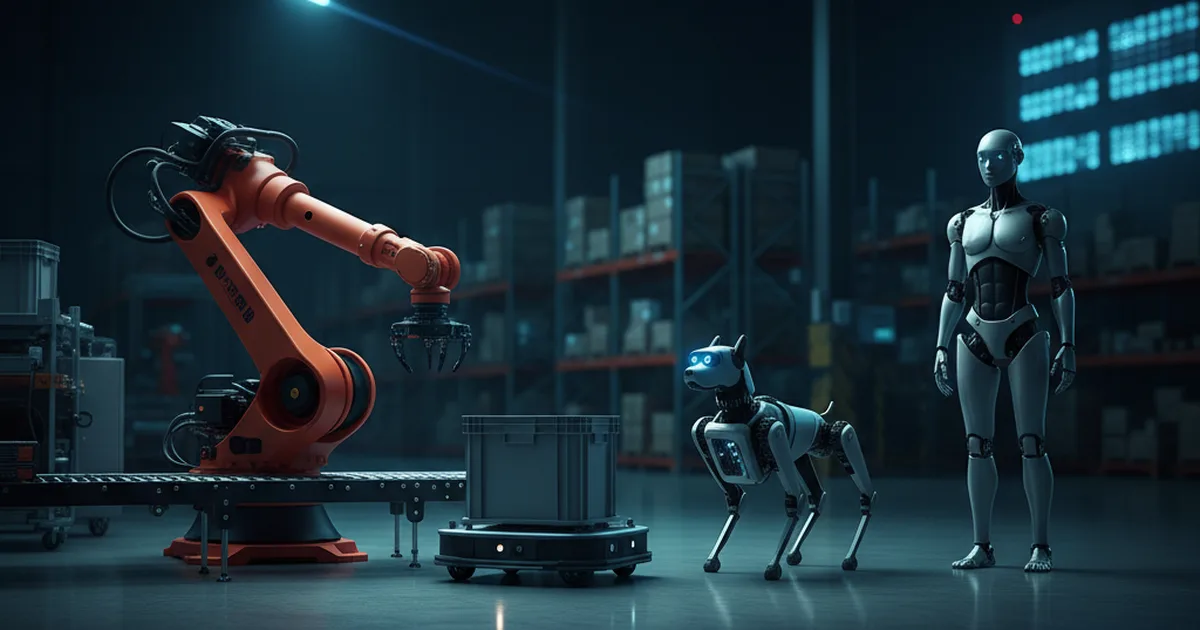
There are seven working categories of AI robot, and the oldest, the industrial arm, is still by far the biggest. The table shows each one with the best verified count for 2025.
| Type | What it does | 2025 count | Examples |
|---|---|---|---|
| Industrial arms | Weld, assemble, paint, palletize, inspect | More than 600,000 installed, about 5 million in use (IFR) | FANUC, ABB, Yaskawa, KUKA, Universal Robots |
| Warehouse and logistics robots | Carry, sort and pick goods | 117,500 transport and logistics service robots sold, 47% of professional service sales (IFR) | Amazon Robotics, Locus Robotics, Symbotic, AutoStore |
| Humanoids | Handle tasks in spaces built for people | About 7,000 full-size sold (IFR); nearly 25,000 shipped in H1 2026 by IDC's wider count | Unitree, AgiBot, Tesla, Figure, Agility |
| Robot dogs (quadrupeds) | Inspect sites, climb stairs, map terrain | No reliable count | Boston Dynamics Spot, Unitree, ANYbotics |
| Service robots | Clean, deliver, serve in hotels and restaurants | Almost 250,000 professional service robots sold, up 24% (IFR) | Pudu, Bear Robotics |
| Surgical robots | Assist surgeons in keyhole procedures | 8,400 sold, up 57% (IFR) | Intuitive Surgical (da Vinci), Medtronic |
| Consumer robots | Vacuum floors, mow lawns, entertain | Almost 34.2 million sold, up 37% (IFR) | iRobot, Roborock |
The categories overlap. A warehouse robot is a mobile robot, a surgical robot is a medical robot, and a humanoid could end up doing warehouse work. The IFR keeps medical robots in their own group, which is why surgical units are not folded into the 250,000.
The warehouse row is the one to watch. According to Amazon's July 2025 announcement, the company deployed its one-millionth robot that month across a network of more than 300 facilities. Humanoids get the headlines. The wheeled robot that slides under a shelf and carries it to a picker is already working at a scale no humanoid has come near. Our guide to humanoid robots covers that one category in depth, and the guide to AI in manufacturing covers how plants use the first row.
Robots Sold or Installed in 2025 by Category (units)
Consumer robots (almost 34.2 million) are left out because they would dwarf every other bar. Industrial and 'more than' or 'almost' figures are rounded as the IFR reports them.
| Category | Value | Unit |
|---|---|---|
| Industrial robots installed (more than) | 600000 | robots |
| Professional service robots sold (almost) | 250000 | robots |
| Transport and logistics service robots | 117500 | robots |
| Surgical robots sold | 8400 | robots |
| Full-size humanoids sold (about) | 7000 | robots |
More AI infrastructure stories like this
The real hardware, chip, and data center side of AI, explained plainly, every Wednesday and Saturday.
How an AI Robot Works: Sensors, a Policy and a Chip
An AI robot runs a loop: sense, decide, move, check. It repeats many times a second, and different parts of it live in different places.
- Cameras and depth sensors give the robot sight. Force and torque sensors give it touch, and encoders report where each joint is.
- Perception models turn that raw data into objects, positions and obstacles.
- The policy is the learned model that picks the next action. For general-purpose robots it is usually a vision-language-action model, or VLA, which takes camera images plus an instruction and outputs movement.
- Classical control software keeps the arm stable, limits force and stops the robot when something goes wrong.
- Motors and grippers do the physical work.
Where the VLA models come from
Google DeepMind introduced Gemini Robotics in March 2025, built on its Gemini 2.0 model. According to the DeepMind paper, the family includes a VLA that controls robots directly and a companion model for spatial reasoning and planning. Physical Intelligence published its pi-zero model in October 2024. NVIDIA released Isaac GR00T N1 as an open humanoid model in March 2025. The idea behind all three is the same. Start with a model that already understands language and images, then teach it to output actions.
Fleet software sits in a separate layer. Amazon says DeepFleet, a generative AI model trained on its own warehouse and inventory data, coordinates the whole robot fleet and should cut travel time by about 10 percent. No single robot runs it. It decides who goes where, much like a traffic controller.
Why the chip sits on the robot
A robot cannot wait on a network round trip to decide whether to catch a fall, so balance, vision and collision avoidance run on the robot itself. NVIDIA's Jetson Thor, a robot computer that 1X lists in its NEO humanoid, is rated at up to 2,070 FP4 TFLOPS (sparse) with 128 GB of memory in a 40 to 130 watt range. A data center H100 draws up to 700 watts, so the robot chip works inside a fifth of that. Our guide to edge AI explains why that trade exists, and the guide to AI training vs inference covers the cloud side.
What AI Robots Cost: Price Points and the Installed-Cell Rule
A robot arm costs far less than a working robot cell, and a humanoid's sticker price is now close to an arm's. Most price lists are guides from integrators and distributors, so read the ranges below as rough, dated to 2026, and quote-based for the big brands.
| Robot | Price signal | Basis |
|---|---|---|
| Collaborative robot (cobot) arm | About $20,000 to $60,000 for the arm | Integrator and distributor price guides, 2026 |
| Traditional 6-axis industrial arm | About $25,000 (small) to $150,000 or more (heavy) | Same guides |
| Installed cobot system | About $40,000 to $150,000 | Same guides |
| Installed traditional cell | About $150,000 to $500,000 | Same guides |
| Unitree R1 humanoid | $5,900 at launch | Bloomberg report |
| Unitree G1 humanoid | From $13,500, excluding tax and shipping | Unitree, 2026 |
| 1X NEO home humanoid | $20,000, or $499 a month | 1X, 2026 |
| Average humanoid (all vendors) | About $29,600 revenue per robot, H1 2026 | IDC, Oct 2026 |
| Boston Dynamics Spot | No public list price. A UK Atomic Energy Authority notice put a Spot Arm package at £181,492 (about $204,840) before VAT | The Stack, contract notice |
| Tesla Optimus, Figure, Agility Digit | No public price | n/a |
None of these sources gives the number a buyer needs most, which is the cost of one finished task. Without it, a $13,500 humanoid and a $150,000 arm cannot be compared. Until companies publish it, treat every price in this table as a starting point for a quote and not as a verdict.
The installed-cell rule explains most of the gap between a price list and a purchase order. Integrators commonly say a finished cell runs two to four times the price of the arm, once tooling, sensing, safety fencing, fixturing and programming are added, and that integration and programming alone are often 20 to 40 percent of the project. A $40,000 arm becomes a $100,000 cell without anyone doing anything wrong.
The Number Most Guides Don't Show
Two comparisons put the humanoid hype in proportion. In 2025, factories installed more than 600,000 industrial robots and the world bought about 7,000 full-size humanoids, so for every humanoid sold there were about 86 conventional robots installed. And Amazon's fleet of more than 1,000,000 robots is about 140 times the number of full-size humanoids sold worldwide in all of 2025. The second figure compares a fleet built over years with a single year of sales, so it overstates the gap, but even a generous correction leaves it enormous.
Spread across Amazon's more than 300 facilities, the fleet averages at most about 3,300 robots per site. That is my arithmetic, and the real spread is uneven. It still says something useful: the robots that work at scale today are the specialized ones that run in a controlled building, not the general-purpose ones.
Where AI Robots Work Today and Who Builds Them
By count, industrial arms dominate, and China buys more of them than any other country by a wide margin. The numbers below come from the IFR's World Robotics 2026 report.
- Factories installed more than 600,000 industrial robots in 2025, up 11%, which took the global fleet to a record 5 million, up 9% (IFR, September 24, 2026).
- China installed 354,000, up 20% and 59% of the world total. Chinese suppliers sold 195,000 of them, a 55% share of their home market, down from 57% in 2024.
- The IFR forecasts 655,000 installations in 2026, up 9%, and 806,000 in 2029.
"Industrial automation is progressing at high speed." (Jane Heffner, IFR President, September 2026)
The IFR's World Robotics 2026 release adds that five million robots in factories is more than double the number seven years earlier. Service robots are growing faster off a smaller base. According to the IFR's service robot release, professional service robot sales rose 24% to almost 250,000 in 2025, and transport and logistics took 117,500 of them.
"Service robots are expanding into everyday operations." (Jane Heffner, IFR President, September 30, 2026)
| Maker | Robot type | What is verified |
|---|---|---|
| Amazon Robotics | Warehouse robots and fleet AI | More than 1,000,000 robots across 300+ facilities, DeepFleet fleet model (Amazon, July 2025). Amazon bought Kiva Systems in 2012 for $775 million |
| FANUC, ABB, Yaskawa, KUKA | Industrial arms | Major arm suppliers. The IFR does not publish per-company shares |
| Chinese industrial suppliers | Industrial arms | 195,000 units, a 55% share of the China market in 2025 (IFR) |
| Unitree, AgiBot, UBTech | Humanoids and quadrupeds | Chinese vendors hold over 95% of humanoid shipments in H1 2026 (IDC) |
| Tesla, Figure, Agility, Boston Dynamics | Humanoids and quadrupeds | Pilots and early production, mostly no public price |
For a closer look at who ships humanoids and where those robots end up, see our humanoid robot guide.
Industrial Robot Installations per Year (units)
The 2025 figure is reported by the IFR as more than 600,000. The 2026 and 2029 bars are forecasts, not measured results.
| Category | Value | Unit |
|---|---|---|
| 2024 installed | 542000 | robots |
| 2025 installed (more than) | 600000 | robots |
| 2026 forecast | 655000 | robots |
| 2029 forecast | 806000 | robots |
Why AI Robots Are an Infrastructure Story
Every AI robot depends on three layers of compute, and the training layer sits in a data center. Robots push AI from generating text toward acting in a room, and that needs training data from the physical world.
| Layer | Where it runs | What it does | Example |
|---|---|---|---|
| On the robot | Edge chip inside the machine | Balance, vision, collision avoidance in milliseconds | NVIDIA Jetson Thor, 40 to 130 W |
| Across the fleet | Cloud and on-site servers | Routes robots, plans tasks, shares what each robot learns | Amazon DeepFleet, 300+ facilities |
| Training | GPU clusters in data centers and simulators | Builds the policy models from demonstrations and synthetic data | Gemini Robotics, GR00T, pi-zero |
Data is a harder problem for robots than for chatbots. A chatbot learns from text that already exists. A robot learns from demonstrations people record by remotely operating a machine, and from simulated worlds that run on GPUs. On Tesla's Q3 2026 earnings call on October 21, 2026, Elon Musk said the company would need roughly 10,000 to 20,000 robots to generate training data through self-play, which he called an Optimus Academy. Tesla did not give a cost or a date for that fleet.
The long-term bet is large. According to Morgan Stanley Research, humanoids alone could become a $5 trillion market by 2050, with about one billion units in use. That is a long-range scenario, and it depends on cost drops and reliability that have not been shown yet. For comparison, the IFR's near-term forecast covers conventional robots and ends at 806,000 installations a year in 2029. The guide on what an AI accelerator is covers the chips behind both ends of that range.
What AI Robots Still Cannot Do
AI robots work best in narrow, supervised jobs, and four limits explain most of the gap between a demo and a deployment.
- The IFR says most humanoid applications still need some human teleoperation, and remote operators also record training demonstrations. A clip of a robot working does not show how much of it was the robot.
- IDC says 69% of humanoids shipped in the first half of 2026 went to research, education, exhibitions, entertainment and government data centers. A robot delivered is not a robot doing paid work.
- ISO 25785-1, the humanoid-specific safety standard, was still a working draft in early 2026, so pilots use older industrial robot rules and keep robots in marked zones.
- A robot that loads one part type in one mapped cell can fail the moment the lighting or the object changes.
Whether AI robots will take jobs is a separate question. The numbers above show robots doing narrow tasks, not whole jobs. Our guides on whether AI will take over jobs and which jobs AI cannot replace look at the labor side.
On the IFR's forecast, arms keep growing, and service robots grow faster from a smaller base. Humanoids stay a small bet that people watch closely. When you read any AI robot claim, ask three things: what exact task does it do, how often does it need help, and what does each finished task cost?
Frequently Asked Questions
What is an AI robot?
An AI robot is a machine that senses its surroundings, decides what to do with a trained model, and acts with motors, instead of replaying a fixed program. Examples include warehouse robots, humanoids, robot dogs and surgical robots.
What is the difference between an AI robot and an industrial robot?
An industrial robot repeats taught motions in a controlled space. An AI robot uses cameras and a learned model to handle objects and situations nobody programmed in advance. Many real systems combine both, with classical control keeping the motion safe.
What are the main types of AI robots?
Seven: industrial arms, warehouse and logistics robots, humanoids, robot dogs, service robots, surgical robots and consumer robots. Industrial arms are the biggest group, with more than 600,000 installed in 2025 according to the IFR.
How many robots are there in the world?
The IFR counts about 5 million industrial robots working in factories at the end of 2025, with more than 600,000 installed that year. Separately, almost 250,000 professional service robots and almost 34.2 million consumer robots were sold in 2025.
How much does an AI robot cost?
It ranges from about $5,900 for Unitree's R1 humanoid at launch to hundreds of thousands for a finished factory cell. A cobot arm costs about $20,000 to $60,000, and a complete cell is often two to four times the arm price.
Are AI robots the same as humanoid robots?
No. A humanoid is one type of AI robot. In 2025 the IFR counted about 7,000 full-size humanoids sold, against more than 600,000 industrial robots installed, so most robots at work today are not humanoid.
What AI model controls a robot?
Many general-purpose robots use a vision-language-action model, which takes camera images and an instruction and outputs movement. Examples are Google DeepMind's Gemini Robotics, Physical Intelligence's pi-zero and NVIDIA's Isaac GR00T N1.
Do AI robots run on the cloud or on the robot?
Both. Balance, vision and collision avoidance run on a chip inside the robot, such as NVIDIA's Jetson Thor at 40 to 130 W. Fleet planning runs on servers, as with Amazon's DeepFleet, and the models are trained in data centers.
Who makes AI robots?
Industrial arms come from FANUC, ABB, Yaskawa, KUKA and Universal Robots, plus Chinese suppliers that held 55% of China's market in 2025. Amazon Robotics builds warehouse robots. Unitree, AgiBot, Tesla, Figure and Agility lead humanoids.
Are AI robots controlled by people?
Often in part. The IFR says most humanoid applications still need human teleoperation, and remote operators generate much of the training data. Companies rarely publish how much human help each task takes.
Will AI robots take jobs?
The evidence so far points to tasks, not whole jobs. Robots handle narrow, repeated work in controlled settings, and most humanoid shipments in 2026 went to research and exhibitions. Long-range forecasts exist, but none has been shown to hold.
Related Articles
Humanoid Robots Explained: Cost, Makers and What Works in 2026
14 min read
AI in Manufacturing: How It Works and Where It Runs in 2026
15 min read
Edge AI Explained: How It Works and Why Cloud Cannot Match It
10 min read
AI Training vs Inference: What's the Difference and Why the Cost Gap Is Growing
10 min read