
Data Center Tiers Explained: Tier 1, 2, 3, and 4 Compared

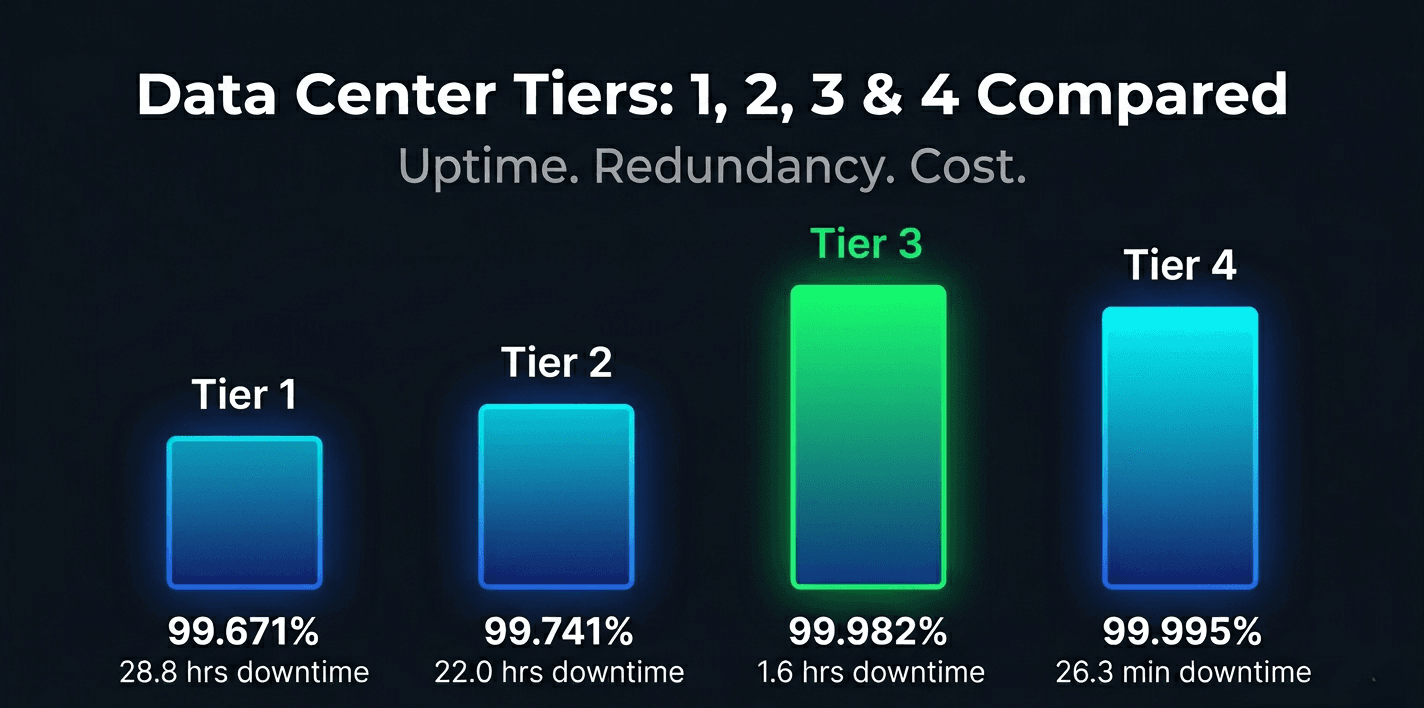
Key Numbers
Key Takeaways
- 1Data center tiers are a four-level classification system from Uptime Institute that rates facility resilience by uptime, redundancy design, and maintainability. Tier 3 is the industry standard, accounting for 57.4% of U.S. data center construction in 2024 (Mordor Intelligence).
- 2Building to Tier 4 costs roughly 20-40% more per delivered megawatt than Tier 3 because it requires fully duplicated 2N power and cooling systems. For a 10 MW facility, that premium adds $16-60 million in construction cost to buy roughly 70 fewer minutes of annual downtime.
- 3AI GPU clusters running at 60-150 kW per rack are pushing operators to design for higher density within Tier 3 rather than shift to Tier 4. Major cloud providers achieve equivalent resilience through multi-site Tier 3 architecture rather than single-site Tier 4 builds.
A data center tier is a rating from 1 to 4 that specifies how much downtime a facility is designed to allow each year. Tier 1 permits 28.8 hours. Tier 4 permits just 26.3 minutes. That gap drives most of the cost and complexity differences between facilities.
The Uptime Institute created this classification system over 30 years ago, and it remains the international standard by which facilities are designed, built, certified, and marketed. The tiers are not marketing labels. Each one sets precise requirements for power redundancy, cooling paths, and whether maintenance can happen without shutting down the IT load.
In 2024, 57.4% of all new data center construction in the United States was built to Tier 3 standards, according to Mordor Intelligence. That figure tells you where the industry has settled: Tier 3 is where the economics of resilience and cost converge for most professional operations. This article explains what separates each tier, what Uptime Institute certification actually verifies, and how to figure out which tier a given workload genuinely requires.
In This Article
- 1What Are Data Center Tiers?
- 2Tier 1 and Tier 2: Basic Infrastructure
- 3Tier 3: Why It Became the Industry Standard
- 4Tier 4: Fault-Tolerant Infrastructure and What It Actually Costs
- 5Uptime Institute Certification: What It Verifies
- 6Which Tier Does Your Business Actually Need?
- 7How AI Is Changing Data Center Tier Decisions in 2025-2026
What Are Data Center Tiers?
Data center tiers are a four-level infrastructure classification system developed by Uptime Institute. The system rates how resilient a facility's power, cooling, and physical infrastructure is, from Tier 1 (most basic) to Tier 4 (most fault-tolerant).
The framework does not rate the IT equipment inside the facility. It rates the building infrastructure: power distribution systems, cooling architecture, redundancy levels, and whether individual components can be serviced without interrupting the data hall.
| Tier | Availability | Max Annual Downtime | Redundancy Type | Concurrent Maintainability |
|---|---|---|---|---|
| Tier 1 | 99.671% | 28.8 hours | None | No |
| Tier 2 | 99.741% | 22.0 hours | Partial N+1 | No |
| Tier 3 | 99.982% | 1.6 hours | Full N+1 | Yes |
| Tier 4 | 99.995% | 26.3 minutes | 2N or 2N+1 | Yes (fault-tolerant) |
Source: Uptime Institute Tier Classification System
Uptime Institute states: "Our data center Tier definitions explain the infrastructure required for data center operations. There are different Tiers according to the system availability needed." The tiers are not suggestions. Each one sets binding requirements across four dimensions: power supply paths, cooling distribution paths, maintenance capabilities, and fault tolerance design.
Each tier includes the requirements of all tiers below it. A Tier 3 facility must meet all Tier 1 and Tier 2 requirements, plus concurrent maintainability. Tier 4 adds fault tolerance on top of that.
To understand how these facilities actually function at the physical level, including how power and cooling systems are laid out inside a building, see our overview of what a data center is and how it works.
Maximum Annual Downtime by Data Center Tier
Tier 4 value (0.44 hours) represents 26.3 minutes of maximum annual downtime
| Category | Value | Unit |
|---|---|---|
| Tier 1 | 28.8 | hours/year |
| Tier 2 | 22 | hours/year |
| Tier 3 | 1.6 | hours/year |
| Tier 4 | 0.44 | hours/year |
Tier 1 and Tier 2: Basic Infrastructure
Tier 1 is the entry level, and its defining characteristic is the absence of redundancy. One power path, one cooling path, no parallel systems. If any critical component fails or requires maintenance, the facility goes down. Planned maintenance requires a full shutdown. Annual downtime allowance: 28.8 hours.
Tier 2 adds partial redundancy to the power and cooling systems, so a single failed component does not automatically cause an outage. The downtime ceiling narrows to about 22 hours per year. Maintenance on redundant components is possible without a shutdown. However, maintenance on primary systems still requires a scheduled outage, because the design has not eliminated all single points of failure.
Who uses Tier 1 and Tier 2 facilities
Tier 1 is appropriate for organizations with low uptime requirements: internal office IT, development and testing environments, and small businesses where occasional outages have limited operational impact.
Tier 2 suits organizations that want protection against component failure but cannot justify the capital cost of full concurrent maintainability. Small regional healthcare facilities running non-critical systems, small financial firms with limited compliance requirements, and mid-size enterprises sometimes build or lease Tier 2 space.
Neither tier is appropriate for customer-facing production workloads. An e-commerce platform that allows 22 hours of downtime per year will lose measurable revenue and customer trust. Financial and healthcare applications often face regulatory requirements that Tier 1 and Tier 2 cannot satisfy.
More AI infrastructure stories like this
The real hardware, chip, and data center side of AI, explained plainly, every Wednesday and Saturday.
Tier 3: Why It Became the Industry Standard
Tier 3 is where most professionally built and operated data centers land. A Tier 3 facility is concurrently maintainable: any single component in the power or cooling infrastructure can be taken offline for repair or replacement without shutting down the IT load. The result is 99.982% uptime and a ceiling of 1.6 hours of unplanned downtime per year.
In 2024, Tier 3 accounted for 57.4% of all U.S. data center construction (Mordor Intelligence). Most commercial colocation providers, enterprise data centers, and cloud provider regional facilities operate at Tier 3 or target it in new builds.
How N+1 redundancy works in practice
N+1 redundancy means installing one more critical component than the minimum needed to support the full IT load. N equals the number required; the extra unit is the buffer. If a data hall needs six cooling units to handle full load (N = 6), a Tier 3 design installs seven (N+1 = 7). If one unit fails or goes offline for maintenance, the other six carry the load without interruption.
The same logic applies across the entire power system:
- UPS modules: if three are needed for full load, four are installed
- Generators: if four are needed, five are installed
- Distribution paths: multiple A and B power feeds run to every equipment rack, each independently capable of carrying full load
CoreSite describes the practical result: "A Tier III data center offers additional reliability over Tier II in the form of N+1 redundancy and multiple power and cooling distribution paths. N+1 redundancy means the architecture offers the capacity to support the full IT load, and also offers an additional component for backup purposes, so performance is not impacted if a single component fails."
The one limit of Tier 3
Tier 3 is concurrently maintainable, not fault-tolerant. That distinction matters operationally. A Tier 3 facility handles one component failure or one maintenance operation without going down. If a second unplanned failure occurs while a first component is already out for scheduled maintenance, the facility may lose availability. Tier 4 closes this gap through full system duplication.
Tier 4: Fault-Tolerant Infrastructure and What It Actually Costs
Tier 4 is fully fault-tolerant. The architectural difference from Tier 3 is 2N redundancy: every critical system is duplicated, with two complete and physically isolated paths for power and cooling. If one entire path fails, the second carries the full load automatically. No single failure of any component, and no maintenance operation on any system, can cause a service interruption.
The result is 99.995% uptime and a ceiling of 26.3 minutes of downtime per year. Failover is automatic, not dependent on human response time.
What 2N redundancy means for construction
Building two physically isolated systems for every critical component roughly doubles the electrical and mechanical plant. A facility that needs three UPS modules at Tier 3 needs six at Tier 4, installed in two separate rooms on separate electrical circuits. Chillers, cooling towers, generators, and distribution switchgear are all duplicated the same way, with physical separation between the two systems.
Industry analysis consistently estimates Tier 4 construction at 20-40% higher capital cost per delivered megawatt compared with a Tier 3 facility of equivalent capacity. In 2025, new-build Tier 3 colocation facilities in mature markets such as Northern Virginia, Chicago, and Frankfurt typically cost $8-15 million per megawatt, covering land, shell, power infrastructure, and cooling plant.
The Number Most Guides Don't Show
Upgrading from Tier 3 to Tier 4 buys roughly 70 fewer minutes of annual downtime: from Tier 3's 96-minute maximum to Tier 4's 26-minute maximum.
For a 10 MW facility, a 20-40% capital premium adds $16-60 million in construction cost. Divided across 70 minutes of annual downtime reduction, each minute of protection costs approximately $228,000 to $857,000 per 10 MW of capacity.
Whether that math makes sense depends entirely on what downtime costs the specific operation. For a major financial trading platform, regulatory penalties and lost revenue during 30 minutes of downtime can exceed $1 million. For an enterprise internal tool with no external SLA, the same capital expenditure protects against something that may never have meaningful consequences.
Where Tier 4 certified facilities actually exist
Tier 4 certification is rare because few workloads justify the cost premium. Publicly documented Tier 4 certified facilities include the National Bank of Kuwait's primary data center in Kuwait, Rack Centre's LGS1 facility in Lagos (Nigeria), and financial sector facilities in the Middle East and Latin America certified by Uptime Institute. Financial institutions and national governments account for most of the Tier 4 footprint globally.
AWS, Azure, and Google Cloud do not typically build Tier 4 single-site facilities. They achieve equivalent or higher effective availability through multi-site architecture: multiple availability zones, each built to Tier 3 or equivalent, deployed within a geographic region. The distributed system behaves like Tier 4 from an application standpoint, at a lower per-site construction cost.
Uptime Institute Certification: What It Verifies
Uptime Institute certification is the independent verification that a facility claiming a particular tier actually meets that tier's infrastructure requirements. Without certification, any operator can describe their facility as "Tier 3" based on self-assessment. Certification converts that claim into a documented, third-party verified statement.
"Uptime Institute created the data center Tier classification levels over 30 years ago, and today, they remain the international standard for data center performance." (Uptime Institute)
Three certification stages
Certification is not a single point-in-time event. Uptime Institute offers separate programs for three stages of a facility's lifecycle.
Design Documents certification verifies that architectural and engineering drawings meet Tier requirements before construction begins. Constructed Facility certification verifies that the finished building matches the approved design in the actual physical installation. Management and Operations (M&O) certification verifies that the facility is operated and maintained in a way that sustains the certified Tier level over time.
A facility holding only Design certification has not proven that construction matched the design. A facility holding all three certifications has demonstrated compliance at design, physical build, and ongoing operations levels.
"Tier certified" versus "Tier rated": the distinction that matters
Colocation providers frequently market facilities as "Tier 3 equivalent" or "designed to Tier 3 standards" without pursuing formal certification. These descriptions may be accurate, but they are self-assessed. Uptime Institute certification involves on-site review of documentation, infrastructure, and operating procedures by Uptime's own engineers.
For organizations evaluating colocation providers, asking specifically for Uptime Institute Tier Certification for Constructed Facility documentation (not just Design Documents) is the right question. A provider who cannot produce it has either not pursued certification or holds only partial coverage.
Which Tier Does Your Business Actually Need?
The right tier comes down to two variables: what each hour of downtime costs the business, and how much capital or colocation budget is available to prevent it.
| Business type | Critical workload | Recommended tier | Reason |
|---|---|---|---|
| Hospital | Clinical systems, patient records, imaging | Tier 3 or Tier 4 | Regulatory requirements; downtime has direct patient care consequences |
| Financial institution | Real-time transactions, trading systems | Tier 4 | Regulatory penalties plus revenue loss during any outage |
| E-commerce platform | Customer storefronts, checkout, payments | Tier 3 | 24/7 SLA requirements met by Tier 3 plus multi-site redundancy |
| Enterprise (internal IT) | ERP, HR systems, internal tools | Tier 2 or Tier 3 | Tier 3 where SLA commitments exist; Tier 2 for lower-criticality internal systems |
| Startup (non-critical) | Development, testing, early applications | Tier 1 or cloud | Cost sensitivity outweighs uptime requirements at early stage |
| Government / national security | Mission-critical control infrastructure | Tier 4 | Any failure carries systemic consequences; cost is secondary |
Why most enterprises stop at Tier 3
The 26-minute annual downtime allowance at Tier 4 is technically better than Tier 3's 96 minutes, but the practical difference does not justify the 20-40% construction premium for most workloads. An organization with well-designed application-level redundancy, automated failover, and geographic backup typically meets operational requirements without Tier 4 infrastructure.
The more common decision is between Tier 2 and Tier 3, not between Tier 3 and Tier 4. For any customer-facing production workload, financial transaction system, or regulated healthcare application, Tier 3 is the minimum reasonable standard.
For organizations that colocate rather than build, the tier of the host facility sets the ceiling on what the SLA can deliver. A thorough breakdown of how colocation contracts work and what to evaluate in a provider is available in our guide to colocation data centers.
How AI Is Changing Data Center Tier Decisions in 2025-2026
AI GPU clusters are introducing a variable the traditional tier framework was not designed around: rack power density. Standard enterprise server racks consume 5-15 kW. AI GPU racks running NVIDIA H100 or H200 hardware consume 60-150 kW per rack. That gap creates physical demands on data center infrastructure regardless of which tier a facility is certified to.
A Tier 3 facility rated for 10 MW across 1,000 racks at 10 kW each may not physically accommodate AI workloads at 60-100 kW per rack, even if the total electrical capacity is present on paper. The constraint is as much about cooling geometry, floor loading, and cabinet spacing as it is about available megawatts.
"Generative AI and GPU clusters are pushing rack densities beyond 50 kW per rack, requiring liquid cooling and significant power and cooling upgrades." (Industry analysis, 2025-2026)
Tier 3 remains the standard for AI builds
Despite the density pressure, Tier 3 is the dominant specification for new AI data center construction in 2025-2026. Major operators all land on the same conclusion: the 20-40% capital premium for Tier 4 adds substantial cost for roughly 70 additional minutes of annual uptime protection, while multi-region architecture and geographic redundancy deliver equivalent effective availability for distributed AI inference workloads at lower per-site cost.
AWS, Microsoft Azure, and Google Cloud design their AI infrastructure around multiple Tier 3-equivalent availability zones within a region. Each zone is independent. The cluster behaves like Tier 4 from an application availability standpoint, without the per-facility Tier 4 premium. For a broader look at how AI data centers differ from conventional facilities, including their power and cooling requirements, see our dedicated overview.
What to evaluate in AI colocation beyond tier certification
For organizations selecting colocation space for GPU AI clusters, tier certification is necessary but not sufficient. The practical evaluation goes further:
- Maximum kW per rack: does the facility support 60-100 kW for GPU workloads?
- Cooling type: does the facility offer liquid cooling options such as rear-door heat exchangers or direct-to-chip liquid cooling for high-density AI racks?
- Per-rack power redundancy: are dual A+B power feeds available at the individual rack level?
A Tier 3 facility with strong liquid cooling infrastructure and dual power feeds per rack serves AI workloads better in practice than a Tier 4 facility designed for 10 kW air-cooled server racks.
According to Lawrence Berkeley National Laboratory, U.S. data center energy consumption is growing significantly as AI workloads scale, and operators are responding with higher-density designs. The prevailing pattern is Tier 3 plus redundant multi-site architecture, not a broad market shift toward Tier 4 single-site builds.
Frequently Asked Questions
What is a Tier 3 data center?
A Tier 3 data center is concurrently maintainable, meaning any single component in the power or cooling infrastructure can be serviced without shutting down the IT load. It uses N+1 redundancy throughout: one more unit of each critical system than the minimum required to support full load.
Tier 3 guarantees 99.982% uptime and a maximum of 1.6 hours of unplanned downtime per year. It is the most common standard for commercially operated data centers, accounting for 57.4% of U.S. data center construction in 2024 (Mordor Intelligence).
What is the difference between a Tier 3 and Tier 4 data center?
Tier 3 is concurrently maintainable: any single component can be taken offline without disrupting the data hall, but a second simultaneous failure can still cause downtime. Tier 3 guarantees 99.982% uptime and a maximum of 1.6 hours of annual downtime.
Tier 4 is fault-tolerant: all critical systems use 2N redundancy with physically isolated paths. No single failure and no maintenance operation can cause a service interruption. Tier 4 guarantees 99.995% uptime and a maximum of 26.3 minutes of annual downtime.
Building to Tier 4 costs 20-40% more per delivered megawatt than Tier 3. The additional cost buys roughly 70 fewer minutes of annual downtime.
How much downtime does each data center tier allow per year?
The maximum annual downtime for each tier, based on Uptime Institute standards:
- Tier 1: 28.8 hours per year (99.671% uptime)
- Tier 2: 22.0 hours per year (99.741% uptime)
- Tier 3: 1.6 hours per year (99.982% uptime)
- Tier 4: 26.3 minutes per year (99.995% uptime)
These figures represent the maximum allowable downtime under the tier standard, not typical operational downtime. Well-run Tier 3 and Tier 4 facilities regularly achieve better numbers than the ceiling allows.
What does Uptime Institute Tier certification mean?
Uptime Institute Tier certification is independent, third-party verification that a data center facility meets the infrastructure requirements for a specific tier. It is distinct from self-described "Tier 3 equivalent" or "designed to Tier 3 standards" marketing claims, which are self-assessed.
Certification is available at three stages: Design Documents (before construction), Constructed Facility (after the build), and Management and Operations (ongoing operations). A facility with all three certifications has demonstrated compliance at design, physical build, and operational practice levels.
Without formal certification, any data center operator can claim any tier level. Formal Uptime Institute certification involves on-site review by Uptime's own engineers.
Is Tier 4 necessary for most businesses?
No. Tier 4 is appropriate for mission-critical workloads where even 26-96 minutes of annual downtime carries severe financial, regulatory, or operational consequences. Core banking transaction systems, national security infrastructure, and financial trading platforms are examples where the cost premium may be justified.
For most enterprises, Tier 3 is sufficient. The 20-40% construction cost premium for Tier 4 is substantial, and most organizations achieve equivalent effective availability through multi-site architecture and geographic redundancy at lower per-site cost. AWS, Azure, and Google Cloud all use multiple Tier 3 availability zones rather than single-site Tier 4 builds for their AI infrastructure.
What does N+1 redundancy mean in a data center?
N+1 redundancy means a data center installs one more critical component than the minimum number required to support the full IT load. N equals the number of components needed; the +1 is the backup unit.
For example, if a data hall needs six cooling units to support its full IT load (N = 6), an N+1 design installs seven. If one unit fails, the remaining six cover the full load without interruption. The same logic applies to UPS modules, generators, and other critical infrastructure.
N+1 is the redundancy level required for Tier 3 certification. Tier 4 requires 2N redundancy: two complete, independent systems, each capable of running the full load on its own.
What percentage of data centers are Tier 3?
Tier 3 is by far the most common standard among professionally built commercial and colocation data centers. According to Mordor Intelligence, 57.4% of U.S. data center construction in 2024 was built to Tier 3 standards.
Tier 1 and Tier 2 facilities are more common in smaller internal IT environments and edge locations. Tier 4 is rare globally, concentrated in financial sector, government, and mission-critical infrastructure where downtime carries the highest regulatory or operational cost.
How do AI GPU workloads affect data center tier requirements?
AI GPU clusters introduce a rack density challenge that tier certification alone does not address. Traditional server racks consume 5-15 kW. AI GPU racks running NVIDIA H100 or H200 hardware consume 60-150 kW per rack. A facility may be Tier 3 certified and still unable to support AI workloads if its cooling design was built for lower-density equipment.
For AI deployments, Tier 3 remains the standard. Major cloud operators use multiple Tier 3 availability zones rather than Tier 4 single-site builds for AI infrastructure. For AI colocation buyers, the practical evaluation goes beyond tier certification to cover maximum kW per rack, liquid cooling availability, and per-rack power redundancy.
What is the cost difference between building a Tier 3 and Tier 4 data center?
Tier 4 typically costs 20-40% more per delivered megawatt of IT load capacity than Tier 3. The premium comes from 2N redundancy requirements: fully duplicated and physically isolated power and cooling systems throughout the facility.
In 2025, Tier 3 new-builds in mature markets such as Northern Virginia and Chicago typically cost $8-15 million per megawatt (covering land, shell, power, and cooling infrastructure). A Tier 4 build at the same scale adds roughly $1.6-6 million per megawatt in construction cost. For a 10 MW facility, that is $16-60 million in additional capital to reduce maximum annual downtime from 96 minutes to 26 minutes.
Related Articles
What Is a Data Center? How the Buildings That Run the Internet Work
10 min read
What Are AI Data Centers? The Full 2026 Breakdown
10 min read
Data Center Cooling Systems: Air, Liquid, and Immersion Compared
10 min read
What Is a Colocation Data Center? Costs and How It Works
11 min read
What Is an Enterprise Data Center? Cost and Scale in 2026
9 min read