
What Is a Data Center? How the Buildings That Run the Internet Work

Key Numbers
Key Takeaways
- 1A data center is a physical facility that houses servers, storage, networking equipment, and the cooling and power systems that keep them running. The US alone has 5,427 data centers, the most of any country.
- 2Data centers consumed 415 TWh of electricity globally in 2024 — equivalent to about 4% of total US electricity generation. That figure is projected to nearly double to 945 TWh by 2030, driven by AI workloads (IEA, 2025).
- 3Every time you send a message, stream a video, or use a generative AI tool, your request is processed inside a data center. The largest hyperscale facilities hold hundreds of thousands of servers and consume 100 megawatts or more of power continuously.
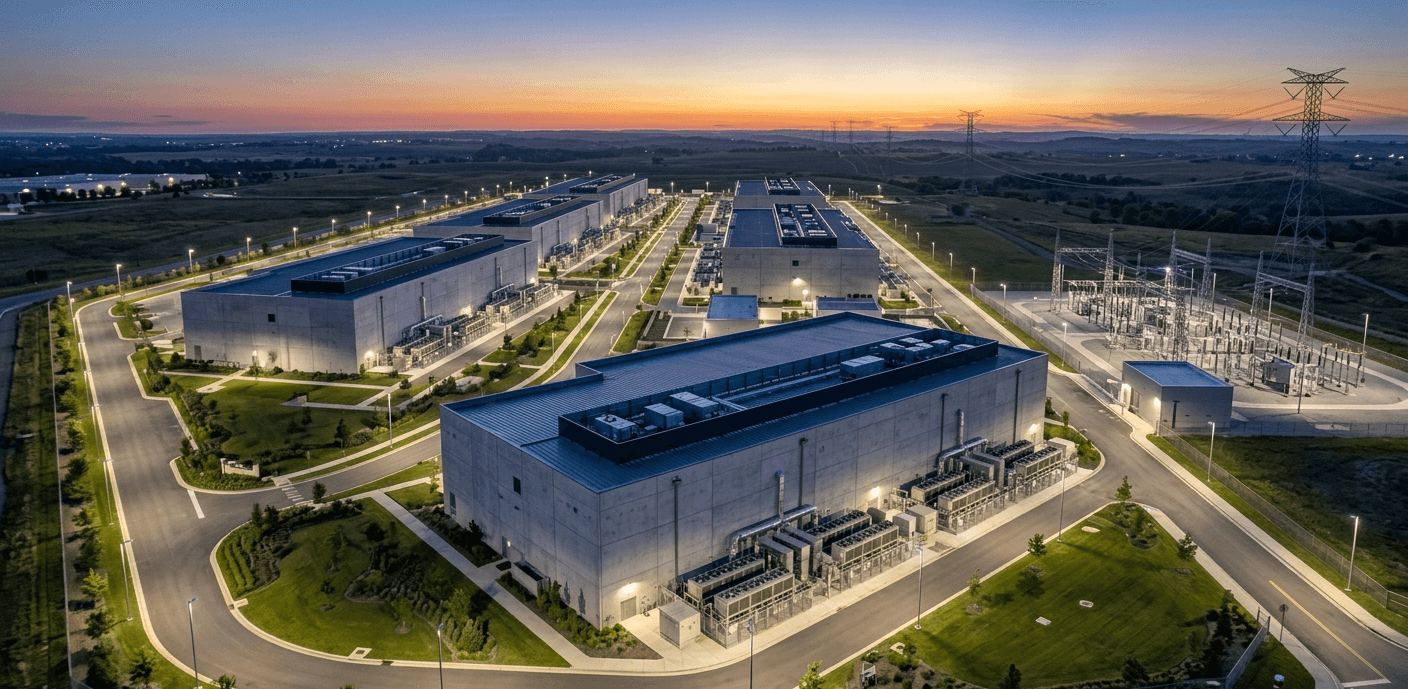
A data center is a building, or a campus of buildings, that houses the servers, storage systems, networking equipment, cooling infrastructure, and power systems needed to store, process, and deliver data at scale. When you send an email, stream video, run a search, or ask a question to an AI chatbot, the computation happens inside a data center somewhere.
There are more than 12,000 operational data centers worldwide as of 2025, with 5,427 of them located in the United States. That is 45% of the global total concentrated in one country. The next largest are Germany with 529 and the United Kingdom with 523 (Cargoson, 2025). At the large end of the scale, hyperscale facilities operated by AWS, Google, and Microsoft span hundreds of thousands of square feet and draw 50 to 500 megawatts of power continuously.
This article explains what a data center is, what is physically inside one, the five main types of data centers and how they differ, the Uptime Institute tier system that defines reliability levels, how much power data centers consume globally, who the largest operators are, and why data centers have become the most important physical infrastructure for AI.
In This Article
What Is a Data Center?
A data center is a purpose-built facility that consolidates computing infrastructure — servers, storage, networking, cooling, and power — in one controlled environment. The goal is to keep that infrastructure running continuously, at high availability, and under physical and digital security controls.
The term covers a wide range of facilities. A small enterprise data center might occupy one room in an office building and hold 20 racks of servers. A hyperscale facility built by Google or Microsoft might cover 500,000 square feet across multiple connected buildings, hold hundreds of thousands of servers, and require its own power substation.
What all data centers share, regardless of size, is the same core architecture: servers that do the computing, storage systems that hold the data, networking equipment that moves data in and out, cooling systems that remove the heat generated by servers, and power systems that keep everything running even when the grid fails.
| Scale | Server Count | Floor Space | Power Draw | Who Operates |
|---|---|---|---|---|
| Small enterprise | 1-100 | Under 1,000 sq ft | Under 100 kW | Single business |
| Mid-size enterprise | 100-1,000 | 1,000-10,000 sq ft | 100 kW to 1 MW | Single business or colo tenant |
| Large enterprise | 1,000-5,000 | 5,000-50,000 sq ft | 1-10 MW | Large corporation |
| Colocation | Varies | 10,000-500,000 sq ft | 10-100 MW | Third-party colo provider |
| Hyperscale | 5,000+ | 100,000-1M+ sq ft | 20-500 MW | AWS, Google, Microsoft, Meta |
The physical address of a data center rarely matters to the people using its services. When you use Gmail, Netflix, or ChatGPT, you are consuming compute capacity from data centers you will never see, likely in states like Virginia, Texas, or Oregon.
What Is Inside a Data Center?
Data centers contain five categories of physical infrastructure. Each one is engineered for redundancy, meaning if one component fails, a backup takes over without interrupting service.
Servers
Servers are the computing core. They look like thin, horizontal boxes — 1U or 2U form factors — that slide into racks. Each server contains one or more processors (CPUs), memory (RAM), storage (SSD or HDD), and network interfaces. A standard 42U server rack holds up to 42 of these units. Most enterprise data centers have dozens to hundreds of racks. Hyperscale facilities have tens of thousands.
AI data centers differ from traditional ones in one critical way: GPU density. A rack optimized for AI training might hold 8 NVIDIA H100 GPUs drawing 10 to 30 kilowatts, compared to 3 to 5 kW for a standard compute rack. That higher density drives everything else — more heat, more cooling capacity, more power infrastructure per square foot.
Cooling Systems
Servers generate heat. Removing that heat is one of the most expensive engineering problems in a data center. Three cooling approaches are in common use:
- Air cooling: Computer room air handlers (CRAHs) circulate cool air through cold aisles, past servers, and exhaust hot air into hot aisles. Works well for rack densities below 10 kW/rack.
- Direct liquid cooling: Water or coolant runs through pipes directly attached to server components. Handles densities up to 100 kW/rack. Required for most AI training configurations.
- Immersion cooling: Servers are submerged in a non-conductive fluid. Extremely efficient but requires specialized hardware. Used in a small number of high-density AI facilities.
Cooling accounts for 15 to 20% of data center construction cost and is directly reflected in Power Usage Effectiveness (PUE). For a full breakdown of cooling methods and costs, see our data center cooling systems guide.
Power Infrastructure
A data center needs two things from its power system: reliability and redundancy. Power arrives from the utility grid, passes through transformers, and is conditioned through uninterruptible power supplies (UPS). Diesel generators provide backup power during grid outages, typically capable of running the facility for 24 to 72 hours on stored fuel. Tier III and Tier IV facilities run on redundant power paths so that no single failure interrupts service. Power infrastructure represents 40 to 50% of data center construction cost (Construct Elements, 2025).
Networking
Data enters and exits through fiber optic connections running into the facility from multiple carriers. Inside, switching equipment connects servers to each other and to the outside world. Enterprise data centers typically operate at 10 Gbps inter-server links. Hyperscale facilities use 25 Gbps to 400 Gbps links. AI training clusters require extremely low-latency interconnects between GPUs, often using NVIDIA InfiniBand or NVLink for speeds that Ethernet cannot match.
Physical Security
A data center is a high-value target. Standard security layers include perimeter fencing, biometric access controls, mantrap entry systems, continuous CCTV monitoring, and on-site security personnel. Most carrier-neutral colocation facilities maintain SOC 2 Type II compliance and ISO 27001 certification, which requires documented security controls and annual third-party audits.
The Five Types of Data Centers
Data centers serve different purposes and are built to different specs. The five main types differ in ownership, tenant structure, scale, and the workloads they support.
| Type | Who Owns It | Who Uses It | Typical Size | Primary Use |
|---|---|---|---|---|
| Enterprise | The company using it | One company | 1-50 MW | Internal IT, corporate applications |
| Colocation | Third-party provider | Multiple tenants | 10-200 MW | Flexible capacity for enterprises |
| Hyperscale | Cloud provider | Millions of users | 20-500+ MW | Cloud services, AI training |
| Edge | Telecom, CDN | End users indirectly | Under 1 MW | Low-latency local compute |
| Cloud | Cloud provider | Businesses, individuals | Varies | Rented compute, storage, services |
Enterprise Data Centers
Enterprise data centers are built and owned by a single organization for its own use. A bank, hospital, or government agency might operate its own facility to maintain direct control over hardware, security, and data sovereignty. The tradeoff is cost: building and operating a private data center requires capital investment, specialized staff, and ongoing maintenance regardless of utilization. Many organizations have shifted enterprise workloads to colocation or cloud over the past decade.
Colocation Data Centers
A colocation facility, or colo, is a third-party data center that leases space, power, and cooling to multiple tenants. The tenants bring their own servers. The colo operator provides the building, power redundancy, cooling, physical security, and network connectivity. Equinix and Digital Realty are the two largest colocation providers globally. For businesses that want physical control over their hardware without the capital cost of building a facility, colocation is the standard option.
Hyperscale Data Centers
Hyperscale facilities operate at a scale that makes most enterprise data centers look like server closets. The threshold is generally 5,000 or more servers and 10,000 square feet of floor space per building. AWS, Microsoft Azure, Google Cloud, and Meta operate the largest hyperscale footprints. According to Synergy Research Group, 130 to 140 new hyperscale data centers are built globally every year. As of 2025, there are 1,189 hyperscale facilities worldwide, with 642 of them (54%) in the United States. For a deeper look at how hyperscale infrastructure works, see our hyperscalers explained guide.
Edge Data Centers
Edge data centers are small facilities positioned close to end users, typically in metro areas, to deliver low-latency compute. A 5G tower might connect to an edge facility a few miles away. A content delivery network (CDN) uses edge locations to serve video without routing traffic back to a central data center across the country. Edge facilities typically handle under 1 MW of power and are designed for automation rather than on-site staffing.
Cloud Data Centers
Cloud data centers are operated by cloud providers and accessed entirely remotely. Users rent virtual machines, storage, and services rather than physical hardware. AWS, Azure, and Google Cloud operate cloud data centers in dozens of regions worldwide. The distinction between "cloud" and "hyperscale" is mainly conceptual: cloud data centers are hyperscale facilities viewed from the customer's perspective.
Data Center Tiers: What Tier I, II, III, and IV Mean
The Uptime Institute defines four data center tiers based on redundancy levels, uptime guarantees, and the ability to perform maintenance without taking systems offline. Tier ratings apply to the facility's physical infrastructure, not to the software or services running inside it.
| Tier | Annual Uptime | Downtime Per Year | Redundancy Level | Maintenance Possible Without Downtime |
|---|---|---|---|---|
| I | 99.671% | 28.8 hours | None (single path) | No |
| II | 99.741% | 22.7 hours | Partial (redundant components) | No |
| III | 99.982% | 1.6 hours | N+1 (multiple paths, active-passive) | Yes |
| IV | 99.995% | 26.3 minutes | 2N+1 (fully fault-tolerant) | Yes |
Most enterprise applications can tolerate Tier II or Tier III uptime. Financial trading systems, healthcare records, and AI inference APIs that serve millions of users typically require Tier III or Tier IV. The cost difference between tiers is significant: a Tier IV facility requires twice the power and cooling infrastructure of a Tier I facility for the same compute capacity, and full 2N+1 redundancy means every critical system has two fully independent backups plus a spare.
"The Uptime Institute Global Data Center Survey 2025 reveals an innovative and resilient industry — but one that is also facing rising costs, worsening power constraints and challenges in meeting the demands for AI." (Uptime Institute, 2025)
Most large colocation providers operate Tier III facilities. Tier IV is relatively rare and typically found in government, financial, and mission-critical enterprise deployments. AWS, Google, and Microsoft do not publish Tier ratings for their cloud facilities because their distributed architecture achieves equivalent or higher availability through redundancy across multiple geographic regions rather than within a single building.
How Much Power Do Data Centers Use?
Data centers consumed 415 terawatt-hours (TWh) of electricity globally in 2024, according to the International Energy Agency. To put that in context, 415 TWh is roughly equivalent to the total annual electricity consumption of Spain. The United States accounts for the largest share, with domestic data center consumption estimated at 183 TWh in 2024.
The IEA projects that global data center electricity demand will nearly double to 945 TWh by 2030 — close to 3% of total global electricity generation. US demand is forecast to reach 426 TWh by 2030. The primary driver is AI: training and running large language models requires orders of magnitude more compute than traditional web applications, and that compute is concentrated in GPU-dense data centers with power draws that existing grids were not designed to support.
"Despite Persistent Power Constraints, Hyperscale Growth Accelerates." (CBRE Global Data Center Trends 2025, June 2025)
The Number Most Guides Don't Show
415 TWh across 12,000 data centers gives an average of 34.6 GWh per facility per year. At a commercial electricity rate of $0.07 per kWh, that is approximately $2.4 million in electricity per data center per year, on average. But averages are misleading here. A small enterprise facility drawing 500 kW continuously spends around $306,000 per year on power. A 100 MW hyperscale facility, running continuously at full load, spends approximately $61 million per year on electricity alone, before factoring in cooling overhead.
That electricity cost gap is why hyperscale operators spend billions engineering custom cooling, signing long-term renewable energy contracts, and building facilities near cheap power sources. A 1 percentage point improvement in Power Usage Effectiveness (PUE) at a 100 MW facility saves roughly $600,000 per year.
Power Usage Effectiveness (PUE)
PUE measures how efficiently a data center uses power: a PUE of 1.0 would mean all electricity goes directly to compute, with zero overhead for cooling, lighting, or power conditioning. That is physically impossible, but the industry has improved significantly. Google reports a fleet-wide PUE of 1.10. Microsoft averages approximately 1.19. Industry average across all facility types runs around 1.5, dragged upward by older enterprise facilities built before efficiency became a priority (Uptime Institute, 2025).
AI-dense facilities can temporarily show worse PUE during peak training runs because GPU racks generate heat faster than cooling systems designed for lower-density workloads can remove it efficiently.
Who Operates the World's Data Centers?
The data center industry divides into two segments: hyperscale cloud operators who build for their own use, and colocation providers who lease capacity to enterprise tenants.
| Company | Type | Key Figures |
|---|---|---|
| Amazon Web Services | Hyperscale cloud | Largest cloud data center footprint globally; presence in 34+ regions |
| Microsoft Azure | Hyperscale cloud | 60+ regions; $80B+ planned data center capex in 2025 alone |
| Google Cloud | Hyperscale cloud | Fleet-wide PUE of 1.10; 40+ regions |
| Meta | Hyperscale (own use) | 5 GW Hyperion campus in Louisiana planned |
| Equinix | Colocation | 260+ IBX data centers in 70+ metro areas; ~$8B annual revenue |
| Digital Realty | Colocation | 300+ facilities in 50+ metros; largest colo by floor space |
Northern Virginia remains the world's largest data center market. The region added 523 MW of new capacity in a single year. Atlanta follows with 1,279.4 MW of total inventory. Outside the US, CBRE identifies Singapore, Frankfurt, Amsterdam, Tokyo, and London as the dominant international markets.
The market value of global data center infrastructure reached $527.46 billion in 2025 and is projected to reach $739.05 billion by 2030, a compound annual growth rate of 6.98% (Cargoson market analysis, 2025). Hyperscalers — AWS, Azure, Google, and Meta — own approximately 40% of the 35 gigawatts of data center capacity currently under construction in North America, per JLL North America Data Center Market Dynamics 2025.
Why Data Centers Are the Foundation of AI
Every AI model you interact with runs inside a data center. ChatGPT, Claude, Gemini, Copilot, Grok — the models behind these products were trained on GPU clusters inside hyperscale facilities, and every query you send is processed by GPU or CPU hardware in the same kind of environment.
The relationship between AI and data centers is creating a feedback loop. AI demand drives new data center construction. New data centers enable larger AI models. Larger AI models drive more user adoption. More users drive more data center demand. The Gartner forecast of $489.5 billion in global data center systems spending for 2025 reflects this cycle: that spending grew 46.8% in a single year, driven almost entirely by AI infrastructure investment.
Three workloads define the AI data center requirement:
- Training: Building a foundation model like GPT-4 or Gemini requires thousands of H100 or H200 GPUs running continuously for weeks or months. Training runs are performed inside dedicated GPU clusters that need extremely low-latency interconnects between chips. For more on the hardware that powers these clusters, see our NVIDIA H100 specs and pricing breakdown and the cloud GPU providers comparison.
- Fine-tuning: Adapting a foundation model to a specific task or domain. Smaller scale than pre-training, but still GPU-intensive. Most enterprise AI deployments involve fine-tuning rather than pre-training from scratch.
- Inference: Running a trained model to respond to user queries. Inference is the most compute-intensive workload in terms of sustained, continuous GPU utilization, because it runs 24 hours a day at scale. OpenAI serving ChatGPT to millions of users simultaneously is an inference problem, not a training problem.
The AI transition is changing the physical specifications of new data centers. Facilities built for traditional web workloads used air cooling designed for 3 to 5 kW per rack. AI training facilities now target 10 to 30 kW per rack or more, requiring liquid cooling infrastructure, heavier power delivery, and reinforced floors. The gap between traditional and AI-optimized data centers, in construction cost and operating complexity, is one of the defining infrastructure stories of 2025 and 2026.
"The scale of investment now required for AI data center builds would have seemed implausible five years ago. A single campus can cost more than the GDP of a small country." (CBRE Global Data Center Trends 2025)
Frequently Asked Questions
What is a data center and what does it do?
A data center is a physical facility that houses servers, storage systems, networking equipment, cooling infrastructure, and power systems. It stores, processes, and delivers data and applications for businesses, cloud services, and AI systems. When you use the internet, stream video, send email, or interact with an AI chatbot, the computation is happening inside a data center.
How many data centers are there in the world?
There are more than 12,000 operational data centers worldwide as of 2025. The United States has 5,427 of them, representing 45% of the global total. Germany has 529 and the United Kingdom has 523. The hyperscale segment includes 1,189 facilities globally, with 642 (54%) located in the United States. Synergy Research Group estimates that 130 to 140 new hyperscale data centers are built each year globally.
What are the different types of data centers?
There are five main types of data centers. Enterprise data centers are privately owned by a single company for internal IT use. Colocation data centers are shared facilities where businesses lease rack space and power, using providers like Equinix or Digital Realty. Hyperscale data centers are built by cloud providers like AWS, Google, and Microsoft at massive scale. Edge data centers are small facilities positioned near users for low-latency compute. Cloud data centers are remote, virtualized facilities accessed by renting compute capacity rather than physical hardware.
What are data center tiers (Tier 1, 2, 3, 4)?
The Uptime Institute defines four data center tiers based on redundancy and uptime. Tier I guarantees 99.671% uptime (28.8 hours of downtime per year) with a single power and cooling path. Tier II guarantees 99.741% uptime with redundant components but still a single distribution path. Tier III guarantees 99.982% uptime (1.6 hours/year) with multiple active paths and the ability to perform maintenance without downtime. Tier IV guarantees 99.995% uptime (26 minutes/year) with fully fault-tolerant 2N+1 redundancy — every system has two independent backups.
How much electricity does a data center use?
Data centers consumed 415 TWh of electricity globally in 2024, according to the IEA. The United States accounted for approximately 183 TWh of that total. Global demand is projected to reach 945 TWh by 2030. A large 100 MW hyperscale facility consumes approximately 876,000 MWh per year, which at $0.07/kWh commercial rates equals roughly $61 million annually in electricity costs alone. A small enterprise data center drawing 500 kW continuously spends around $306,000 per year on power.
How much does it cost to build a data center?
Building a standard enterprise or colocation data center costs approximately $10 to $12 million per megawatt of IT load capacity in 2025. An AI-optimized hyperscale facility, with liquid cooling and higher power density infrastructure, costs $20 million or more per megawatt. A 100 MW traditional facility costs roughly $1 billion to build. A 100 MW AI-optimized facility can cost $2 billion or more. Power infrastructure accounts for 40 to 50% of construction cost. Cooling accounts for 15 to 20%.
What is PUE in a data center?
PUE stands for Power Usage Effectiveness. It measures how efficiently a data center uses electricity: total facility power divided by IT equipment power. A PUE of 1.0 would be perfect efficiency with zero overhead. A PUE of 2.0 means one watt is wasted on cooling, lighting, and power conditioning for every watt used by servers. Google reports a fleet-wide average PUE of 1.10. Microsoft averages approximately 1.19. The industry average is around 1.5, with older enterprise facilities dragging the number up.
What is the largest data center in the world?
The largest data centers by power capacity are hyperscale campuses operated by AWS, Google, Microsoft, and Meta. Northern Virginia is the world's largest data center market by total installed capacity, adding 523 MW of new capacity in a single year. Meta's planned Hyperion campus in Louisiana targets 5 gigawatts of capacity — a single campus larger than most countries' entire data center footprints. The largest individual facilities by floor space are in Iowa, Oregon, and the Netherlands, with several exceeding 1 million square feet.
Related Articles
What Is a Hyperscaler? Hyperscale Data Centers Explained
9 min read
Hyperscale Data Center: What It Is, How It Works, and What It Costs
11 min read
What Is a Colocation Data Center? Costs and How It Works
11 min read
Data Center Cooling Systems: Air, Liquid, and Immersion Compared
10 min read
What Is an Enterprise Data Center? Cost and Scale in 2026
9 min read