
What Is an Enterprise Data Center? Cost and Scale in 2026

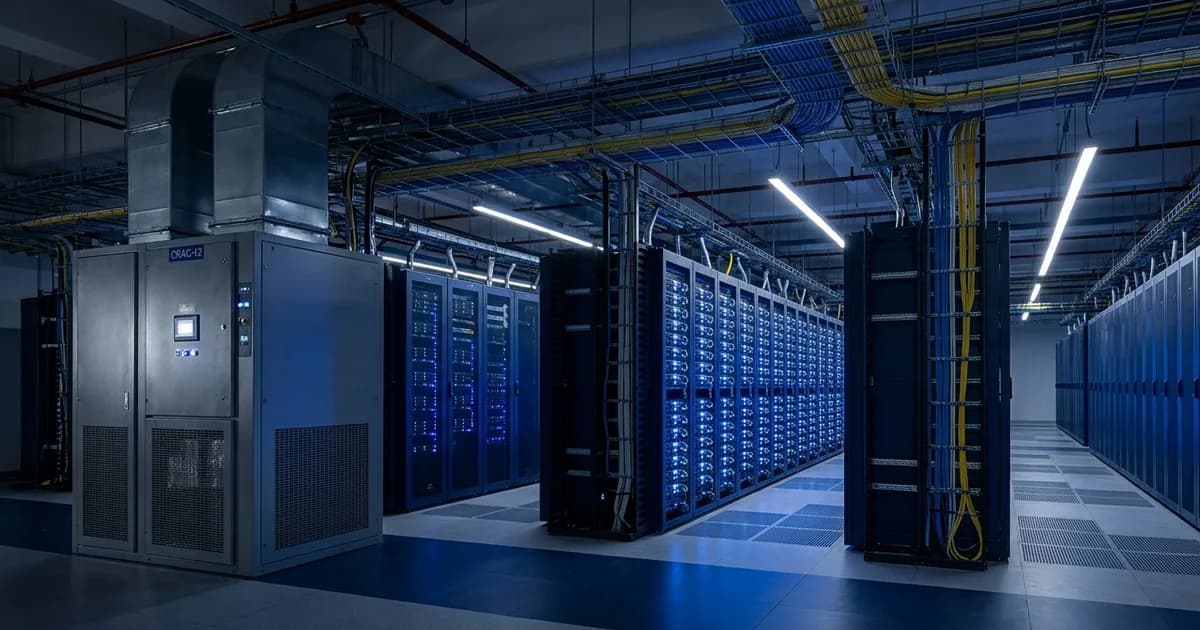
Key Numbers
Key Takeaways
- 1An enterprise data center is a private facility one company owns and operates for its own IT needs, distinct from colocation (rented, multi-tenant) and hyperscale (cloud-scale, 100MW+) facilities.
- 2Standard builds cost $8 million to $12 million per megawatt in 2025-2026. AI-optimized, GPU-ready builds cost $15 million to $20 million or more per megawatt, and a mid-size 5-20MW facility typically runs $50 million to $240 million in total capex.
- 3AI is pushing enterprise data centers toward 10-30kW+ rack densities and on-prem inference, not eliminating them. Average PUE has barely moved in six years even as density rises, according to Uptime Institute's 2025 survey.
An enterprise data center is a facility one company builds and runs entirely for itself. That is the entire definition, and it is the part most coverage glosses over while jumping straight to server specs. It is not a colocation facility, where a provider rents space to dozens of unrelated tenants, and it is not a hyperscale campus, where a cloud company builds at a scale meant to serve hundreds of millions of people at once.
Here is the number that gets skipped: building a standard enterprise facility costs $8 million to $12 million per megawatt in 2025-2026, but an AI-optimized, GPU-ready version of that same facility costs $15 million to $20 million or more per megawatt, according to current industry construction benchmarks. That is roughly 60 to 100 percent more, and almost none of it comes from buying more servers. It comes from the electrical and cooling systems needed to keep dense GPU racks from overheating.
By the end of this article you will know exactly where an enterprise data center sits between colocation and hyperscale, what a GPU retrofit actually costs per rack, and why private, on-premises infrastructure has not disappeared just because public cloud exists.
In This Article
What is an enterprise data center?
An enterprise data center is a single-tenant facility that one organization owns or leases and operates for its own compute, storage, and network needs. The defining trait is ownership and control: one company decides what hardware goes in, how it is configured, and who can access it.
That puts it in the middle of a spectrum. A colocation data center is owned by a provider that rents power and rack space to many different customers under one roof. A hyperscale data center is usually owned by a single cloud or internet company too, but built at a scale meant to serve the public internet, not one organization's internal systems.
| Category | Typical scale | Ownership model | Typical use case |
|---|---|---|---|
| Enterprise | Roughly 1MW to 20MW; tens to a few hundred racks | Single-tenant, owned or leased by one company | Internal IT, regulated workloads, latency-sensitive private applications |
| Colocation | Multi-tenant, small suites up to large wholesale halls | Provider-owned, rented by many tenants | Outsourced facility operations for companies that want to skip building their own |
| Hyperscale | Tens of MW to 100MW+, campus scale | Owned by a cloud or platform operator | Cloud platforms, AI training and inference, mass-market services |
The boundary between these categories blurs in practice. A company that outgrows its enterprise data center often moves into colocation rather than building bigger, and a company running sensitive AI inference might keep a small enterprise footprint even after moving most workloads to the cloud.
What is inside an enterprise data center?
Every enterprise data center needs the same six categories of infrastructure, regardless of size: compute, storage, network, power, cooling, and physical security.
- Compute: the servers running applications, databases, and increasingly AI inference workloads
- Storage: disk and flash arrays holding company data, often with backup and replication built in
- Network: switches, routers, and firewalls connecting everything internally and to the outside world
- Power: utility feeds, UPS battery systems, and often backup generators
- Cooling: air or liquid cooling systems keeping equipment within operating temperature
- Physical security: access control, badge systems, and environmental monitoring
"Routers, switches, firewalls, storage systems, servers, and application-delivery controllers" are the core components networking vendors point to when defining what a data center actually contains. (Cisco, data center components overview)
The relative importance of each category has shifted with AI. Cooling and power used to be a smaller line item next to compute. Now, retrofitting a rack to handle GPUs often costs more in electrical and thermal upgrades than the servers themselves, which is the main reason build costs have risen so sharply since 2024.
Who builds and supplies enterprise data centers?
No single vendor builds an entire enterprise data center. Companies assemble it from specialists, each covering a different layer of the stack.
| Vendor | What they supply | Relevance to AI retrofits |
|---|---|---|
| Dell | Servers and storage for private data centers | Sells GPU server platforms for on-prem AI |
| HPE | Full IT infrastructure stack, including GreenLake hybrid cloud | Positions enterprise data centers as a distinct IT category with dedicated AI infrastructure lines |
| Cisco | Networking: switches, routers, firewalls | Supplies the fabric connecting GPU clusters internally |
| Vertiv | Power and thermal management | Leads on liquid cooling for high-density AI racks |
| Schneider Electric | Power distribution, UPS, cooling systems | Designs electrical architecture for AI-ready facilities |
Vertiv and Schneider Electric matter more than they used to because the bottleneck in most AI retrofits is not finding GPUs, it is finding a facility that can deliver enough clean power to a single rack and remove the heat that rack generates. A traditional enterprise rack pulling a few kilowatts is a straightforward cooling problem. A GPU rack pulling 20 kilowatts or more is not, and that gap is where most of the retrofit budget goes.
How much does an enterprise data center cost to build in 2026?
A standard enterprise data center costs roughly $8 million to $12 million per megawatt to build in 2025-2026, while an AI-optimized version of the same facility runs $15 million to $20 million or more per megawatt, based on current industry construction benchmarks. Construction cost per gross square foot typically falls in the $600 to $1,100 range for standard builds.
| Build type | Cost per MW | What drives the cost |
|---|---|---|
| Standard enterprise | $8M-$12M | Conventional air cooling, standard electrical distribution |
| AI-optimized / GPU-ready | $15M-$20M+ | Liquid cooling, higher-voltage power distribution, denser rack layouts |
| Mid-size facility (5-20MW total) | $50M-$240M total capex | Combines the per-MW cost above with site, redundancy, and fit-out scope |
The number most guides don't show
At roughly $11 million per megawatt, that is $11,000 per kilowatt of facility infrastructure. A single AI-ready rack running at a 20kW density point therefore carries about $220,000 in shared power and cooling infrastructure cost alone, before a single server or GPU is installed in it. Scale that to a 100-rack AI wing and the facility shell and electrical work behind it represents roughly $22 million, which is often more than what gets spent on the GPUs that will eventually sit inside it.
"Average annual PUE ratio of 1.54," with average rack densities increasingly landing in the 10-30kW range as AI adoption grows. (Uptime Institute, 2025 Global Data Center Survey)
That 1.54 figure has barely moved in six years, which tells you something the cost numbers do not: making power delivery more efficient is a much slower fight than simply paying more to build denser.
Why enterprise data centers matter for AI in 2026
AI is the reason enterprise data centers are being rebuilt rather than abandoned. Companies that already operate private facilities are retrofitting racks, power delivery, and cooling to run AI training or, more commonly, inference, rather than starting from scratch with a new building.
On-premises inference keeps growing for a specific reason: many companies want AI running close to their own proprietary data for latency, cost control, or regulatory reasons, even while training large models happens in hyperscale cloud. Gartner's analysis of data center infrastructure technologies notes that on-premises infrastructure is adapting to new industry trends, including the intensive compute demands AI now places on existing facilities.
The practical result is a hybrid architecture: enterprise facilities increasingly handle sensitive workloads and local AI inference, colocation absorbs overflow capacity, and hyperscale cloud handles the largest training runs. None of the three categories is disappearing. They are dividing the work differently than they did before 2024. The same retrofit pressure shows up in data center cooling decisions, since a facility designed for single-digit kilowatt racks cannot simply absorb a 20kW GPU rack without a cooling upgrade first.
Common misconceptions about enterprise data centers
Four mistakes come up repeatedly when people talk about enterprise data centers.
- "Enterprise data center" means any data center: it specifically means a facility owned or operated for one organization's own IT needs, not a generic label for any building full of servers
- It is the same as colocation: colocation is shared, rented space across many tenants; an enterprise data center is dedicated to a single owner
- It is the same as hyperscale: hyperscale facilities are built at cloud scale for the public internet, typically tens of MW to 100MW or more, while enterprise facilities are usually in the single digits to roughly 20MW
- The cloud made enterprise data centers obsolete: cloud adoption changed the mix of where workloads run, but it did not eliminate the need for private facilities handling regulated, latency-sensitive, or sovereignty-driven work
The story in 2026 is not that enterprise data centers disappeared. It is that many of them are being upgraded for GPU-heavy AI inference, higher power density, and better cooling, while still doing the same core job they always did: running one company's own systems under that company's own control.
Frequently Asked Questions
What is an enterprise data center?
An enterprise data center is a private facility one company owns and operates for its own IT needs, covering compute, storage, networking, power, and cooling under a single owner's control. It differs from colocation, where a provider rents space to many tenants, and from hyperscale, which is built by a cloud provider at a far larger scale.
How is an enterprise data center different from colocation?
Colocation facilities are owned by a provider that rents power and rack space to many different companies under one roof, each tenant managing its own equipment within shared infrastructure. An enterprise data center is single-tenant: one company owns or leases the entire building and runs it for its own applications only, with full control over hardware, policy, and access.
How is an enterprise data center different from a hyperscale data center?
Hyperscale facilities run tens of megawatts to 100MW or more, built by a single cloud or internet company to serve hundreds of millions of users through public-facing services. Enterprise data centers are usually in the single-digit to roughly 20MW range, sized for one company's own internal workloads rather than the public internet.
How much does it cost to build an enterprise data center in 2026?
Standard enterprise builds run about $8 million to $12 million per megawatt in 2025-2026, with construction costs of roughly $600-$1,100 per gross square foot. AI-optimized, GPU-ready builds cost $15 million to $20 million or more per megawatt because of denser power distribution and liquid cooling requirements.
Are enterprise data centers being replaced by the cloud?
No. Cloud adoption changed the mix of where workloads run, but enterprises still operate private data centers for regulated workloads, low-latency applications, and data sovereignty requirements that public cloud does not always satisfy. Most large organizations now run a hybrid mix of enterprise, colocation, and cloud infrastructure rather than relying on just one model.
What does an AI or GPU retrofit cost for an enterprise data center?
AI-ready retrofits push per-megawatt costs from the standard $8M-$12M range up to $15M-$20M or more, mainly from upgrading electrical distribution and adding liquid cooling to support GPU racks that draw far more power than legacy server racks. At an 11 million dollar per megawatt midpoint, a single 20kW AI rack carries roughly $220,000 in facility infrastructure cost alone.
What is a typical rack power density in an enterprise data center?
Traditional enterprise racks run in the single-digit kilowatt range. AI and GPU adoption is pushing many facilities into the 10-30kW per rack range, with liquid-cooled deployments going considerably higher, according to Uptime Institute's 2025 Global Data Center Survey.
Who are the main vendors that build enterprise data center infrastructure?
Dell and HPE supply servers and storage, Cisco supplies networking and switching, and Vertiv and Schneider Electric supply the power distribution, UPS, and cooling systems that enterprise data centers depend on, especially for AI-driven retrofits where power and thermal design now matter as much as the servers themselves.
Related Articles
What Is a Colocation Data Center? Costs and How It Works
11 min read
Hyperscale Data Center: What It Is, How It Works, and What It Costs
11 min read
What Is a Data Center? How the Buildings That Run the Internet Work
10 min read
Data Center Tiers Explained: Tier 1, 2, 3, and 4 Compared
12 min read