
What Is Claude AI? Anthropic's Models and Pricing Explained

Key Numbers
Key Takeaways
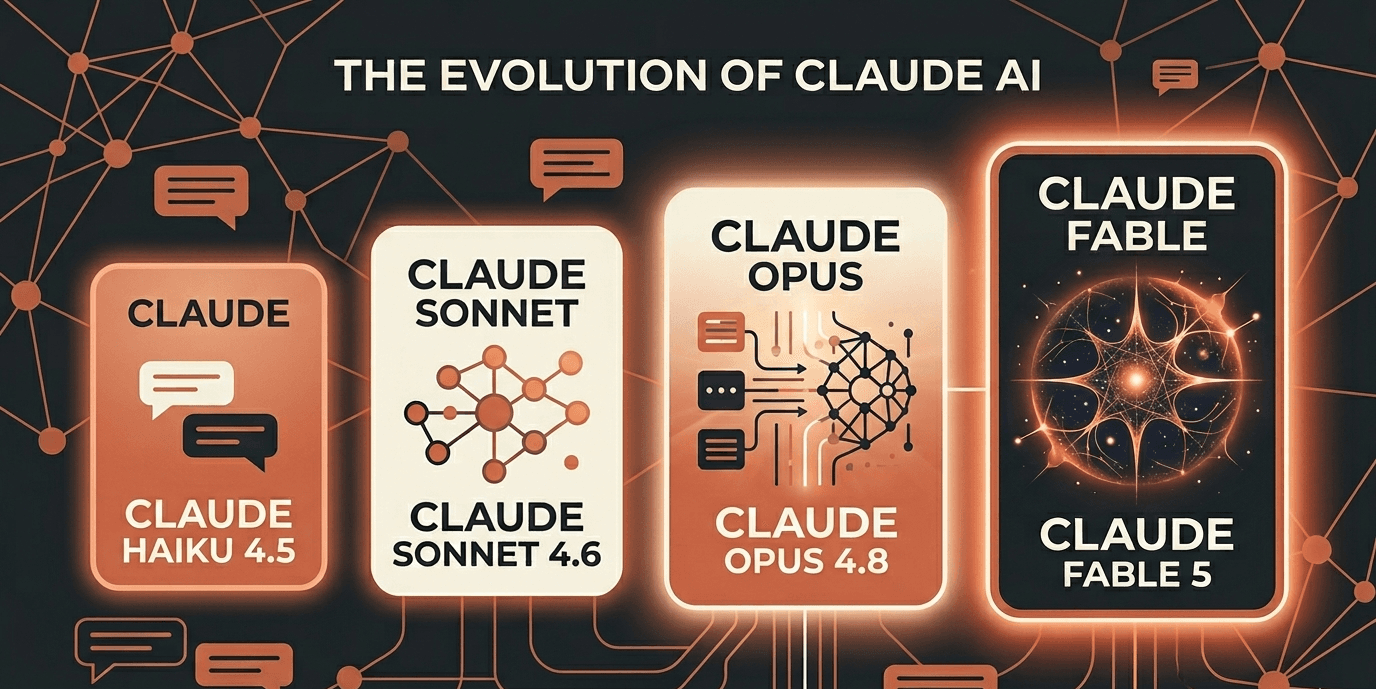
- 1Claude is Anthropic's family of AI models. As of June 2026 the active lineup has four tiers: Claude Fable 5 (flagship, Mythos-class), Claude Opus 4.8, Claude Sonnet 4.6, and Claude Haiku 4.5, each built for a different balance of intelligence, speed, and cost.
- 2Claude Fable 5 launched June 9, 2026 at $10 per million input tokens and $50 per million output tokens, double Claude Opus 4.8's price, but it scored 80.3% on SWE-bench Pro, the highest result any public model has posted on that benchmark.
- 3Claude Sonnet 4.6 runs as the free-tier default with a 1 million token context window, and Claude Haiku 4.5 handles high-volume work at $1/$5 per million tokens. Fable 5 is reserved for complex, multi-day agentic tasks where the higher cost pays for itself.
Claude AI is the family of large language models built by Anthropic, the AI safety company founded in 2021 by former OpenAI researchers Dario Amodei and Daniela Amodei. Claude works as a chat assistant at claude.ai and as an API that powers coding tools, customer support systems, and autonomous agents at companies ranging from startups to Fortune 500 enterprises.
Here is the fact most explainers miss: on June 9, 2026, Anthropic released Claude Fable 5, its first publicly available "Mythos-class" model, and according to early benchmark roundups it scored 80.3% on SWE-bench Pro, a coding benchmark where the previous best public score (from GPT-5.5) was around 58.6%. Anthropic's own framing was blunt: Fable 5 is "a Mythos-class model that we've made safe for general use," while the unrestricted version, Claude Mythos 5, stays locked to government and critical-infrastructure partners.
What follows breaks down every current Claude model (Fable 5, Opus 4.8, Sonnet 4.6, and Haiku 4.5) with release dates, context windows, pricing, and the benchmark scores that separate them. You'll also see how Claude's pricing compares across tiers, how it stacks up against ChatGPT, and which model actually fits your use case instead of just defaulting to the most expensive one.
In This Article
What Is Claude AI?
Claude AI is Anthropic's family of large language models, designed to work as a conversational assistant, a coding partner, and an API-level reasoning engine for other software. Anthropic was founded in 2021 by Dario Amodei and Daniela Amodei, both former OpenAI researchers, specifically to build AI systems that are "helpful, honest, and harmless."
That third word, harmless, is the part that shapes how Claude is built. Anthropic trains Claude using an approach it calls Constitutional AI: instead of relying only on human thumbs-up/thumbs-down feedback, the model is trained against an explicit written "constitution" of principles and values. That constitution has grown enormously. In January 2026, Anthropic published a new version running to roughly 23,000 words, up from about 2,700 words in 2023, shifting toward reason-based explanations of ethical principles rather than blanket rules (Anthropic, "Claude's new constitution").
Claude is sold in two main forms. The consumer assistant runs as web, desktop, and mobile apps at claude.ai, with Free, Pro, Max, Team, and Enterprise plans. The developer platform is the Claude API, available directly from Anthropic and through Amazon Bedrock, Google Vertex AI, and Microsoft Foundry, billed per million tokens.
By mid-2026, Anthropic describes Claude as moving from a "chat tool" toward a "platform layer": something that plugs into a company's existing infrastructure (self-hosted sandboxes, Microsoft 365, legal and workflow connectors) rather than a window you type questions into.
The short version
| Question | Answer |
|---|---|
| Who makes Claude? | Anthropic, founded 2021 |
| What is it? | A family of LLMs: chat assistant + developer API |
| Current flagship | Claude Fable 5 (Mythos-class), released June 9, 2026 |
| Safety approach | Constitutional AI, ~23,000-word constitution (Jan 2026) |
| Where to use it | claude.ai, Claude API, Amazon Bedrock, Vertex AI, Microsoft Foundry, GitHub Copilot |
The Claude Model Lineup in 2026
As of June 2026, Anthropic runs four active model tiers, and the gap between the cheapest and most expensive is larger than most people expect: a 10x difference in per-token pricing between Claude Haiku 4.5 and Claude Fable 5.
| Model | Released | Context Window | Input $/1M tokens | Output $/1M tokens | Best for |
|---|---|---|---|---|---|
| Claude Haiku 4.5 | Oct 15, 2025 | 200K (64K max output) | $1.00 | $5.00 | Fast, high-volume, cost-sensitive tasks |
| Claude Sonnet 4.6 | Feb 17, 2026 | 1M tokens (beta) | $3.00 | $15.00 | Default everyday model, agentic coding |
| Claude Opus 4.8 | 2026 | Up to 1M tokens | $5.00 ($10 Fast Mode) | $25.00 ($50 Fast Mode) | Complex coding and professional reasoning |
| Claude Fable 5 (Mythos-class) | Jun 9, 2026 | 1M tokens | $10.00 | $50.00 | Frontier multi-day agentic work |
Pricing is from Anthropic's own model pages and launch coverage (Anthropic, 2026). Prompt caching cuts input costs by up to 90% and batch processing cuts costs by up to 50% on Opus-tier models, according to Anthropic's pricing pages.
Claude Haiku 4.5: the fast, cheap tier
Released October 15, 2025, Haiku 4.5 is Anthropic's small model, and "small" is relative. It scored 73.3% on SWE-bench Verified, which Anthropic and partners describe as making it "one of the world's best coding models" at that price point, roughly matching Claude Sonnet 4 on coding tasks at one-third the cost.
| Achievement | Score | Notes |
|---|---|---|
| SWE-bench Verified | 73.3% | Comparable to Sonnet 4 at 1/3 the price |
| Terminal-Bench | 41% | Roughly on par with Sonnet 4 and GPT-5 |
| Max output tokens | 64,000 | Up from 8,192 on Haiku 3.5 |
| Pricing | $1 / $5 per 1M tokens | Up from $0.80 / $4 on Haiku 3.5 |
Haiku 4.5 is the model behind most "instant" Claude features: quick chat replies, high-volume API calls, and any workflow where you're running thousands of requests and the per-token cost adds up fast.
Claude Sonnet 4.6: the everyday default
Sonnet 4.6 launched February 17, 2026 with a 1 million token context window in beta, and Anthropic's own messaging leans hard on one idea: "Tasks that previously required an Opus-class model... are now achievable [with] Sonnet" (CNBC, citing Anthropic, Feb 17, 2026).
| Achievement | Score | Notes |
|---|---|---|
| SWE-bench Verified | 79.6% | Within striking distance of Opus 4.8's 88.6% |
| OSWorld (computer use) | 72.5% | Browser/desktop automation benchmark |
| Internal coding preference | ~70% | Preferred over Sonnet 4.5 in Anthropic's internal tests |
| Prompt-injection resistance | Improved | Anthropic says it matches Opus 4.6 on safety evals |
Sonnet 4.6 is the model most free-tier and Pro users interact with by default. It handles agentic coding, code review, frontend UI generation, and long-document analysis without the per-token cost of Opus or Fable.
Claude Opus 4.8: the pre-Fable flagship
Before Fable 5 shipped, Opus 4.8 was Anthropic's most capable public model, and it remains the practical choice for teams that don't need Fable 5's multi-day autonomy. Anthropic's alignment team reported that Opus 4.8 is "around four times less likely" than its predecessor (Opus 4.7) to let coding flaws slip through unremarked, with overall misalignment rates "substantially lower" than Opus 4.7 and close to the unreleased Claude Mythos Preview (VentureBeat, 2026).
| Achievement | Score | Notes |
|---|---|---|
| SWE-bench Verified | 88.6% | Highest of any Claude model except Fable 5 |
| SWE-bench Pro | 69.2% | The score Fable 5 (80.3%) had to beat |
| Terminal-Bench 2.1 | 74.6% | Command-line and tool-use tasks |
| USAMO 2026 (math) | 96.7% | Olympiad-level math reasoning |
Opus 4.8 introduced "dynamic workflows for parallel agentic coding," letting it spawn multiple subagents to work across a codebase at once, plus an "effort control" setting and a Fast Mode that cuts latency at $10/$50 per million tokens.
Claude Fable 5 (and Mythos 5): the new flagship
Claude Fable 5 is the headline release of June 2026. Anthropic's announcement describes it as a "Mythos-class model that we've made safe for general use" (Anthropic, "Claude Fable 5 and Claude Mythos 5"). Fable 5 and Mythos 5 share the same underlying architecture and capabilities, but Fable 5 wraps that architecture in additional safety classifiers and "dynamic routing": when a request touches high-risk domains like cybersecurity, advanced biology, or chemistry, Fable 5 can automatically hand the request to a more constrained model (typically Opus 4.8), reportedly affecting under 5% of sessions.
| Achievement | Score | Comparison |
|---|---|---|
| SWE-bench Pro | 80.3% | vs Opus 4.8: 69.2%, vs GPT-5.5: ~58.6% |
| Hex analytical benchmark | First model over 90% | Structured data-reasoning test |
| Context window | 1,000,000 tokens | No surcharge for long-context use |
| Max output tokens | 128,000 | Matches Opus 4.8's ceiling |
Mythos 5 itself, the unrestricted version, is not generally available. It's limited to approved US government and critical-infrastructure partners under what Anthropic calls "Project Glasswing." For everyone else, Fable 5 is "the same performance as Claude Mythos 5, except with much more strict guardrails in place to prevent it being used for harmful things," per Anthropic.
Fable 5 is available as `claude-fable-5` on the Claude API and claude.ai, inside Claude Code and Claude Cowork, and through Amazon Bedrock, Google Vertex AI, Microsoft Foundry, and GitHub Copilot. For a deeper look at how developers are actually using Claude's coding tools day to day, see our Claude Code Reddit roundup, and for ready-made automation add-ons, see our guide to Claude Code skills.
More AI infrastructure stories like this
The real hardware, chip, and data center side of AI, explained plainly, every Wednesday and Saturday.
How Much Does Claude AI Cost?
Claude pricing splits into two systems: subscription plans for the chat app, and per-token API pricing for developers. The two are easy to mix up, and the gap between Anthropic's cheapest and most expensive models is the part most pricing pages bury.
Subscription plans (claude.ai)
| Plan | Price | What you get |
|---|---|---|
| Free | $0/month | Claude Sonnet 4.6 by default, with limited daily usage |
| Pro | $20/month | Higher usage limits, priority access to new models |
| Max | Custom, higher tier | Expanded usage caps for individual power users |
| Team / Enterprise | Per-seat, custom | Admin controls, larger context, platform integrations |
Through June 22, 2026, Claude Fable 5 is included at no extra cost across Pro, Max, Team, and seat-based Enterprise plans. From June 23, 2026, Anthropic is shifting Fable 5 access on those plans to metered usage credits, with an intent to restore it as a standard included feature once capacity allows, according to Anthropic's own documentation.
API pricing per million tokens
| Model | Input | Output | Fast Mode (where available) |
|---|---|---|---|
| Claude Haiku 4.5 | $1.00 | $5.00 | n/a |
| Claude Sonnet 4.6 | $3.00 | $15.00 | n/a |
| Claude Opus 4.8 | $5.00 | $25.00 | $10 / $50 |
| Claude Fable 5 / Mythos 5 | $10.00 | $50.00 | n/a |
The Number Most Guides Don't Show
Look at that table again: Fable 5 costs 10 times more per token than Haiku 4.5, on both input and output. Run the same moderate workload, say 10 million input tokens and 2 million output tokens in a week of heavy agentic coding, through each model and the gap becomes concrete: that's $100 + $100 = $200 on Fable 5, versus $10 + $10 = $20 on Haiku 4.5. Same task, same token counts, a $180 difference based purely on which model name you typed into the API call.
That's not an argument for always choosing the cheapest model. SWE-bench Pro shows an 11-point capability gap between Fable 5 (80.3%) and Opus 4.8 (69.2%), and a much larger one against Haiku. But it does mean the default choice of "just use the most capable model for everything" gets expensive fast at scale, and most production workloads are better served by routing routine tasks to Haiku or Sonnet and reserving Fable 5 for the genuinely hard, multi-day agentic jobs it was built for.
For a broader look at how token-based pricing works across the industry, our explainer on what an LLM is covers the training and inference cost basics that drive these numbers.
How Claude Compares to ChatGPT and Gemini
On raw capability, the clearest data point in mid-2026 is SWE-bench Pro: Claude Fable 5 scored 80.3%, compared with roughly 58.6% for GPT-5.5, a 22-point gap on a benchmark specifically designed to measure real-world software engineering ability. That single number is why Fable 5's launch coverage focused so heavily on coding and agentic tasks rather than general chat quality.
Outside of benchmarks, the practical differences come down to positioning:
| Factor | Claude | ChatGPT | Gemini |
|---|---|---|---|
| Best known for | Long-context reasoning, agentic coding, safety-first design | General versatility, plugin ecosystem | Native Google Workspace integration |
| Largest context window (2026) | 1M tokens (Sonnet 4.6, Fable 5) | Large, varies by tier | Varies by tier |
| Entry-level paid plan | $20/month (Pro) | $20/month (Plus) | $19.99/month (Advanced) |
| Safety framework | Constitutional AI, ~23,000-word constitution | RLHF-based alignment | Google's internal safety policies |
Reddit's developer community has been tracking this shift closely. The consensus in our Claude vs ChatGPT Reddit roundup is that Claude leads on coding quality and writing style, while ChatGPT remains the more versatile all-rounder with a larger plugin and integration ecosystem. For a side-by-side feature and pricing breakdown across all four major assistants, see our AI tools comparison guide.
The honest answer for most people is that the "best" assistant depends on the task: Claude's advantage shows up most clearly in long documents, large codebases, and agentic workflows that run for hours or days, which is exactly the niche Fable 5 was built to extend.
What Can You Do With Claude AI?
Claude's capabilities fall into four broad categories, and which Claude model you should reach for depends heavily on which of these you're doing.
Coding and software engineering
This is where Claude has built its reputation in 2026. Claude Code (the CLI and web-based coding agent) runs on Sonnet 4.6 by default and Fable 5 or Opus 4.8 for harder tasks. Opus 4.8's "dynamic workflows for parallel agentic coding" let it spawn multiple subagents to work across a large codebase simultaneously. Our Claude Code Reddit roundup tracks what developers are actually building with it, from multi-agent pipelines to full production deployments.
Long document and research work
With a 1 million token context window on Sonnet 4.6 and Fable 5, Claude can ingest entire codebases, legal contracts, or research papers in a single request without chunking. This is the use case Anthropic's original "200K context" Claude built its early reputation on, now extended 5x.
Computer use and agents
Sonnet 4.6 scored 72.5% on OSWorld, a benchmark for controlling a desktop environment (clicking, typing, navigating applications) the way a human would. Combined with Fable 5's multi-day autonomous operation, this is the foundation of Anthropic's "platform layer" pitch: Claude as a digital employee that can run a project over days, not just answer one prompt.
Extending Claude with skills
Claude Code supports "skills," reusable instruction files that add a specific capability behind a single slash command, so you don't retype a long prompt every time. Our Claude Code skills guide covers the ones that hold up in real workflows after testing 40+ of them.
Where the safety layer shows up
Anthropic's Constitutional AI approach is most visible in Fable 5's dynamic routing: requests touching cybersecurity, advanced biology, or chemistry can be automatically redirected to a more constrained model. For everyday coding, writing, and research tasks, this layer is invisible. It mainly matters if you're working in a regulated or dual-use-sensitive domain.
Common Misconceptions About Claude AI
"Claude is just a ChatGPT clone"
Claude and ChatGPT are both large language models, but they're built on different training philosophies. Claude's Constitutional AI approach trains the model against an explicit, published set of principles (now around 23,000 words) rather than relying primarily on human preference ratings. The practical effect shows up in tone, refusal behavior, and how each model handles long, structured tasks.
"Fable 5 and Mythos 5 are the same thing you can use"
They share the same core architecture, but only Fable 5 is publicly available. Mythos 5 itself is restricted to approved US government and critical-infrastructure partners under Anthropic's "Project Glasswing." When people refer to "Claude Mythos," they're almost always describing what Fable 5 can do, since that's the version anyone outside that program can actually access.
"All Claude models cost about the same"
The spread is large: $1/$5 per million tokens for Haiku 4.5 versus $10/$50 for Fable 5, a 10x difference on both input and output pricing. Picking the wrong model for a high-volume task can multiply your API bill without a proportional gain in output quality.
"Claude can browse the web and use any app by default"
Computer use and tool access depend on the surface you're using and what's been connected. Claude's web and desktop apps, the API, and Claude Code each expose different levels of tool access, and OSWorld's 72.5% score for Sonnet 4.6 reflects performance under test conditions with tools enabled, not a default always-on capability for every Claude interaction.
Where Claude AI Is Headed
Two threads from 2026 point at where Claude goes next.
The first is the platform shift. Anthropic has been explicit that it sees Claude moving from a chat window to infrastructure: self-hosted sandboxes, Microsoft 365 integrations, and workflow connectors that let Claude operate inside a company's existing systems rather than alongside them. Fable 5's multi-day autonomous operation is the technical piece that makes this possible, since a model that needs constant prompting can't run a project unsupervised over days.
The second is the safety-capability split that Fable 5 and Mythos 5 represent. Anthropic now ships two versions of its frontier architecture: a public one wrapped in safety classifiers and dynamic routing, and a restricted one for vetted government and infrastructure partners. If that pattern holds, future "Mythos-class" releases will likely follow the same template: a Fable-style public release with guardrails arriving alongside, or shortly after, a more capable restricted version.
For now, the practical takeaway is that Claude's lineup spans a genuinely wide range, from a $1/$5 model that handles routine tasks at scale to a $10/$50 model posting the best public SWE-bench Pro score on record. Most users and teams will get the most value picking the model that matches the task rather than defaulting to whichever one launched most recently.
Frequently Asked Questions
What is Claude AI?
Claude AI is the family of large language models built by Anthropic, available as a chat assistant at claude.ai and as a developer API. It's designed around Anthropic's Constitutional AI approach, which trains the model against an explicit written set of principles rather than relying only on human preference feedback.
As of June 2026, the active Claude lineup includes Claude Haiku 4.5, Claude Sonnet 4.6, Claude Opus 4.8, and the new flagship Claude Fable 5.
Who owns Claude AI?
Claude AI is owned and developed by Anthropic, an AI safety company founded in 2021 by Dario Amodei and Daniela Amodei, both former OpenAI researchers. According to a 2026 industry analysis, Anthropic raised approximately $30 billion at a $380 billion valuation, with annualized revenue reaching roughly $30 billion by April 2026.
What is Claude Fable 5?
Claude Fable 5 is Anthropic's first publicly available "Mythos-class" model, released June 9, 2026. It shares its core architecture with the restricted Claude Mythos 5 but adds extra safety classifiers and dynamic routing that can redirect high-risk requests to a more constrained model.
Fable 5 scored 80.3% on SWE-bench Pro, the best result any public model has posted on that benchmark, and supports a 1 million token context window with up to 128,000 output tokens. It's priced at $10 per million input tokens and $50 per million output tokens.
Is Claude AI free to use?
Yes, Claude has a free tier at claude.ai that defaults to Claude Sonnet 4.6 with limited daily usage. Through June 22, 2026, the free tier and paid plans (Pro, Max, Team, Enterprise) also include access to Claude Fable 5 at no extra cost beyond the subscription. From June 23, 2026, Fable 5 access on these plans shifts to metered usage credits.
The Pro plan costs $20/month for higher usage limits and priority access to new models.
How is Claude different from ChatGPT?
Claude and ChatGPT are both large language model assistants, but Claude is built using Anthropic's Constitutional AI approach, training the model against an explicit, published set of principles (about 23,000 words as of January 2026) rather than relying primarily on human preference ratings.
In practice, Claude has built a reputation for long-context reasoning and agentic coding, with Claude Fable 5 scoring 80.3% on SWE-bench Pro versus roughly 58.6% for GPT-5.5. ChatGPT remains the more versatile general-purpose assistant with a broader plugin ecosystem. See our Claude vs ChatGPT Reddit roundup for the community's detailed take.
What is Claude Mythos 5 and can I use it?
Claude Mythos 5 is the unrestricted version of the architecture behind Claude Fable 5. It is not generally available and is limited to approved US government and critical-infrastructure partners under what Anthropic calls "Project Glasswing."
For everyone else, Claude Fable 5 provides "the same performance as Claude Mythos 5, except with much more strict guardrails in place to prevent it being used for harmful things," according to Anthropic's announcement.
Which Claude model should I use?
It depends on the task and your budget. Claude Haiku 4.5 ($1/$5 per million tokens) handles fast, high-volume work and scores 73.3% on SWE-bench Verified, roughly matching Sonnet 4 on coding at a third of the cost. Claude Sonnet 4.6 ($3/$15) is the best balance for everyday agentic coding and long-document work with its 1M token context window.
Claude Opus 4.8 ($5/$25) and Claude Fable 5 ($10/$50) are for harder problems: Opus 4.8 for complex coding and reasoning, and Fable 5 for multi-day autonomous agentic tasks where its 80.3% SWE-bench Pro score and extended autonomy justify the higher cost.
How much does the Claude API cost?
Claude API pricing is per million tokens and varies 10x across the lineup as of June 2026: Claude Haiku 4.5 costs $1 input / $5 output, Claude Sonnet 4.6 costs $3 input / $15 output, Claude Opus 4.8 costs $5 input / $25 output ($10/$50 in Fast Mode), and Claude Fable 5 costs $10 input / $50 output.
Prompt caching can cut input costs by up to 90%, and batch processing can cut costs by up to 50% on Opus-tier models, according to Anthropic's pricing pages.
Related Articles
What Is an LLM? Large Language Models Explained
10 min read
How Does ChatGPT Work? How AI Learns, Thinks, and Generates Text
12 min read
What Is AGI? Artificial General Intelligence Explained
11 min read
Open Source LLMs: The Best Models You Can Run Yourself in 2026
12 min read
Want hands-on setup guides?
These step-by-step guides relate to topics covered in this article.